Entertainment
10 Greatest Soft Sci-Fi Movie Masterpieces, Ranked

Science fiction is one of the most vast genres at filmmakers’ disposal, at least in terms of the sheer myriad of subgenres that they can use as vehicles for some of the strongest stories cinema has ever told. One of the ways in which this genre can be divided is into hard science fiction and soft science fiction. The former is strongly concerned with scientific accuracy and logic, usually dealing chiefly with natural sciences like biology and astrology. On the other hand, soft sci-fi explores soft sciences (like psychology and sociology) and is more concerned with emotions, speculative societies, and the relationships between its characters, rather than science or engineering.
Soft sci-fi is often looked down on even by sci-fi fans, who see it as a pulpy and lesser form of the genre that lacks the rigor and prestige of hard science fiction. Over the years, however, several of the greatest sci-fi films ever made have been on the softer side, showing beyond a shadow of a doubt that it is a form of science fiction as respectable as any other. From modern action blockbusters to classic horror movies, there are many ways of making a good soft sci-fi film.
10
‘Arrival’ (2016)


Canadian auteur Denis Villeneuve was already a well-established filmmaker going into 2016, but it was 2016 that introduced the world to his work in the genre that has come to define him: science fiction. Based on Ted Chiang‘s novella Story of Your Life, Arrival is an alien invasion story unlike any other, boosted by Jóhann Jóhannsson‘s hauntingly beautiful score and Amy Adams at her absolute (and most egregiously Oscar-snubbed) best.
Arrival is one of those films that can be argued to be both soft and hard sci-fi, but it definitely leans more toward the former. Its strong focus on linguistics, communication, and the concept of memory as it relates to identity is science fiction at its softest, even if Villeneuve relies on quite a bit of hard scientific exposition to show his characters’ intelligence. The result is one of the most thought-provoking films the genre had to offer at any point during the 2010s.
9
‘Everything Everywhere All At Once’ (2022)
An over-the-top indie comedy that mixes sci-fi and martial arts movie elements to tell a story about generational trauma, family, immigration, and existential dread? It sounds a bit all over the place, and it’s definitely not the type of concept that screams “Oscars material.” That only makes the Daniels‘ Everything Everywhere All At Once and its winning seven Academy Awards all the more admirable.
Everything Everywhere relies on some elements of hard sci-fi to explain the mechanics of its multiversal elements, but that’s a relatively tiny part of a film that’s as soft as butter. It is one of the most perfect sci-fi movies of the 21st century, and it achieves that status through a focus on the family dynamics between its characters, a strongly philosophical story, and sci-fi elements that serve the emotional dimension of the narrative much more than they do its scientific dimension.
8
‘Alien’ (1979)


Ridley Scott is nowadays known as one of the most prolific and successful Hollywood filmmakers in history, but even the greats have to start somewhere. Alien was only Scott’s second-ever feature film, and it must have surely been ample proof for 1979 audiences and critics that they were witnessing the birth of a master filmmaker. Who, if not a maestro of the craft, could possibly revolutionize sci-fi horror in quite this way?
Alien is profoundly atmospheric, genuinely scary even after almost half a century of its release, and one of the most perfectly written sci-fi movies ever made. Psychological horror, character drama, and atmospheric tension are far more important to this late New Hollywood classic than scientific rigor. It makes for a sort of haunted house in space whose slow-burning approach to its story makes it even more suspenseful.
7
‘Mad Max: Fury Road’ (2015)

After three decades away from the Mad Max universe that he revolutionized Australian cinema and low-budget action cinema with, George Miller returned to the action genre with Mad Max: Fury Road, easily one of the greatest legacy sequels ever made. It’s one of the most perfectly-directed action epics of all time, two hours of pure non-stop adrenaline and high-octane action.
The post-apocalyptic and dystopian genres are typically science fiction by nature, and this one’s no exception. But science isn’t really important to Miller here, nor any kind of particularly intellectual approach to the natural crisis that makes Max Rockatansky’s world a desert wasteland. That doesn’t detract from Fury Road‘s quality in any way, however. On the contrary, the movie’s soft approach to its genre allows it to focus on its rapid-fire pacing, exhilarating action scenes, and delectably over-the-top world-building.
6
‘Star Wars: Episode IV — A New Hope’ (1977)

Star Wars‘ status as a sci-fi franchise is a hotly debated topic. Whereas some people agree that George Lucas‘ immensely successful creation is a science-fantasy franchise at heart, there are those sci-fi purists who claim that this is mostly a fairy tale that just happens to be set in space. If anything, this debate is a testament to how ambiguous a blanket term soft sci-fi can sometimes be, but it only takes one look at Episode IV — A New Hope—the one that started it all—to realize that cataloging the story of the Skywalkers as soft science-fantasy makes the most sense.
It is the quintessential Hero’s Journey movie, a classic that has mostly aged like fine wine, and gave birth to what’s arguably the biggest transmedia franchise in history. Lucas is in no way, shape, or form interested in intellectual scientific rigor here. A New Hope is a space opera made up of pure action, emotion, and fun character arcs. It may not be the best soft sci-fi film ever made, but it might just be the most iconic example of the subgenre.
5
‘Children of Men’ (2006)
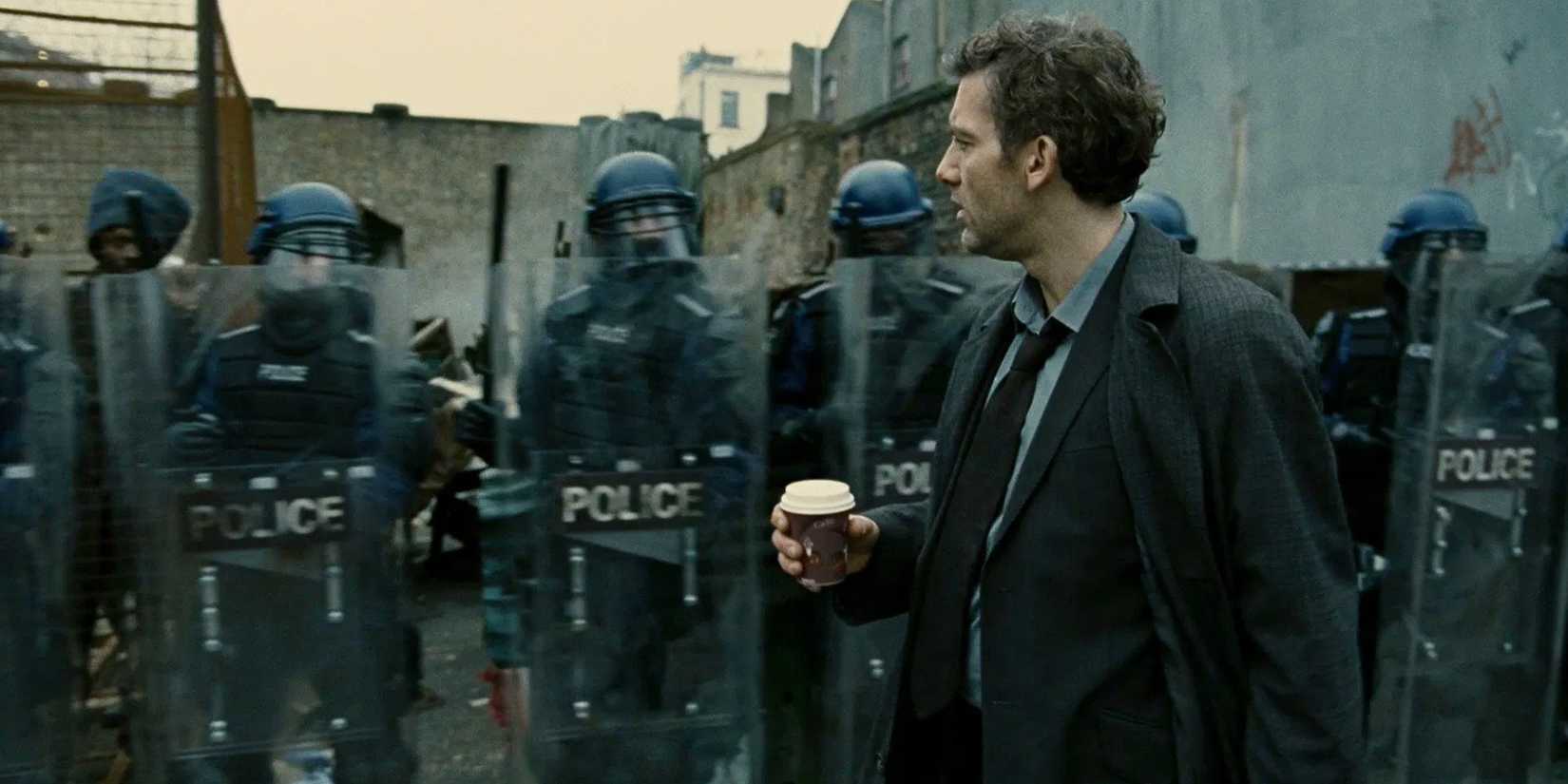
Mexican filmmaker Alfonso Cuarón has spent the vast majority of his career in Hollywood, and it’s there that he made what some may consider his magnum opus: Children of Men, one of the best dystopian movies of the 21st century. Supported by Clive Owen‘s phenomenal lead performance, Cuarón’s admirably atmospheric direction, and Emmanuel Lubezki‘s legendary camerawork (which includes some of the most impressive long takes of any action film of the 21st century), it’s among the most thrilling movie masterpieces of all time.
The mysterious scientific crisis at the core of Children of Men might have provided a solid basis for an interesting hard sci-fi film.
But though the mysterious scientific crisis at the core of Children of Men (a case of worldwide infertility) might have provided a solid basis for an interesting hard sci-fi film, that’s never Cuarón’s focus here. Instead, Children of Men is a masterpiece dealing with themes of migration and the struggle to maintain faith in the face of an international crisis, which is about as focused on the social sciences as a sci-fi movie can possibly be.
4
‘Dune: Part Two’ (2024)

The differentiation between soft and hard science fiction first appeared in the late 1970s, attributed to Australian literary scholar Peter Nicholls. It was in 1965 that Frank Herbert‘s seminal space opera Dune came out, but though it predicts the coining of the term “soft science fiction,” it absolutely fits the definition of the subgenre in every way that matters. And though many fans of the source material believed for many years that it was impossible to make a film worthy of Herbert’s legacy, Denis Villeneuve’s Dune: Part Two proved them wrong.Perhaps the best sci-fi movie of the last 15 years, Dune: Part Two definitely has some elements of hard sci-fi (though less significantly than Herbert’s novel), but those are minuscule in comparison to the film’s focus on softer elements. Light-speed space travel and psychic powers are crucial elements of this landmark of soft sci-fi, and the narrative is far more focused on sociology, ecology, and political science than any kind of natural discipline.
3
‘Star Wars: Episode V — The Empire Strikes Back’ (1980)

The original Star Wars may be great, but there’s one film that’s almost universally agreed to be the best piece of Star Wars content ever created, and that’s Episode V — The Empire Strikes Back. Full of exciting action sequences, delightfully creative science-fantasy elements, and possessing one of the most untouchable twists in the history of sci-fi movies, it’s undoubtedly one of the most iconic examples of the genre.
The Empire Strikes Back is every bit as unconcerned with scientific rigor as its predecessor, and that’s perfectly fine—particularly when the soft sci-fi elements that director Irvin Kershner leverages here are so well-executed. Inventive, epic, and with some of the most engrossing world-building and fun character arcs of any 20th-century sci-fi movie, the fifth chapter of the Skywalker Saga is an example of science fiction at its soft best.
2
‘Eternal Sunshine of the Spotless Mind’ (2004)

On the basis of Charlie Kaufman‘s genius writing — one of the best screenplays of the 2000s for sure — Michel Gondry made Eternal Sunshine of the Spotless Mind. One of the most complex, creative, and beloved romance films ever created, this masterpiece is what many cinephiles immediately think of as soon as they hear the term “soft sci-fi,” and for a very good reason.
Kaufman is never interested in explaining the scientific viability of the memory-erasure technology at the heart of the story, because that’s not what the story’s about. Instead, the sci-fi elements of Eternal Sunshine are a plot device used to anchor its examination of romance, the psychology of love, and the importance of memories in human identity. This film is all about the emotional effects of its story on both its characters and the viewer, proving that soft sci-fi can still make for absolutely perfect examples of the genre.
1
‘Stalker’ (1979)

Soviet auteur Andrei Tarkovsky was one of the greatest filmmakers that have ever lived, author of several of the greatest films of his time, including two of the best sci-fi movies of the last 75 years. While Solaris leans more toward the harder side of sci-fi, Stalker is about as cashmere-soft as the genre can possibly get. There’s also a strong argument to be made that it is both Tarkovsky’s strongest movie and the greatest European sci-fi film of all time, making it all the more of a must-see for those who love soft science fiction.
Stalker revolves around three men traveling to The Room, a mysterious place that grants those who visit it their innermost wish. There’s no semblance of even a remote attempt at an explanation of the scientific dimension of this story. Instead, Stalker is an arthouse movie through and through, and Tarkovsky’s approach to it is both poetic and sociopolitically charged. Slow-burning, emotionally stirring, and intellectually provocative, this masterpiece is a testament to the tremendous heights that soft science fiction can reach at its best.
You must be logged in to post a comment Login