Entertainment
10 Greatest Sword-and-Sorcery Movies of All Time

The fantasy genre can be broken down into various sub-genres, such as the magic-heavy high fantasy or the more gritty dark fantasy. One sub-genre is sword-and-sorcery, defined by its emphasis on action and adventure, as sword-wielding heroes battle all sorts of monsters on their quests, which often veer towards self-serving rather than altruistic. Magic is usually presented as a rare and powerful thing wielded by villains, so the heroes usually save the day through strength of arms and a cunning mind.
A good number of fantasy movies over the decades can be called sword-and-sorcery. Impressive effects, beautiful scenery, and compelling actors turn what could easily be silly or pulpy stories into daring quests full of monsters and mystery, making them a great and timeless watch. With the upcoming release of Masters of the Universe, now it’s a great time to look at the all-time best sword-and-sorcery movies, must-watches for any self-respecting fantasy fan.
‘Dragonheart’ (1996)


A dragon (Sir Sean Connery) gives up half of his heart to save the dying Prince Einon (Lee Oakes and David Thewlis), but the Prince soon reveals himself a tyrant, prompting his trainer, Sir Bowen (Dennis Quaid), to swear vengeance against all dragons, whom he blames for the change. Years later, Bowen has become a skilled dragon hunter and is followed by the Monk Brother Gilbert (Pete Postlethwaite), who wishes to record his exploits. Bowen eventually finds the last dragon in existence, not realizing it’s the one that saved Einon, and after fighting to a stalemate, they instead form a partnership to scam villagers out of gold.
Dragonheart is more light-hearted than other sword-and-sorcery stories, but it still hits a lot of the required tropes, especially through Bowen’s arc about becoming disillusioned with the chivalric code and rediscovering his faith. In between the lighthearted jokes are a lot of dark and melancholic moments as well, from the deaths of the dragons to the extent of Einon’s cruelty. While the CGI for the dragon, nicknamed Draco by Bowen, is showing its age, it’s still impressive for the time, and, combined with Connery’s performance, goes a long way in making him one of cinema’s most iconic dragons.
‘Willow’ (1988)

Willow Ufgood (Warwick Davis) is a Nelwyn farmer with a loving family who wishes to one day practice magic. One day, he discovers a baby named Elora Danan, who is prophesied to bring about the downfall of the tyrannical sorceress queen Bavmorda (Jean Marsh). Aided by two brownies named Rool and Franjean (Kevin Pollak and Rick Overton), a charismatic swordsman named Madmartigan (Val Kilmer), and a cursed sorceress named Fin Raziel (Patricia Hayes), Willow tries to protect Elora from Bavmorda’s forces.
Willow is one of those movies that doesn’t take itself too seriously or switch up the status quo, instead offering a fun, creative experience. That’s not to say it doesn’t play around with some classic tropes: Willow himself deviates from the usual farmboy to wizard archetype by being a father and relying just as much on his sleight-of-hand tricks as his budding sorcery. Speaking of sorcery, the movie uses impressive morphing technology to pull off some of the best transformation scenes in fantasy, especially when Willow tries to restore Fin Raziel to her human form.
‘Fire and Ice’ (1983)

The sorcerer king Nekron (Stephen Mendel) and his mother Juliana (Susan Tyrrell) use their powers over ice to spread glaciers south and weaken other human nations for conquest, until only the volcanic kingdom of Firekeep resists them. Under the guise of messengers, Juliana sends her minions to kidnap Princess Teegra (Maggie Roswell) to be Nekron’s bride. She escapes into the wilds and finds allies in Larn (William Ostrander), a warrior whose people were killed by Nekron, and Darkwolf (Steve Sandor), a mysterious warrior who is committed to killing the sorcerers.
Fire and Ice comes from the bizarre mind of legendary animator Ralph Bakshi and is a beautiful example of pulpy dark fantasy stories. It’s a standard sword-and-sorcery about daring heroes overthrowing an evil tyrant, but it carves an identity for itself thanks to its gritty and interesting worldbuilding, such as Nekron and Juliana’s powers over ice or the people of Firekeep using pterosaurs as mounts. The film is also gorgeous to look at, with stylistic backgrounds that look like heavy metal covers, and detailed rhotoscoping to give the characters realistic movements.
‘The Flight of Dragons’ (1982)

When the Green Wizard Carolinus (Harry Morgan) realizes that the world is turning away from belief in magic and towards logic and science, he summons his brothers, the Gold Wizard Lo Tae Zhao (Don Messick), Blue Wizard Solarius (Bob McFadden), and Red Wizard Ommadon (James Earl Jones), to create a hidden world where magic can continue to thrive. Ommadon refuses to help and instead vows to use his magic to enhance mankind’s vices so that they destroy themselves, prompting Carolinus to put together a quest to steal Ommadon’s crown and rob him of his powers. At the suggestion of the ancient force of Antiquity (Paul Frees), Carolinus also summons Peter Dickinson (John Ritter), a 20th-century man with a love of both science and magic.
The Flight of Dragons is an oft-overlooked animated film from the partnership of Topcraft—the predecessor to Studio Ghibli—and Rankin/Bass, known for their stop-motion holiday specials. The movie is a beautiful love letter to the fantasy genre, playing into classic tropes while also exploring certain topics in greater detail, such as offering scientific answers for why dragons can fly and breathe fire. What sticks out most about it are its themes, which explore the loss of wonder in the world, idealism vs cynicism, and heroism in the face of impossible odds.
‘Jason and the Argonauts’ (1963)
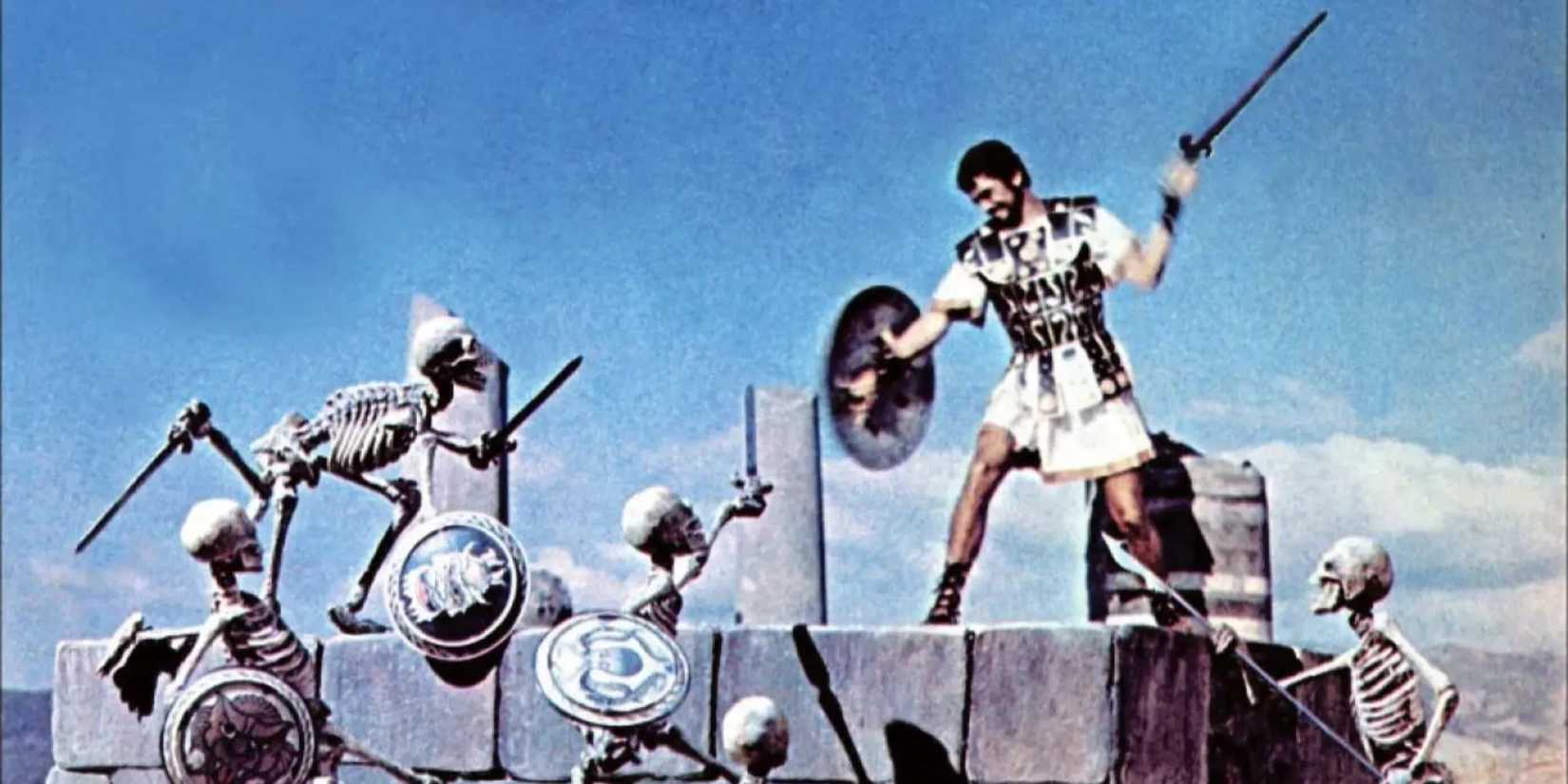
Jason (Todd Armstrong) is the rightful king of Thessaly and is watched over by the Goddess Hera (Honor Blackman) after his family is killed by the usurper Pelias (Douglas Wilmer). As a young man, Jason rescues Pelias, not knowing who he is, and explains that he plans to rally support to overthrow the tyrant. Pelias encourages him to sail forth and find the Golden Fleece, hoping that the various monsters and dangers on the way will kill Jason.
Jason and the Argonauts is a grand epic that does justice to its mythological origins, thanks in large part to the now-legendary stop-motion effects by Ray Harryhausen. The creatures look and move as if they come from a different world, which helps to make them feel all the more mythological compared to the flesh-and-blood heroes. The choreography is also something to praise, especially during the climax, where Jason and his men fend off a horde of skeleton warriors, and yet every blow looks like it’s actually connecting.
‘Clash of the Titans’ (1981)

Angered that Zeus (Laurence Olivier) cursed her wicked son, Calibos (Neil McCarthy), for killing his herd of winged horses, Thetis (Dame Maggie Smith) transports Zeus’ demigod son, Perseus (Harry Hamlin), from Seriphos to the city of Joppa. Perseus cuts off Calibos’ hand, and in doing so is able to break his curse over the city’s princess, Andromeda (Judi Bowker). However, Thetis demands that Andromeda be sacrificed lest Joppa be destroyed by the Kraken, so Perseus must go on a quest to find the means to kill the monster.
Clash of the Titans is the last film Harryhausen worked on before his retirement, and it shows because the creatures have never looked better. The best example happens during the climax when Perseus and his companions descend into the lair of the gorgon Medusa. Her model is textured in such a way that it looks like living stone, further accentuated by her stiff, methodical movements, which make her all the more terrifying and fill the scene with tension and mounting dread.
‘Dragonslayer’ (1981)
The kingdom of Urland is plagued by the dragon Vermithrax Pejorative, who demands a tithe of virgin maidens, lest it burn the kingdom in its wrath. An expedition travels to Cragganmore to recruit the last great sorcerer, Ulrich (Sir Ralph Richardson), but he dies when trying to demonstrate his powers to the captain of the king’s guard, Tyrian (John Hallam). However, his magic amulet chooses his young apprentice, Galen (Peter MacNicol), as its new master, and he offers his services against the dragon.
Dragonslayer is an underrated masterpiece of dark fantasy thanks to its grounded storytelling and fantastic effects. Vermithrax is a masterfully realized creature, brought to life through a combination of life-sized animatronics, stop-motion puppets, and World War II flamethrowers, all of which work together to make the dragon look and feel like a real creature from an ancient past. As for the human characters, they stand out thanks to their moral complexities: no character is truly good or evil, and each of them follows the path that they think will spare the most lives, even if it means ending some in the short-term.
‘The 7th Voyage of Sinbad’ (1958)
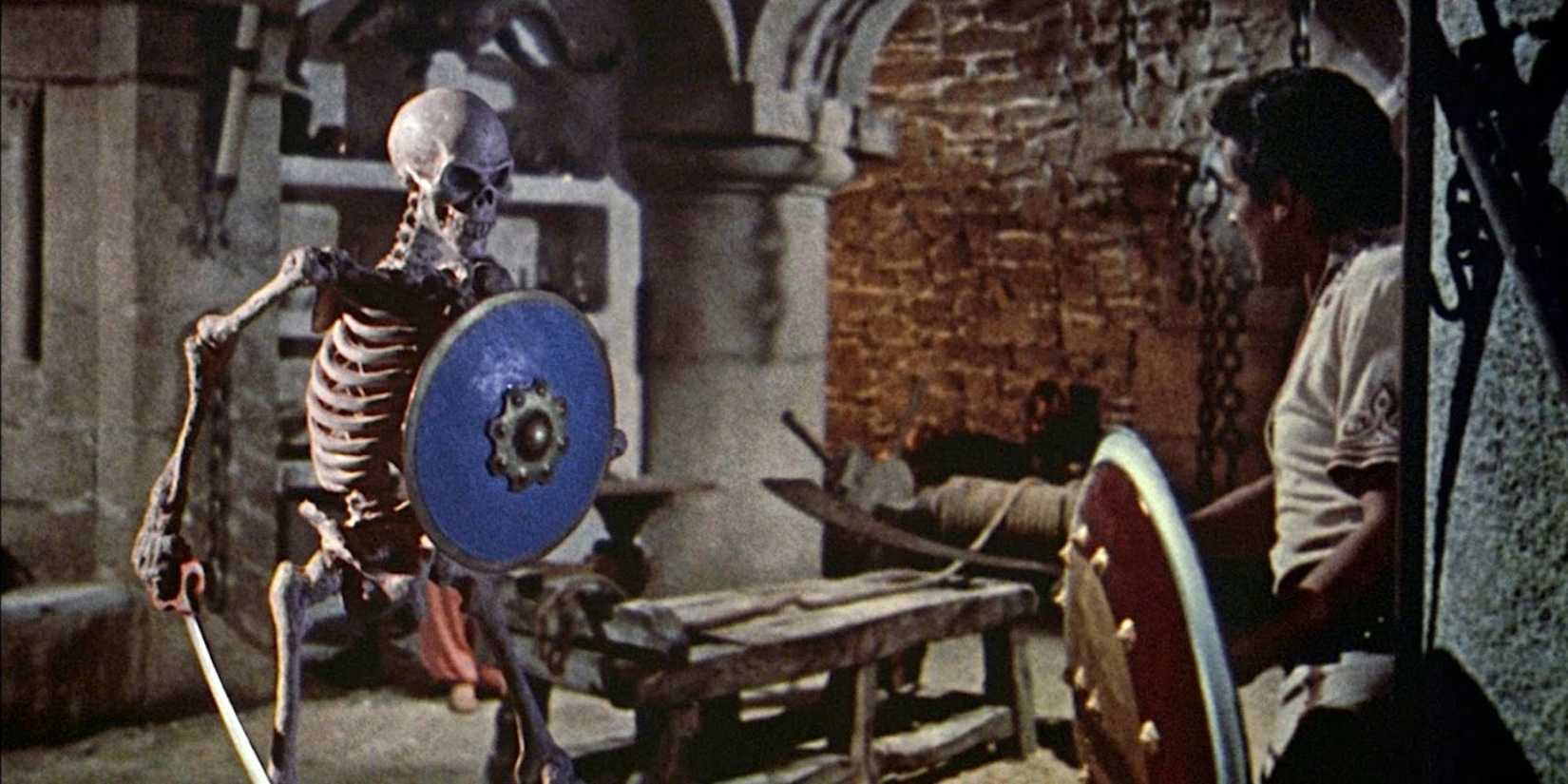
Image via Columbia Pictures
En route to Baghdad to marry Princess Parisa of Chandra (Kathryn Grant), Sinbad the Sailor (Kerwin Mathews) stops at the Isle of Colossa, where his crew rescues a magician named Sokurah (Torin Thatcher) from a cyclops. Sokurah wants the crew to go back so he can recover his magic lamp, but Sinbad refuses, so Sokurah uses his magic to shrink Parisa to the size of a chess piece, thus threatening war between Baghdad and Chandra. To restore her, Sokurah requires the shell of a Roc egg, but the giant bird only nests on Colossa, forcing Sinbad to lead an expedition back to the monster-infested island.
The 7th Voyage of Sinbad is the first and greatest of the trilogy of Sinbad films featuring effects by Ray Harryhausen. Though not as technically impressive as the movies that would follow, it’s amazing how well they hold up, especially Sinbad’s iconic duel with an undead warrior. As for the characters, they perfectly embody their respective archetypes, especially Sokurah, who is given a fair bit of charisma from Thatcher.
‘The Thief of Bagdad’ (1940)

When King Ahmad (John Justin) of Baghdad disguises himself as a commoner to get to know his people, he is betrayed and imprisoned by his Grand Vizier, Jaffar (Conrad Veidt), who takes over the city. Ahmad escapes execution with the help of a young thief named Abu (Sabu), and the two make their way to Basra, ruled over by a toy-collecting Sultan (Miles Malleson). There, Ahmad falls in love with the Sultan’s daughter (June Duprez), but Jaffar also desires her, using his mastery over black magic to eliminate anyone in his way.
The Thief of Bagdad is a remake of the 1924 silent movie of the same name, and is perhaps the movie most responsible for our modern view of the One Thousand and One Nights. It was the first film to use blue-screen technology, which, combined with its elaborate sets and colorful outfits, makes the world feel lively and magical, especially when the characters encounter a towering wish-granting Djinn (Rex Ingram). Of the characters, Abu and Jaffar stand out the best, perfectly encapsulating the plucky thief and wicked sorcerer archetypes, and brought to life thanks to iconic performances from Sabu and Veidt.
‘Conan the Barbarian’ (1982)


After his village is destroyed by raiders, Conan (Arnold Schwarzenegger) is sold into slavery, where he is turned into a deadly pit fighter. After earning his freedom, Conan meets a thief named Subotai (Gerry Lopez) and a warrior named Valeria (Sandahl Bergman), and the three join forces to get rich by robbing a snake cult. However, Conan soon learns that the leader of the cult, Thulsa Doom (James Earl Jones), is the same man who slaughtered his family, sending Conan and his friends on a path of revenge and a meeting with an eccentric wizard (Mako).
Conan the Barbarian is one of the most important fantasy movies of the 1980s, and the film that made Schwarzenegger a major celebrity. With its impressive sets, epic soundtrack, and gritty battles, the movie transports audiences into a world where danger lurks around every corner and forces far stronger than humans are at work, be they gods or powerful spirits. It’s the ultimate sword-and-sorcery film because it makes you feel like you’re watching a legend in the making, as Conan fights against insurmountable odds in the name of vengeance and spite.
You must be logged in to post a comment Login