Entertainment
10 Heaviest Sci-Fi Books of All Time

Science fiction books have existed for at least a couple of centuries, or possibly longer, depending on what you want to define as science fiction. Mary Shelley‘s Frankenstein probably counts, and that was originally published in 1818, but it’s a little more horror-focused and maybe not “hard” science fiction. H.G. Wells also wrote the likes of The Time Machine and The War of the Worlds in the late 1800s, and then sci-fi, as it’s now understood, really took off in the 20th century.
Some sci-fi books are kind of fun, while others have a mix of heavy-going/thought-provoking elements alongside some possible sense of escapism… and then there are the following books that take one or more steps further away from escapism. These ones are all among the heaviest sci-fi books of all time, and most of them are great, so long as you don’t mind reading something a little bleak (and they might be best read during the day, too, rather than right before you turn off the light at night).
10
‘Brave New World’ (1932)


The setting of Brave New World is a little removed from the sort of dystopias that are right on the line of becoming post-apocalyptic hellscapes, or at least it seems that way, at first. The whole book is about a society that’s said to be utopian, though there are countless ways that people have certain liberties restricted or crushed, and then there’s also a certain emptiness to the kind of pleasure that seems constant.
It’s an undeniably interesting angle for a dystopian novel to take, and maybe it adds some nuance, even if ultimately, the message of Brave New World proves hard to miss. Brave New World, therefore, isn’t entirely subtle or anything, but it does stand apart from other books about dystopias, and there is a definite uneasy kind of heaviness to the whole thing, with much of that being why it’s considered such an essential and enduring book.
9
‘Lucifer’s Hammer’ (1977)


There’s no real sense of a dystopia to be found in Lucifer’s Hammer, because it’s about the lead-up to the world becoming a post-apocalyptic wasteland, and then a good chunk of it’s about the people still around surviving that whole mess. The world-ending event here is a comet that gets dubbed “The Hammer,” and yeah, Earth gets hammered by it. Chaos ensues.
It gets quite technical about the comet and its force, with quite a bit of hard science fiction informing what might happen to the Earth after such a drastic collision. There’s also some more visceral and outwardly horrific stuff in Lucifer’s Hammer, what with it being a post-apocalyptic story and all, with everything being very compelling. Like, it is a fairly underrated book, even if it’s not wholly overlooked (a Hugo Award nomination is something, after all), but it still feels like a few more people ought to read it.
8
‘A Clockwork Orange’ (1962)

A Clockwork Orange is one of its decade’s best books, and very much worth reading, even if you’ve already seen the movie of the same name. Stanley Kubrick could just about always be relied upon to do interesting things with the source material his movies adapted, as Lolita and The Shining also showed, with A Clockwork Orange joining that camp. The movie definitely gets what the book was going for, albeit with one major difference near the end.
To focus just on the book, though, this one’s about a dystopian society where crime is extra violent and widespread, and measures taken to combat said crime are also heightened in intensity. There’s an experimental procedure developed to make violent thoughts cause nausea, and the narrator goes through that “treatment,” with the consequences explored after. Like a lot of good science fiction, difficult questions about technology and human nature are asked here, and A Clockwork Orange ultimately proves undeniably thought-provoking because of all that it goes for thematically.
7
‘Gravity’s Rainbow’ (1973)

There’s a real mix of genres found in Gravity’s Rainbow, but a little by way of science fiction, so it’s still going to be counted here. It takes place mostly during the closing stages of the Second World War, and there are a whole heap of characters spread out across Europe (for the most part), with many of them trying to find a particular V-2 rocket that is important for, like, reasons, or something.
There’s some absurdity and dark humor in it, with it getting a little sci-fi and metaphysical/postmodern in nature beyond being a book about World War II, and then much of Gravity’s Rainbow also proves to be confronting.
With Gravity’s Rainbow, answers of a conventional kind are hard to come by, though might be there if you read the book like, a few dozen times, and then consult with the three other people in the world who’ve also found time to get through its almost 800 pages a few dozen times. There’s some absurdity and dark humor in it, with it getting a little sci-fi and metaphysical/postmodern in nature beyond being a book about World War II, and then much of Gravity’s Rainbow also proves to be confronting, profane, and sometimes even weird in a way that puts other so-called “weird” books to shame.
6
‘Slaughterhouse-Five’ (1969)

Slaughterhouse-Five is, like Gravity’s Rainbow, worth considering as an all-timer as far as ambitious books go, and it does all the stuff it does within a relatively lean number of pages, too. Much of the narrative here, like with Gravity’s Rainbow, takes place during World War II, but Slaughterhouse-Five does have more by way of conventional sci-fi elements, since its protagonist is someone grappling with becoming apparently “unstuck in time.”
This makes Slaughterhouse-Five something of a time travel-related book, but if it’s time travel, then it’s the extra chaotic and nightmarish kind, and then part of the horror of it all also relates to how it’s a traumatic time in history (generally and for the protagonist) to keep jumping around in, with him struggling to process his wartime experiences that aren’t, strictly speaking, all in the past. So, yes, it’s a nightmare, but a very compelling and honestly quite readable one, all things considered.
5
‘Hard to Be a God’ (1964)

It might feel like an obscure pick, but Hard to Be a God has had a decent amount of exposure for a Soviet novel from the 1960s (being adapted into two different movies kind of helps). It’s got an undeniably intriguing premise, for a work of science fiction, being about a man from the future who goes to a planet that’s currently slogging it out through their equivalent of the Middle Ages.
He observes more than he interferes, at least at first, but there is a tension there, and that’s where the title kind of comes in. Hard to Be a God is a pretty bleak look at human nature (of sorts) on an alien planet, with the way it goes back to a certain kind of Middle Ages ensuring that the setting definitely feels distinct. It’s all pretty brutal and bleak, but kind of has to be, to really dig into the things it tackles.
4
‘The Forever War’ (1974)

The titular war in The Forever War really does last an incredibly long time, and because of technology in the future, the protagonist is around – and part of it in some sort of way – for a very long time, too. There is so much more to the book than just the way it rushes through time, but that is one of the more exciting and surprising parts (surprising in the sense that you don’t know how long “Forever” is going to be, when you and the protagonist are sort of just trapped in it).
So, it’s not subtle about being an anti-war book, and there are definite parallels to be drawn between the war in this novel and wars that have happened in real life, which is, yes, something certain works of science fiction do well. The Forever War is sometimes thrilling and surprising, but it’s also pretty soul-crushing, and it does a remarkably effective job at being anti-war while not “technically” or “explicitly” being about an “actual” war humanity has fought. Implicitly, or being reminiscent of, on the other hand…
3
‘Under the Dome’ (2009)

There aren’t nearly as many sci-fi books Stephen King’s written as horror or thriller ones, but of them, Under the Dome is probably the bleakest. And it might well be one of the best, even if the sci-fi elements here are quite controversial, to say the least. Putting them aside, though, Under the Dome does have a bit of a dystopian/post-apocalyptic thing going for it, so even before you get “answers” to what’s behind the situation all the characters are in, it kind of fits into those particular kinds of science fiction sub-genres.
Basically, the members of a small town are trapped in that town because of an invisible and impenetrable dome that confines them all, with pre-existing problems in the town getting much worse, since no one can leave. Under the Dome just has more and more things fall apart, pretty much chapter by chapter, and there are so many chapters, so things go from bad, to worse, and then get even worse somehow, and on and on, for about 1000 pages. It’s equal parts compelling and anxiety-inducing, really.
2
‘Nineteen Eighty-Four’ (1949)

Mentioning Nineteen Eighty-Four is obligatory, for present purposes, which is quite the understatement, honestly. This is probably the quintessential dystopian story, and a good companion piece to Brave New World. That 1932 novel is also dystopian, yet in a way that makes the world look – or seem to be – utopian at first, even if it’s pretty dire once you dig into things. The world of Nineteen Eighty-Four is dystopian in a more in-your-face way.
The only light, so to speak, comes from a protagonist who, alongside some side characters, think they might be able to rebel against the dystopia they’re in, in one way or another, but no, Big Brother gets them, gets them, gets them, gets them. That’s all a simplistic way to break Nineteen Eighty-Four down, but that is the gist of it. Great novel and an essential read, of course, but there’s a definite heaviness to it throughout that you have to be (and probably will be, given the novel’s reputation) prepared for.
1
‘Watchmen’ (1986–1987)

If you’re talking Alan Moore graphic novels, Watchmen isn’t even the heaviest, as the existence of From Hell makes pretty plain to see. There’s an almost sci-fi element to part of that graphic novel, but it’s not as heavy on sci-fi qualities as either V for Vendetta or Watchmen, and of the two, Watchmen is perhaps darker and more subversive… though honorable mention to V for Vendetta, since it’s still very effective as a work of dystopian fiction.
With Watchmen, it just balances the dystopian elements and some post-apocalyptic elements in a more startling way, and elaborating on all that too much might be spoiling things, and yeah, it’s still worth staying away from discussing the ending in too great detail, even if the graphic novel’s about four decades old. And yeah, it’s a graphic novel, and it’s ranking ahead of a bunch of “normal” novels, but it feels like a suitable #1 pick. It’s got the sci-fi side of things represented, with the stakes and it being set in an alternative history, and then it’s extremely heavy – and groundbreaking – as a deconstruction of superhero stories and the conventions you can (or could) often find in them.

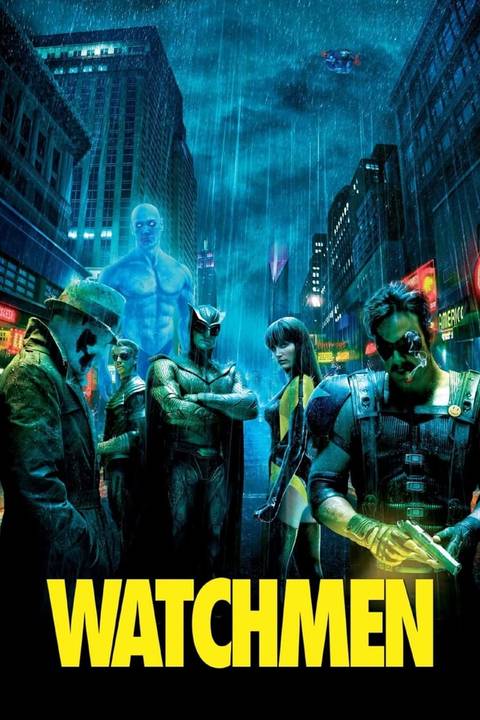
Watchmen
- Release Date
-
March 6, 2009
- Runtime
-
163 minutes
- Director
-
Zack Synder
- Writers
-
Alex Tse, David Hayter, Alan Moore, Dave Gibbons
You must be logged in to post a comment Login