Entertainment
10 Near-Perfect Noir Movies That No One Remembers Today

Critics, film historians, and film scholars have never quite come to a definitive conclusion on whether film noir is a genre, a style, or a film movement. Regardless, these movies about morally grey characters dealing with complex, crime-filled plots can be deliriously entertaining—and, when at their best, can even be among the greatest films of their respective era.
With time, however, even the best of noir films can fall into oblivion. Indeed, several near-perfect noir masterpieces are barely remembered nowadays, whatever the reason for that may be. Directed by some of the best filmmakers of their generation, from Fritz Lang to Carol Reed, these exceptional films are proof that film noir can make for some of the most unforgettable movies ever made.
‘The Fallen Idol’ (1948)


In The Fallen Idol, a butler working in a foreign embassy in London falls under suspicion when his wife accidentally falls to her death, the only witness being an impressionable boy. All in all, it is one of the most underrated film noir masterpieces of all time, a Carol Reed gem that earned its director the first of only three Best Directing Academy Awards he was ever nominated for.
Also known as The Lost Illusion, this British mystery thriller proves that, though noir was mostly an American phenomenon, the production of excellent noir movies wasn’t limited to Hollywood exclusively. It’s a suspenseful, nerve-racking film that builds suspense slowly throughout its runtime, until it all erupts in one of the most brilliant third acts of any film from the ’40s.
‘Pickup on South Street’ (1953)

Combining traditional film noir and Cold War espionage drama elements, Pickup on South Street tells the tale of a pickpocket who unwittingly lifts a message destined for enemy agents and becomes a target for a Communist spy ring. One of the most underrated noirs of the ’50s, Pickup on South Street is a hidden gem with some excellent performances (including Thelma Ritter‘s, which earned her an Oscar nomination) and great direction by Samuel Fuller.
It’s a dark, complex story of urban existential dread that proves Cold War films and film noir were a match made in Heaven. Though critics were split on the movie back in 1953, cinephiles nowadays look back on Pickup on South Street with far more admiration and fondness. It’s a gloriously pulpy movie that all fans of film noir should check out at least once in their lives.
‘Odd Man Out’ (1947)


Another Carol Reed gem, the British film Odd Man Out is a psychological thriller about a wounded Irish nationalist leader who tries to evade the cops after a failed robbery in Belfast. It’s probably the movie most similar to Reed’s magnum opus and most iconic film noir outing, The Third Man, yet it’s entirely its own thing—and very much worthy of being rediscovered today.
Odd Man Out was a hit both with critics and at the box office, particularly in a European landscape where Reed seemed to have perfectly understood the general postwar mood and mentality. With a well-deserved score of 100% on Rotten Tomatoes, the film is grim and absolutely enrapturing, full of hard-hitting visuals and deeply compelling drama.
‘Scarlet Street’ (1945)

Austrian filmmaker Fritz Lang jumped over the pond to Hollywood in 1936. By the time he made Scarlet Street, he was already a properly established and highly prolific director of American classics, and that shines through in this adaptation of the French novel La Chienne by Georges de La Fouchardière. In it, a man going through a mid-life crisis befriends a young woman whose fiancé has persuaded him to con him out of the fortune they mistakenly assume he has.
It’s another masterpiece with a well-deserved score of 100% on Rotten Tomatoes, benefiting from Lang’s sharp eye for unforgettable images and the excellent cast led by Edward G. Robinson, Joan Bennett, and Dan Duryea. It’s one of the greatest films currently in the public domain, a Dostoevskian melodrama so powerful and dark that it was originally banned in Atlanta, Milwaukee, and the entirety of New York State.
‘Leave Her to Heaven’ (1945)

A Golden Age Hollywood noir in Technicolor? In this economy? John M. Stahl‘s Leave Her to Heaven certainly isn’t your usual classic noir, but it’s nevertheless one of the most defining films of the ’40s—at least in its genre. Russian-born Stahl was a master of classic melodrama and what were then known as “women’s films,” and those unique sensibilities lend themselves to one of the most fascinatingly unique film noir efforts of all time.
The characters aren’t particularly likable, but Jo Swerling‘s phenomenal script and the cast’s extraordinary performances (particularly Gene Tierney‘s) make the narrative engrossing nonetheless. It’s a delightful bit of pure pulp enhanced by Stahl’s distinctive artistic voice, which makes it rather unsurprising that the film has gained a small cult following that should definitely be far bigger.
‘Angels with Dirty Faces’ (1938)
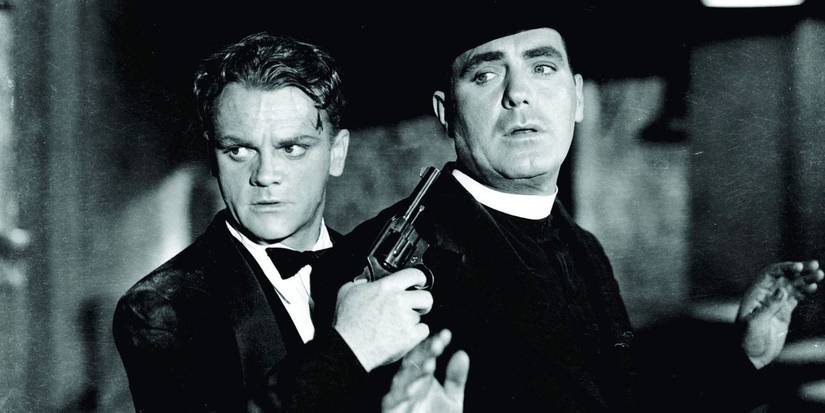
Directed by Michael Curtiz of Casablanca fame, Angels with Dirty Faces is about a priest trying to stop a gangster from corrupting a group of street kids. The movie has one of the most star-studded casts of any ’30s noir, including James Cagney (who earned an Oscar nod for his performance) and Humphrey Bogart. All in all, it’s one of the best gangster movie masterpieces of the last 100 years.
Angels with Dirty Faces is explosive, gritty, exciting, and absolutely riveting.
Powerfully melodramatic and occasionally utterly harrowing, Angels with Dirty Faces tells a story built on the foundations of a somewhat commonplace premise, but the directions in which it takes that premise are stunning. It’s explosive, gritty, exciting, and absolutely riveting. It’s just as much of a masterclass in noir filmmaking as it is in gangster filmmaking, a fantastic classic film all around.
‘The Set-Up’ (1949)

There aren’t many noir movies that are also boxing movies, which only makes Robert Wise‘s The Set-Up more special. Based on a 1928 narrative poem by Joseph Moncure March, it was named by Wise as one of his favorite films of his career. It tells the story of Bill “Stoker” Thompson, a 35-year-old has-been boxer whose manager, sure he will continue to lose fights, takes a bribe from a betting gangster without telling Stoker.
Working with a relatively low budget, Wise made a brutal and exciting melodrama that stands out among most other noir films from the era, since this one’s also one of the best sports movies of the last 100 years. Wise’s gritty style here is so different from his voice in later works like West Side Story and The Sound of Music that one could even think they’re made by different filmmakers, which only speaks to the director’s versatility.
‘Fury’ (1936)

The first film Fritz Lang directed in Hollywood was Fury, which also happens to be one of the director’s best works. Loosely based on the events surrounding the Brooke Hart murder, the movie follows a wrongly accused prisoner who barely survives a lynch-mob attack and is presumed dead, after which he decides to get revenge.
The movie, whose screenplay was Oscar-nominated, is an engrossing revenge film that portrays the dangers of mob justice in ways that still hit hard 90 years later. Led by Spencer Tracy at the top of his game, this incredible psychological thriller has all the traditional noir elements down to a T, including its pessimistic—yet all-too timeless—view of humanity.
‘Night and the City’ (1950)

Directed by Jules Dassin, one of the most notorious names of the Hollywood blacklist, Night and the City is a British noir based on Gerald Kersh‘s novel. It follows Harry Fabian, a small-time grifter who takes advantage of some fortuitous circumstances to try to become a big-time player as a wrestling promoter. Though its revolutionarily bleak tone and complete lack of sympathetic characters made many critics dislike it when it originally came out, cinephiles today look back at it as one of the best noir films of the ’50s.
It’s one of those noir masterpieces with great acting, infused with a moody and pessimistic atmosphere that was clearly influenced by Dassin’s exile from the U.S. It’s a nuanced, pulpy gem that shows noir elements in their purest form. As one of the genre’s biggest masterpieces from the era, it’s a tragedy that it’s not considered a far more mainstream classic nowadays.
‘I Am a Fugitive from a Chain Gang’ (1932)

Far and away one of the best movies of the 1930s, Mervyn LeRoy‘s I Am a Fugitive from a Chain Gang is a pre-Code tragedy based on a true story. It tells the story of a World War I veteran who tries to re-enter civilian life, but after being unwittingly caught up in a robbery, he falls victim to the horrible conditions of a Southern chain gang.
Bold, realistic, and so dark that one has to wonder if LeRoy would have been able to get it made in its current form after the Hays Code began being strictly enforced, it’s a gut-wrenching critique of the penal system whose biggest tragedy is perhaps the fact that it still feels timely in 2026. Led by a top-form Paul Muni, it’s just as important a social document as it is a marvelous Golden Age Hollywood work of art.