Entertainment
10 Nearly Perfect Fantasy Movies, Ranked

It’s easy to single out those fantasy movies that are considered pretty much perfect, starting as far back in cinema history as The Wizard of Oz, and then into the 21st century, with something like Pan’s Labyrinth, for instance, that’s honestly hard to fault. Perfection is rare, and also a little too easy to talk about, since it involves looking at something and being like, “Yeah, there’s nothing wrong here.”
So, here are some fantasy movies that are “merely” near-perfect. Some of them are very good with some noticeable flaws, and then the ones near the end of this ranking are the closest to perfect, perhaps with just one or two things that can be nitpicked. You’re also welcome to disagree, but if something’s not here and you’re not happy about that, then consider the possibility that it was potentially too good/perfect for this ranking, and then maybe you’ll feel a little less angry.
10
‘Lost Horizon’ (1937)


Not to be mixed up with the camp-heavy musical movie of the same name, from 1973 (which has the same plot, too), Lost Horizon (1937) has been a little lost to time, at least if you compare its legacy to The Wizard of Oz or Snow White and the Seven Dwarfs, the latter of which also came out in 1937. Lost Horizon is about a man discovering a valley known as Shangri-La, which is hidden from the real world and unlike pretty much any other area previously known to humanity.
Or it seems that way at first, at least, since nothing can really be as perfect as it first seemed. Lost Horizon is interesting, and also ahead of its time in some ways, regarding what it’s going for thematically and with some of its technical qualities, too. It might’ve been a bit much for people in the 1930s, but at least it can be better appreciated nowadays.
9
‘Versus’ (2000)

There’s a lot of wonderful chaos to be found in Versus, even if it’s also close to being a bit too much at times. It’s sort of an action/crime movie that has an increasing number of fantastical and supernatural elements as it goes along, seeing as the premise here (more of an excuse to have wild things happen) involves a bunch of shady people having to battle zombies and other creatures in a forest.
They really just have to fight for their lives, and do so in one bombastic scene after another, for two hours. Versus seldom slows down and, by the time it wraps up, you feel as though you’ve binged three or four wild B-grade action movies in a row, rather than just a single one. Whether this is a reason to watch or avoid Versus is entirely up to you.
8
‘Allegro non troppo’ (1976)

Pretty much everyone knows about Fantasia, which is one of the most important animated movies ever made, famously for the way it blends animation and classical music through a series of very memorable and eye-catching segments. Less well-known is Allegro non troppo, which could be sarcastically labeled as “Fantasia, but Italian, and also a bit weirder,” but it’s also pretty good.
Not as good as the movie it feels like it borrows the most from, but if you want to see a bunch of strange and creative images while having a cinematic experience that feels genuinely psychedelic, that’s just what Allegro non troppo provides. It might be all about vibes over anything else, so call it shallow if you want to, but what imaginative vibes there are to be found here, of both the pleasant and not-so-pleasant variety.
7
‘Beau Is Afraid’ (2023)


After directing Hereditary and Midsommar, both of which were horror movies, Ari Aster directed Beau Is Afraid, which… was almost/sort of a horror movie? But not entirely. It’s a difficult one to try and explain, since it’s meant to feel like something between a panic attack and a fever dream (maybe even both at the same time) for what ends up being a very long time, since the movie clocks in at just under three hours.
The title character here has to travel a great distance to get to his mother’s funeral, basically. Along the way, various messy, chaotic, and unpleasant things happen. Beau Is Afraid isn’t very fun, but it’s also not trying to be, and though it asks a lot from you, as a viewer, it is perhaps a trip worth taking if you’re feeling brave enough (and if you have quite a bit of time to spare, too).
6
‘Ghidorah, the Three-Headed Monster’ (1964)

Sure, the Godzilla series is always a bit more sci-fi than fantasy, but depending on the monster Godzilla fights (or aligns himself with), the series can sometimes function as a bit of both. Take Ghidorah, the Three-Headed Monster, for instance. Ghidorah himself looks a bit like a dragon, which is a fantastical creature (Ghidorah is admittedly from space, though), while Mothra also plays a big part in the film, and she’s more of a mythological/fantastical monster than one of scientific origin.
Also, Ghidorah, the Three-Headed Monster is worth mentioning because it was a key film in the progression from Godzilla’s status as a villain to a hero of sorts, since Ghidorah is the real bad guy here, so to speak. It’s a better-than-average giant monster movie, and a good showcase for some of the most iconic monsters to have ever appeared in the Godzilla series.
5
‘Dante’s Inferno’ (1911)

One of the earliest of all feature films, at least of those that haven’t been completely lost to time, Dante’s Inferno is pretty remarkable, and worth watching just because of its place in cinema history. Thankfully, it’s also quite good on top of being historically significant, being an adaptation of one part of Dante Alighieri‘s Divine Comedy; namely, the part that sees Dante being guided through the Nine Circles of Hell.
It’s easy to forgive/overlook the clunkier parts here, considering the movie was released way back in 1911.
Sure, it can all look a bit primitive 115 years later, but also, come on… it’s 115 years later. Dante’s Inferno did a lot for something of its time, and is still admirably unnerving in some ways all these decades later. It’s easy to forgive/overlook the clunkier parts here, considering the movie was released way back in 1911, and felt so tremendously impressive and ambitious for a work of silent cinema.
4
‘Castle in the Sky’ (1986)
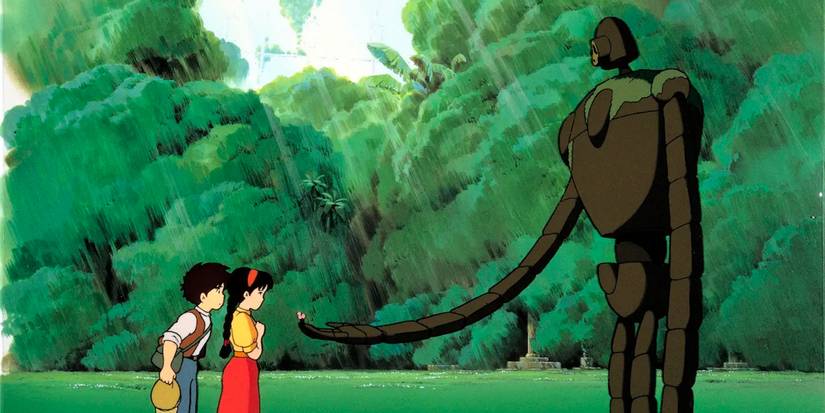
It’s interesting looking at the earlier films directed by Hayao Miyazaki, since they’re a little different from the sorts of fantasy movies he got the most acclaim for directing (like Spirited Away and Princess Mononoke). Some films of his were a little fantasy and sci-fi at the same time, like Castle in the Sky, which has magic and fantasy elements, sure, but it’s also a little steampunk stylistically, plus robots factor into the plot, too.
It’s also a family-friendly movie that’s not just a kids’ movie, having a lot that people of all ages can appreciate here. Castle in the Sky is a very well-executed “chase/race for a MacGuffin” kind of movie, with that MacGuffin being key (and a key) to accessing the titular castle in the sky. It’s all very imaginative and easy on the eyes, only being held back from technical “top-tier Miyazaki” status because he made a handful of true masterpieces that were somehow even better.
3
‘Holy Motors’ (2012)

Holy Motors does not play out over a lengthy period of time, but it does take you to many different locations and forces you to try (and maybe fail) to comprehend a variety of unusual sights, with the whole thing feeling deliberately episodic. The main character is a man with a series of strange tasks he has to undertake, with each of them requiring him to adopt a new identity.
It’s a film directed by Leos Carax, who’s never been afraid to make strange, distressing, and perplexing movies, with Holy Motors being maybe the most intense of all his movies, when it comes to those aforementioned adjectives. That makes it perhaps a bit much, and some stretches of the film are more absorbing than others, but it does overall remain an unusual cinematic trip worth taking.
2
‘Hellboy II: The Golden Army’ (2008)
Guillermo del Toro has always been closely associated with the fantasy genre, since he’s one of the best directors in recent memory to have really explored (and arguably elevated) that sort of film. Pan’s Labyrinth, for instance, is just about perfect, and there’s an argument to be made that The Devil’s Backbone and The Shape of Water (the latter of which might cross over into sci-fi territory) are almost just as good.
A little further down quality-wise, then, is Hellboy II: The Golden Army, which certainly has its flaws, but also, so much of it’s charming and visually dazzling to such a great extent that the missteps barely register. Also, the biggest obstacle to loving Hellboy II: The Golden Army isn’t really its fault (it was quite clearly set up to be the middle chapter of a trilogy that del Toro ultimately never got to finish, which leaves some things hanging here to a frustrating extent).
1
‘The Lord of the Rings: The Two Towers’ (2002)

The most controversial pick here, so listen: if you take The Lord of the Rings as a single thing, or one massive movie, then that entire epic is pretty much perfect. It has an opening movie that’s ideal, and then the third movie is everything the final chapter of a trilogy should be, itself having a perfect ending. Or perfect endings. It needed to have a perfect/extended ending, given that it wraps up everything that came before.
But if you look at The Lord of the Rings: The Two Towers on its own, then it’s probably the only movie in the trilogy that’s imperfect. Those imperfections, mostly regarding pacing (some things happen a little too quickly, and other things feel a bit drawn-out), are easy to overlook when you judge the trilogy as a whole thing. It feels okay to have a transitional movie within a broader, excellent trilogy, and even if the setup is imperfect, it allows perfect payoffs by the time The Return of the King comes around. And also, The Two Towers is still phenomenal, since even if you judge it as its own movie, the issues still feel like nitpicks (the final act, in particular, is unbelievably good).
You must be logged in to post a comment Login