Entertainment
10 Obscure Sci-Fi Shows That Became Cult Classics

Every sci-fi fan has a show they’d go to war for that nobody else has heard of. It aired on some cable network that’s since been rebranded, it ran for maybe three seasons before getting axed on a cliffhanger, and it’s the first thing out of your mouth when someone asks for a recommendation. Streaming has made most of these shows easier to find than ever, which means there’s never been a better time to catch up on the weird, ambitious, canceled-too-soon series that built cult followings for a reason.
We’ve rounded up the best of these obscure sci-fi shows. They’ve all got inventive world-building, unfairly talented casts, and the kind of bonkers plotting that keeps you up until 3 AM muttering, “just one more episode.”
‘Dark Angel’ (2000–2002)


Before she was running a billion-dollar company, Jessica Alba was Max Guevara, a genetically enhanced super-soldier on the run in a post-apocalyptic Seattle that James Cameron built for Fox’s Dark Angel. It was 2000, Cameron was fresh off Titanic, and he decided his next move was a cyberpunk television show about a bike messenger with cat DNA and an attitude problem. The show aired for two seasons and made Alba a household name, earned her a Saturn Award, and then got canceled because Fox moved it to the Friday night death slot to make room for 24.
The world-building is pure early-2000s grit. An electromagnetic pulse has crippled the U.S., Seattle looks like a tech-noir fever dream, and Alba’s Max navigates it all while searching for her fellow Manticore escapees, trading barbs with Michael Weatherly’s cyber-journalist Logan Cale, and outrunning government agents who want her back in a lab. Jensen Ackles joined the cast in Season 2 as a fellow supersoldier, and his chemistry with Alba gave the show a jolt it sorely needed. Dark Angel is a time capsule of a very specific era of sci-fi television, the kind that trusted its female lead to carry action sequences and moral complexity, usually in the same scene. We still miss it.
‘Killjoys’ (2015–2019)

Before Hannah John-Kamen was fighting Ant-Man (Paul Rudd) in the MCU, she was Dutch, a lethally charming bounty hunter chasing warrants across a distant planetary system called the Quad with her partner Johnny (Aaron Ashmore) and his ex-military brother D’avin (Luke Macfarlane). Created by Michelle Lovretta, who also gave us Lost Girl, Killjoys ran for five seasons on Syfy from 2015 to 2019 and delivered a fully realized sci-fi universe where class warfare, body-snatching parasites, and interplanetary barroom brawls coexisted with surprising ease. Think Firefly if Mal Reynolds (Nathan Fillion) were a woman with a mysterious past and significantly better hand-to-hand combat skills.
What makes Killjoys such a satisfying binge is its refusal to take itself too seriously. The world-building is dense but never homework-y: you’ve got a feudal corporate hierarchy, a caste system that spans multiple moons, and an ancient alien threat that unfolds slowly across the series, all woven into a show that never forgets it’s supposed to be fun. The chemistry between its three leads carries even the weaker episodes, and the fact that it actually got to end on its own terms, with a proper finale, makes it a rarity in the graveyard of canceled sci-fi.
‘Revolution’ (2012–2014)
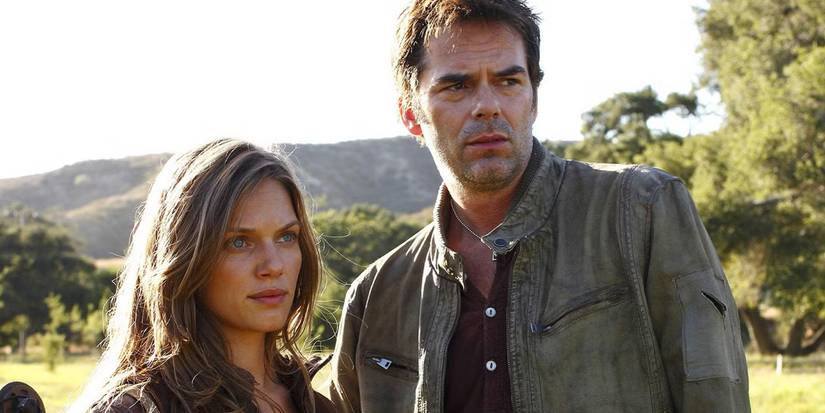
What if every piece of technology on the planet just stopped working and never came back on? That’s the question at the center of Revolution, Eric Kripke‘s post-apocalyptic NBC drama that aired from 2012 to 2014 and featured J. J. Abrams as executive producer and Jon Favreau directing the pilot. Set 15 years after a mysterious global blackout, the show follows a scrappy band of survivors navigating a fractured America where former U.S. states have become warring militia territories and arrows have replaced drone strikes. Billy Burke, fresh off playing Bella Swan’s (Kristen Stewart) dad in Twilight, reinvented himself here as Miles Matheson, a former Marine turned reluctant hero with a complicated past and a very big sword.
The cast is stacked for a network show that only lasted two seasons. Giancarlo Esposito, doing what Giancarlo Esposito does, plays a militia captain whose ambitions rival Gus Fring’s in a post-electrical world. Elizabeth Mitchell brings gravitas as the scientist hiding the secret behind the blackout. Tracy Spiridakos leads the early episodes as Charlie, Miles’ niece. Kripke himself later joked that if Revolution had been a streaming show with a bigger budget and shorter episode order, it would have been The Last of Us. He’s not entirely wrong.
‘Mutant X’ (2001–2004)

Here’s a deep cut. Mutant X debuted in first-run syndication in 2001, created by Avi Arad under a Marvel Comics license, and it was immediately so X-Men-adjacent that 20th Century Fox sued Marvel over it. The lawsuit was settled, the show carried on for three seasons and 66 episodes, and it cultivated a following among fans who couldn’t get enough of the mutant-team formula on a weekly basis. The premise follows Adam Kane (John Shea), a geneticist trying to atone for his role in creating “new mutants” by assembling a team of them to protect others from a shady government agency. Victoria Pratt‘s feral Shalimar Fox, Victor Webster‘s electricity-wielding Brennan Mulwray, and Forbes March‘s density-shifting Jesse Kilmartin round out the crew.
Mutant X is not prestige television. The dialogue can be clunky, the effects are of the early 2000s variety, and the plotting sometimes feels like it’s making things up as it goes. But there’s something genuinely charming about its scrappiness, and the team dynamics carry it through the rougher patches. Lauren Lee Smith, who later turned up in CSI, adds a compelling energy as the tele-empath Emma DeLauro for the first two seasons. The show got abruptly canceled after Season 3 when its production company folded, leaving it on a cliffhanger that was never resolved, which is, at this point, basically a rite of passage for any self-respecting cult sci-fi series.
‘Falling Skies’ (2011–2015)

Noah Wyle spent over a decade playing a mild-mannered doctor on ER, so naturally, his follow-up was a TNT series where he plays a mild-mannered history professor who picks up a gun and leads a guerrilla resistance against alien invaders. Falling Skies ran for five seasons from 2011 to 2015 with Steven Spielberg as executive producer, and it wears his fingerprints all over it: the Americana, the emphasis on family bonds under impossible duress, and the weird aliens. Wyle’s Tom Mason becomes the reluctant leader of the 2nd Massachusetts Militia Regiment, and the show mines surprisingly effective drama from watching civilians figure out how to fight a war they were never trained for.
The supporting cast gives Wyle plenty to work with. Will Patton is grizzled and excellent as Captain Weaver, Moon Bloodgood brings gravity to the group’s medic, and Colin Cunningham is a scene-stealer as John Pope, an outlaw whose allegiances shift with the wind. The first three seasons are the strongest and the show’s willingness to keep introducing new alien species and political complications keeps the mythology from going stale. The final season rushes its ending, but the journey there offers one of the more satisfying post-invasion narratives cable TV has attempted.
‘Avenue 5’ (2020–2022)

Armando Iannucci, the acid-tongued genius behind Veep, set his satirical sights on space tourism with Avenue 5, and the result is a two-season HBO comedy so viciously funny it makes you wonder how it didn’t find a bigger audience. Hugh Laurie plays Captain Ryan Clark, the reassuringly handsome figurehead of a luxury interplanetary cruise ship owned by Josh Gad‘s obnoxious tech billionaire, Herman Judd. When a technical malfunction throws the ship off course, what was supposed to be an eight-week pleasure cruise becomes a years-long ordeal, and the passengers, who are exactly as awful as you’d expect rich people trapped in a tin can to be, start losing it.
The comedy here is bleak and unrelenting, which is probably why it struggled to find its crowd during its initial run in 2020, a year when being trapped in an enclosed space with terrible people hit a little too close to home. Zach Woods is perfect as the ship’s incompetent head of customer relations, as is the supporting cast of Nikki Amuka-Bird, Suzy Nakamura, and Lenora Crichlow. The second season improved significantly, which makes HBO’s decision to cancel it in 2023 sting even more.
‘Dark Matter’ (2015–2017)

Six strangers wake up on a derelict spaceship with no memory of who they are, so they name themselves One through Six and start trying to piece together why everyone in the galaxy seems to want them dead. That’s Dark Matter in a nutshell, a Syfy series that ran from 2015 to 2017 and delivered the kind of pulpy, character-driven space opera that the network hadn’t managed since the Battlestar Galactica days. Created by Joseph Mallozzi and Paul Mullie, who spent years writing for the Stargate franchise, it’s a show built on the bones of everything those writers learned about making sci-fi on a budget feel lived-in and propulsive.
Melissa O’Neil is the standout as Two, the crew’s de facto leader whose backstory turns out to be far wilder than anyone’s, and Zoie Palmer brings a warmth and dry humor to the ship’s android that quickly makes her the fan favorite. The show’s three seasons build an increasingly complex web of corporate wars, alternate dimensions, and identity crises, and it got canceled on a cliffhanger that its fanbase has still not forgiven Syfy for. It never got the sendoff it deserved, but the ride to that point is engaging enough that it’s worth the frustration.
‘The 4400’ (2004–2007)

USA Network’s The 4400 debuted in 2004 as a miniseries and was so well-received that it earned three additional seasons before the 2007 writers’ strike killed its momentum. The hook is irresistible: 4,400 people who vanished at various points over the last century all reappear simultaneously near Mount Rainier, dumped in a ball of light with no memory of where they’ve been and not having aged a day. The catch is that many of them come back with new abilities, and the government isn’t thrilled about it. Joel Gretsch and Jacqueline McKenzie anchor the show as the Homeland Security agents tasked with monitoring the returnees, but the real draw is the sprawling ensemble.
A young Mahershala Ali plays Richard Tyler, one of the 4,400 who disappeared in the 1950s, and Billy Campbell is magnetic as Jordan Collier, a charismatic millionaire returnee whose intentions stay murky right up until they don’t. The 4400 was doing the “ordinary people with extraordinary abilities and a shadowy conspiracy” thing years before Heroes made it mainstream, and its willingness to go truly dark with its mythology still holds up.
‘Continuum’ (2012–2015)

Continuum is the kind of Canadian sci-fi export that flies completely under the radar in the U.S. and then slowly builds a following that will not shut up about it, for good reason. Rachel Nichols plays Kiera Cameron, a law enforcement officer from a corporately controlled dystopia in the year 2077 who accidentally gets transported back to 2012 Vancouver along with a group of terrorists she was supposed to be guarding. Stranded in our timeline, she teams up with a young tech genius named Alec Sadler (Erik Knudsen) and a local detective (Victor Webster) to hunt down the fugitives while secretly trying to find a way home to her husband and son.
What elevates Continuum past its time-travel premise is the way it complicates its own morality. The “terrorists” Kiera is chasing, a group called Liber8, are fighting to prevent the corporate oligarchy that Kiera serves and protects. The show asks you to root for its protagonist while slowly revealing that her side might be the wrong one, and it threads that needle across four seasons without ever fully tipping its hand. Created by Simon Barry (who went on to make Warrior Nun), it aired on Showcase in Canada and Syfy in the States from 2012 to 2015, and while the truncated final season of six episodes means it wraps up faster than ideal, it does actually wrap up, which counts for something, right?
‘The 100’ (2014–2020)
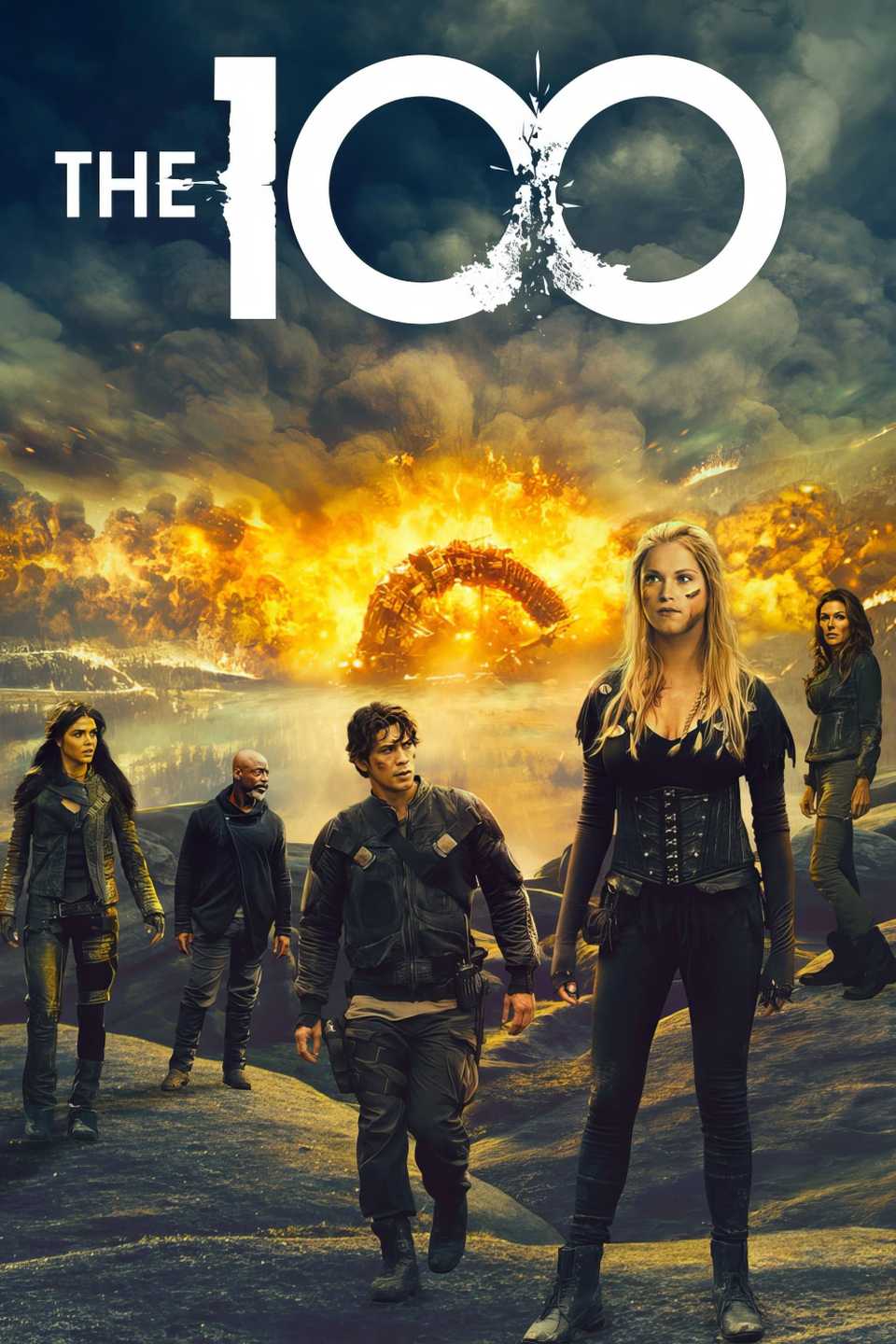
The elevator pitch for The 100 sounds like every other CW show circa 2014: pretty young people, love triangles, post-apocalyptic setting, based on a YA novel series by Kass Morgan. And the first few episodes do lean into that formula hard enough that plenty of viewers bounced. Their loss. By the end of its first season, The 100 had evolved into something ruthless and morally knotty that regularly shocked even its most devoted fans. Eliza Taylor‘s Clarke Griffin starts as a reluctant leader and ends up making the kind of decisions that would give war-criminals nightmares.
Set 97 years after a nuclear apocalypse, the show follows 100 juvenile delinquents sent from a failing space station back to Earth as expendable guinea pigs. What they find down there, surviving ground-dwellers, a militarized mountain bunker, an AI that wants to end all human conflict by ending most humans, keeps escalating in ways that The CW rarely allowed. Bob Morley, Marie Avgeropoulos, and Henry Ian Cusick round out a strong cast, and the show ran for seven seasons. It’s a slow starter that rewards patience with one of the more ambitious sci-fi arcs network television has produced.

You must be logged in to post a comment Login