Entertainment
10 Perfect Double Features To Watch With ‘One Battle After Another’

One of the most celebrated movies of 2025, Paul Thomas Anderson’s One Battle After Another is a multi-award-winning film inspired by Thomas Pynchon’s 1990 novel Vineland. Starring Leonardo DiCaprio, Sean Penn, Benicio del Toro, Teyana Taylor, and more in Oscar-nominated roles, the film is a darkly comedic thriller following a washed-up former revolutionary (DiCaprio) on a chaotic quest to save his daughter from the clutches of a corrupt military officer (Penn). It’s easily one of the best movies of recent years: entertaining, thematically complex, and politically charged.
One Battle After Another was quite popular with both critics and audiences, and has been having a spectacular awards season, winning three Critics’ Choice Awards, four Golden Globes, and six BAFTAs. As we wait for the verdicts on the movie’s 13 Academy Award nominations, it seems like the perfect time to revisit this recent masterpiece, and if you’d like to turn your movie night into a double-header, we’ve got some suggestions. Read on to discover our choices for the 10 most perfect double features to watch with One Battle After Another.
1
‘The Big Lebowski’ (1998)


Written, directed, and produced by Joel and Ethan Coen, The Big Lebowski is a cult classic crime comedy starring Jeff Bridges as Jeffrey “The Dude” Lebowski. A bowler, stoner, and all-around layabout, the Dude’s easygoing life is unexpectedly disturbed when he is mistaken for a millionaire and finds himself dragged into a surreal conspiracy involving a kidnapped trophy wife, a postmodern artist, and a group of European nihilists. Besides Bridges, the film’s ensemble cast also includes John Goodman, Sam Elliott, Julianne Moore, Steve Buscemi, John Turturro, and Philip Seymour Hoffman.
The Big Lebowski and One Battle After Another don’t have any direct parallels in their plots or themes, but their protagonists, both pot-smoking, bathrobe-wearing oddballs, are quite alike. Bridges’s iconic character is a clear inspiration behind Leonardo DiCaprio’s performance as One Battle’s Bob, and greater themes aside, both movies deliver equally entertaining adventures. With its evergreen humor, quotable dialogue, quirky characters, and truly unpredictable narrative, The Big Lebowski would be a great watch any day, and a perfect watch alongside One Battle After Another.
2
‘Inherent Vice’ (2014)

Directed, written, and co-produced by Paul Thomas Anderson, Inherent Vice is a neo-noir black comedy movie adapted from Thomas Pynchon’s 2009 novel, the first Pynchon book to get a film adaptation. Set in 1970s Los Angeles, the movie stars Joaquin Phoenix as private eye Larry “Doc” Sportello, who investigates three seemingly separate cases all linked to an enigmatic ex-girlfriend (Katherine Waterston) and her rich new boyfriend (Eric Roberts). The film’s ensemble cast also features Josh Brolin, Owen Wilson, Reese Witherspoon, Benicio del Toro, Jena Malone, Maya Rudolph, Martin Short, and Joanna Newsom.
Inherent Vice’s most obvious connection to One Battle After Another is in their shared director and the fact that they’re both based on Pynchon novels. Like the later film, Inherent Vice is also darkly funny and wildly entertaining, though its story doesn’t have the revolutionary undertones of Anderson’s latest masterpiece. The movie is a great watch for fans of stoner noir crime films, and it has earned praise from critics and audiences for its performances, production values, and writing, though it was not a success at the box office.
3
‘The Company You Keep’ (2012)


Directed by and starring Robert Redford, The Company You Keep is a political thriller adapted from Neil Gordon’s 2003 novel. Redford plays Jim Grant, a recent widower and single father who was once an anti-war militant for the Weather Underground. Wanted for bank robbery and murder for over 30 years, Grant’s second life is upended when an aggressive young reporter, Ben Shepard (Shia LaBeouf), exposes his true identity, forcing the former revolutionary to go on the run. Julie Christie, Susan Sarandon, Jackie Evancho, Brendan Gleeson, Brit Marling, Anna Kendrick, Terrence Howard, Nick Nolte, Sam Elliott, Stanley Tucci, and more star in supporting roles.
The Company You Keep has many thematic and plot similarities with One Battle After Another, but where the latter film is defined by its chaotic, madcap energy, Robert Redford’s 2012 movie is a more traditional political film. The Company You Keep had very mixed critical and commercial results in the U.S. but performed significantly better in international markets. The movie premiered at the 2012 Venice Film Festival, where it received two awards, and though it’s still not as talked-about as it ought to be, the film is a solid political thriller with a deep, introspective exploration of revolutionary ideals and the consequences of a violent past.
4
‘The Master’ (2012)
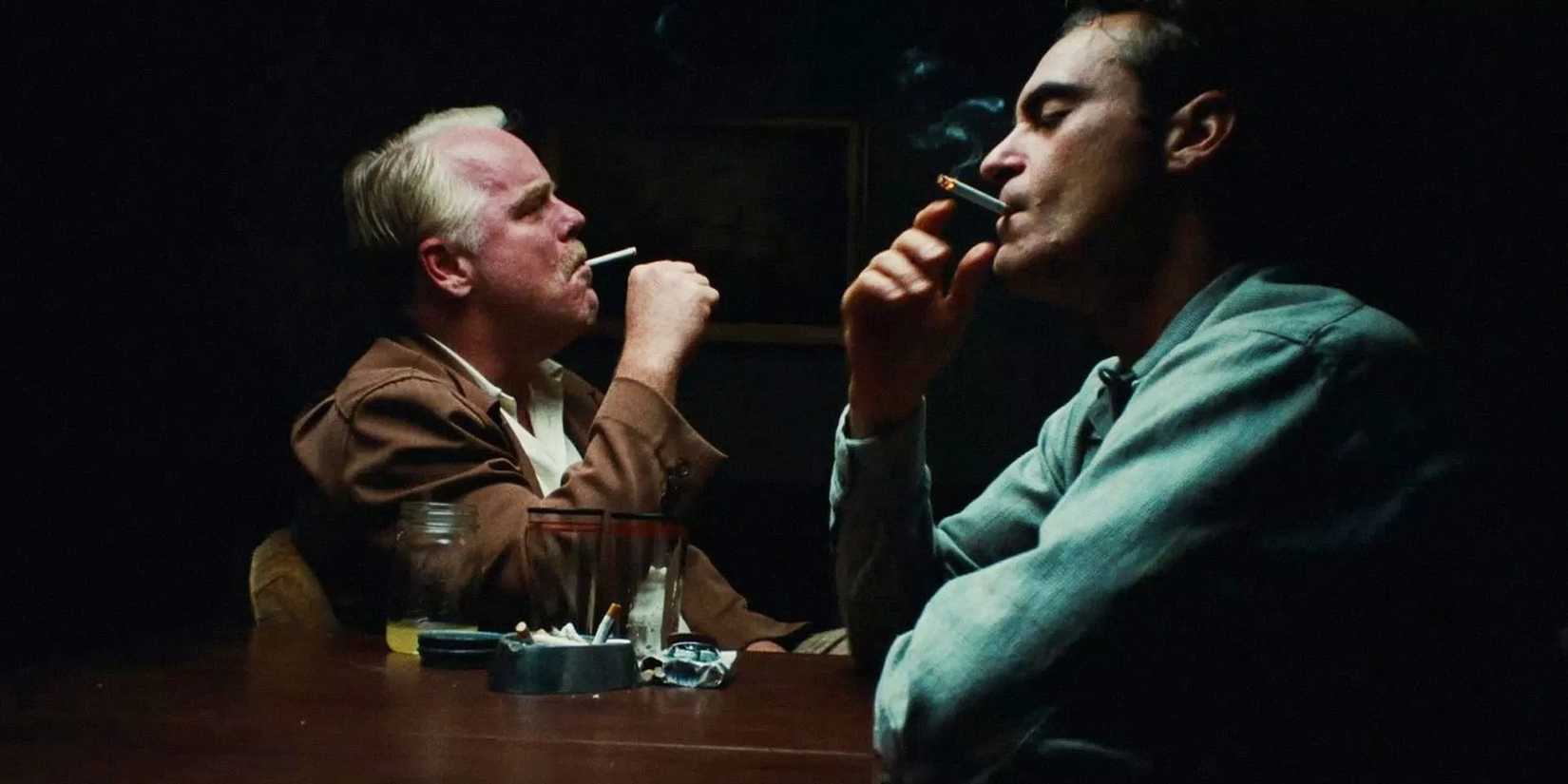
Just like One Battle After Another and Inherent Vice, The Master also has roots in the works of Thomas Pynchon, specifically his 1963 novel V., but it’s not a direct adaptation of the book. The film, written and directed by Paul Thomas Anderson, is a period psychological drama that follows a World War II Navy veteran struggling to adjust to civilian life who becomes involved with a charismatic cult leader. Joaquin Phoenix stars as the veteran, Freddie Quell, and Philip Seymour Hoffman as the cult leader, Lancaster Dodd. The movie also stars Amy Adams, Laura Dern, Ambyr Childers, Rami Malek, Jesse Plemons, and more in key roles.
The Master had its world premiere at the 2012 Venice Film Festival, where it earned universal acclaim and won three awards: the FIPRESCI Award for Best Film, the Silver Lion for Best Direction, and the Volpi Cup for Best Actor (shared by Phoenix and Hoffman). Though it’s arguably not as entertaining as One Battle After Another, the film is a powerful psychological character study powered by amazing performances, writing, and direction, and it’s widely regarded as one of Anderson’s best movies. Featuring a career-best performance by Philip Seymour Hoffman, The Master is an impressive and thematically deep movie that synthesizes multiple inspirations and lends itself to just as many interpretations.
5
‘The Battle of Algiers’ (1966)

What could be a better movie to watch alongside One Battle After Another than the one that’s actually referenced in the film? An Italian-Algerian war film, The Battle of Algiers was co-written and directed by Gillo Pontecorvo, and explores events that take place during the Algerian War of Independence. Presented in a documentary-style black-and-white narrative, the film chronicles the organization of the Algerian guerrilla movement and the cruel tactics used by the French to counter them, using a cast of primarily non-professional actors who lived through the real conflict.
First released in 1966, The Battle of Algiers was an internationally acclaimed film that earned numerous accolades, winning the Venice Film Festival’s Golden Lion prize and receiving an Academy Award nomination for Best Foreign Language Film. Easily one of the most sociopolitically significant films of all time, the movie was an inspiration to anti-Vietnam War activists in the ’60s and ’70s, and it continues to receive critical and scholarly acclaim today. Among its many achievements, The Battle of Algiers received its highest honor in 2008, when it was included on the Italian Ministry of Cultural Heritage’s list of 100 Italian films to be preserved as a movie that “changed the collective memory of the country between 1942 and 1978″.
6
‘Kiss of the Spider Woman’ (2025)

A relatively lesser-known 2025 movie, Kiss of the Spider Woman is also a film with themes of political rebellion, but a vastly different story. Written and directed by Bill Condon, the surreal musical drama is an adaptation of the 1992 stage musical, in turn an adaptation of Manuel Puig’s 1976 novel. Set in Argentina in the 1980s, the film stars Diego Luna as political prisoner Valentin Arregui Paz and Tonatiuh as his new cellmate, Luis Molina, a talkative window dresser who identifies as a woman. Though initially annoyed by the arrangement, Valentin eventually lets Molina tell him the plot of a Hollywood musical starring Ingrid Luna (Jennifer Lopez).
With its committed performances, layered story, and wonderful music, Kiss of the Spider Woman was highly acclaimed after its world premiere at the 2025 Sundance Film Festival, but it failed to make much of a mark at the box office. Despite its lack of popular appreciation, this surreal musical is one of the most underrated and original cinematic visions of the year, with a story that combines themes of rebellion, authoritarian oppression, and escapism through fantasy. Though the movie may not have earned as many accolades as One Battle After Another, The Kiss of the Spider Woman did win the GLAAD Media Award for Outstanding Film – Wide Release.
7
‘How to Blow Up a Pipeline’ (2022)

Directed and co-written by Daniel Goldhaber, How to Blow Up a Pipeline is an action thriller inspired by the non-fiction book by Andreas Malm. The movie follows a group of activists in West Texas who decide to blow up an oil pipeline, using their story to examine the ethics of sabotage and property damage as tactics in the fight against the climate crisis. Ariela Barer (who also co-wrote the screenplay) leads the cast, with Kristine Froseth, Lukas Gage, Forrest Goodluck, Sasha Lane, Jayme Lawson, Marcus Scribner, Jake Weary, and Irene Bedard in significant roles.
As controversial as the book that inspired it, How to Blow Up a Pipeline premiered at the 2022 Toronto International Film Festival to favorable reviews, and its later theatrical release set off alarm bells for numerous federal and state law enforcement authorities. While the movie has been criticized by some (the authorities and energy companies in particular) for its apparent promotion of terrorist activities, the film is a far more nuanced exploration than those criticisms give credit for, and it’s a genuinely entertaining thriller at the same time.
8
‘Judas and the Black Messiah’ (2021)

Directed, co-written, and produced by Shaka King, Judas and the Black Messiah is a biographical crime drama that revolves around Fred Hampton, chairman of the Illinois chapter of the Black Panther Party. Set in late 1960s Chicago, the movie stars Daniel Kaluuya as Hampton and LaKeith Stanfield as William O’Neal, the FBI informant who betrayed him, exploring the social and personal events that lead up to the incident. The film also stars Jesse Plemons, Dominique Fishback, Ashton Sanders, Darrell Britt-Gibson, Lil Rel Howery, Algee Smith, Dominique Thorne, and Martin Sheen in supporting roles.
Judas and the Black Messiah premiered at the 2021 Sundance Film Festival, and though it wasn’t a box office success (having been released during the COVID-19 pandemic), the movie earned great acclaim from critics and audiences. Widely praised for its direction, cinematography, writing, and performances, the film is a gripping drama that successfully captures the revolutionary spirit and ideals of its time and its subject. The movie went on to receive numerous accolades as well, including an Oscar, a BAFTA, a Golden Globe, and more for Kaluuya’s central performance.
9
‘Running on Empty’ (1988)

Directed by Sidney Lumet and written by Naomi Foner, Running on Empty is a 1988 drama that, like One Battle After Another, examines parent-child relationships within the context of a fugitive revolutionary family. Judd Hirsch and Christine Lahti star as former anti-war protesters who have been on the run ever since someone was accidentally hurt in one of their bombings, but they’re forced to question the cost of their actions on the lives of their children when their son (River Phoenix) shows great musical talent and a desire to chase his own dreams. Martha Plimpton, Ed Crowley, Steven Hill, Jonas Abry, and more star in other significant roles.
Anchored by Phoenix’s stellar performance and chemistry with Plimpton, Running on Empty was a popular and acclaimed film of the late ’80s, hailed as one of the best movies of the decade. An emotional, socially conscious, and psychologically complex coming-of-age story, the film earned several honors, including two Academy Award nominations and one Golden Globe win out of five nominations. Though it isn’t as widely discussed anymore, Running on Empty is a moving landmark of its time that deserves greater attention, and a great companion piece to the similarly themed One Battle After Another.
10
‘Dr. Strangelove’ (1964)

Dr. Strangelove (or, to use the full title, Dr. Strangelove or: How I Learned to Stop Worrying and Love the Bomb) is a legendary political satire film directed, produced, and co-written by Stanley Kubrick. The movie’s story kicks off when a paranoid brigadier general of the United States Air Force launches a pre-emptive nuclear attack on the Soviet Union, forcing the President of the United States, his titular nuclear war expert, and a British Royal Air Force exchange officer to frantically attempt to recall the bombers before they start a nuclear war. Peter Sellers portrays all three central characters, with George C. Scott, Sterling Hayden, Keenan Wynn, Slim Pickens, and Tracy Reed in supporting roles.
Loosely adapted from Peter George’s 1958 novel Red Alert, Dr. Strangelove is easily one of the most influential films ever made and a landmark of political satire. Filled with the same kind of unhinged authority figures and black comedy as One Battle After Another, the movie is a sharp critique of state incompetence, the dangers of unchecked power, and the sheer absurdity of the whole Cold War situation. As funny as it is thought-provoking, Dr. Strangelove may just be the perfect double feature to watch with Paul Thomas Anderson’s latest masterpiece.