Entertainment
10 Saddest Movie Endings of All Time

You can’t avoid spoilers here, just as a heads-up, because if you’re talking about the saddest movie endings of all time, it’s kind of necessary to actually dig into the endings, you know? Most of these are classics, and then a few are at least several years old, so there won’t be anything too recent that’s spoiled. Also, many will be expected picks that have famously moving final scenes.
“Saddest” can be a little different from “heaviest” or “bleakest.” The films here run the gamut from being bittersweet to just bitter, but if you’re looking for purely outright depressing and heavy-going endings, they might not be found here as much. Also, there’ll be a general avoidance of historical movies here, because it can feel a little strange to compare real-life tragic events to tragic events from fiction (Titanic will be the one exception, but that’s because a large part of that story is fictional, albeit set against the backdrop of an admittedly real-life tragedy).
10
‘Ikiru’ (1952)


Ranking up there among the best Japanese movies of all time, Ikiru is also the greatest Akira Kurosawa film that lacks anything by way of samurai or crime/thriller elements. And even if you want to stack it against the movies of his that do have those things, Ikiru doesn’t rank all that far behind other all-time masterpieces like Seven Samurai, Ran, and High and Low.
The premise here might well sound too simple, at least on paper, because Ikiru is about a man learning he’s going to die soon, and then he sets out to battle bureaucracy in an attempt to make some kind of positive and meaningful change in the world before he dies. He does, though still dies, and then things get a bit sadder when the movie reckons with the idea of how worth it the endeavor was, and whether it’ll actually be able to inspire change in others… but all that’s not really up to Kanji Watanabe. He did what he wanted to, and hopefully, that’s the main thing.
9
‘Call Me by Your Name’ (2017)

Of the actors who’ve both blown up fairly recently and are reliably good at breaking your heart, Timothée Chalamet is rivaled perhaps only by Paul Mescal (and one of his movies is going to show up later, don’t worry). Chalamet’s dramatic chops were proven particularly well in Call Me by Your Name, where he plays a 17-year-old who, during one summer, discovers things about himself and eventually experiences heartbreak for the first time.
There was a good bit of sadness before the ending, but then you get to the actual ending, and it’s Chalamet’s character staring into a fire and crying, held on his face for a long time while the credits roll. It is straightforward, and perhaps not all that surprising that the film chooses to end in this way, given the slightly melancholic tone it has throughout, but it still proves effectively tearjerking because of the shot itself, Chalamet’s acting, and the Sufjan Stevens music used.
8
‘Twin Peaks: Fire Walk with Me’ (1992)

It’s best to watch Twin Peaks before watching Twin Peaks: Fire Walk with Me, even if most of the latter takes place before the former chronologically. It’s largely a prequel, but since it’s David Lynch doing a prequel, it’s fair to say that it’s a bit more complicated than a pure prequel… maybe it’s fair to say that narratively, it takes place earlier, but thematically, it builds upon what was already there (and felt) in the TV series.
It’s a film that inspires a tremendous amount of dread, because it’s largely about the final few days of Laura Palmer’s life, who’s found dead at the very start of Twin Peaks, though she does haunt that show and make appearances of sorts in it. You know what’s coming, and you also know who kills her, but seeing it actually happen nonetheless proves to be so mortifying and haunting. It’s all in the execution, and Lynch really, really knew what he was doing here (and viewers/reviewers have caught up to it, and found what it was going for, in the years/decades since its release).
7
‘La La Land’ (2016)

Compared to most of the movies here, La La Land is actually fairly fun and breezy, at least for a good chunk of its runtime. It’s a throwback to old-school Hollywood musicals, but very much set in the 2010s (it’ll be a good time capsule of sorts for that decade, one day), and involves two people meeting and slowly falling in love, all the while continuing to follow their passions in a professional sense.
One wants to act, and the other wants to become an established musician, and things do eventually get a bit more serious, with the relationship ending because both want to follow their other dreams more. At the end of La La Land, they do see each other again, very briefly, and then there’s a purely fantastical sequence about them reuniting and everything being perfect, only for reality to be snapped back to, and the pair to more realistically (and wordlessly) acknowledge that the past is the past, and the future’s anything else, just not anything else involving the two together. It really is surprisingly moving, coming at the end of what’s been, up until that point, a fairly straightforward movie.
6
‘Mysterious Skin’ (2004)

Unlike what you get with the comedic and romantic La La Land, there’s nothing but emotional devastation throughout most of Mysterious Skin, and then it’s only the ending where you might, if feeling optimistic, read a tiny bit of hope into the whole situation. Two troubled teenagers spend much of the movie dealing with hardships, and then they meet, before realizing the past that they share, and the devastation of what happened to them.
Again, if optimistic, the idea that the truth’s been revealed and the notion that they now have each other might be worth something, but you’ve still got the horror of the truth coming out and being revealed, which serves to make an already heavy and eerie movie feel all the more overwhelming. That’s all that should be said. The ending’s not going to be spelled out here, mainly because it’s very confronting, but also because it makes a much bigger impact if you don’t know all the details ahead of the ending in question actually hitting.
5
‘Aftersun’ (2022)

There is a sense of “Where might this be going?” throughout a good chunk of Aftersun, which is about a young woman looking back on a vacation she took with her father, back when she was a child. It’s made progressively clearer that her father is not in a good place emotionally, to put it mildly, and seems to be grappling with the notion that their vacation will be the last one they have together.
It’s unpacked and explored (more than implied, even if, again, the death is not confirmed) in a way that does hit very hard emotionally, in the moment.
The ending of Aftersun doesn’t spell out the father’s fate 100%, but it feels likely that he took his life after the vacation ended, and so that whole block of time contained the daughter’s final memories of her father. It’s unpacked and explored (more than implied, even if, again, the death is not confirmed) in a way that does hit very hard emotionally, in the moment, being the kind of thing that’s hard to put into words. You’re better off just experiencing Aftersun (and possibly having your day ruined by it) for yourself.
4
‘City Lights’ (1931)


Charlie Chaplin seemed particularly good at crafting endings to his movies, because the likes of Modern Times and The Great Dictator have final scenes that are almost as good as the one found in City Lights. But still, the ending to City Lights is the ending to City Lights, and it’s boring to say that it has one of the strongest final moments in cinema history, yet it really does.
The whole movie’s about The Tramp falling in love with a blind flower girl, and going on a series of misadventures in the quest to raise money for her so that she can have her eyesight restored. He sacrifices a lot, is imprisoned, and then reconnects with the flower girl some time later, with her eyesight restored. It’s bittersweet… sweet in the sense that things worked, and that there was a reconnection, but bitter because it’s uncertain whether there can be any genuine romantic relationship between them, since The Tramp is very unlikely to look how the flower girl pictured him. That uncertainty is made very emotional, largely thanks to Chaplin’s facial expression in that final shot, which looks so happy/hopeful and emotionally crushed at the same time.
3
‘Titanic’ (1997)
One of the quintessential tearjerkers of all time, and one that’s definitely not afraid to be broadly (and maybe even obviously) sad, Titanic is grim in the ways you’d expect, because there’s only one way the story at hand can go. It finds sadness in the reality of the situation, and the sinking itself, but further twists the knife because of the fictional love story at the heart (in more ways than one) of the film.
Rose survives the events of the film, and the bulk of the film’s made up of her recollections of the night in 1912, some 80+ years later. The ending does have her making a decision that makes emotional sense, albeit not financial sense, yet the idea that she’s still held onto the memory of this soulmate of hers for so long is moving, and made especially so when she (likely) dies of old age at the film’s end, at peace, and reconnects with him in what seems to be the afterlife.
2
‘The Mist’ (2007)
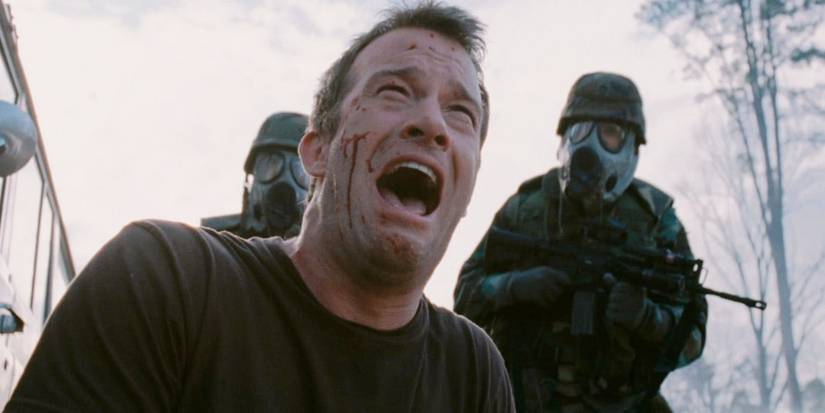
The novella The Mist was based on was written by Stephen King, and the premise is the same on both page and screen. People in and around a small town have their lives upturned when a strange mist rolls in, bringing with it all sorts of horrifying monsters, and the main characters end up in a supermarket, locked down in an attempt to survive. Then, when in the supermarket, more conflicts arise because of all the different people and their varying beliefs.
Where the novella and movie differ is in how they end, because the source material has a more ambiguous ending that’s a little hopeful yet still a little eerie, while the movie’s ending becomes a full-on tragedy. It features the protagonist making a devastating choice just moments before realizing that had he not made that choice, he and some fellow survivors (including his son) would’ve been rescued. Describing it that way might make it sound over-the-top and almost comical, but the execution of the ending here, in this adaptation of The Mist, really does make it all work.
1
‘Dancer in the Dark’ (2000)

Dancer in the Dark is perhaps the easiest movie to put here, just because the devastation is so intense and in-your-face, and what you get with that ending is built toward very gradually over a fairly long runtime. The film’s about a woman who’s struggling financially, trying to raise a son on her own, and dealing with some kind of medical condition that’s causing her to go blind.
There’s an operation that can stop her son from going blind, which she tries to raise the money for no matter what, and an eventual dispute around the money (to simplify things) leads to her killing a man. She doesn’t spend money on the trial, keeping it for her son, and so she’s sentenced to death, even with there being ways to defend the crime she committed. The only silver lining is she learns her son’s going to get the operation right before she’s hanged, and then she’s hanged. Also, it’s a musical, and a far more hard-hitting one than the more bittersweet La La Land.


Dancer in the Dark
- Release Date
-
October 6, 2000
- Runtime
-
140 Minutes
- Director
-
Lars von Trier
- Writers
-
Lars von Trier, Sjon


You must be logged in to post a comment Login