Entertainment
10 Sci-Fi Movies That Are Definitely Not for Kids

This genre gets sold with spaceships, robots, strange planets, and cool technology whether the story carries substance or not. Then some films use those same ingredients to talk about bodily violation, war, exploitation, grief, sexual control, and the fear that human beings may be the ugliest thing in the room. But that’s cliche too at this point. So when a sci-fi film needs to stand out, it needs to do more. The movies on this list do more in a different way.
These are not family-night picks with a few scary scenes. They are adult films built around disturbing ideas, difficult images, and questions that stay uncomfortable long after the credits. A younger viewer might be impressed by the effects. An adult is more likely to recognise the anger, loneliness, political cruelty, or existential dread hiding underneath them. If that interests you, scroll down slowly.
‘Upgrade’ (2018)


Upgrade begins as a revenge thriller set in a near future where technology has entered nearly every part of daily life. Grey Trace (Logan Marshall-Green) distrusts that world until a violent attack kills his wife and leaves him paralysed. An experimental computer chip called STEM restores movement to his body, and Grey soon discovers that the system can do far more than help him walk. It can fight, analyse threats, and act with a speed his human brain cannot match.
The action is brutal, but the adult edge comes from the loss of control. Grey may look stronger after the implant, yet every victory makes the relationship between body and machine more unsettling. The story is lean, nasty, and increasingly suspicious of every technological promise. Watch it for the bone-snapping fights, then stay for the much darker question about who is actually using whom.
‘Event Horizon’ (1997)

A rescue crew travels to Neptune after the Event Horizon suddenly reappears seven years after vanishing during an experimental voyage. The ship was designed to create an artificial black hole and travel across impossible distances. Something went wrong during the first test, and the empty corridors now contain evidence that the crew reached a place nobody was meant to find. That’s Event Horizon for you. This movie is messy in places, but its best ideas are genuinely frightening. Put it on late at night, turn the lights off, and let that ship ruin deep space for you.
It starts with hard science-fiction language and turns into full cosmic horror. The production design mixes industrial machinery with religious architecture. The ship resembles a cathedral built for pain. Captain Miller (Laurence Fishburne) has that steady authority that any and every Fishburne character does. Dr. Weir (late Sam Neill) becomes increasingly tied to whatever came back with the vessel. Gore, hallucinations, self-mutilation, and flashes of hellish imagery explain the R rating very quickly. If you get the idea I’ve tried painting so far, you’ll love it.
‘Possessor’ (2020)

Corporate assassins in Possessor carry out murders by taking control of other people’s bodies. Tasya Vos (Andrea Riseborough) enters a host’s mind through implanted technology, completes the assignment, and then forces the host to die so she can return to herself. Her latest job places her inside Colin Tate (Christopher Abbott), whose relationship with a wealthy family gives the company access to its next target. The process then starts breaking down when Colin resists her control.
Brandon Cronenberg (the director) takes the body-horror interests associated with his family name and pushes them into questions about identity, labour, and emotional detachment. Tasya’s character spends so much time becoming other people that her own home life seems distant and rehearsed. Tate brings an entirely different energy once he begins fighting for ownership of his mind. The violence is intimate, graphic, and deliberately hard to watch. Possessor is the pick for viewers who want science fiction that leaves them fascinated, slightly sick, and eager to argue about whose personality survived.
‘The Fly’ (1986)

The Fly is romantic, sad, funny, revolting, and far more human than most respectable dramas. Watch it when you want a horror film with a real heart beating under all the slime. A brilliant scientist believes he has solved teleportation. Seth Brundle (Jeff Goldblum) can move objects between two pods, but living tissue remains the final challenge. After successfully transporting himself, he starts feeling stronger, faster, and more confident. He later learns that a fly entered the pod with him and that the computer fused them at a genetic level.
Not to mention that this is a remake of a 1958 film. And David Cronenberg’s remake is famous for body horror, though reducing it to melting flesh and practical effects misses half the experience. Seth’s transformation also resembles terminal illness, addiction, and the terror of watching someone you love become unrecognisable. Jeff Goldblum and Veronica Quaife (Geena Davis) create a relationship warm enough to make every physical change hurt. All that counts. The effects remain astonishingly disgusting, but the emotional damage hits harder than the makeup.
‘District 9’ (2009)

An alien spacecraft stalls above Johannesburg, and its starving passengers are eventually confined to a government-controlled settlement called District 9. Years later, officials decide to relocate them to another camp. Wikus van de Merwe (Sharlto Copley), a nervous employee of the private military company handling the operation, leads the eviction effort until exposure to alien technology changes his body and destroys his place in human society. That premise allows District 9 to thrill a crowd and still leave everyone arguing about complicity on the drive home.
The documentary-style opening makes the discrimination feel disturbingly normal too. Aliens are insulted, exploited, experimented on, and discussed as a public nuisance by people who profit from keeping them powerless. South Africa’s history of forced removals and apartheid gives the premise an unmistakable political charge. Wikus begins as part of the system and only develops empathy once the same system targets him. The film eventually erupts into heavy weapons, mech combat, and gruesome violence, but the anger underneath never disappears.
‘Ex Machina’ (2014)

In Ex Machina, a young programmer wins a private visit to the isolated home of Nathan Bateman (Oscar Isaac), the billionaire behind the world’s dominant search engine. Caleb Smith (Domhnall Gleeson), the intern, soon learns the real purpose of the trip. Nathan has created an artificial intelligence named Ava (Alicia Vikander) and wants Caleb to decide whether her consciousness is genuine. Their conversations take place through glass while cameras observe every reaction.
The setup looks clean and controlled, but the house is full of power imbalances. Nathan owns the building, the information, and the bodies inside it. Caleb wants to believe his empathy makes him different, though attraction quickly interferes with judgment. Alicia Vikander’s Ava remains compelling without being reduced to innocence or threat, and Oscar Isaac turns Nathan’s confidence into something increasingly ugly. The film includes nudity, coercion, violence, and enough psychological manipulation to make every conversation suspect. So while it’s not for everybody, Ex Machina is perfect for anyone who likes leaving a movie with three theories and no trust left in the person sitting beside them. That’s a joke. Or not.
‘Annihilation’ (2018)

A strange zone called the Shimmer is expanding across the American coastline. Few people return after entering it, and those who do come back are changed. It is gorgeous, frightening, and strange enough to make a second viewing feel almost necessary. Lena (Natalie Portman), a biologist and former soldier, joins an all-female expedition hoping to understand what happened to her husband during an earlier mission. Inside the Shimmer, plants, animals, landscapes, and human bodies begin combining in ways that break every familiar biological rule. It’s almost like Alex Garland adapted Jeff VanderMeer’s novel into something less interested in invasion than transformation.
The women enter with different private wounds, and the environment seems to reflect their fear, grief, illness, and self-destructive impulses back at them. The infamous bear is terrifying, yet some of the quieter images are even harder to process. Flowers grow in human shapes. Memories lose their stability. DNA behaves like language being rewritten. That’s Annihilation.
‘Under the Skin’ (2013)

Under the Skin is slow, cold, and hypnotic. Give it your full attention and it becomes the kind of film that quietly follows you home. An unnamed woman (Scarlett Johansson) drives around Scotland, approaching lonely men and inviting them into a house where they disappear beneath a black liquid surface. She looks human, speaks calmly, and studies attraction with the distance of someone performing a task she barely understands. Gradually, contact with ordinary people begins changing how she sees them and herself.
Scarlett Johansson filmed several encounters with unsuspecting members of the public, which gives the early conversations an awkward reality, authenticity, that no normal casting process could create. Jonathan Glazer strips away familiar science-fiction explanations and lets behaviour, sound, and imagery carry the experience. Nudity appears but without comfort, sex becomes predatory, and the human body looks vulnerable from every angle.
‘Children of Men’ (2006)
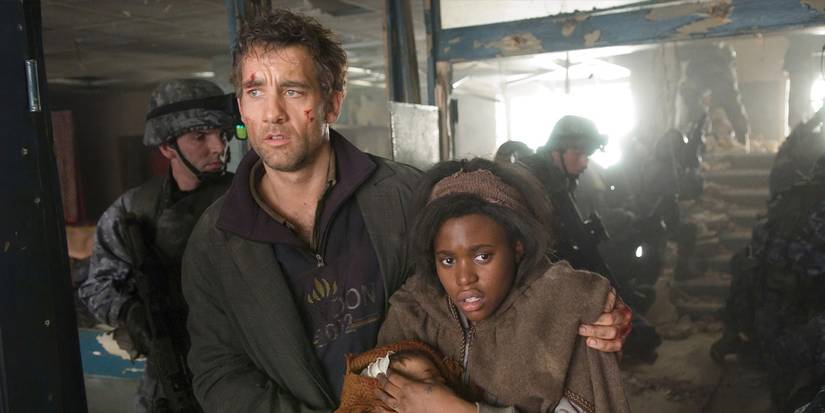
Humanity has been infertile for nearly two decades, and the youngest person alive has just died. Britain survives through authoritarian control while refugees are hunted, caged, and deported. Theo Faron (Clive Owen) has stopped believing in political causes until his former partner asks him to help transport Kee (Clare-Hope Ashitey), a young refugee carrying the first known pregnancy in eighteen years.
The premise is huge, yet the movie stays close to streets, buses, safe houses, checkpoints, and frightened people trying to keep one woman alive. Alfonso Cuarón’s long takes place the viewer inside violence. Theo begins emotionally numb, while Kee’s pregnancy forces him to imagine a future again. War, state cruelty, terrorism, grief, and childbirth all collide without easy speeches about hope. Children of Men is exhausting in the best way. It leaves you desperate for the characters to reach safety and furious at how recognisable their world has become.
‘The Thing’ (1982)
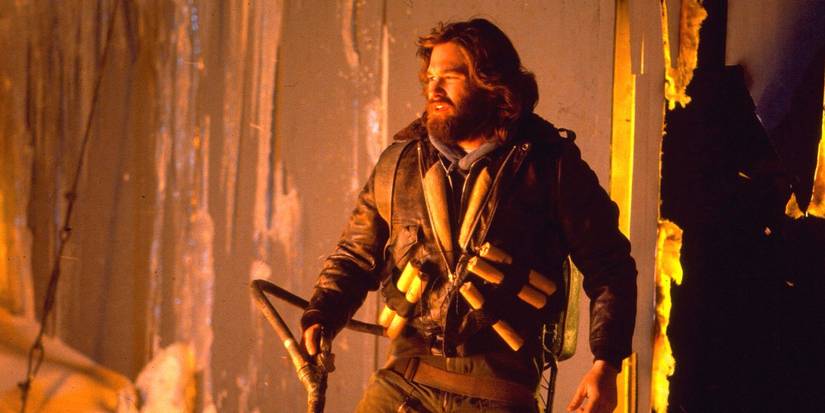
The Thing gives you monsters, gore, mystery, and this highly debated closing moment without spelling out the answer. Watch it with friends and enjoy distrusting every single one of them afterward. A research team in Antarctica discovers an alien organism capable of absorbing and perfectly imitating other living creatures. Nobody knows when the infection began or who has already been replaced. The isolated station becomes a pressure cooker where trust disappears faster than the temperature drops.
John Carpenter’s film arrived to harsh reviews in 1982 and later earned its place among the greatest science-fiction horror movies ever made. Rob Bottin’s practical effects still look grotesque, imaginative, and physically wrong in ways digital work rarely matches. MacReady (Kurt Russell) has no magic solution, only observation, improvisation, and a flamethrower. The blood test, the scale of it is great but the paranoia surrounding it is even better. Every conversation could be happening with something pretending to be human. It’s a great film, and so not for kids.

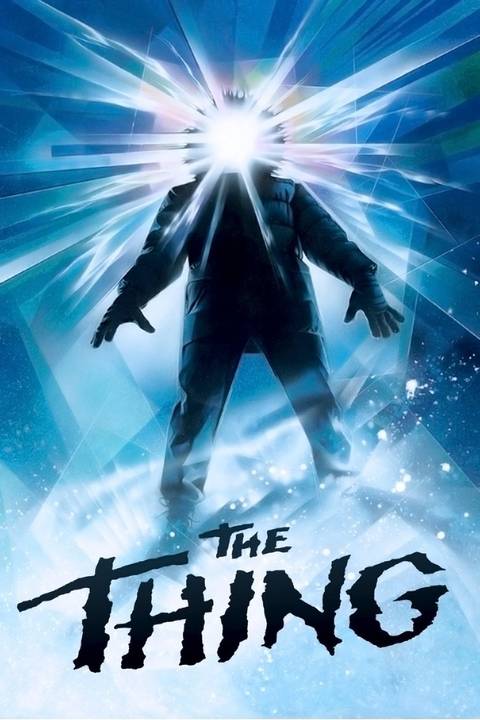
The Thing
- Release Date
-
June 25, 1982
- Runtime
-
109 minutes
- Director
-
John Carpenter
- Writers
-
Bill Lancaster, John W. Campbell Jr.
You must be logged in to post a comment Login