Entertainment
12 Years Later, ‘The Simpsons’ Biggest Sci-Fi Mistake Still Makes No Sense

As a network television institution that has been on the air for nearly 40 years, The Simpsons has more than earned its reputation as one of television’s greatest all-time sitcoms. There have been episodes that aren’t especially good (I still contend “Moe’s Bar Rag” is the worst), even entire seasons, but few shows could possibly maintain a perfect track record across that much television. Still, one storyline stands out as a rare instance where The Simpsons doesn’t simply miss the mark — it completely botches what should have been one of the show’s most reliable formats. That episode is Season 25’s “Days of Future Future.”
‘The Simpsons’ “Days of Future Future” Starts by Killing Homer Over and Over Again
Marge (Julie Kavner) wakes up to find pizza boxes all over the living room, and, despite hoping that it was a bear and not Homer (Dan Castellaneta)… it’s Homer, sprawled out on top of the kitchen table in nothing but his tighty-whities. She implores Homer to take his health more seriously, which he vows to do, only to succumb to a fatal heart attack. Homer’s funeral is interrupted by Jonathan Frink Jr. (Hank Azaria), who announces he’s made a clone of Homer, a simpler subject to experiment with than his original plan to use a sheep. An overjoyed Marge pleads with Homer to take this second chance seriously, which lasts for mere moments after he eats all the potato salad, prompting a second funeral. Each successive Homer clone succeeds in dying in idiotic ways: by toaster electrocution, pulling the plug on himself after hearing he can’t have solid food for two weeks, and falling off a pile of dead clones while reaching for something on a high shelf, among others.
Thirty years later, the Simpsons mourn the death of yet another Homer clone, only this time Frink is unable to create any more, with Homer having used up all his clones. He does, however, have Homer’s memory on a flash drive, which he plugs into a TV screen. The TV screen lights up, and there’s Homer, a face on the screen with his voice coming through the speakers. Back at the house, Marge asks Milhouse (Pamela Hayden), now married to Lisa (Yeardley Smith), how he is, to which he replies that he and Lisa have nothing to talk about.
Lisa interjects, reminding Milhouse that during their last conversation a month ago, she told him about her time devoted to charity work for the undead. Marge, having left the room, visits with Homer, who asks her to reboot the screen yet again. Tired of repeatedly rebooting, Marge ejects the flash drive and gives it to Bart (Nancy Cartwright), who brings him back to his home, an abandoned classroom at Springfield Elementary. Bart could certainly use his advice, given he still has feelings for his ex-wife, Jenda (Amy Poehler), stirred up after sending their two sons to her home via a teleporting door, only Homer’s frozen up again.
Zombie Milhouse Is Where “Days of Future Future” Starts To Fall Apart
Meanwhile, Milhouse comes looking for Lisa at a zombie soup kitchen, where she’s doling out synthetic vegan “brain” food to the undead. As he tries to explain why he’s there to an annoyed Lisa, he inadvertently insults a nearby zombie, who bites him on the arm, turning him into a zombie. It’s at this point that “Days of Future Future” ventures into “Treehouse of Horror” territory. For Lisa, Milhouse’s turn is “coming up Milhouse” for her, attracted to Milhouse in a way she hasn’t been in ages. Dr. Hibbert (Harry Shearer) can bring Milhouse back to normal (and is hilariously relentless about suggesting it), but Lisa’s not sure that she wants him changed back (spoiler: she relents and he’s turned back). It’s the perfect setup for a “Treehouse” segment, and, had they sat on the idea for a few more years, it would have been ideal for a Santa Clarita Diet parody (or eerily predicted it). Instead, the zombie plot pulls the episode away from the future-story formula that had been holding its various ideas together.
Bart undergoes a procedure at MovingOn that will help him forget about Jenda, only for his feelings to be reignited after the boys tell him that her alien boyfriend ditched her. Jenda confirms it’s true, crying in front of Bart for having been a fool, but his efforts at comforting her reignite her feelings for him, and they make a dinner date. After that date, they decide to give their marriage another shot, but the effort fails after they fall back into their old routine, splitting them up once more. As such, Bart’s storyline just seems pointless, like they just needed something for him to be doing in the episode.
He meets up with Lisa at Moe’s, each airing their relationship woes before Marge appears, telling them that the secret to keeping a relationship is to stick with whatever decisions you make. With that, she electrocutes herself to join Homer once again on the TV screen. Had the writers ended it here, committing to it, the episode may have fared better. Instead, it turns out that most of it was all a dream, experienced by Bart during the MovingOn procedure. Homer is now in a C-3PO-like robot body doing multiple chores, endearing him more to Marge. Lisa reminds Bart that there is no cure for zombieism, and everything is wonderful because Milhouse is still a zombie. It’s like a second ending was tacked on because no one was satisfied with the first potential ending.
‘The Simpsons’ “Days of Future Future” Doesn’t Know What It Wants To Be

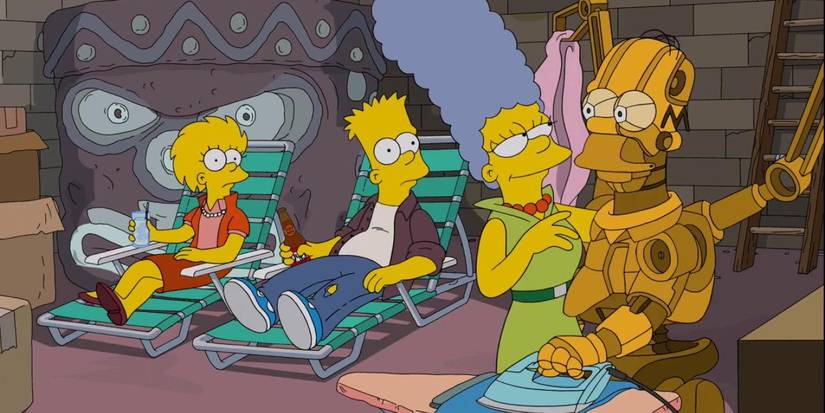
The biggest problem with “Days of Future Future” is that it never commits to what kind of episode it actually wants to be. It’s either a half-baked episode set in the future, or it’s a half-baked “Treehouse of Horror” episode. Some elements satisfy both: the future sees Homer in a robot body, a cutaway scene reveals driverless cars hacked by unknown hackers, hoverboards and the like, while the zombie Milhouse plot, the MovingOn Eternal Sunshine of the Spotless Mind-like element, and even Bart’s job at Cretaceous Park, a clever dig at Jurassic Park, would be more at home in a “Treehouse” setting. Heck, the Homer clone device had already been used by the time “Days of Future Future” aired, back in Season 14 in the “Send in the Clones” segment of “Treehouse of Horror XIII,” lending the episode a “been there, done that” feel.
Really, Lisa having married Milhouse is the only plot device in the episode that would seemingly be at home in either camp (if the thought of Lisa marrying Milhouse doesn’t send a chill down your spine, you are made of stronger stuff than I). The disparate feel of the episode supersedes whatever satirical jabs the writers were hoping to hit, with only the shot at the driverless cars delivering a particularly pointed barb. More importantly, it just isn’t all that funny. Seeing Homer as nothing more than a scrolling icon wears thin quickly, and the one element that consistently works — the repeated clone deaths — had already been done. That lack of commitment is ultimately what sinks “Days of Future Future.” The Simpsons has repeatedly proved how much fun it can have imagining its characters decades from now, but this episode tries to combine a future story, a supernatural parody, a relationship drama, and a fake-out ending without giving any of them enough room to work. Splitting those ideas apart might have produced two memorable stories. Cramming them together produced one of the show’s messiest.

The Simpsons
- Release Date
-
December 17, 1989
- Network
-
FOX
- Directors
-
Steven Dean Moore, Mark Kirkland, Rob Oliver, Michael Polcino, Mike B. Anderson, Chris Clements, Wes Archer, Timothy Bailey, Lance Kramer, Nancy Kruse, Matthew Faughnan, Chuck Sheetz, Rich Moore, Jeffrey Lynch, Pete Michels, Susie Dietter, Raymond S. Persi, Carlos Baeza, Dominic Polcino, Lauren MacMullan, Michael Marcantel, Neil Affleck, Swinton O. Scott III, Jennifer Moeller
-

Homer Simpson / Abe Simpson / Barney Gumble / Krusty (voice)
-
Julie Kavner
Marge Simpson / Patty Bouvier / Selma Bouvier (voice)

You must be logged in to post a comment Login