Entertainment
20 Years Later, These Are the 8 Best Sci-Fi Movies of 2006

Science fiction is among the most celebrated genres in cinema. It encompasses everything from profound, ambitious explorations of space travel to smaller, more intimate depictions of futures in varying degrees of unrest. Sci-fi is still thriving in cinema, perhaps now more than ever, with the recent releases of movies like Project Hail Mary proving that the genre is experiencing what is likely its best period to date.
Twenty years ago, however, the landscape was much more different. That’s not to say that sci-fi movies didn’t exist or that they weren’t recognized, but it is fair to say that they were a lot less appreciated, perhaps even dismissed as “genre fare.” However, a few of these twenty-year-old movies have aged beautifully and are now considered genuine masterpieces of the genre. Here, we take a look at the sci-fi movies from 2006 that are outright perfect, becoming incredible representatives of their home genre.
‘Southland Tales’


Richard Kelly followed his 2001 cult classic Donnie Darko with an even bigger deep cut: the dystopian black comedy thriller Southland Tales. Set in 2008, in a United States under the threat of nuclear attack, the film follows several stories, including a movie star (Dwayne Johnson) planning his next movie with the help of a porn star (Sarah Michelle Gellar), who herself is attempting to launch a reality TV show.
Southland Tales was quite misunderstood upon release — in fact, it remains misunderstood and underrated. The film juggles several complex ideas, offering scathing criticisms of the industrial military complex and the entertainment industry. However, its approach is decidedly abstract, to the point where many might dismiss it as too artsy or outright pretentious. Yet, there’s a genuine allure to the film’s chaos; it has something to say, but it doesn’t figure out how to say it. Yet, its attempts still result in an engaging and fascinating movie, one that throws the audience directly into the mayhem and never concerns itself with making sense of it.
‘Idiocracy’

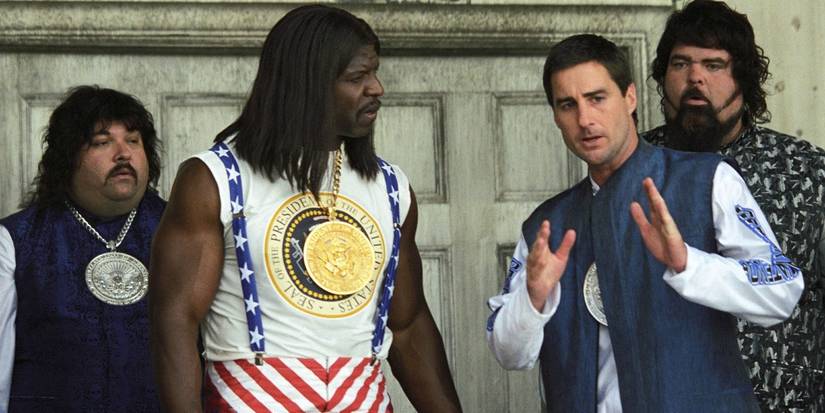
Idiocracy is a movie that not many paid attention to when it came out, but which has become so relevant in the decades since that it seems outright prophetic. Luke Wilson and Maya Rudolph play a librarian and a prostitute who undergo a government procedure that puts them in cryosleep for five hundred years. Upon awakening, they discover that society has regressed to the point where they are now the smartest people in the world.
Mike Judge‘s film satirizes society’s path to progress, commenting on the rise of anti-intellectualism and absurd, seemingly endless consumerism. Sharp and surprisingly insightful, the film has a lot to say about the pernicious relationship between politics and the media, and how superficiality can only lead to something far darker. This cult classic remains perfect, largely because it seems so hauntingly precise in its observations — for example, the presidential plot is no longer as funny as it was because it now uncomfortably hits too close to home. Today, we might be constantly asking ourselves, “Have we actually reached peak idiocracy?” but the awful truth is that we can always go beyond it.
‘The Girl Who Leapt Through Time’

A loose sequel to the 1967 eponymous novel, The Girl Who Leapt Through Time is among the best anime movies of the 2000s. The plot sees teenager Makoto Konno learning to travel in time, thanks to her aunt Kazuko Yoshiyama (the protagonist of the original novel). Makoto uses her newfound abilities to pursue selfish gains, soon realizing her actions have far broader consequences that go beyond just herself.
The Girl Who Leapt Through Time deftly balances several genres, mainly science fiction and coming-of-age, with a healthy dose of romance to boot. The visuals are simply spectacular, capturing a carefree, warm atmosphere that makes everything seem strangely wholesome; it’s like watching a child learn how to ride a bike, except it’s a teenage girl literally manipulating time. The core of the story is a classic tale of self-discovery and growth, but the execution makes this anime movie far more special. There’s also a 1983 live-action adaptation, but the anime version is slightly more striking.
‘A Skanner Darkly’
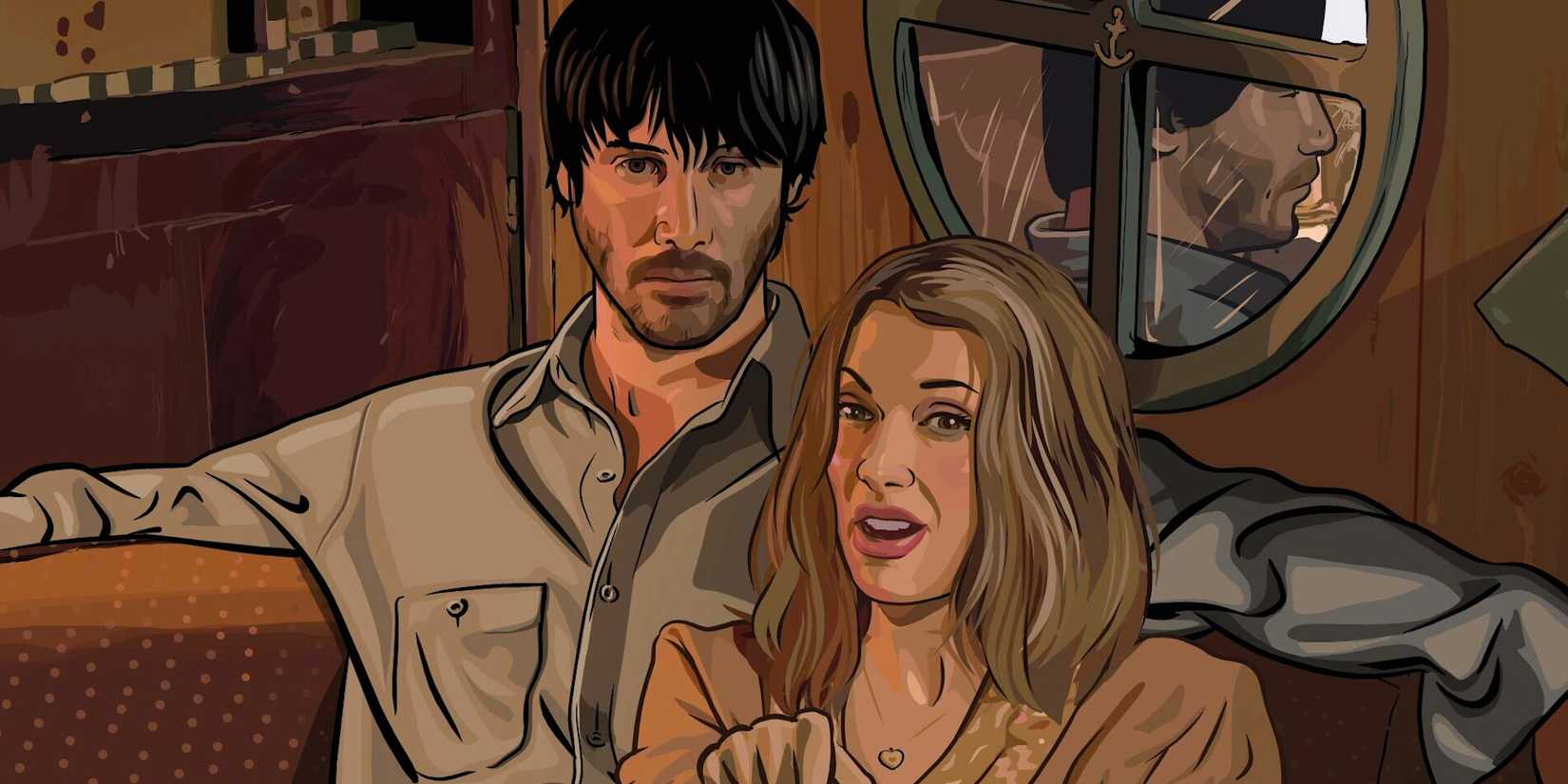
Richard Linklater‘s A Scanner Darkly is among the most singular animated movies of the 2000s — indeed, of all time. Keanu Reeves stars as Bob Arctor, a narcotics officer living in a future where the United States is undergoing a drug-addiction pandemic. While wooing drug dealer Donna (Winona Ryder) in an effort to identify her supplier, Bob is also tasked with spying on his neighbors. Deep undercover, Bob himself develops an addiction.
Based on the novel by Philip K. Dick, A Scanner Darkly is a trippy experience brought to life through rotoscoping, a technique where animators manually trace over the original footage, frame by frame, thus achieving a distinct visual approach. The film looks like a literal comic book brought to life, a deliberate choice that only enhances the themes of addiction, paranoia, and the loss of self. Like other Linklater movies, A Scanner Darkly has a lot to say; the dialogue cracks, and the conversations feel both surreal and heavy with meaning. What exactly that meaning is remains unclear, as the film is far more concerned with posing questions than straight-up answering them.
‘The Host’
Bong Joon Ho‘s movies usually offer a heavy dose of social commentary, be it anti-capitalist sentiment, class struggle, or institutional incompetence. All of those are perfectly showcased in his 2006 monster flick, The Host. The plot centers on intellectually disabled food stand vendor Park Gang-du (Song Kang-ho), whose daughter is kidnapped by a mysterious amphibious monster terrorizing the Han River in Seoul.
Here, Bong pulls no punches, presenting a bleak vision of the United States as uncaring and warmongering, to the point where the film flirts with anti-American sentiment. Like many of his other movies, The Host offers strong commentary on the sheer incompetence of the institutions meant to protect and enhance society, and how the ultimate prize is often paid by those less fortunate. Humanity’s relationship with the environment, another favorite of Bong, is also heavily featured here, but the movie still offers all the monster carnage one would expect from a genre flick. The result is a creature feature that is as effective as it is bittersweet and even chilling.
‘The Prestige’

Christopher Nolan has mastered many genres, from thriller to mystery and crime drama. However, sci-fi is where he often thrives, and perhaps his most underappreciated entry into the genre is 2006’s The Prestige. An intriguing mix of genres, the film stars Hugh Jackman and Christian Bale as rival magicians in Victorian London. As the two try to surpass the other, they embark on an increasingly dark and desperate quest that will ultimately cost them far more than they expected.
For most of its runtime, The Prestige is a psychological thriller laced with hints of a revenge story. It’s not until the halfway point that the sci-fi elements arrive, courtesy of a hypnotizing David Bowie as legendary inventor Nikola Tesla. Yet, Nolan uses science fiction to explore the darkest corners of the human psyche, the unrelenting thirst to surpass another, no matter the cost. Yet, The Prestige is as much about showmanship as it is about vengeance, presenting itself under the same structure as the magic tricks at the center of the narrative.
‘Paprika’

Arguably the trippiest and most challenging sci-fi movie of the 2000s, Paprika is a stellar exploration of dreams and the last film made by the genius Satoshi Kon. The narrative centers on Dr. Atsuko Chiba, a scientist who moonlights as the dream detective Paprika. When a device she’s been working on is stolen by a so-called “dream terrorist,” Atsuko jumps into action as both herself and as Paprika.
Paprika operates under a singular set of rules. In fact, if you watch it and can’t make much sense of it, fear not, because that’s partly by design. Perhaps thanks to its nature as an exploration of dreams, and perhaps because of Kon’s desire to push the audience to the edge of lofic, Paprika is a famously daunting experience. It’s visually, mentally, and emotionally exhausting, a journey through the subconscious that is half dream, half nightmare. It might also probably, kinda, sorta, most likely influenced Nolan’s Inception; he’s never officially addressed it, but the similarities are… striking. You be the judge.
‘Children of Men’
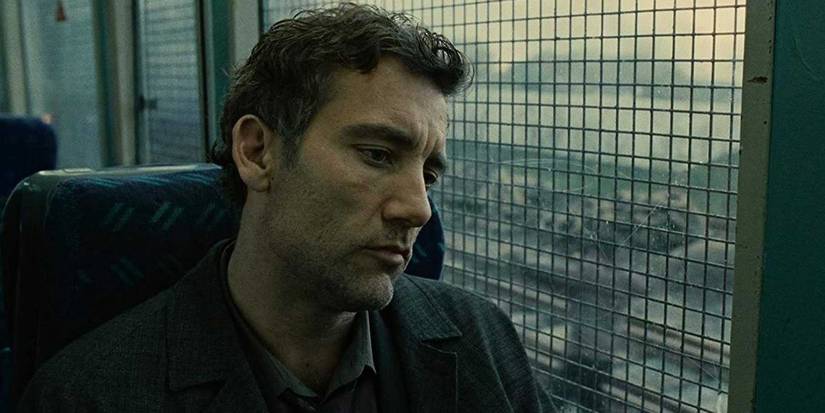
What would happen to the world if people stopped having children? Such is the premise for Alfonso Cuarón‘s dystopian action thriller Children of Men, arguably his magnum opus, give or take a Roma. Clive Owen stars as Theo, a disillusioned bureaucrat tasked by his ex-wife, Julian (Julianne Moore), to escort Kee (Claire-Hope Ashitey), the first pregnant woman in two decades. Facing incredible danger, Theo will have to rise to the challenge.
Children of Men is a curious beast. The sci-fi elements are subtler, but the film still deals with a near-future where civilization has outright collapsed under the weight of mounting desperation provoked by infertility. It’s quite incredible how accurately the film predicted the near future, with asylum seekers seeking asylum in the United Kingdom, leading to their imprisonment, deportation, and even execution. Watching Children of Men in 2026 is an uncomfortable experience, as it’s difficult not to draw similarities with the current socio-political landscape. The film is a true masterpiece of the 21st century, and a confirmation of Cuarón’s prowess as an auteur of singular vision.
You must be logged in to post a comment Login