

Entertainment
32 Years Later, Quentin Tarantino’s Bloody Road Trip Thriller Is Aging Like Fine Wine

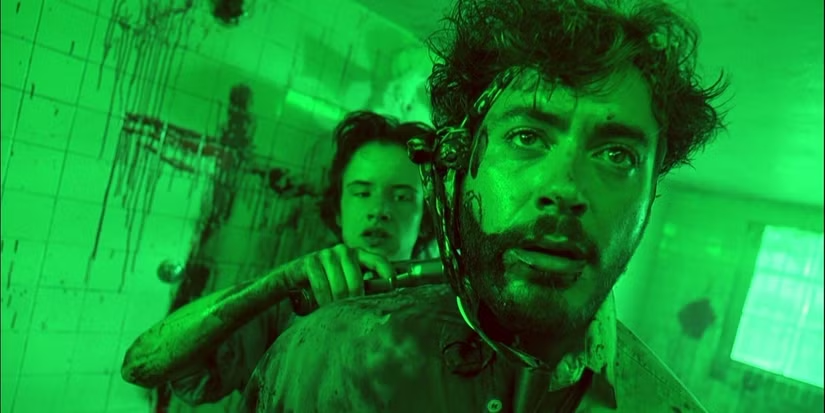
Already mired in controversy long before its release, disowned by original screenwriter Quentin Tarantino, and hitting cinemas just as the O.J. Simpson murder case shocked the country, Natural Born Killers made a bloody splash in the summer of 1994. Oliver Stone’s tale of serial-killing lovebirds Mickey (Woody Harrelson) and Mallory (Juliette Lewis) Knox instantly sparked a classic 1980 and ’90s-style moral panic, as media figures blasted it for glamorizing violence and predicted a rash of killings inspired by the film.
But despite the moral hysteria, the picture was a pure satire — albeit one soaked in blood and psychedelics, shot and cut for maximum impact. Although Tarantino’s original script differed vastly from Stone’s final product, reading it makes clear that Natural Born Killers was always intended as a send-up of America’s culture of celebrity worship and the then-burgeoning true crime media ecosystem. And the film hit at just the right time to strike a very raw nerve with the public, given that it premiered shortly after the Jeffrey Dahmer case, the acquittal of the police tried for beating Rodney King and the subsequent L.A. riots, and at the height of tabloid television’s dominance.
Why Was ‘Natural Born Killers’ So Controversial?

Considered one of the most controversial films in history, Natural Born Killers is derided even to this day not only for its violence, but for crimes carried out by its fans, as well as Stone’s admittedly broad-brush approach to satire. And the criticism of the film’s approach began before it was released: it was immediately slapped with an NC-17 by the MPAA, who required that four minutes of violence be cut to achieve an R-rating. And even after that, the famously mercurial film board gave one of their most feverish warnings ever regarding the rating: “For extreme violence and graphic carnage, for shocking images, and for strong language and sexuality.”
Seen today, it’s easy to find the MPAA’s thinking a bit laughable (one can easily see much more graphic violence in contemporary network dramas), but it was clearly Stone and cinematographer Robert Richardson‘s (Pulp Fiction) aggressive stylization that made every killing hit so hard. Writing at the time, Janet Maslin of the New York Times acknowledged the film’s technical qualities, but thought Stone himself was “enamored” by the psychopathic Mickey and Mallory and said the film’s point was ultimately “banal” and buried by Stone’s cinematic tricks.
More serious, however, are several alleged copycat crimes linked to the film over the past few decades. Several teen shooters have been self-professed superfans, including Columbine killers Eric Harris and Dylan Klebold. One pair of teens in Oklahoma watched the film repeatedly on LSD, then went out to re-enact it, killing one man and rendering a woman paraplegic. Fourteen-year-old killer Barry Loukaitis shot two students and a teacher dead in his Washington state high school while allegedly dressed as Mickey. Multiple lawsuits have ground through the system over the years targeting Stone and the film’s producers and distributors, though all have ultimately wound up dismissed.
The dust has long settled over Natural Born Killers as a cultural lightning rod, but it offers the same dubious pleasures today as in 1994, and in some ways its bite has even sharpened. While its targets at the time were shows like Hard Copy and Larry King Live, the overriding message still rings true in our era of true crime entertainment.
Stone’s film remains an overpowering cinematic experience. Everything is turned up to 11 using mixed media, multiple film stocks, canted angles, music ranging from Nine Inch Nails to Edith Piaf, and over 3,000 cuts.Harrelson and Lewis embody their bloodthirsty yet hippie-esque murderers to an eerie degree, while Tom Sizemore plays one of the most repellent corrupt cops in film history. Tommy Lee Jones plays to the rafters as a psychotic prison warden whose head ends up on a pike and Rodney Dangerfield oozes hatefulness as Lewis’s sexually abusive father in an extended sequence filmed like a hallucinatory sitcom. It’s a lot to take in and still one of the definitive films of the 1990s.
And it may be even more relevant today. True crime content has never been more popular — or more lurid. According to Edison Research, some 84 percent of Americans consume some form of true crime media, with podcasts examining particular serial killers and grisly family annihilations reaching 19 million regular listeners. On top of that, social media allows true crime fanatics to air their every thought and theory, up to and including crushes on notorious killers. In fact, Robert Downey Jr.‘s manic Aussie tabloid host in Natural Born Killers can seem downright quaint when compared to today’s true crime obsessives and slew of stylish, bloody miniseries recreating famous killing sprees. So maybe it’s not that Natural Born Killers was ever “too much”…only that it arrived too soon.

- Release Date
-
August 26, 1994
- Runtime
-
118 minutes
- Director
-
Oliver Stone

Continue Reading
As explored in that now infamous Family Guy clip where Peter confesses he didn’t care for The Godfather because “it insists upon itself,” there are sometimes movies that get praised, and you hear they’re great, and then you watch them, and they don’t do much for you. Worst-case scenario, you might well find yourself thinking they’re totally overrated, like, if you hate a movie most people love… but what about when it’s not quite so dramatic?
Enter the following movies, which are generally well-regarded, and here, they’re going to be acknowledged as just fine. More along the lines of “good” than “great.” You won’t like seeing certain films here, but if you clicked on this, you accepted it might make you angry before that click was completed. Admit it. Also, if you don’t like the detached writing style here, just pretend phrases like “I believe” and “I feel” are sprinkled throughout, because this is subjective, even if it’s not being written in the first-person. And, if you have further complaints and wish to voice them, please click here.
10
‘Opening Night’ (1977)

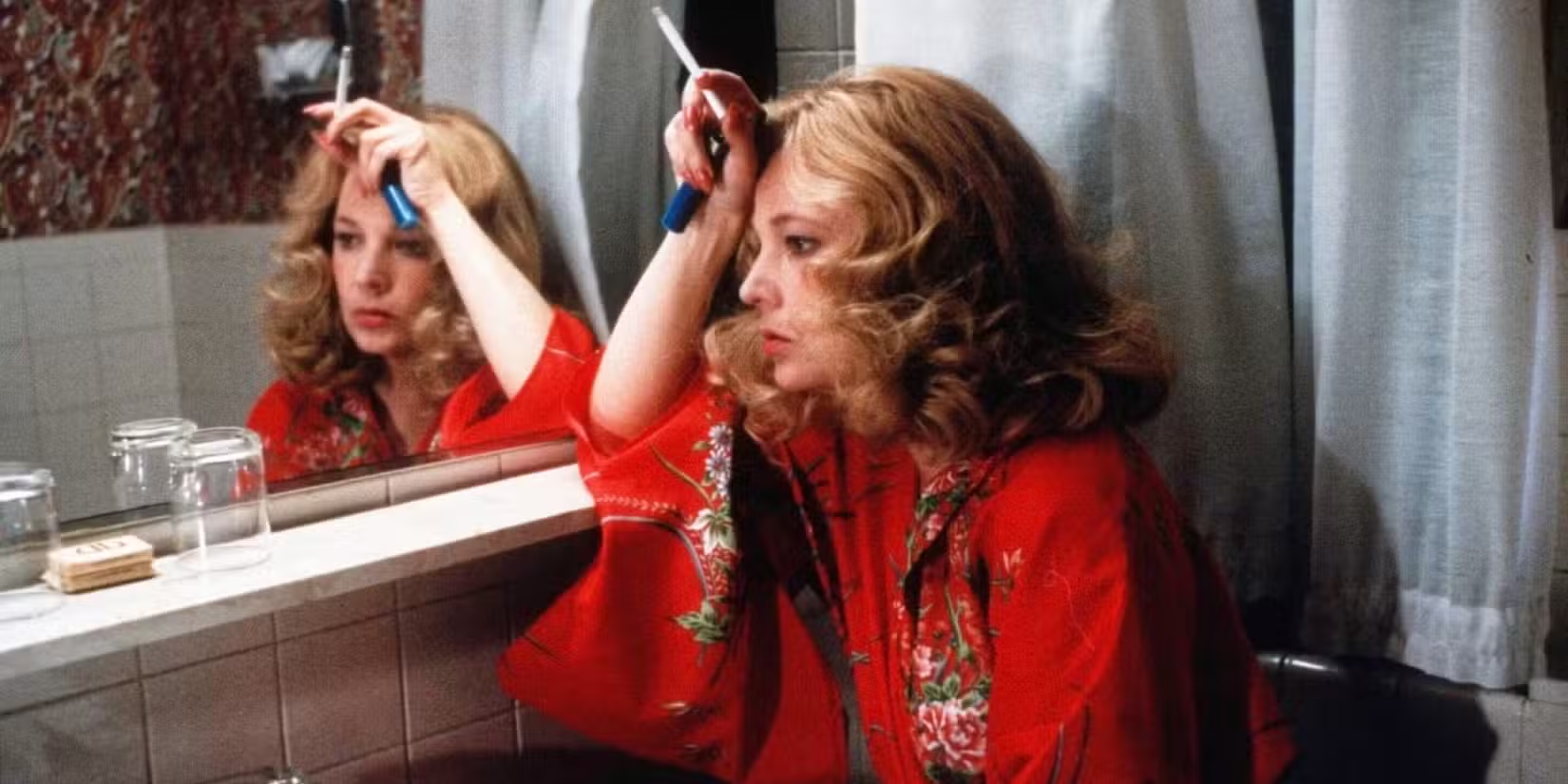
Like a fair few movies that are going to be mentioned here, Opening Night is very long, perhaps even to the point where it’s a bit self-indulgent. John Cassavetes was a filmmaker who very much did his own thing, and was a trailblazer as far as independent directors went for sure, but his movies are sometimes easier to admire than they are to genuinely feel engaged by. Opening Night is one such film.
It doesn’t really build in the same way that better Cassavetes films like A Woman Under the Influence or the underrated Gloria do.
It’s a rambling movie about a group of people involved with putting on a stage play, and as that titular opening night gets closer, they all get a bit more stressed about all the drama in their lives. Kind of. It doesn’t really build in the same way that better Cassavetes films like A Woman Under the Influence or the underrated Gloria do. But, like those films, Opening Night does boast a strong lead performance by Gena Rowlands, so that’s definitely something.
9
‘Jeanne Dielman, 23, quai du Commerce, 1080 Bruxelles’ (1975)

Credit where credit’s due, Chantal Akerman was surprisingly young when she directed the incredibly mature Jeanne Dielman, 23, quai du Commerce, 1080 Bruxelles. At least it’s fair to say that it doesn’t feel like it was directed by someone who was still in the first half of their 20s while making it, because this is a film about a middle-aged woman and the emptiness of her existence.
It’s a movie about a routine that gets followed, but then unravels, albeit incredibly slowly. Jeanne Dielman, 23, quai du Commerce, 1080 Bruxelles is like an anti-epic, running for almost 3.5 hours while spanning a small period of time, having very few characters, and also being purposefully repetitive until, eventually, it’s not. It’s arduous to get through, and it’s supposed to be, but still. It asks a lot of you, as a viewer, and doesn’t give you much in return, but then again, the titular character sacrifices a lot in her life, and gets little in return, so yes… very clever, Jeanne Dielman, 23, quai du Commerce, 1080 Bruxelles. You’re still a waste of time, but at least you’re a thematically effective waste of time.
8
‘Secrets & Lies’ (1996)

A little like John Cassavetes, Mike Leigh has a distinctive style that he pretty consistently sticks to, with about as much variety as you get being the fact that some of his films are dramedies, or dark comedies, while others are more straightforward dramas. In either instance, there’s usually a good deal of realism and solemnity, with a slow pace usually found alongside all that dourness.
Secrets & Lies is one of many movies of his that aren’t particularly exciting or entertaining, yet it’s not really trying to be, because this is a drama about what happens after a woman connects with her birth mother and finds she wasn’t who she expected. And there are some secrets and lies that get kept, and then get revealed. What a twist. Look, it’s okay. It’s fine, it’s cool.
7
‘All About Eve’ (1950)

There was a lot Joseph L. Mankiewicz did throughout the years he was active, and he did conclude his filmmaking career on an incredibly strong note, thanks to Sleuth (1972) being his final directorial effort. All About Eve might well be the most celebrated film he directed, though, from about two decades earlier. It’s the one that won a bunch of Academy Awards, at least.
It’s a movie about people being endlessly snarky at each other for a runtime that nears 2.5 hours, for some reason. If you click with the dialogue here, and like the actors, it’s probably glorious, but if you find it’s not really working for you early on, then little about how it plays out later is going to win you over. You can single out numerous elements here that are technically well executed, sure, but as to what they all add up to… not sure. Just not sure. Don’t get this one. Help.
6
‘Ordet’ (1955)

Ordet is a very slow-moving drama about faith, and even if you’re not particularly wild about the film, it does feel like it achieves what it (seemingly) set out to do. There are some family members who are all dealing with following their religion in their own personal ways, and they grapple with some very personal issues very internally, so Ordet does demand a viewer’s attention, for what that’s worth.
It’s not a particularly eye-opening or interesting film, though, unless you find yourself really relating to one or more of the personal journeys being undertaken here. It has something of a distinctive atmosphere, and so maybe you’ll find Ordet kind of haunting at times, but it’s also likely going to be too hard to penetrate – or really care about – for other people.
5
‘3 Women’ (1977)

If you prefer psychological dramas to psychological thrillers, and don’t mind things getting quite surreal at points, then 3 Women might be your kind of thing. Robert Altman was definitely doing something a little unexpected here, which has to be admired, since so many of his best-known movies have huge ensemble casts and feel very spontaneous, while 3 Women has fewer main characters, and there is also a greater feeling of purposefulness to it all.
That being said, it does still drift and seems keen to confound at times, but there are probably things to unpack here if you’re willing to put in the time analyzing and/or rewatching it. It’s got that haunting quality to it, which is something, even if, in the moment, it’s a difficult film to really get immersed in and blown away by.
4
‘Rear Window’ (1954)

The good thing about Alfred Hitchcock is that you can find yourself slightly underwhelmed by a couple of movies of his, here and there, and you’ve still got so many more to dig into. He was prolific for sure, and he made a number of movies that are pretty much masterpieces during that time, so it was a bit of a quality and quantity kind of thing. He got stuff done on both fronts.
With Rear Window, this one is often considered one of his very best, but since it’s here, and what “here” is has already been established… uh… you know. It’s good. Like, actually, conceptually, it’s amazing. To have a character who’s stuck in an apartment, and then filming pretty much the entire movie from his perspective, it’s all very immersive. It’s just a shame that much of the film’s so slow, and it plays out like a mystery story where there’s little to no actual mystery as to what’s happened, and what’s going to happen. Also, the part near the end where the footage of people running and reacting to an alarming sight is so goofy in a way it’s probably not supposed to be.
3
‘The Leopard’ (1963)
Yes, The Leopard is a lengthy film, at just over three hours, so it can be expected to feel long… but not this long, right? It goes on and on, perhaps to reflect a certain emptiness within the privileged lifestyles many of its characters live, but there’s an eventual repetition when it comes to how it drives home that point again, and again, and again.
Also, for all the lavish costumes and party scenes, there’s one battle set piece early on that’s woefully directed and executed, looking like a film within a film (like, if one of the characters were directing a movie somehow, and they weren’t good at directing, you might show such a sloppy scene and have it be a fake-out; a movie within a movie). Though longer, you’re better off watching War and Peace, another epic from the 1960s that has better scenes of lavishness and opulence, and then it also has war sequences that actually look impressive.
2
‘Cries and Whispers’ (1972)

Cries and Whispers is noteworthy for being one of the (relatively) few films not in the English language to be nominated for Best Picture, doing so decades before one actually ended up winning Best Picture (2019’s Parasite). It’s also an Ingmar Bergman film, so you can rely on it being emotionally intense and visually engaging while boasting at least a couple of good performances.
It’s also really tedious, to be honest. Like, it’s well-made to some extent, so calling it an outright terrible movie would be dramatic, yet it’s hard to see what other people see in this. So many other Bergman films are worth your time before this one. It’s too mopey, despair-filled in a borderline comical way, and almost like a parody of arthouse cinema, rather than a genuinely great example of an arthouse film.
1
‘The Man Who Shot Liberty Valance’ (1962)

Saving what’s probably the most brazen hot take for last, here’s The Man Who Shot Liberty Valance. If you were still waiting to hurl rotten produce, and made it this far without making any of it airborne, feel free to fling all that moldy stuff now. But also, this is still a good Western, and is admirable for being a little heavier and weightier than your typical John Wayne film.
He’s fine here, as he usually is, and James Stewart is also good, because James Stewart couldn’t really help but be good, whatever he was in. If you’re in the mood for something deliberately dry and somber, The Man Who Shot Liberty Valance might scratch that itch. There are far better subversive Westerns, and it’s not nearly as good as The Searchers, which was another John Wayne and John Ford collaboration that stands as an early revisionist Western of sorts, but this is fine. It’s a tricky one to get excited about, but you can more or less see why it’s considered a classic.

The Man Who Shot Liberty Valance
- Release Date
-
April 22, 1962
- Runtime
-
123 Minutes
- Director
-
John Ford
- Writers
-
James Warner Bellah, Willis Goldbeck, Dorothy M. Johnson
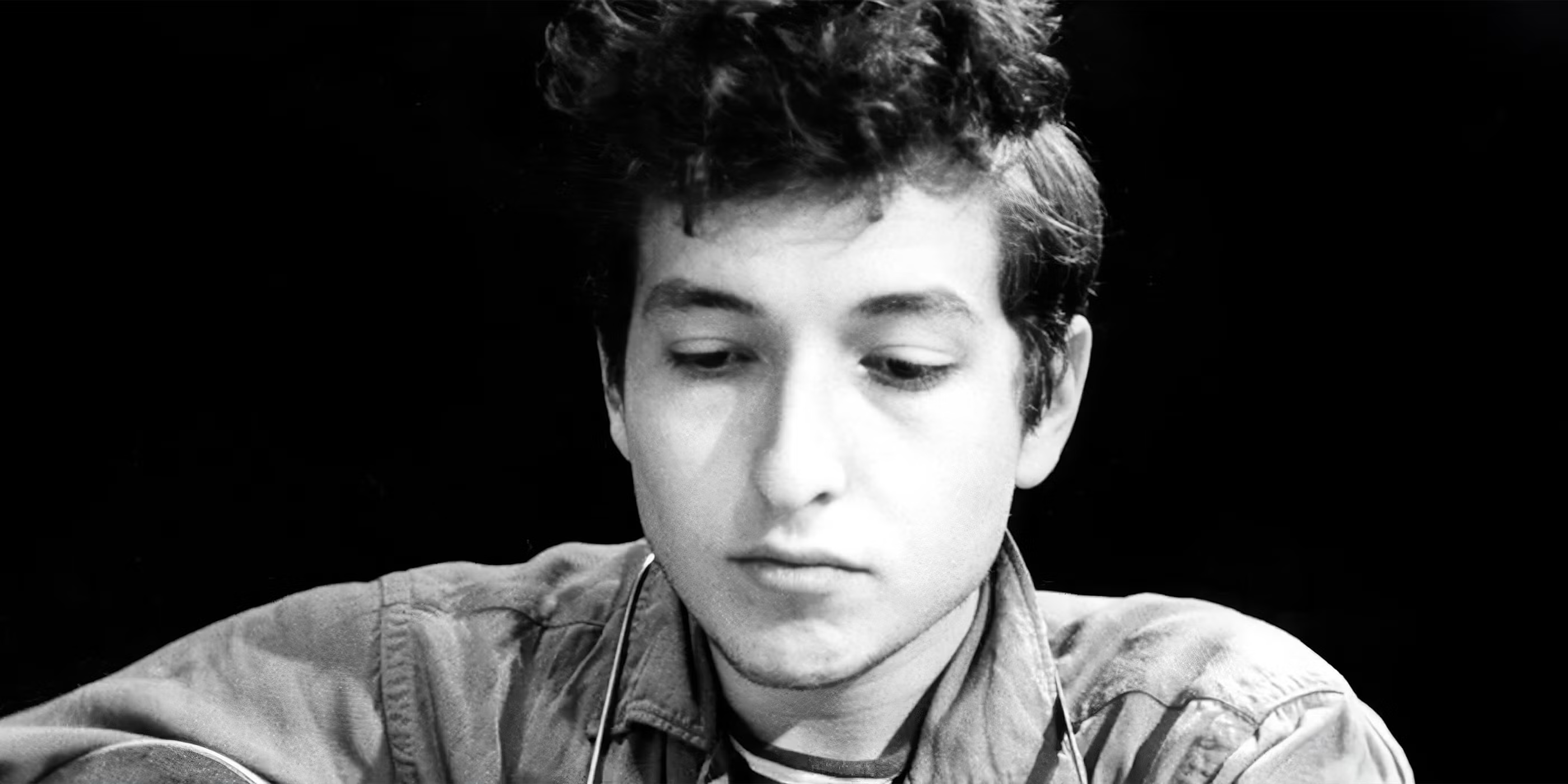
Bob Dylan might have built one of the greatest discographies in music history, but with more than 700 songs to his name, some are bound to slip through the cracks. Since releasing his debut album in 1962, Dylan has gone through countless creative and personal phases, from his marriages and bold artistic reinventions to a quieter life away from the spotlight.
Along the way, plenty of songs—both released and unreleased—have quietly faded into obscurity. That doesn’t make them any less brilliant. In fact, some of Dylan’s most overlooked tracks rank among the finest he’s ever written. Without further ado, here are 10 forgotten Bob Dylan songs that are masterpieces, ranked.
10
“Sign on the Window” (1970)
By 1970, at just 29 years old, Dylan had already accomplished everything a young musician could dream of: a record label contract, nine studio albums (with several becoming essential pieces of American music), and the creative freedom to pursue whatever genre he wanted. There was only one thing still missing: contentment.
As part of his move into country music, “Sign on the Window” is a warm piano ballad that shows that, despite everything the music industry says about success never being enough, Dylan simply longs for a quiet, ordinary life. Isolation and heartbreak may be inevitable, but by the final verse, he realizes it’s the simple things in life that matter most.
9
“Moonshiner” (1963)
“Moonshiner” might not be Dylan’s original song, but he sings it with genuine sincerity and deep respect for the people at its center. In the song, alcohol becomes a symbol of working-class communities that have long been overlooked by society. Historically, moonshiners produced liquor without government permits, making it an illegal trade.
But Dylan doesn’t villainize the people who choose that life, nor does he romanticize breaking the law in search of fortune. Instead, he focuses on the hardships they endure. Being a moonshiner offers a sense of freedom, but it also traps people in a cycle of crime and poverty that feels impossible to escape—lasting, in the song’s words, “for seventeen long years.”
8
“Sweetheart Like You” (1983)
“Sweetheart Like You” sounds like a typical love song about meeting a woman in a seedy place: “But what’s a sweetheart like you doin’ in a dump like this?” The first half recreates a conversation between Dylan and the woman, making it feel intimate and personal.
But beyond the surface, the song is about someone caught in a world where people constantly trade their morals for success. Even the kindest people can be worn down by a system that punishes loyalty instead of rewarding it. As Dylan puts it, “They say that patriotism is the last refuge”—a line that hints at how blind idealism can be misused for someone else’s personal gains.
7
“Up to Me” (1974)
We can’t control the cards life deals us, but we can choose how we play them—hence the title, “Up to Me.” For the longest time, Dylan sang about how unfair the world can be. But “Up to Me” reinforces the idea that resistance can also mean taking control of what happens next in our lives.
Even when everything goes “from bad to worse,” and life gives you little reason to smile—”In fourteen months I’ve only smiled once”—nobody can decide what we do next except ourselves. Had he followed what everyone else thought was the right way to live, Dylan declares with dramatic conviction, “the heart inside me would’ve died.”
6
“Red River Shore” (1997)
“Red River Shore” shows how much Dylan’s songwriting had matured from his early days. The Dylan of the ’60s experimented with surrealism, layered meanings, and stream of consciousness. By the ’90s, the much older Dylan had grown more reflective, opting for narrative structures that retell different scenarios while immortalizing each moment in its essence.
Dylan pieces together little quirks and intimate moments he shares with his lover. Every stanza in “Red River Shore” feels like a memory, moving naturally from the smallest details, like what he wears, to the best advice she’s given him. But by the end, it all comes together on a bittersweet note: nobody could truly see him except the girl from the Red River shore.
5
“Abandoned Love” (1985)
The best heartbreak songs are often the ones based on real pain. Inspired by Dylan’s failing relationship with his then-wife, Sara Lownds, “Abandoned Love” grasps the moment when a romance can no longer be saved, yet letting go still feels impossible. Rather than recounting specific events, Dylan expresses his emotions through surreal imagery.
From being deceived by “the clown inside of me,” suggesting he was foolish to believe the relationship could survive, to his “patron saint… fighting with a ghost,” implying that even faith cannot rescue him, he blames himself throughout the song. Despite every attempt to disguise his feelings, his heart remains certain: it’s “a-tellin’ me I love ya still.”
4
“Series of Dreams” (1991)
“Series of Dreams” opens with rolling drums and soaring guitars that immediately pull listeners into a dreamlike adventure. Fittingly, the song is literally about the metaphysical sensation of entering the dreamworld. As Bob Dylan himself explained, there’s no deeper rationale behind them—”nothing too very scientific”—because dreams simply happen.
Like much of Dylan’s work, “Series of Dreams” recreates an experience. The song seizes the fragmented, mysterious nature of dreams, where the subconscious becomes an unexplored landscape. Logic disappears; there is “no exit in any direction,” and “anything you’re holding on to, they’ll just collapse.” Instead of searching for meaning, Dylan invites listeners to surrender to the moment.
3
“Where Are You Tonight? (Journey Through Dark Heat)” (1978)
Another song inspired by Dylan’s breakup with Lownds, “Where Are You Tonight? (Journey Through Dark Heat)” is the singer’s desperate plea as he realizes that, like the relationship itself, he’s far from perfect. Dylan once said that a person’s greatest battle is against “the enemy within,” and that idea shapes the song as he wrestles with guilt, temptation, and self-doubt.
Sometimes mourning a relationship isn’t just about losing someone you love, but grieving the person you could’ve been. Drawing on Biblical imagery, Delta blues, and a gospel-tinged sound, Dylan turns heartbreak into a spiritual struggle rather than simply blaming his former lover, making it one of his most cathartic songs.
2
“Caribbean Wind” (1985)
An unreleased track from Shot of Love, “Caribbean Wind” is one of Dylan’s songs from his early ’80s Christian era. Where there’s faith, there’s desire. And in a world full of turmoil, desire becomes even more tempting, none more so than the woman Dylan describes as “the Rose of Sharon from Paradise Lost.”
With images of “armies on the march,” famines, and earthquakes, personal love still survives despite a world filled with spiritual anxiety. The recurring chorus, where the “Caribbean winds” keep “fanning the flames in the furnace of desire,” shows that his feelings refuse to fade. Dylan rewrote and revised the song several times, but it was never released on the album.
1
“Angelina” (1981)
One of his most mysterious songs, “Angelina,” is up to anybody’s interpretation. Written after his Gospel Tour, the song attracted attention because each stanza contains an intentional rhyming scheme. However, each line doesn’t seem to connect to another, with no overarching theme to link them all together.
The lyrics jump from personal confessions like “it’s always been my nature to take chances” to strange, dreamlike visions filled with biblical imagery. Giants, the “pale white horse,” and an “angel with four faces” all echo the Book of Revelation, but Dylan never explains what any of it means. Whether Angelina is a real woman, a symbol of faith, or something else entirely is left up to the listener.
Entertainment
‘Dark Winds’ Season 5 Officially Sets Up Jessica Matten’s “Career-High Performance” [Exclusive]
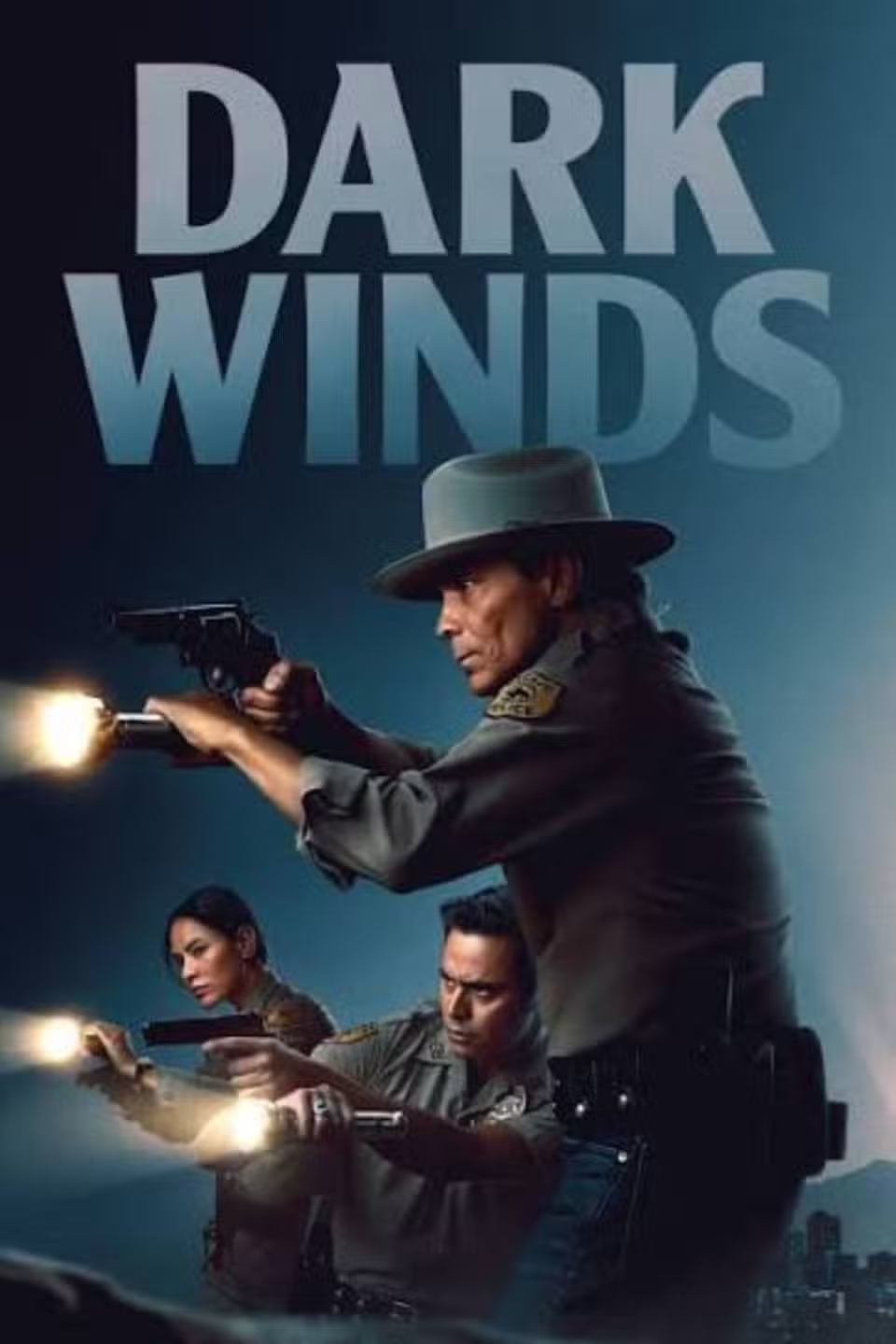
The Dark Winds are blowing in for another season of AMC’s acclaimed 1970s-set neo-noir mystery series. Jessica Matten, who stars on the series as Bernadette “Bernie” Manuelito, is hyping up the new season, with one particular scene serving as a “career high” for the actor. Collider’s Perri Nemiroff caught up with Matten at San Diego Comic Con, where she’s promoting her new animated movie, Avatar Aang: The Last Airbender.
Based on the Southwest-set novels of the late Tony Hillerman, Dark Winds follows a trio of Navajo Tribal Police officers in the 1970s; veteran Joe Leaphorn (Zahn McClarnon), his longtime deputy Manuelito (Matten), and newcomer Jim Chee (Kiowa Gordon). Over the course of the show’s four seasons, the initial rivalry between Manuelito and Chee has turned to romance; having endured a bout of “ghost sickness” and a life-or-death battle with a lethal survivalist assassin in the last season, their relationship has only become stronger. That’s set to continue in the show’s fifth season.
It won’t be too long before that new season hits AMC, as Matten reveals that season 5 is now in the can, having wrapped shooting last month. And while she can’t say much about the upcoming season’s plot, she can reveal that the new season was a personal milestone for herself, and gave her an experience she’d never had before as an actor:
“The producers pulled me aside, and they said they think it’s a career-high performance for me in Season 5. I’m very good as an actor at separating my personal life from the characters I play, and I have a lot of coping techniques for that, and it was the first time where those lines really did get blurred. You hear about it so many times through other performers and how they couldn’t shake off a character. I’m a little tough about it. I’m like, “I’ll just shake it off. It’s fine.” And I experienced for the first time what they were talking about. So, I will say it’s so not characteristic of who I am as a performer, going into Season 5.”
And although the series is now in its fifth season, Matten isn’t experiencing any fatigue. She’s grateful that the show exists as a space for Indigenous actors and creators to tell their stories, beyond the confines of a conventional detective series.
“Because we’ve been running for so long, you think you know these characters, and so it was surprising for me to say that, being like, “Oh, I did not expect this,” especially for Dark Winds. But I’m really grateful because, with it being one of the few Indigenous shows out there, globally seen and acknowledged, it’s a big deal for me. And to be able, as an actor, to play a role with so many layers, I think it’s going to be something. I think all of my costars are doing an incredible job of also showing the different many facets and the layers of the human soul, just being a Native person, or a person, a human being, in general.”
Season 5 of Dark Winds will premiere on AMC in 2027.
What Is ‘Avatar Aang: The Last Airbender’?
A continuation of the acclaimed animated series Avatar: The Last Airbender, Avatar Aang is set thirteen years after that series’ finale, and sees Aang (Eric Nam), a man with the ability to control the element of air who believed he was the last of his kind, discover a long-lost fellow airbender in the form of Tagah (Dave Bautista). Learning of a powerful staff that could restore the airbender’s lost culture, his old friends, including Katara (Matten), Sokka (Román Zaragoza), Toph (Dionne Quan), and Zuko (Steven Yeun) unite to aid him in his quest, even as the sinister organization known as The Denied seeks it for their own evil ends. It will debut exclusively on Paramount+ on July 25.
Season 5 of Dark Winds will premiere in 2027. Stay tuned to Collider for future updates.

- Release Date
-
June 12, 2022
- Network
-
AMC
- Directors
-
Michael Nankin
- Writers
-
John Wirth, Steven Judd, Max Hurwitz, Rhiana Yazzie, Thomas Brady, DezBaa’
By TeeJay Small
| Published

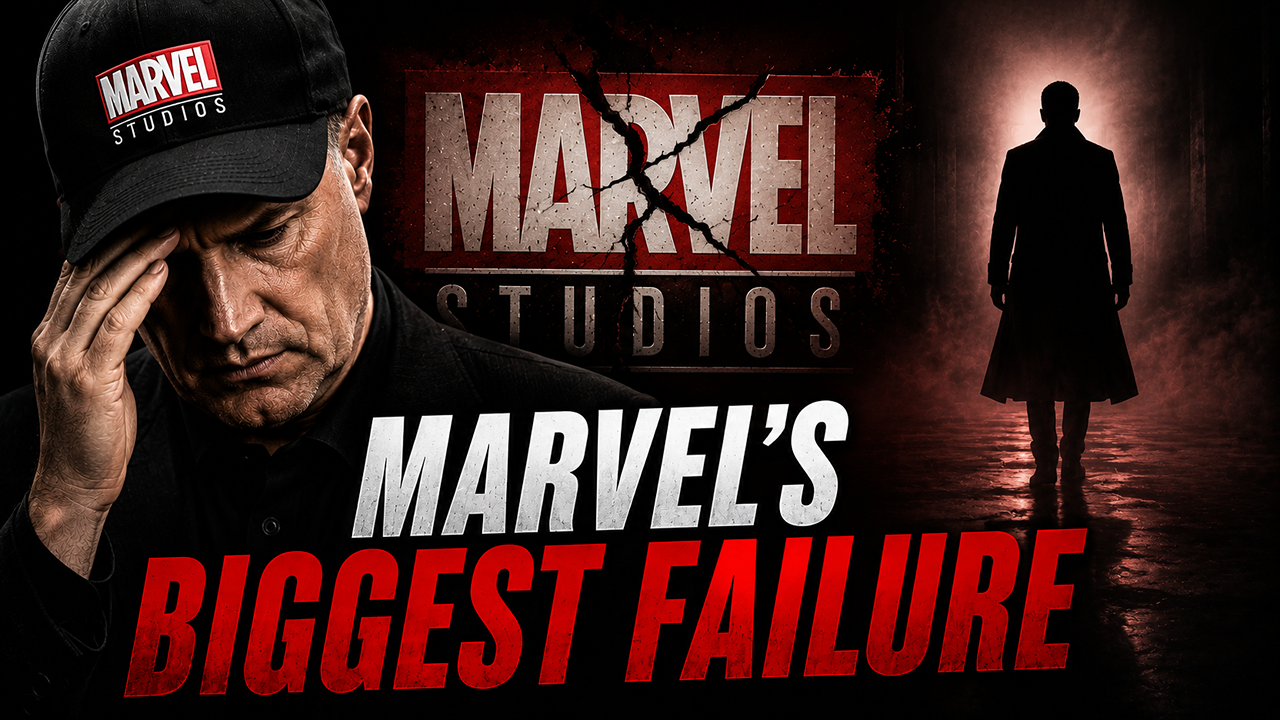
Though I’ve had many critiques of the Marvel Cinematic Universe over the years, it’s impossible to deny the scope and impact that these movies have accomplished. Sometimes I think we take for granted just how much coordination, logistics, and careful planning has gone into a decades-long movie universe that delivers such hits as Captain America: Civil War and Avengers: Endgame. Even still, not every move made by the architects of the franchise has paid off, as Marvel head Kevin Feige would be quick to admit. In fact, Feige recently sat down with the Happy Sad Confused podcast to discuss his handling of Mahershala Ali’s Blade film, concluding “I’m feeling … like a gigantic loser and failure that we didn’t get off the ground with Mahershala.”
The Blade That Got Away
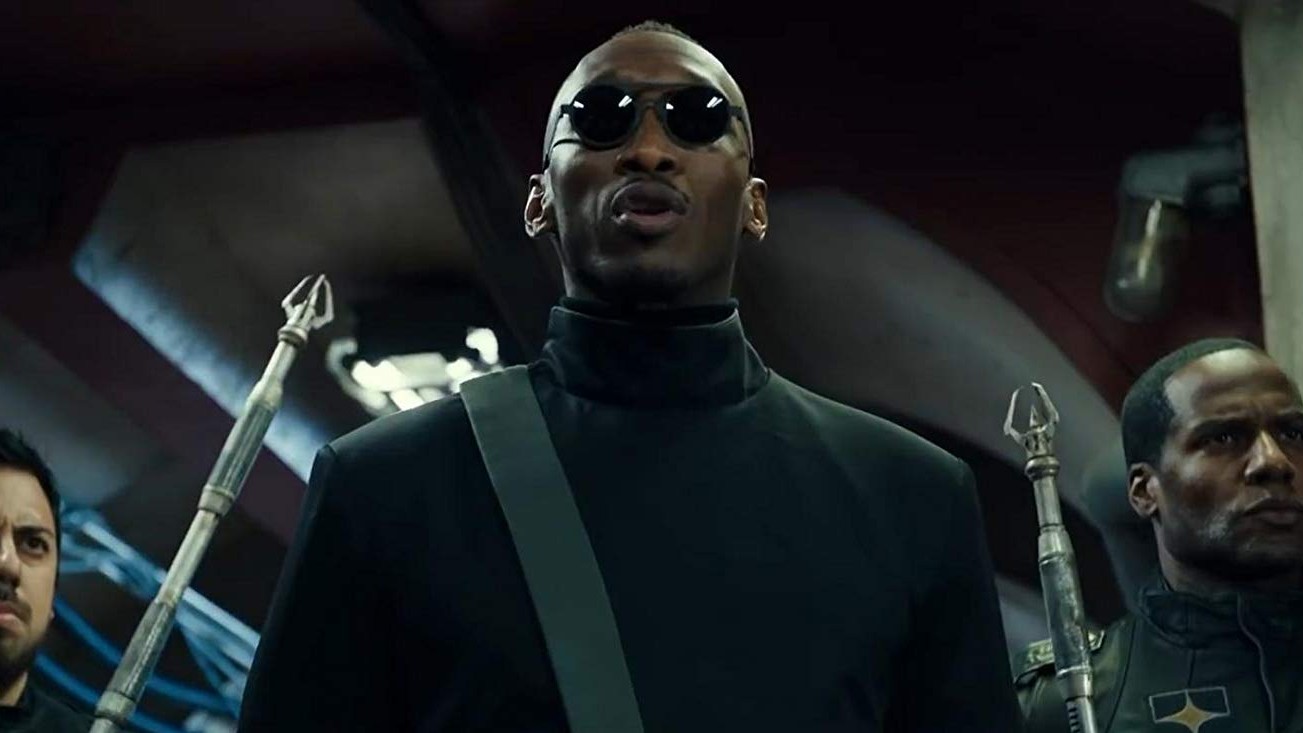
Feige didn’t officially confirm that the Mahershala Ali Blade reboot is dead in the water, but his comments, paired with the fact that we’ve had virtually no updates about the project in years, suggest that the film will never hit the box office. This is obviously a massive disappointment to fans, since the Blade character is one of the greatest comic book characters to ever be adapted for the screen. Wesley Snipes famously bolstered the franchise for an epic (if slightly dated) trilogy back in the late 90s and early 2000s, long before the MCU had even kicked off.
Ironically, Feige and company had the perfect opportunity to trojan horse the new Blade into the MCU with 2024’s Deadpool & Wolverine, which featured a cameo appearance from Snipes in the iconic leather duster. The Marvel creative head did mention during his podcast interview that he was proud of how that appearance shook out, though it seemed to weigh heavily on him that he couldn’t organize the new Blade film to coincide with Deadpool & Wolverine‘s release.

In case you’re not up to date on the timeline here, Mahershala Ali’s Blade reboot was initially announced over seven years ago. That’s back before the COVID-19 pandemic, before the 2023 WGA and SAG-AFTRA strikes, and long before GTA VI was given an official release window. Since then, the film has languished in development hell, with multiple writers and directors departing the project over creative differences. Variety reports that the film has fumbled no less than five screenwriters, and insiders have still been unable to confirm whether a completed screenplay has been locked in.
Kevin Feige’s official explanation for the film’s failure is Marvel’s aggressive over-expansion into Disney+ limited series. He even went so far as to comment that “for the very first time ever, quantity trumped quality” regarding his own prioritization of streaming shows over Blade. So the next time you’re laying in bed at night, tossing and turning with anxiety about the times you’ve screwed up at work, just remember that the guy who turned Marvel into the biggest cinematic profit mill in history experiences imposter syndrome too.
With The Odyssey, Christopher Nolan spent a reported $250 million and every available inch of IMAX 70mm film to drag Homer into the multiplex. But, before a single frame rolled, Nolan did the thing every serious director does with a star-studded cast and a story burdened by big expectations: he handed out homework. Three films, specifically, that he wanted stars like Matt Damon, Tom Holland, Anne Hathaway, Robert Pattinson, and Zendaya to sit with before they picked up a spear.
The Odyssey is dense with the influence of other films, and Nolan has been unusually open about where some of it comes from. Those three assigned titles are the ones he’s shared on record. Look closely, and you can find plenty more: David Lean‘s boundless deserts, the sword-and-sandal epics that made a Greek myth bankable again, one of the director’s own recent blockbusters, even a monster movie still warm from a Netflix-backed Oscar run. The list of must-watch movies below traces all of it, starting with the three films Nolan named himself.
‘Andrei Rublev’ (1966)

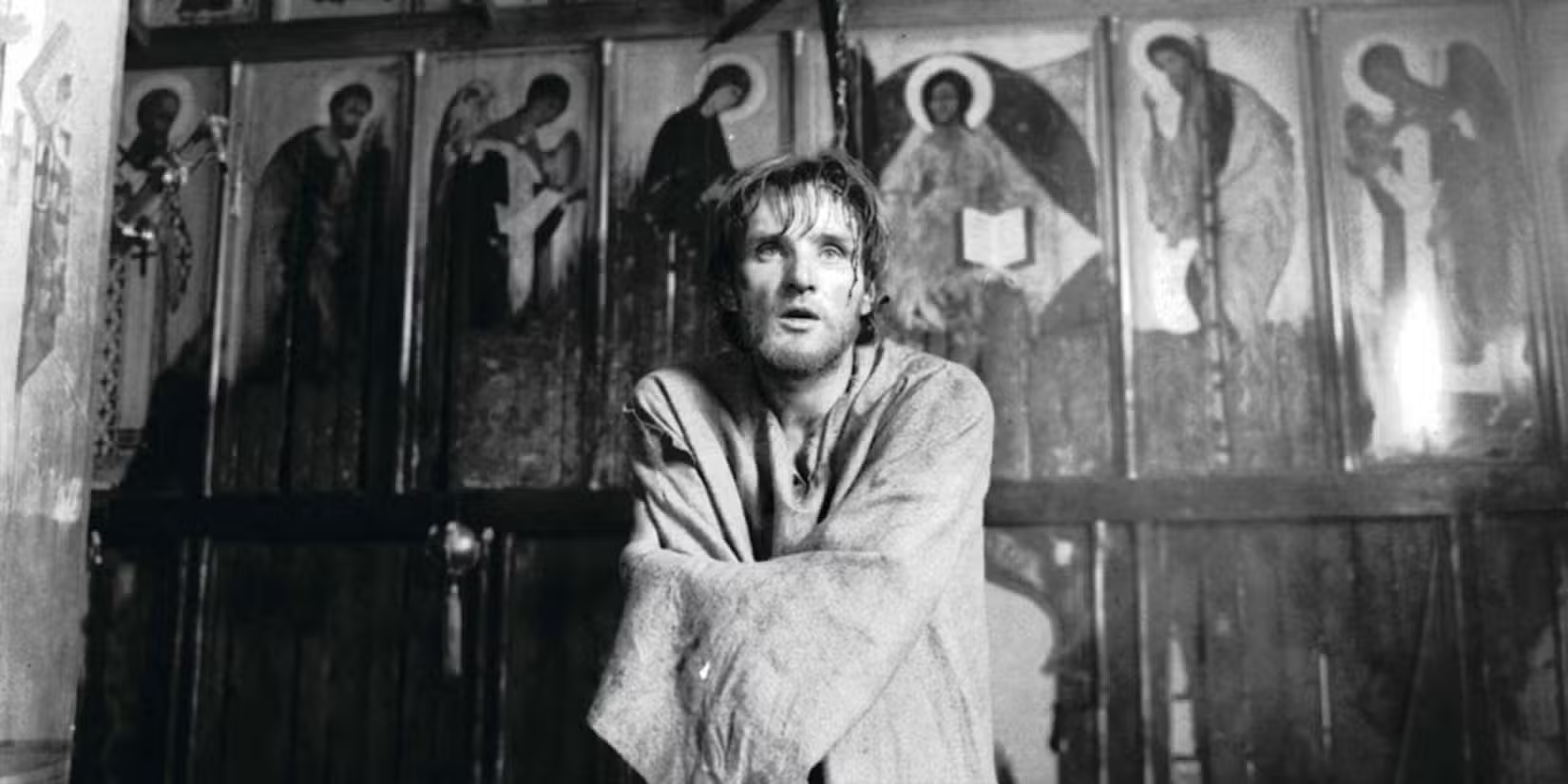
Andrei Tarkovsky‘s three-hour-plus film, Andrei Rublev, follows a medieval icon painter drifting through a Russia that’s coming apart at the seams. It takes two decades, famine, and a brutal Tatar raid to set the stakes for Rublev (Anatoly Solonitsyn) to lose faith in his art and stop painting. But then, he watches a young man strain to cast an enormous church bell and finds his reason to begin again. It’s all shot in long, patient takes that hold on mud and faces, and Nolan screened it for his cast because of that texture.
With The Odyssey, Nolan wanted an ancient world with weight to it, where the light and the faces belong to the era and not to a green screen. Odysseus (Damon), like Rublev, is a man ground down by cruelty and by the sheer length of his own road, and the film needs you to believe he has lived through every brutal year of it.
‘Ran’ (1985)

With Ran, Akira Kurosawa took King Lear to feudal Japan and set it on fire. An aging warlord hands his kingdom to his sons and then watches his family and his country tear each other apart, in some of the largest and most punishing battle scenes ever filmed. The armies march in blocks of pure color, and the wind moves through everything, bending grass and banners and smoke. Nolan zeroed in on exactly that, praising the movie’s use of “landscape” and the “banners flapping in the wind.”
It’s a natural fit. Nolan builds his films out of real places at real scale, and The Odyssey is about a hero at the mercy of forces far larger than himself. Kurosawa supplies the template for how to translate that on-screen.
‘The Last Temptation of Christ’ (1988)

Martin Scorsese‘s sweaty, doubt-ridden, once-scandalous take on Jesus (a raw Willem Dafoe) tells a familiar myth from the inside out, as the story of a man arguing with his own destiny. It was protested and picketed on release. It’s also one of the boldest things Scorsese ever made. Nolan called it “a fresh and accessible window into history” and admitted the technical work Scorsese was doing struck him as “quite inspiring.”
The connection isn’t hard to trace. Odysseus is a hero who lies, cheats, and stalls his way home, and Scorsese’s blueprint for a flawed legend given a human pulse is key to making The Odyssey‘s sheer density palatable.
‘Interstellar’ (2014)
Sometimes the biggest influence on a Nolan movie is another Nolan movie. Interstellar sends a father into space to save the human race and loses him in time, so that every hour out there costs him years with the children he left on Earth. The whole movie yearns for a homecoming that always feels heartbreakingly out of reach.
Swap the wormhole for the wine-dark sea, and you’re most of the way to The Odyssey. Both follow a man desperate to get back, and both let time do the cruelest work, piling up while he is powerless to stop it. Odysseus loses ten years to the gods; Cooper (Matthew McConaughey) loses decades in the span of an afternoon. Nolan has clearly been mapping this particular journey for a while.
‘Gladiator’ (2000)

“Are you not entertained?” turned out to be a rhetorical question with a very obvious answer in this Ridley Scott banger. The director dragged the sword-and-sandal epic out of the grave and stood it back on its feet with Russell Crowe playing a betrayed Roman general fighting through the blood and sand of the arena toward home… and revenge. The film became a sensation, winning Best Picture and reminding Hollywood that the ancient world could still fill a theater.
Every toga-draped blockbuster since has walked through the door Gladiator opened. Without its success, no studio would hand Nolan a quarter of a billion dollars to put a Greek myth on IMAX screens 26 years later.
‘Troy’ (2004)

This is the most obvious comparison on the list, and the one Nolan may be subtly answering. Wolfgang Petersen took The Iliad, cast Brad Pitt as an oiled, sulking Achilles, and swung for grand, star-driven spectacle. Because of that, Troy landed somewhere between genuinely stirring and faintly ridiculous.
The Odyssey picks up the very next chapter of the same story, which makes the contrast feel almost pointed. Where Troy went for beefcakes and battlefields, Nolan seems to be after the interior wear of the myth, the psychology of a man who can’t stop scheming even when scheming is what keeps him from his wife and son. It is the same source material approached from the opposite direction.
‘Lawrence of Arabia’ (1962)

If Nolan has a sacred text, this is it. Lean drops Peter O’Toole‘s unreadable T. E. Lawrence into a vast desert and shoots it on 70mm, until the sheer size of the landscape presses down on you in your seat. Nolan has cited it for years as the film that shaped the way he thinks about scale. In fact, the whole IMAX 70mm bet of The Odyssey comes straight from Lawrence of Arabia: set a single small figure against an overwhelming world and let the size of the image do the work.
Even the heroes at the center of these two films feel connected. Both men are magnetic and evasive, half-turned into legend but never fully known by the people who follow them. You don’t really need a reason to watch this, one of the greatest films ever made, but Nolan just gave you one anyway.
‘Spartacus’ (1960)

Stanley Kubrick’s Roman masterpiece gave us Kirk Douglas as a slave leading a doomed revolt, and the famous moment when a captured army rises one man at a time to claim his name. Spartacus is a huge, crowd-filling spectacle with a real brain behind it. It’s not the Kubrick entry most associate with Nolan’s work, but it’s the one that connects best here.
The balance between cerebral and crowd-pleasing is what The Odyssey is after. Spartacus carries weighty ideas without ever shrinking from the size of its audience, which is the same line Nolan walks, in every film really, but especially here.
‘Mad Max: Fury Road’ (2015)

George Miller made two hours of near-wordless road chase with real vehicles hurled across real desert and virtually nothing faked that could instead be built and crashed for the camera. His Mad Max: Fury Road is a journey film that runs on pure motion and a myth told at full speed. Put it next to Nolan’s newest film and the fit is closer than you’d expect.
The director is a practical-effects true believer, and Fury Road is the modern peak of that faith. When The Odyssey puts its monsters and shipwrecks on screen, this is the tradition it draws from, the conviction that an audience can always feel when something on screen is tangible on set.
‘Frankenstein’ (2025)

The outlier here, and the newest by a wide margin. Guillermo del Toro finally made the film he had chased for more than a decade, with Oscar Isaac as an obsessive Victor Frankenstein and Jacob Elordi as the creature he abandons. It’s a creation myth staged at full operatic scale and sent to Netflix last November. It shares nothing with Homer and everything with the moment Nolan is working in.
Frankenstein and The Odyssey arrived barely a year apart, two celebrated directors wagering enormous budgets on the idea that audiences still want an old myth told seriously, with real craft and real feeling behind it. And del Toro’s approach to his monsters — his love for them, his compassion, and his commitment to displaying their grotesque, awe-inspiring physicality — is echoed in how Nolan depicts his own mythic beasts. If The Odyssey has one clear peer in the current landscape, this is it.


Camille Kostek is tired of keyboard warriors commenting on her appearance from behind a screen.
“Me wondering when I’m going to stop opening my phone to losers having conversations about my body,” Kostek, 34, wrote alongside a Thursday, July 23, TikTok video.
In the clip, the model shakes her head back and forth and slightly covers her mouth in disappointment.
“Go outside and get some sun!!” Kostek told her haters in the comments section.

Rob Gronkowski gushed over his girlfriend, Camille Kostek, and her ability to keep their relationship afloat — even if she doesn’t want all the credit. During an exclusive interview with Us Weekly over Super Bowl weekend, Gronkowski, 34, said that Kostek, 31, is “definitely the secret sauce” in making their romance work. “She’s special,” he […]
The model wasn’t alone in her annoyance over being publicly ridiculed. Many of Kostek’s followers showed her support and fired back at the body-shamers as well.
“You are and have always been a baddie, please don’t let those trolls get to you ♥️,” one social media user replied.
Another person noted that Kostek is a “SI Swimsuit covergirl BY THE WAY 👏🏼 they can kick rocks ✌🏼,” referring to the model previously landing the Sports Illustrated Swimsuit cover.
A third user replied, “You are literally so hot I don’t understand any different POV.”

Camille Kostek. Alexander Tamargo/Getty Images for Sports Illustrated
“You are my BLUE PRINT babe — tell everyone to stfu,” a separate fan wrote.
“Girl, you are the type of woman that I want my daughter looking up too. Smart, driven, kind, beautiful!!!” a fifth TikToker added. “Pay no mind to the ones who enjoy tearing down others to make themselves feel better!!”
Kostek, who is a former New England Patriots cheerleader, has never been shy about speaking her mind and standing up for herself.
In fact, Kostek revealed during a June 2025 episode of the Honestly Cavallari: The Headline Tour during Kristin Cavallari’s stop in Boston that she didn’t always feel welcome among the NFL WAGs when dating boyfriend Rob Gronkowski.

Kevin Mazur/Getty Images Since officially retiring from the NFL in June 2022, Rob Gronkowski is still figuring out what work-life balance looks like in a post-football world. Gronkowski, 35, who now works as an analyst for Fox Sports after 11 seasons with the New England Patriots and Tampa Bay Buccaneers, still keeps himself remarkably busy […]
“I felt like I was seen as a lesser than girlfriend because I didn’t have a ring on my finger,” Kostek told Cavallari, who was previously married to retired NFL quarterback Jay Cutler. “But you want to know what’s so interesting about that? The woman that’s coming to mind [who] judged me the most, she’s divorced.”
Kostek began dating Gronkowski, 37, in 2015 after meeting when she was a cheerleader for the Patriots and he played tight end for the team. (The couple didn’t go public until after she left the squad, due to rules between cheerleaders and football players.)
While Kostek didn’t get the warmest of welcomes from some of the Patriots players’ wives, she said that Tom Brady’s ex-wife Gisele Bündchen was always sweet and friendly.

To no one’s surprise, Rob Gronkowski was the life of the party at Travis Kelce and Taylor Swift’s wedding. “It was top-notch. Hats off to Taylor and Trav,” Gronkowski, 37, said Thursday, July 9, on Tubi’s The Other Football. “The dance floor, that’s the one thing, it was popping. It was popping.” Gronkowski’s cohost, NFL […]
“Honestly, what’s so special about Gisele is when we would cross paths, she would embrace me and talk to me like we’ve known each other forever,” she said during the reality special. “I only have great things to say about her.”


Bündchen, 46, who divorced Brady, 48, in 2022 after 13 years of marriage, isn’t the only famous WAGs member that Kostek gets along with.
Kostek and Gronkowski were among the A-list guests in attendance at Taylor Swift and Kansas City Chiefs tight end Travis Kelce’s July 3 nuptials at Madison Square Garden.
Kostek told People earlier this month that Swift, 36, looked like “a real-life princess” at the wedding.

Jennifer Lopez is celebrating her 57th birthday with some words of wisdom.
Taking to Instagram on Friday, July 24, the “Love Don’t Cost a Thing” singer commemorated her special day by posting a video of herself riding in a car with the windows down as the sun shined on her and the wind gently blew across her hair.
JLo chose a reading of Theodore Roosevelt’s poignant 1910 speech, “The Man in the Arena” as the audio to accompany the post.
“It is not the critic who counts: not the man who points out how the strong man stumbles or where the doer of deeds could have done better,” the speech begins.
The passage made famous by the late president then praised “the man who is actually in the arena, whose face is marred by dust and sweat and blood, who strives valiantly, who errs and comes up short again and again.”
For her part, Lopez captioned her Instagram with a simple message, writing, “When you keep going it just keeps getting better ✨🥳.”
In the past, Lopez has spoken candidly about the rhetoric surrounding aging in the public eye.
Speaking to Elle in 2020 ahead of launching her JLo Beauty collection, Lopez said age should never be mentioned when complimenting someone’s looks.
“You never want to hear you look great for 50. [People] want to just hear you look great, no matter what age you are. And for me and for the company, that is a big part of it,” the actress told the outlet at the time. “We don’t want people going, you look great for 60, 50, 40, 35. You want people to just go, wow, you look amazing.”
She continued, “[When people say] ‘Oh my God, she’s 50.’ It’s like, does it matter? You’re just your best self, no matter what.”
In December 2024, Lopez also reacted to a reporter who joked about her age “getting up there.”
“Listen, I can’t believe it’s been 30 years since Selena. I can’t believe that 30 years we do the retrospective of this and you will be 60 by then,” a reporter said in a video obtained by TMZ at the time.

Jennifer Lopez is baring it all as she turns 56. The pop star and actress marked her 56th birthday on Thursday, July 24, by sharing a carousel of photos and videos via Instagram from her celebrations in Antalya, Turkey, including a gorgeous makeup-free selfie proving that she is aging like a fine wine! In the […]
“It’s funny you think that I’m getting up there,” Lopez began, while the journalist interjected to clarify that his comment was a “joke.” Lopez appeared unfazed by the remark, and instead chose to praise the audience.
“It’s because I want to say thank you, you guys. Because we’ve been doing this a long time together. Been doing it a long time and you guys have been here with me,” Lopez said. “Today, I was singing some new songs and I went back and sang ‘If You Had My Love,’ which is my first song, 1999. It’s that thing, of like, what a journey this has been.”
She continued, “I honestly feel that the best is yet to come. I honestly feel that my creativity and who I am as an artist — like you said, I also feel that this for me, was another kind of level for me of going deeper into who I am as a person, as an artist.”
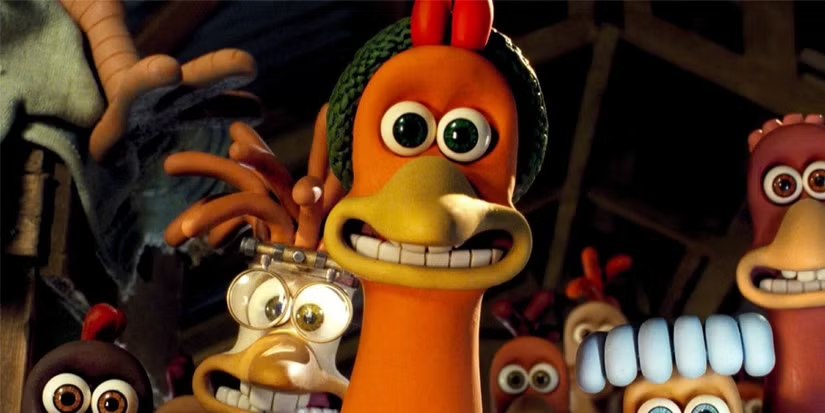
Most rebellious animated movies are usually the darkest ones. But then you realise that the subversive films simply take ideas that most animated movies treat as unquestionable, for instance, happy endings, good versus evil, perfect families, noble heroes and quietly pull them apart until those ideas look completely different. That is probably why these movies have aged so well.
They trust the audience to connect the dots instead of announcing what they’re trying to say, which makes discovering those ideas far more satisfying. Here are ten animated movies that challenged expectations, questioned familiar stories, and proved that some of the boldest filmmaking has happened in a medium people still underestimate.
10
‘Chicken Run’ (2000)

When people remember Chicken Run, they usually remember the chickens building an airplane or Rocky (Mel Gibson) crashing into the farm pretending he can fly. I always come back to something else. The film is mainly about workers who are trapped inside a system that is designed to profit from them, where every failed escape attempt ends with somebody disappearing forever. That is an incredibly bleak idea for something sold as family entertainment, but it is worth a watch.
Maybe that’s why it has aged so well. Ginger (Julia Sawalha) is not trying to become special or discover who she is. She simply refuses to accept that survival is the best life available to her, while everyone around her slowly starts believing escape is impossible. The jokes are still funny, but they almost distract you from how angry and serious the story actually is. Beneath all the clay animation and visual gags sits a prison-break movie that questions authority, exploitation, and the comfort of accepting the way things have always been.
9
‘The Triplets of Belleville’ (2003)

The first time I watched The Triplets of Belleville, I kept waiting for somebody to explain what was happening. They never did, and that turned out to be the point. Champion’s grandmother, Madame Souza (Monica Viegas), barely speaks as she crosses an ocean searching for her kidnapped grandson. Meanwhile, the famous Triplets help her in ridiculous but very natural ways.
That confidence that the film has in its storyline and cast is exactly what makes it so unusual. Most family films are terrified that children might miss something, so every emotion gets explained and every joke gets underlined. However, you won’t see it with The Triplets of Belleville. It asks you to pay attention, sit with silence, and figure things out for yourself. Even its strange, exaggerated world says something about modern society without ever stopping to make a grand speech.
8
‘The Iron Giant’ (1999)

People often describe The Iron Giant as a children’s movie about friendship. I don’t think that’s wrong, but it barely scratches the surface. Hogarth Hughes (Eli Marienthal) finds a machine that everyone else immediately assumes must be a weapon simply because of what it was built to do. The adults never ask whether it has a choice.
That idea feels even more relevant now than it did in 1999. The Giant spends the entire film trying to decide if his purpose has already been chosen for him or he can become someone else. It is a surprisingly mature conversation about fear, identity, and the way societies create enemies before they understand them. I cannot stop but think that the whole film is based on this one question that if the whole world expects you to become a monster, how difficult is it to choose kindness instead?
7
‘Persepolis’ (2007)

Image via Diaphana Distribution
I love that Persepolis refuses to turn Marjane Satrapi (Chiara Mastroianni in the French version) into either a hero or a victim. She is stubborn, funny, immature, angry, hopeful, and selfish depending on the moment. That honesty is the best part of the film because movies about war and revolution often reduce ordinary people to symbols. But Persepolis never does.
The political events are obviously important, but they are not the only story being told. Marjane worries about fitting in, embarrasses herself, argues with her family, falls in love, makes mistakes, and regrets them. Those moments make the larger history feel very real instead of distant. The film in the end reminds you that history happens to people who still have to wake up, go to school, disappoint their parents, and figure out who they want to become.
6
‘Coraline’ (2009)

As a child, I thought the Other Mother was terrifying because of the button eyes. Watching Coraline again as an adult, I realized the buttons are probably the least frightening thing about her. The Other Mother (Teri Hatcher) never forces Coraline (Dakota Fanning) to stay. She simply offers everything a lonely child thinks she wants until leaving starts to feel like the wrong decision.
That is a much darker idea than people usually give the film credit for. Nothing about the Other World looks frightening at first. It is brighter, kinder, more exciting, and filled with adults who seem willing to pay attention. The horror comes from realizing that manipulation does not always begin with threats. It often begins by making someone feel understood. Coraline hides one of animation’s sharpest warnings inside a gothic fairy tale, and that is exactly why it still unsettles audiences years later.
5
‘Anomalisa’ (2015)

Every character in Anomalisa except two shares the exact same face and the exact same voice, played by Tom Noonan, regardless of whether they’re a taxi driver, a hotel clerk, a child, or Michael Stone’s own wife. Michael (voiced by David Thewlis) can’t tell people apart anymore, and Charlie Kaufman doesn’t explain that as a metaphor, he builds it directly into the puppets. You can see the seam lines running across their faces, something stop-motion animation usually spends a fortune hiding.
Then Michael meets Lisa (Jennifer Jason Leigh), the one voice that sounds different from everyone else, and the film gives them a sex scene shot with the same patience and awkward pauses a live-action drama would use, which got the film an NC-17 rating before it was cut down to an R. Animation almost never asks to be taken that seriously as a medium for adult intimacy. Kaguya’s sketch lines fade as her freedom does; here, the puppet seams stay visible on purpose, the whole way through.
4
‘The Tale of the Princess Kaguya’ (2013)

The Tale of the Princess Kaguya looks unfinished on purpose, all loose watercolor lines and bare white space, which is strange for a Studio Ghibli film given how polished the studio’s other movies usually look. Director Isao Takahata spent eight years on it, and the softness of the drawing isn’t a budget shortcut, it tracks with what’s happening to Kaguya (voiced by Aki Asakura). The more her father forces her into noble clothes, blackened teeth, and an arranged marriage, the more the lines around her start to fray and blur, as if the film itself is losing its grip on her the same way she is.
The story ends with Kaguya taken back to the moon against her will, stripped of every memory of the life and people she loved on Earth, and there’s no rescue waiting in the final act. Takahata died five years after finishing it, and this was his last film. It says something that his final statement as a director was about a girl who never got to choose her own ending.
3
‘Princess Mononoke’ (1997)

Lady Eboshi (voiced by Minnie Driver) gives lepers and former sex workers real jobs and real dignity inside Irontown, and she’s also the reason the forest is dying and the Forest Spirit is about to lose its head. San (Claire Danes) was raised by wolves and will kill any human who threatens her forest without hesitation. Hayao Miyazaki gives neither of them the villain role, and Ashitaka (Billy Crudup), the character stuck between them, never fully cures the curse eating away at his arm, not even by the film’s final shot.
When Harvey Weinstein’s Miramax wanted to trim the film for its American release, Miyazaki’s producer reportedly mailed Weinstein a real katana with a note attached that just said “no cuts.” The film stayed intact, arms getting severed and all. An animated fantasy that refuses to hand you a clean winner, backed by a director willing to threaten a studio executive with a sword to protect that refusal, is a rare thing.
2
‘Watership Down’ (1978)

British censors rated Watership Down a U, meaning suitable for the whole family, and then the film opens with a rabbit creation myth about a god of death called the Black Rabbit of Inlé before moving into scenes of rabbits drowning, getting gassed inside their own warrens, and tearing each other apart in a fight against General Woundwort. When the BBC aired it in a teatime family slot years later, the switchboard reportedly lit up with parents complaining about what their kids had just watched.
John Hurt voices Hazel, the rabbit leading his warren to safety, and the film never once cuts away from what happens to the rabbits who don’t make it. Bambi’s mother dies offscreen with a gunshot you only hear. Watership Down shows you the blood directly, frame by frame, and dares you to still call it a children’s film afterward.
1
‘Shrek’ (2001)

Looking back, it is almost impossible to overstate how much Shrek changed mainstream animation. Shrek (Mike Myers) was never interested in becoming the handsome prince, while Princess Fiona (Cameron Diaz) turned out to be the person the fairy tale was trying to “fix.” Even Lord Farquaad (John Lithgow) exists to mock the perfect kingdoms that older animated classics spent decades celebrating.
The clever jokes are only part of the reason the film became such a phenomenon. What really made Shrek feel fresh was its willingness to question stories that audiences had accepted for generations. It laughs at fairy-tale traditions, but it also asks why those traditions existed in the first place. Beauty, heroism, romance, and happily-ever-afters all get turned upside down without ever feeling cynical. Plenty of animated films have been funny since then. Very few have been bold enough to rewrite the rules of the genre while millions of people were laughing.

Shrek
- Release Date
-
May 18, 2001
- Runtime
-
90 minutes
- Director
-
Andrew Adamson, Vicky Jenson
- Writers
-
Terry Rossio, Joe Stillman, Roger S.H. Schulman, Ted Elliott, William Steig, J.M. Barrie, Carlo Collodi
-
Shrek / Blind Mouse (voice)
-
Eddie Murphy
Donkey (voice)
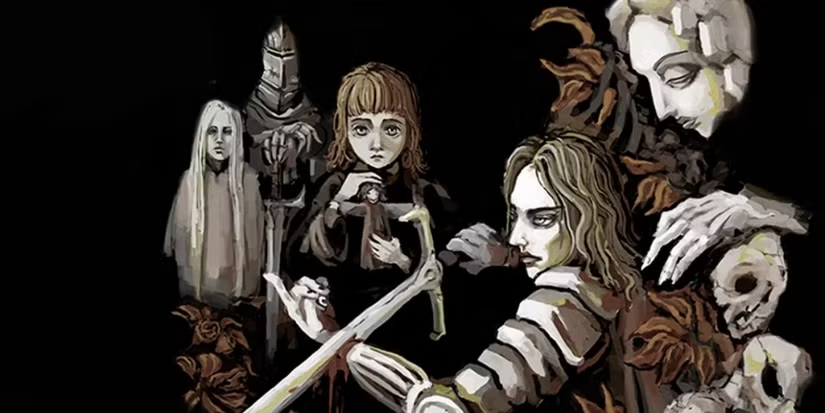
Several of the greatest video games ever made belong to the fantasy genre. But dark fantasy isn’t like your good ol’ regular fantasy, oh no. These are video games where morality is far more grey, where hope and clear-cut heroism are in short supply, where the atmosphere is grim and even scary, and where the characters’ goal is pure survival rather than just triumphing over evil.
Indeed, this is a genre that has produced several of the most beloved video games in history. It’s one thing for a game to be great, however, and a whole other thing for it to be downright perfect. From classics like The Legend of Zelda: Majora’s Mask to modern gems like Elden Ring, there are only a handful of dark fantasy game masterpieces out there which could reasonably be said to be flawless.
10
‘Fear & Hunger’ (2018)

The iconic indie game Fear & Hunger was practically a one-man project. It was Finnish developer Miro Haverinen who created the entirety of this survival horror masterpiece, from the writing to the music to the programming. Set in a Medieval dark fantasy setting as atmospheric as it is creepy, it’s nothing short of one of the best dark fantasy video games of all time.
It’s a dungeon crawler unlike any other, one whose grueling difficulty and disturbingly morbid tone feel like they could have only possibly been the product of an indie development. The game is utterly uncompromising in both its gameplay loop and the grimness of its atmosphere, and that’s precisely why it’s a must-play for adult dark fantasy fans.
9
‘Diablo II’ (2000)

Blizzard’s Diablo series was born with the original game all the way back in 1997, instantly establishing itself as an action RPG franchise to look out for going forward. Its sequel, Diablo II, came only three years later, and fans still widely consider it the best of the bunch. It improved the gameplay and story progression of its already-phenomenal predecessor in substantial ways, and it’s still one of the best 2000s video games worth playing over and over.
Where does that infinite replayability come from? Perhaps from the game’s legendary randomization and tremendously deep character customization, features that fans of dark fantasy RPGs are pretty much guaranteed to appreciate. Some core mechanics definitely feel a bit dated nowadays, but they only add to the timeless charm of this wonderfully immersive experience.
8
‘Shadow of the Colossus’ (2005)

As a gorgeously-built game that has often been interpreted as one of the most profound character studies gaming has ever offered, Shadow of the Colossus is usually part of any conversation about why video games deserve to be considered an art form. Originally conceived as an online multiplayer experience, the game eventually transformed into the single-player masterpiece that fans know and love today.
It’s one of the best video game masterpieces of the last 50 years, a massively influential gem whose clunky controls never get in the way of the emotionally stirring story, the jaw-dropping visuals, or the addictive gameplay loop. With a dark setting whose tone blends poignancy and the wonder of discovery in perfectly equal measure, Shadow of the Colossus has aged as one of the most groundbreaking games of the 2000s.
7
‘Dragon’s Dogma’ (2012)

Capcom’s action RPG Dragon’s Dogma is set in the dark high fantasy world of Gransys, heavily inspired by Sicily. It’s the perfect setting for this wonderfully diverse, uniquely inventive, and satisfyingly challenging gaming experience, one of the most fun that the 2010s ever had to offer. As far as open-world games from the era go, it doesn’t get much better than this.
It’s a cult classic full of groundbreaking action, side missions that make the world feel incredibly alive and vibrant, and a level of tactical depth that few modern RPGs have ever been capable of replicating. All in all, it’s one of the best RPG game masterpieces of all time, an incredibly addictive fantasy experience that refuses to ever hold the player’s hand and is all the more rewarding as a result.
6
‘Dragon Age: Origins’ (2009)

It’s rare for a video game series’ very first installment to be the one that ages the best, but in the case of the groundbreaking BioWare franchise Dragon Age, that’s precisely the case. When fans rank the Dragon Age games, Origins is typically right up there, and for good reason. Heavily inspired by Dungeons & Dragons, this dark high fantasy masterpiece is one that every fan of the genre should play at least once.
That’s because with its incredibly deep tactical combat and fantasy world, its impeccably written story, and its fascinating lore and world-building, this is undoubtedly one of the best fantasy video games of the 2000s. Player choices feel incredibly meaningful here, and that’s pretty much the main thing that anyone should want out of an RPG.
5
‘Bloodborne’ (2015)
FromSoftware’s Dark Souls became such a massively influential groundbreaker that it led the gaming community to coin a new game genre: the “soulslike,” any game sharing Dark Souls‘ unique DNA. Unsurprisingly, it has been FromSoft themselves who have dominated the soulslike space throughout the years, and few of their games have ever achieved the kind of cult status that Bloodborne still holds to this day.
Inspired by the works of dark fantasy and horror masters like Bram Stoker and H. P. Lovecraft, Bloodborne is the ultimate Victorian video game out there. Gothic to the core and unapologetically difficult from beginning to end, it’s simply one of those fantasy video games that are perfect throughout.
4
‘The Witcher 3: Wild Hunt’ (2015)

Andrzej Sapkowski‘s The Witcher books were quite popular in their native Poland from day one, but it wouldn’t be until CD Projekt Red released the 2007 game of the same title that the franchise would be catapulted straight into the mainstream. From that trajectory came what many would confidently refer to as the greatest piece of Witcher media ever: The Witcher 3: Wild Hunt.
Winner of over 200 Game of the Year awards and widely regarded as one of the greatest action RPGs in history, this dark fantasy masterpiece is easily one of the best story-driven video games of all time. You can get hundreds upon hundreds of hours of everlasting fun out of Wild Hunt, thanks to the balance between the engrossing narrative and the richness of the open world.
3
‘Hollow Knight’ (2017)

Saying that Hollow Knight is one of the best Metroidvania video games of all time would be an understatement. Thanks to its dark yet charming art style and its lack of graphic content (especially compared to many of its dark fantasy peers), this modern classic may look kid-friendly on the surface, but make no mistake: At its most challenging, Hollow Knight can be gleefully punishing beyond comparison.
But just like the best hyper-difficult video games, Hollow Knight always knows how to best balance that level of challenge with satisfying rewards that make blasting through the immersive Hallownest map a blast from start to finish. The bosses are legendary, the Metroidvania elements are perfectly balanced, and the whole experience is as addictive as it is replayable.
2
‘The Legend of Zelda: Majora’s Mask’ (2000)

There are those who may argue that Nintendo’s Legend of Zelda franchise is the single biggest and most important fantasy video game series in history, and it would be hard to argue against them. There is only one Legend of Zelda game, however, that truly fits into the dark fantasy box. Fittingly, it happens to be many fans’ favorite installment: Majora’s Mask.
When fans rank the 3D Legend of Zelda games, Majora’s Mask almost always gravitates around the top, and that’s because it truly is one of the most perfect video games ever created. Its unique “save the world in three days” time loop mechanic makes for one of the most enthralling gaming experiences the dark fantasy genre has ever had to offer, and the depth of the mechanics and world make this a top-tier Zelda masterpiece.
1
‘Elden Ring’ (2022)

Co-written by George R. R. Martin of “everything but finishing A Song of Ice and Fire” fame, Elden Ring has given gamers four years to allow any kind of recency bias accusations to die down. And yet, they haven’t. That’s because at this point, it’s almost a universal truth that this is not only FromSoftware’s best and biggest game to date, but also one of the best video game masterpieces of the last 50 years.
As far as dark fantasy gaming goes, it doesn’t get much more essential than this flawless open-world RPG. The unparalleled sense of discovery, the depth of the combat mechanics, the sheer density of it all—everything in Elden Ring comes together perfectly to offer one of the most irresistibly entertaining gaming experiences anyone could ever possibly have, regardless of what genres they usually gravitate to. The soulslike difficulty that fans of the series know and love is there for those who crave it, but the gargantuan openness of the experience also makes this the perfect gateway point for those who have never played a FromSoft game.
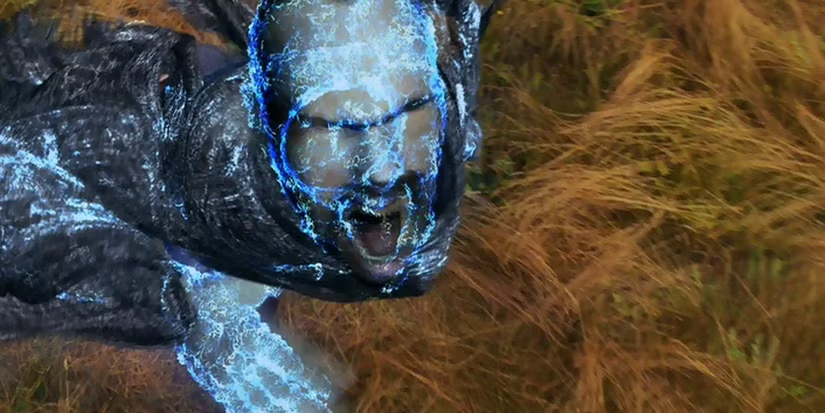
Having aired for an impressive 10 seasons and 217 episodes, Smallville ended in 2011 with a bang as Clark Kent (Tom Welling) finally became Superman. In many ways, Smallville ushered in a new era of superhero television, proving that comic book heroes could in fact still work on the small screen in our modern age. Over a decade, Clark battled many enemies, including his former best friend Lex Luthor (Michael Rosenbaum). Still, despite Lex’s destiny as Clark’s greatest adversary, there is another who rose and took his rightful place as the Man of Steel’s arch-enemy: General Zod.
General Zod Remained a Villain All Throughout ‘Smallville’
Despite the character’s often messy comic book history, General Zod has been one of Superman’s most consistent rogues since his first appearance in 1961’s Adventure Comics #283. Nearly two decades later, the character was re-imagined by director Richard Donner for Superman: The Movie and its immediate sequel, where he was played by Terence Stamp (who, coincidentally, voiced Jor-El on Smallville). Zod only returned to the big screen several decades later for 2013’s Man of Steel, this time played by Michael Shannon, but before that, he made his mark on Smallville.
What’s great about Lex Luthor, his father Lionel (John Glover), and his half-sister Tess Mercer (Cassidy Freeman) is that they’re all complex characters who teeter between good and evil. For the first half of the series, Lex fights his dark destiny, hoping that Clark can help him overcome his family’s personal darkness. Ultimately, Lex succumbs to his dark side, and thus their eternal rivalry is born. By contrast, Tess and Lionel go from being antagonistic figures (and in Lionel’s case, downright evil) to redeeming themselves as some of Clark’s closest allies before their untimely deaths at Lex’s hand.
There’s no denying that without the Luthors, Smallville wouldn’t have been half as good as it was. They always had the best lines, monologues, and character arcs, and that was by design. On Smallville, just because you’re a Luthor doesn’t mean you’re evil. But where the Luthors (and the Kents, in contrast) are portrayed as normal people navigating an extraordinary world, villains like General Zod possess incredible powers, have a deep hatred for our hero, and elevate Smallville to greater heights. From the first time Zod’s name is uttered in Season 5 to his final appearance in the back half of Season 10, the Kryptonian general is entirely focused on turning Earth into his New Krypton and taking revenge on the famed son of Jor-El.
General Zod’s Villainy Goes Back to the Last Days of Krypton

The way Smallville explains it, General Zod is actually the reason that Krypton was destroyed in the first place, killing not just Clark’s entire biological family (save his paternal cousin), but his entire race as well. After going to war against the Kryptonian Council, Zod built himself an army of devoted followers, corrupted Jor-El’s version of the Brain InterActive Construct (aka James Marsters‘ Brainiac), genetically engineered “the ultimate destroyer” Doomsday (later played by Sam Witwer), and, allied with Jor-El’s brother Zor-El (Christopher Heyerdahl), ignited the planet’s core and caused its destruction. In many ways, Zod is either directly or indirectly responsible for the biggest tragedies in Clark’s life, including the famed meteor shower he arrived in.
For someone who wants the Kryptonian race to thrive, Zod sure has a funny way of showing it. His ultimate goal was to create a New Krypton in his own image and slaughter his own people to do so, hoping that Earth would be a better template for his design. This meant that Doomsday’s goal to wipe out humanity, Brainiac’s mission to corrupt our technology, and even Zor-El’s plan to use cloning as part of the means toward repopulation were all by Zod’s design. While the Smallville mythos can be a bit confusing at times, everything relating to Krypton and alien invaders always finds its roots in the original General Zod.
Because of his crimes, Zod was stripped of his physical body and was sent to the Phantom Zone by Jor-El and the Council. At the end of Season 5/beginning of Season 6, Zod is unwittingly released by Clark, only to possess Lex’s newly superpowered body. Michael Rosenbaum’s performance as Zod is powerful and commands a type of respect that would make even Lex kneel. Up to this point on the show, everything had been leading to this. Two meteor showers, Zod’s disciples, and Brainiac all pave the way for the General to arrive on Earth. Had Clark not been able to defeat him, he would’ve taken over right then and there. Season 7’s “Apocalypse” emphasizes this when Jor-El shows Clark what the world would look like if he never arrived on Earth. Here, Lex (now the President of the United States) still becomes Zod’s vessel via Brainiac’s influence, though with Clark’s cousin Kara (Laura Vandervoort) as his bride. Thankfully, Clark expelling General Zod from Lex and sending him back to the Phantom Zone stops all that.
Zod’s Personal History With Superman’s Family Is Intense

While Clark and Lex’s story starts that miraculous day on the bridge, Zod’s rivalry with the House of El extends further into Kryptonian history. Back when Zod was just a Major (Callum Blue), he and Jor-El (Julian Sands) enjoyed a friendship that paralleled the Clark and Lex dynamic. As allies in the war against the terrorist group Black Zero, Jor-El and Zod were part of a cloning program meant to be the salvation of their species if an extinction-level event ever occurred. But the war followed them home.
After Zod’s wife and son are murdered in the destruction of Kandor, the Major asks Jor-El to bring them back through cloning, but the scientist refuses on ethical grounds. This apparent betrayal fractures the relationship between Zod and Jor-El, and sets the former on his dark path that ultimately leads to Krypton’s destruction. So, when a clone of Major Zod arrives in Smallville during the show’s Season 9, he attempts to forge a similar bond with Jor-El’s now-adult son. Hoping to see good in this younger Zod, who had yet to commit the same atrocities that his counterpart did, Clark tries to befriend the clone and lead the Kandorians on a better path. Unsurprisingly, Zod’s militaristic ambition and quest for power lead to a similar falling out between these Kryptonian blood brothers, which comes to a head in the epic Season 9 finale “Salvation.”
But rather than making the younger Zod a one-note villain, Season 9 expands on the character’s personal history and complex morality. At times, it seems like there may be good in Zod after all, even if most of the time his choices are questionable at best and horrific at worst. The Kryptonian clone may not be as menacing or powerful as his original counterpart, but Blue plays a mean Zod that surpasses what Rosenbaum was able to do with his limited screen time as the character. After all, Blue had a whole season to explore Zod’s motives, while Rosenbaum only got two episodes.
Each Version of Zod Impacted ‘Smallville’

While alternate takes on characters via parallel universes, timelines, and even through the use of drugs, Red Kryptonite, or shapeshifting doppelgängers were commonplace on Smallville, rarely did the series ever introduce two versions of the same distinct person, especially not characters who made a serious impact on the show. Clones on the show usually only got an episode or two, with all their development crammed into a single story. The Zod clone, on the other hand, was granted Smallville main cast status upon his first appearance and made his mark on thirteen episodes of the series in its final two seasons.
Both versions of General Zod be it the phantom from the series’ middle years or the clone from Season 9 have an air of authority to them that they take everywhere. The character’s trademark phrase, “Kneel before Zod,” commands respect, submission, and attention. It’s no wonder then that his actions always enforce those words. To make things even more interesting, after a whole season of wondering what would happen if the clone Zod and the original phantom met, Season 10 merges the two of them together. As a merged entity, General Zod retains the knowledge and memories of two lifetimes, which means that the original’s rivalry with Jor-El and the clone’s with Kal-El are both at the forefront of his mind as he sits trapped in the inescapable Phantom Zone.
The original Zod’s combat and leadership experience paired with the younger version’s physical body, knowledge of Earth, and hatred for Clark makes this Smallville villain one of the show’s best. Unlike Lex, who loses all his memories in the series finale (an odd choice indeed), Zod’s dual memories only fuel the fire of this alien tyrant. If there’s one villain from Smallville you don’t want to mess with, it’s General Zod. His ruthlessness, competence, and single-minded rage are powerful motivators in his quest to rule his own domain. No wonder his “son” Doomsday is a literal “rage monster.”
‘Smallville’ Opens the Door for General Zod To Return to Face Superman in the Future
Though Smallville often introduced Superman villains long before Clark officially took flight, there was always hope that many of those antagonists would return again once our hero was sporting a red cape instead of a jacket. Doomsday being buried beneath Metropolis seemed to imply a potential return in a Death of Superman-like story, while Toyman’s (Chris Gauthier) knowledge of Clark’s secret made him a formidable opponent worth revisiting in the future. Others such as Brainiac, Parasite (Brendan Fletcher), Livewire (Anna Mae Routledge), and Bizarro (Tom Welling) were either reformed, killed off, or disregarded in a way where it would be unlikely if they ever fought a suited-up Superman. Thankfully, General Zod falls into the former.
In Zod’s final appearance in Season 10’s “Dominion,” he and two of his new Phantom Zone lackeys (likely Ursa and Non from Superman II fame) are last seen trapped in the Zone, floating off into space in a manner that echoes the original Christopher Reeve Superman films. While the continuation comic book Smallville Season 11 doesn’t revisit Zod and his companions, given that the merged Kryptonian now has twice the hatred for Kal-El, it’s unlikely that he won’t return down the line seeking revenge. “Dominion” sets up the conflict between Superman and General Zod made famous by the source material and Superman II, a film which Smallville took clear inspiration from throughout its run. It’s clear that while Smallville developed the Luthors as antagonists, General Zod’s hatred for the Man of Steel remains strong, and the show wouldn’t have been the same without his presence.

News Videos39 seconds ago
These Money Moves Feel Like Financial Cheat Codes

NewsBeat2 minutes ago
Moment Ukraine backseat gunner shoots down Russian drone from open cockpit – as Putin’s Russia is hit by new wave of long-range strikes

Business2 minutes ago
Why Multi-Site Businesses Overpay for Energy, and How to Spot It


-

 Fashion21 hours ago
Weekend Open Thread: Brooks Brothers
-

 Politics6 days ago
Democrats look to World Cup watch parties to register thousands of voters
-

 News Videos6 days ago
Big Money Is Entering XRP
-

 Crypto World4 days ago
Grayscale Files For Worldcoin ETF, WLD Registers Sharp Rise
-

 Tech5 days ago
Sail Virtually Aboard The “Itanic” With IA-64 Emulator
-
 Tech4 days ago
Turtle Beach Command Series KB7 review: a nifty screen-equipped gaming keyboard
-

 NewsBeat5 days ago
Unregistered fitter used Gas Safe logo on business flyers
-
 Business3 days ago
New Jersey voter registration controversy explained: How 6,600 noncitizens got on the rolls, and what happens next
-
 Entertainment4 days ago
Johnny Depp’s R-Rated Gothic Cult Classic Gets New Release Ahead of Sydney Sweeney Remake
-

 Crypto World3 days ago
Ethics, other provisions in crypto Clarity Act to be further discussed
-

 Tech5 days ago
Watch Flock Safety CEO Garrett Langley discuss the future of surveillance at TechCrunch Disrupt 2026
-
 NewsBeat4 days ago
Shanghai science forum photos show China’s AI and robotics advances in rivalry with US
-

 Crypto World5 days ago
Circle’s President Sold Over 360,000 Shares, The Filings Explain Why
-

 Tech5 days ago
Subway Sandwich Computers Get a Second Life as Gaming Machines
-

 News Videos2 days ago
The Peugeot Family: How 200 Years of an “Old Money” Dynasty Died in A Boardroom
-

 Sports1 day ago
2026 3M Open leaderboard: Scottie Scheffler finds putter in Round 1, sits three back
-

 Tech5 days ago
The 35 Best Board Games for Family Game Night
-

 Fashion1 day ago
16 Dresses for the High Summer Event
-

 Tech6 days ago
How To Use Claude’s Reflect Dashboard And Learn When It’s Time To Touch Grass
-

 Entertainment5 days ago
Stephen Colbert Returns to Social Media After Late Show End
You must be logged in to post a comment Login