Entertainment
5 Epic Sci-Fi Books That Could Officially Give Apple TV Its Next Franchise

Almost seven years after its inception, Apple TV has firmly established itself as the home of prestige science fiction. What began with the ambitious, high-budget cinematic storytelling of For All Mankind and See evolved with the patient pacing and serialized depth of the unapologetically cerebral Foundation and Severance, and set a new standard for high-concept world-building with Silo and Dark Matter. Trusting its audience to follow intricate details as they unfold not over episodes but across seasons, the platform has built an empire out of complex, philosophical television that uses spectacle to examine big-picture ideas rather than existing for its own sake.
No longer needing to prove itself, Apple TV has been dabbling heavily in sci-fi’s weird and wonderful subgenres, exploring post-humanist dystopia with Pluribus, Lovecraftian cosmic horror with Widow’s Bay, speculative neo-noir with Sugar, and high tech, low life cyberpunk with Neuromancer. But since so many of its biggest success stories are adaptations, the widening of the platform’s sci-fi remit presents a massive opportunity to finally bring some of the most epic novels ever written to TV. From 1Q84 to Children of Time, these are the books at the top of the queue; primed, ready, and waiting to become Apple TV’s biggest, most ambitious franchise ever.
1
‘1Q84’
By Haruki Murakami


1Q84 centers on two people who shared a single unforgettable moment as children who, 20 years later, independently find themselves in a surreal, alternate version of Tokyo where reality has subtly shifted, and two moons hang in the sky. Aomame, a fitness instructor and skilled assassin who eliminates abusive men for a wealthy dowager, and Tengo, a math teacher and aspiring novelist who ghostwrites a novella for a mysterious teenager, find their separate lives increasingly intertwined as they each navigate a sinister religious cult and a group of enigmatic supernatural beings whose influence in the altered reality is profound. A parallel-universe mystery and magical realism-laced journey of self-discovery; at its core, it’s a metaphysical love story where mutual desire and faith can shift the fabric of reality itself.
A three-volume journey clocking in at more than a thousand pages, Haruki Murakami’s masterwork could never be adapted as a movie without losing its core identity and becoming a standard-fare action or mystery thriller. But it has limitless potential as multi-season episodic television, the ideal medium for a visual translation of an exposition-and-monologue-heavy story; it’s a format that would allow for the epic dual narratives to layer and build, the deep-seated philosophy to weave its way towards earning its merit, and the magical realism to develop and expand on its own terms. While Murakami is extraordinarily choosy about where and how his stories get adapted, Apple TV’s auteur-first mentality might be the one time he might actually want a part in bringing his work to life on the small screen.
2
‘Children of Time’
By Adrian Tchaikovsky
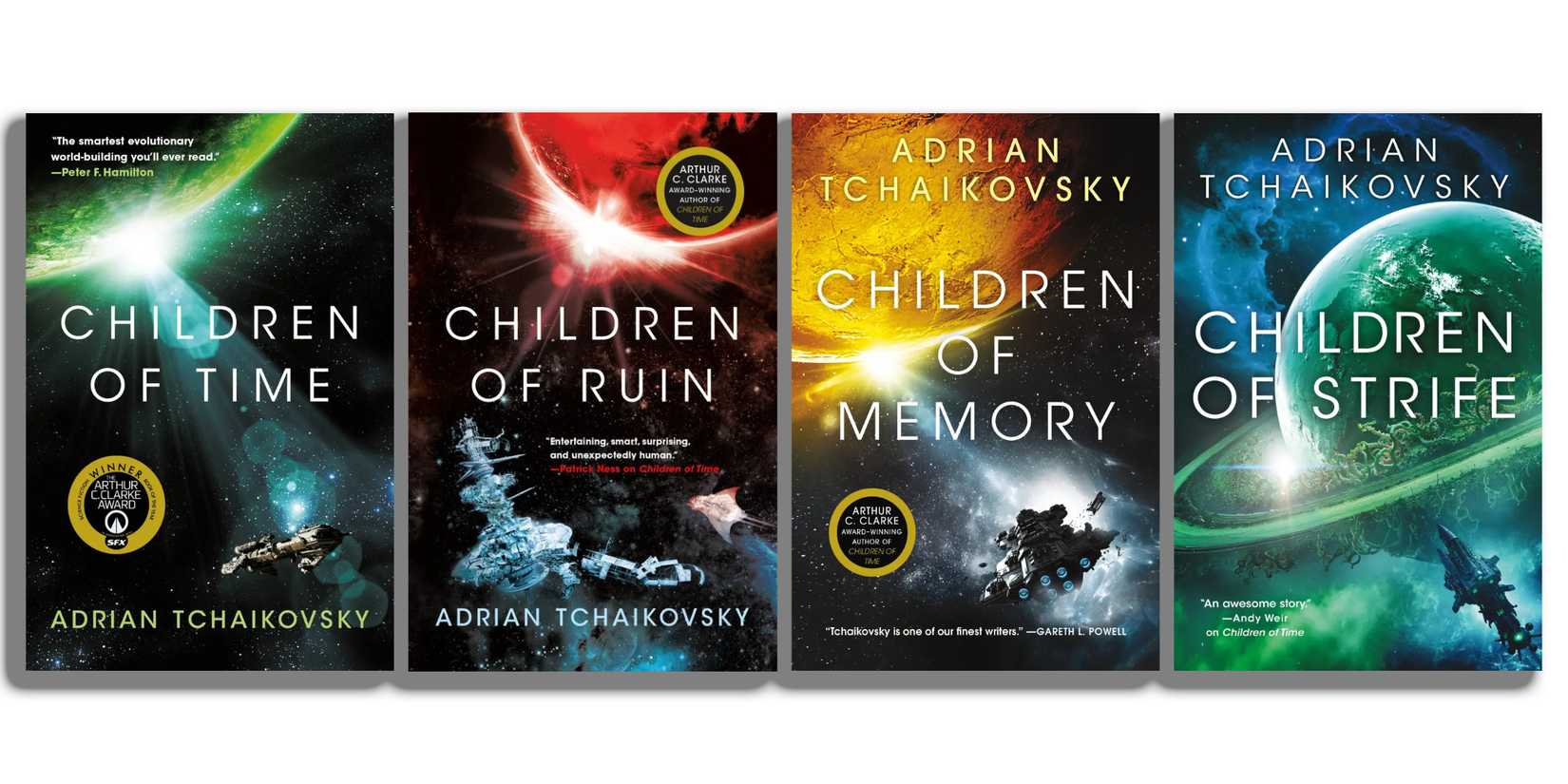
Children of Time tracks humanity’s attempt to relocate across the stars and their ongoing encounters with advanced species on distant worlds that, after a human terraforming mission went sideways centuries earlier, have evolved into highly intelligent races and created civilizations of their own. With every first contact, the trauma inflicted by human hubris is laid bare, and the vast disconnect between different forms of intelligence forces humankind, alongside an interspecies crew, to reconsider its understanding of society, identity, and the meaning of sentience. But as the struggle for survival becomes more interconnected, the series asks whether cooperation and radical empathy are enough to overcome the dangerous instincts toward domination that have shaped intelligent life from the very start.
The four books in Adrian Tchaikovsky‘s series are uniquely suited to television, as each one doesn’t simply continue the story but expands its universe, presenting a unique opportunity to lay the groundwork for a long-running series steeped in lore and mythology. But what makes it such a standout in a crowded world of sci-fi epics is its meticulous depiction of its alien civilizations, its intrinsic weirdness that stays with you, permeating your consciousness for weeks and months after reading it. Keeping the core oddities of the source material instead of softening them requires a level of creative fearlessness, which makes it an ideal franchise for Apple TV in its adventurous era, one with the potential to alter the way hard sci-fi is brought to life on TV going forward.
3
‘The Deluge’
By Stephen Markley

The Deluge opens in an alternate 2013 rife with political discord and extreme weather, with a scientist issuing a public warning after discovering a climatological tipping point, only to find his message ignored, his career sidelined, and his life threatened. What follows is an epic journey through three decades of American collapse, experienced through a sprawling cast of characters across the country, including activists, politicians, experts, executives, extremists, and regular people. But as the crisis intensifies, political paralysis and government failure trigger economic and societal upheaval, making the consequences of inaction impossible to ignore and forcing the characters to converge in a high-stakes reckoning of what they’re willing to sacrifice to save even the smallest portion of humanity’s future.
Stephen Markley‘s novel already has all the makings of a prestige ensemble series: a massive cast, power struggles amid deep personal relationships and passions, warring American factions, and of course, a series of escalating disasters. Markley, who currently serves as a writer on Hulu’s hit series Paradise, is uniquely placed to tackle his 900-page source material in the slow-drip fashion that Dan Fogelman has mastered – and he’s worked under for the last three seasons – especially when considering the 27-year timeline. But what makes his novel so appealing for TV is how it tackles its story from every angle, bringing a fresh look at a world that, in many ways, mirrors ours, but extends into an unfamiliar sci-fi future, making it feel both incredibly plausible and urgent for the moment we’re living in.
4
‘Sea of Tranquility’
By Emily St. John Mandel

The four timelines in Sea of Tranquility are linked by a single anomaly, a jarring glitch in reality that causes three people to experience a flash of darkness followed by the echoing sound of a violin in an airship terminal. From a distant British royal exiled to the Canadian wilderness in 1912, to a New Yorker searching for a long-lost friend in 2020, to a moon-based writer on a book tour in 2203, three people find their lives upended by an unexpected event that connects them across time and space, while a time-traveling detective tasked with investigating the anomaly in 2401 becomes more and more certain that reality is a simulation. A sweeping temporal mystery, the novel is a devastating examination of fate and isolation, and the transcendence of human connection across all imaginable distances,
A faithful adaptation of Emily St. John Mandel‘s book would work best in a limited-series format, as it’d require a steady hand to nail the eerie details that echo across centuries, and a tight focus to truly deliver the canny, quiet interior lives of its characters while capturing the vast scope of its visual landscape. But here’s where it gets interesting, and where things move into franchise territory: the book exists in the same universe as The Glass Hotel, and while the earlier work is a realistic white-collar literary crime drama, it adds a tremendous amount of color to the characters and plot of Sea of Tranquility. There’s a world where these two books come together to tell a much more expansive story that dabbles in genre-bending and literary boundaries, one perfectly suited to being a franchise for Apple TV.
5
‘The Bone Clocks’
By David Mitchell

The Bone Clocks tells the extraordinary story of Holly Sykes, who runs away from home as a teenager in 1984 and begins experiencing unexplained visions and events that leave her certain a secret supernatural war is being waged in an invisible realm. The sweeping novel is divided into six sections, each spanning a decade, tracking Holly from rebellious teen to elderly grandmother as she becomes increasingly involved with the immortal beings who use her as a pawn, with her narrating the first and last sections. The other sections are narrated by individuals whose lives become part of her story, giving depth to a tale that begins as 80s realism, twists into supernatural horror, and ultimately leads to dystopia, a future on the brink of a collapse, where Holly must finally end the war that only she can see.
David Mitchell is a truly one-of-a-kind author, but when approaching his vast, interconnected body of work, it’s important to note that it’s incredibly unsuited to the brevity of a feature film – ahem, Cloud Atlas – but his spectacular writing lends itself beautifully to the format of a long-running television series. Each section of The Bone Clocks provides enough material to carry multiple episodes, if not a season, with Holly a strong, unforgettable anchoring protagonist, the supernatural lore begging to be turned into a mystery box, and a new leading character introduced at the top of each time shift to keep it fresh. Most importantly, it starts as a coming-of-age tale, morphs into an occult thriller, then becomes a dystopian journey, offering something for every type of Apple TV viewer in its franchise-ready story.
You must be logged in to post a comment Login