Entertainment
5 Essential Detective Books for Beginners

Who doesn’t love a good (murder) mystery? As the summer winds down and the cooler seasons stumble in, nothing beats a good book with a riveting, page-turning conspiracy. No matter the era you pull from, the detective novel has been a part of our Western canon for over a century, and there’s a reason we always find ourselves returning to it. Whether you love shows like Agatha Christie’s Poirot or BBC’s Sherlock, it’s likely that you’ll find yourself enveloped in a good, old-fashioned mystery sooner or later — so why not start with the classics?
Detective fiction is a cerebral experience that pushes the reader to better understand not just the psychology of others, but of oneself. Discerning the deceptions and putting the pieces together requires skill and attentiveness. So, if you want the most essential detective stories to start with, look no further than these five thrillers that will keep you on the edge of your seat. While each of these tales has been adapted at some point or another for the screen (either as a major motion picture or a television miniseries), we’d encourage you to give them a read first. If you’ve already seen the movie, you’ll probably still get a kick out of the original too!
‘The Big Sleep’ (1939)


When it comes to hard-boiled detective stories, there’s no better place to start than with Philip Marlowe. Raymond Chandler‘s The Big Sleep is not only one of the most famous detective novels, but it produced one of the greatest noir pictures ever made, featuring the stunning duo of Humphrey Bogart and Lauren Bacall. The tale follows the LA-based private eye after he is hired by General Sternwood to deal with a bit of blackmail that’s found its way to his younger daughter. Of course, that’s only the beginning of the mystery, as Marlowe is soon thrust into a strange landscape full of morally bankrupt characters and deceptive femme fatales.
The Big Sleep is full of unforeseen twists and turns that make for a rocky (but enjoyable) read. Marlowe is somehow the most decent person in the narrative, as the wicked actions of all those involved in this budding criminal conspiracy come to a horrid light. Los Angeles itself is depicted almost as a living, breathing entity that pushes its residents to further depths of depravity than the reader might think possible. Like the best mysteries, it’s a study in the complexity of human nature. Just, whatever you do, don’t watch the ’70s adaptation — it may be more faithful to the ending than the iconic ’40s film, but that’s about all it has going for it.
‘Murder on the Orient Express’ (1934)


Speaking of studies in human nature, perhaps no mystery novel is as famous as Murder on the Orient Express. A Hercule Poirot novel by the “Queen of Crime” herself, Agatha Christie, the tale is about exactly what you would expect. When shady American businessman Samuel Ratchett is suddenly killed, the train is stopped by sudden snowfall, prompting Poirot to do what he does best. The investigation is quite thrilling, with more possible suspects than the detective could have thought all in the same closed compartment. Even if you already know the ending, you’ll find yourself quite enthralled by how Poirot reaches his conclusions.
Plenty of live-action Poirot’s have tackled this case (making some cozy on-screen mysteries for those who love the genre), but nothing quite compares to Christie’s literary classic. Murder on the Orient Express is classic detective fiction that doesn’t hit the brakes. The mystery itself was partially inspired by the Lindbergh kidnapping in 1932, prompting Christie to weave a crime novel the only way she could. Poirot is in rare form too, once again commanding every scene with his keen wit and unusual appearance, solving this case with the dogged determination of a man completely obsessed with putting the puzzle together — and you’ll be just as obsessed with reading it.
‘The Hound of the Baskervilles’ (1902)

Despite the popularity of Sherlock Holmes himself, Sir Arthur Conan Doyle only wrote four novels starring the character — the rest of your favorite Sherlock stories were all short stories. Of the novels, The Hound of the Baskervilles is arguably the most famous, and for good reason. Although first published as a serial in The Strand Magazine as the protagonist’s first appearance following his supposed death (in “The Final Problem”), the tale was later collected and published in book format in 1902, changing the game forever. It’s no wonder the character’s popularity never waned after his death, since Doyle proved himself a master of his craft again here.
As Holmes and Watson look into a local West Country legend about a devilish hellhound, they must protect the Baskerville family from this supposed curse. Is this a real supernatural force, a folktale that has struck fear into the hearts of men, or something else? That’s exactly what our hero has set out to uncover. With brilliant pacing and suspense that could kill, The Hound of the Baskervilles is often considered a piece of detective fiction that is perfect from the first page to the last. It’s also among the most adapted Doyle stories, having been remade as a major motion picture several times and re-imagined on shows like Sherlock and Elementary.
‘The Moonstone’ (1868)

Ironically, it’s the tale often considered the first modern detective novel that is the least recognizable on this list — but that by no means should imply that it’s the least of these mysteries. The Moonstone was published way back in 1986 by Wilkie Collins, who first released it as a serial story in Charles Dickens‘ own All the Year Round magazine (bet you didn’t know he had his own magazine). When a priceless (and supposedly cursed) Indian jewel is stolen from under the nose of its new owner, Rachel Verinder, Sergeant Cuff is on the case. However, it’s Rachel, not Cuff, who is truly the protagonist of this novel, making The Moonstone unique compared to most detective works.
As one of the best crime books of all time, The Moonstone was quite influential in how future authors like Doyle and Christie would construct their fictional detectives. Still, while most of the novels on this list feature either a third-person narrator or a single character recounting the scene, Collins utilizes several. Eventually, Franklin Blake, Rachel’s beloved cousin, pieces the different accounts together, allowing the mystery to come into full view. Having been adapted to the screen — and the stage by Collins himself — The Moonstone remains a classic in mystery literature that is just as suspenseful now as it was 140 years ago.
‘The Maltese Falcon’ (1930)

You may be more familiar with the different film adaptations of The Maltese Falcon than Dashiell Hammett‘s original novel, but there’s no reason not to take another look at this hard-boiled piece of crime fiction. Initially a serial published in the pulpy Black Mask magazine, the tale follows San Francisco P.I. Sam Spade as he searches for the titular statuette, overturning the entire Bay Area in the process. Spade encounters not only several criminals also looking for the gold centerpiece, but a femme fatale who is not to be trifled with — though trifling is sort of his specialty.
The Maltese Falcon is one of those mystery books that became the blueprint for the genre. Hammett’s unconventional prose — you won’t find any internal monologue here — can’t help but hook you in as the mystery presents itself. Spade’s encounters with Brigid O’Shaughnessy are perhaps the most memorable bits of the novel, though the entire conspiracy itself is quite a fascinating turn of events. If you’re looking for detective fiction that has profoundly impacted all other crime novels (and still packs a mean punch), then The Maltese Falcon is a perfect adventure for you.

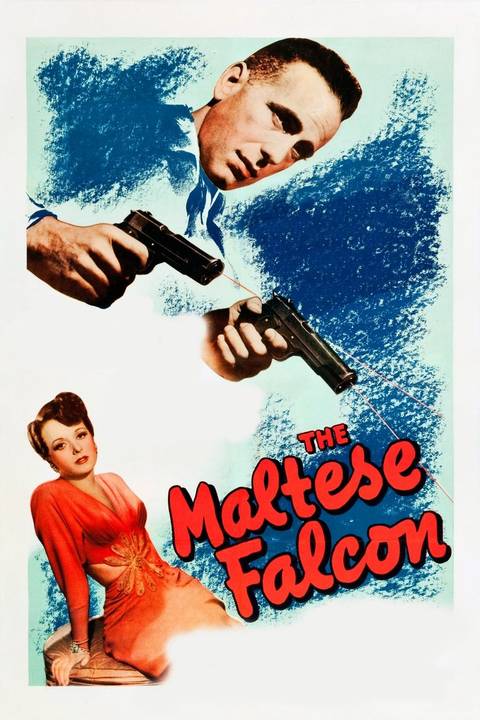
The Maltese Falcon
- Release Date
-
October 18, 1941
- Runtime
-
100 minutes
- Writers
-
John Huston
-

Humphrey Bogart
Samuel Spade
-
Mary Astor
Brigid O’Shaughnessy

You must be logged in to post a comment Login