Rom-com superstardom can make people weirdly lazy about Julia Roberts. They remember the smile, the laugh, the posters, the box-office heat, and then act like the whole career was built on charm alone. That misses the real thing. Roberts became massive because the charm had fight in it. Even when she was being funny or romantic, there was usually impatience, pride, hurt, or survival sitting right under the surface.
These five films prove how strong that screen presence can get when the material knows what to do with it. Roberts can be cold, magnetic, furious, and so much more. That range is why the movie-star label actually means something with her.
Advertisement
5
‘Closer’ (2004)
Julia Roberts in CloserImage via Columbia Pictures
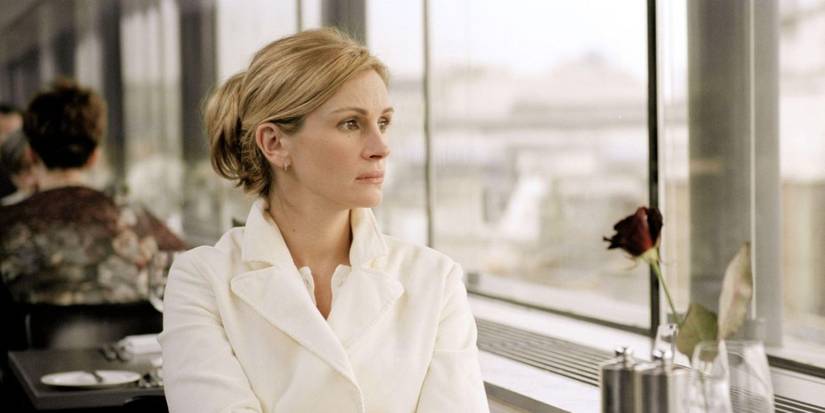
Mike Nichols lets everyone in Closer sound intelligent while behaving terribly, which is exactly why the movie still stings. Anna Cameron (Julia Roberts) gets pulled into the emotional wreckage between Dan Woolf (Jude Law), Alice Ayres (Natalie Portman), and Larry Gray (Clive Owen), and she never feels like the safe “adult” in the room. Anna is controlled, yes, but the control often looks more like exhaustion than wisdom. She knows desire can humiliate people, and she still keeps stepping into it.
Roberts strips away the easy warmth audiences usually expect from her. Anna’s face often looks guarded, almost tired of being wanted by men who turn attraction into possession. Her scenes with Larry are especially brutal because the marriage has turned into a contest of confession, punishment, and sexual power. Closer uses Roberts against her own romantic image, and that choice gives the film real bite. She is no fantasy here. She is a woman trying to stay composed while everyone keeps demanding access to the parts of her she would rather keep private.
Advertisement
4
‘Ocean’s Eleven’ (2001)
Image via Warner Bros. Pictures
A casino heist movie packed with Danny Ocean (George Clooney), Rusty Ryan (Brad Pitt), Linus Caldwell (Matt Damon), Basher Tarr (Don Cheadle), Frank Catton (Bernie Mac), and Reuben Tishkoff (Elliott Gould) could easily reduce Tess Ocean (Julia Roberts) to “the ex-wife prize.” Steven Soderbergh’s Ocean’s Eleven avoids that trap by making her taste matter. Tess is the reason Danny’s confidence has a weakness. He can plan around vaults, cameras, guards, timing, and Terry Benedict (Andy Garcia)’s empire, but he cannot treat Tess like another piece of the job without exposing how badly he still wants her respect.
Roberts does a lot with stillness here. Tess has heard Danny’s charm before, which makes her the rare person in the movie who is almost immune to the sparkle. That changes the rhythm whenever she appears. The heist is sleek and funny, but the romantic thread gives Danny’s cool-guy routine a bruise. Tess is not impressed by the performance of being clever and wants proof that he understands the consequences. In a film full of perfect timing, Roberts brings the one thing Danny cannot simply steal back.
Advertisement
3
‘Erin Brockovich’ (2000)
Close up of Erin Brockovich (Julia Roberts) sitting at a desk in an office in Erin Brockovich.Image via Universal Pictures
The miracle of Erin Brockovich is how messy it lets its hero be. Erin Brockovich (Julia Roberts) is broke, unemployed, raising three kids, angry at being dismissed, and tired of people treating her clothes, voice, and attitude like evidence against her intelligence. Then she starts digging into medical records tied to Pacific Gas and Electric’s contamination of Hinkley’s water, and the film becomes a legal drama powered by outrage that feels completely personal.
Erin talks fast because she has spent her life fighting to be heard before someone shuts the door. She dresses the way she wants, flirts when she wants, swears when she wants, and still does the work better than the people looking down on her. The case matters because the victims matter to her as people, not files. Roberts earned the Oscar here through more than charisma. She made Erin’s anger useful, specific, and impossible to patronize.
Advertisement
Collider Exclusive · Oscar Best Picture Quiz Which Oscar Best Picture Is Your Perfect Movie? Parasite · Everything Everywhere · Oppenheimer · Birdman · No Country
Advertisement
Five Oscar Best Picture winners. Five completely different visions of what cinema can be — and what it can do to you. One of them is the film that was made for the way your mind works. Ten questions will figure out which one.
🪜Parasite
🌀Everything Everywhere
☢️Oppenheimer
🐦Birdman
Advertisement
🪙No Country for Old Men
Advertisement
01
What kind of film experience do you actually want? The best movies don’t just entertain — they leave something behind.
Advertisement
02
Which idea grabs you most in a film? Great films are driven by a central obsession. What’s yours?
Advertisement
03
How do you like your story told? Form is content. The way a story is shaped changes what it means.
Advertisement
04
What makes a truly great antagonist? The opposition defines the protagonist. What kind of opposition fascinates you?
Advertisement
05
What do you want from a film’s ending? The final note is the one that lingers. What do you want it to sound like?
Advertisement
06
Which setting pulls you in most? Where a film takes place shapes everything — mood, stakes, what’s even possible.
Advertisement
07
What cinematic craft impresses you most? Every great film has a signature — a technical or artistic element that makes it unmistakable.
Advertisement
08
What kind of main character do you root for? The protagonist is the lens. Who you choose to follow says something about you.
Advertisement
09
How do you feel about a film that takes its time? Pace is a choice. Some films sprint; others let tension accumulate slowly, deliberately.
Advertisement
10
What do you want to feel walking out of the cinema? The best films leave a mark. What kind of mark do you want?
Advertisement
The Academy Has Decided Your Perfect Film Is…
Your answers have pointed to one Oscar Best Picture winner above all others. This is the film that was made for the way your mind works.
Advertisement
Parasite
You are drawn to films that operate on multiple levels simultaneously — that begin in one genre and quietly, brilliantly migrate into another. Bong Joon-ho’s Parasite is a film about class, desire, and the architecture of inequality that manages to be darkly funny, deeply suspenseful, and genuinely shocking across a single extraordinary running time. Your instinct is for cinema that hides its true intentions until the moment it’s ready to reveal them. Parasite is exactly that — a film that rewards close attention and punishes assumptions, right up to its devastating final image.
Advertisement
Everything Everywhere All at Once
You want it all — and this film gives you all of it. The Daniels’ Everything Everywhere All at Once is one of the most maximalist films ever made: action comedy, multiverse sci-fi, family drama, existential crisis, and a genuinely earned emotional core that sneaks up on you amid the chaos. You are someone who responds to ambition, who doesn’t want cinema to choose between being entertaining and being meaningful. This film refuses that choice entirely. It is overwhelming by design, and its overwhelming nature is precisely the point — because the feeling of being crushed by infinite possibility is exactly what it’s about.
Advertisement
Oppenheimer
You are drawn to cinema on a grand scale — films that understand history not as a backdrop but as a force, and that place their characters inside that force and watch what happens. Christopher Nolan’s Oppenheimer is a film about the terrifying gap between what we can do and what we should do, told with the full weight of one of the most consequential moments in human history behind it. You want your films to feel important without feeling self-important — to earn their ambition through sheer craft and the gravity of their subject. Oppenheimer does exactly that. It is enormous, complicated, and refuses easy comfort.
Advertisement
Birdman
You are drawn to films that foreground their own construction — that make the how of the filmmaking part of the what it’s about. Alejandro González Iñárritu’s Birdman, shot to appear as a single continuous take, is cinema examining itself through the cracked mirror of a fading actor’s ego. You respond to formal daring, to the feeling that a film is doing something that probably shouldn’t be possible. Michael Keaton’s performance and Emmanuel Lubezki’s restless camera create something genuinely unlike anything else — a film that is simultaneously about creativity, relevance, self-destruction, and the impossibility of ever truly knowing if your work means anything at all.
Advertisement
No Country for Old Men
You are drawn to cinema that trusts silence, that refuses to explain itself, and that treats dread as a form of meaning. The Coen Brothers’ No Country for Old Men is a film about the arrival of a new kind of evil — implacable, arbitrary, and utterly indifferent to the moral frameworks we use to make sense of the world. It is one of the most formally controlled films ever made, and its controlled restraint is what makes it so terrifying. You want your films to haunt you, not comfort you. You are not interested in resolution if resolution would be dishonest. No Country for Old Men is honest in a way that most cinema never dares to be.
Advertisement
2
‘My Best Friend’s Wedding’ (1997)
Michael (Dermot Mulroney) and Jules (Julia Roberts) in ‘My Best Friend’s Wedding’Image via Sony Pictures Releasing
Advertisement
Julianne Potter (Julia Roberts) is a disaster, and that is the whole thrill of My Best Friend’s Wedding. She finds out her best friend Michael O’Neal (Dermot Mulroney) is marrying Kimmy Wallace (Cameron Diaz), panics, and turns a romantic comedy setup into a sabotage mission against a woman who has done almost nothing wrong. That could have made the movie unbearable. Roberts saves the whole thing by letting Julianne be funny, jealous, charming, insecure, mean, and painfully aware of her own bad timing.
The genius is that the film refuses to reward her selfishness with the usual fantasy ending. Kimmy is sweet without being stupid, Michael is not some secret soulmate waiting to wake up, and George Downes (Rupert Everett) keeps pointing out the emotional truth Julianne wants to dodge. Roberts lets the audience love Julianne while also knowing she is wrong. That is a harder trick than it looks. Julianne, in the end, has to accept that love sometimes arrives too late, and the person you want may still belong with someone else. But the film keeps you hooked and invested throughout.
1
‘Notting Hill’ (1999)
Julia Roberts and scuba-goggle-wearing Hugh Grant watch a movie in a theater in Notting Hill.Image via Universal Pictures
Advertisement
Notting Hill understands movie-star fantasy better than almost any romantic comedy of its era. Anna Scott (Julia Roberts) is famous enough to make ordinary life impossible, and William Thacker (Hugh Grant) is ordinary enough to make her feel, briefly, like she can breathe. The setup sounds light, almost impossible to mess up: a Hollywood star walks into a London bookshop and falls for the awkward owner. The reason it lasts is that the film keeps remembering how strange and painful that fantasy would be for the person everyone is staring at.
Roberts brings her own celebrity history into Anna without turning the role into self-pity. The dinner scene with William’s friends matters because Anna is allowed to be funny, bruised, competitive, and honest in a room that slowly stops treating her like an image. The “just a girl” line became famous for a reason, but the real power sits in everything around it: the failed timing, the public exposure, the fear of being loved as an idea rather than a person. Notting Hill is the Roberts classic that knows exactly why people adore her and exactly how lonely adoration can become.






You must be logged in to post a comment Login