Entertainment
5 Years Since Its Oscar Win, This Absolute Masterpiece Has Been Completely Forgotten

With this year’s Academy Awards nominations, Chinese filmmaker Chloé Zhao made history by becoming the second woman nominated for Best Director, contending for her historical drama, Hamnet. However, five years ago, Zhao made history by becoming the third woman to win the award for her contemplative and deeply humane 2020 drama, Nomadland. The film also walked away with the awards for Best Actress and Best Picture, winning half of its six nominations.
At the moment, the win seemed inevitable — Nomadland had been consistently picking up steam since it premiered at the Venice Film Festival, where it won the Golden Lion. However, that didn’t stop some from dismissing it as one of the Academy’s more pretentious picks, an arthouse drama made for so-called film connoisseurs and not for the masses. And yet, today, Nomadland is sort of forgotten, its quiet approach drowned by the loud chaos that dominates the Oscars the following years, from slaps to multiversal movies, atomic bombs, green witches, and vampires. Five years on, time has been extremely kind to Nomadland, to the point where it might just be the movie that has best represented and captured the nature of the 2020s as a whole. In fact, its win wasn’t just inevitable; it was divine justice.
‘Nomadland’ Is a Life-Affirming Poem
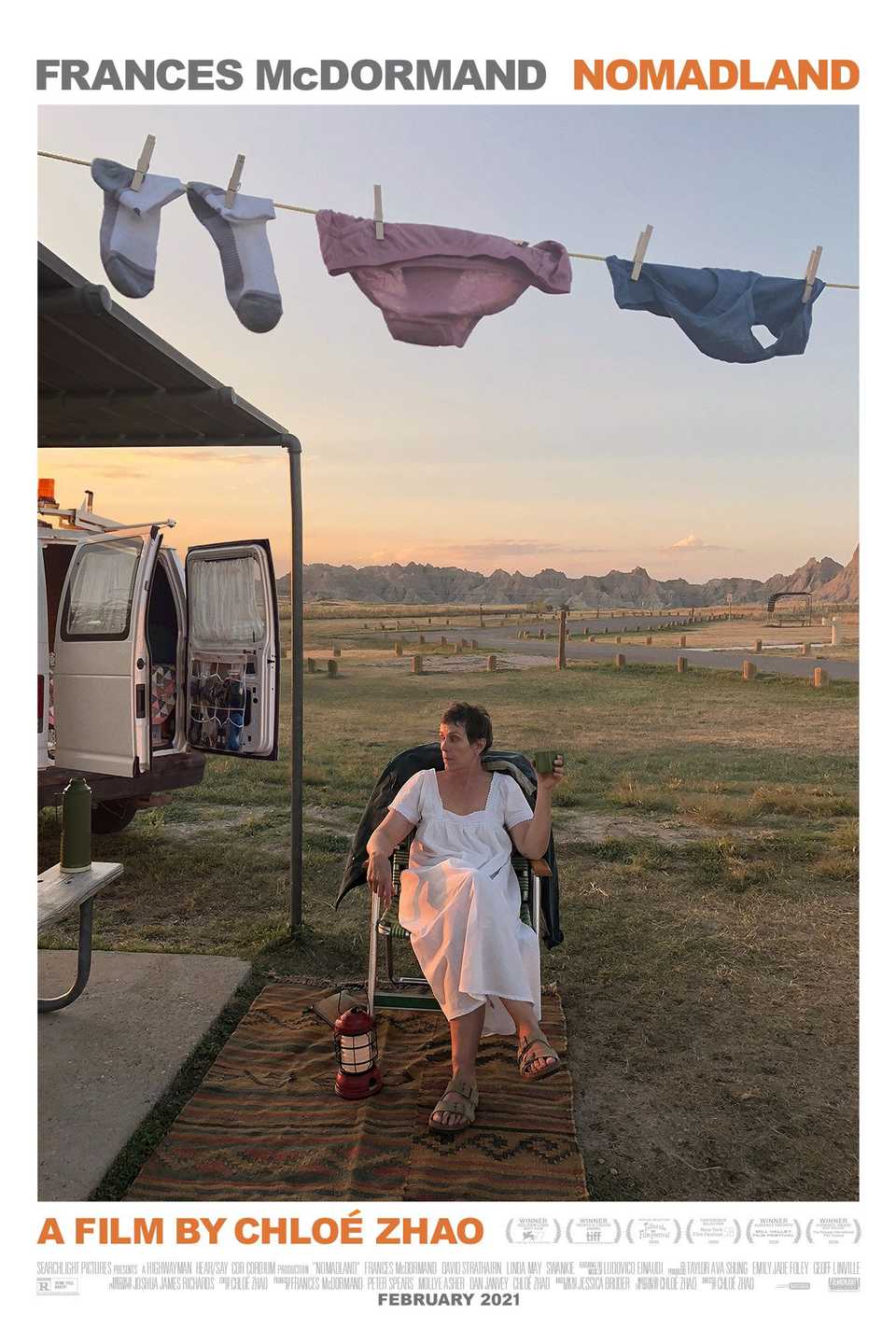
Nomadland stars Frances McDormand as Fern, whose husband recently died. When she loses her job at US Gypsum after the plant shuts down in 2011, and the company town of Empire, Nevada, also closes, she sells her belongings, buys a van, and decides to begin living as a nomad. She takes seasonal jobs — at an Amazon fulfillment plant, as a camp host, at a sugar beet processing plant — and gets to know other fellow nomads along her travels.
Like Zhao’s other movies, Nomadland is quiet and contemplative, humanistic and naturalistic to a fault. Zhao tackles it with a cinéma vérité approach, more interested in revealing truth than in capturing sequences. At points, Nomadland seems more documentary than fiction, even using many non-professional actors. Zhao doesn’t concern herself with constructing a plot per se; instead, she becomes a silent observer: her camera slowly tracks Fern as she goes on long walks, works her many jobs with silent resolve, and rediscovers life, perhaps not with passion, but with determination and a desire to make the most of it.
Nomadland is perhaps the most life-affirming movie to claim Best Picture in the 21st century — perhaps of all time. Its power lies in its focus on the lives of those that society has left behind. Nomadland doesn’t romanticize the nomad experience; it’s not a PSA or a recruitment ad, but rather an ode to the everyday happenings that make up the bulk of our existence. It’s not about small lives, but the small moments that make up big lives, and every life is big. The film’s thesis is simple but no less potent: merely wanting to live and be present requires strength and courage. One doesn’t need to achieve to thrive; there’s dignity in merely being and power in enduring.
‘Nomadland’ Has Aged Incredibly Well
What makes a good Best Picture winner? Do we go for one of great staying power, like Casablanca or The Silence of the Lambs? Are we looking for a feat of filmmaking that pushes the medium’s limits and redefines genres, like It Happened One Night or Oppenheimer? Or perhaps it’s an icon, a title that becomes synonymous with cinema itself, like The Godfather or The Lord of the Rings: The Return of the King? I think the answer is far easier: a good Best Picture winner captures its time and place, encapsulating twelve months of cinematic achievement, representing the concerns of the medium and, thus, society at large.
People were scared shitless in 2020. Uncertainty was the order of the day, and there was a prevalent mood of dread. Many wondered if things would ever go back to normal — whatever “normal” means, anyway. Ask anyone what they remember about 2020, and they’ll probably say something along the lines of “routine” or “continuity.” It wouldn’t be an overstatement to say that 2020 didn’t quite exist, whether because we didn’t do much or because we’re so desperate to put it behind us. In that context, it makes sense that a movie like Nomadland, about the importance of everyday life and the solemnity that comes with going through another day, would resonate with Academy members and the viewers who actually watched it.
More than that, Nomadland has aged quite beautifully. Sure, it has given us its fair share of pop culture moments — going number two in buckets, this GIF, this image — but its power lies in just how well it captures the distinct time and place in which it was made. Nomadland is 2020: the good and the bad, the ugly and the beautiful, unfiltered reality, warts and all. At the time, its Oscar wins seemed okay enough, a final period to the long yet seemingly inconsequential sentence that was 2020. Yet, today, Nomadland is a cinematic testament, its victories poetic justice.
The film could’ve easily made the nomads’ lifestyle seem like a gimmick, an escape, or a last resort; instead, it paints it as a choice worthy of our respect. There’s a melancholy to it, but then again, there’s a melancholy to life. Compared to its competitors, many of which have aged like milk under the sun (cough, Promising Young Woman), Zhao’s masterpiece keeps getting better, an ode to camaraderie in a world that desperately needs to remember its humanity. Nomadland doesn’t exactly echo in the annals of cinematic excellence. Instead, it whispers, its influence far more intimate yet no less powerful. It’s not the type of film that makes a brute impact, but it leaves a lasting one, a feeling that’s impossible to shake. And if that doesn’t make a great Best Picture winner, I don’t know what does.
Nomadland is available to rent or buy on VOD services.

- Release Date
-
February 19, 2021
- Runtime
-
107 minutes