Thrillers from the ‘90s just hit differently. For some reason, films from that era had a way of crawling under the audience’s skin without needing to rely on hollow twists every 10 minutes or turning everything into franchise bait. They felt darker, stranger, and far more willing to leave the audience with a sense of discomfort.
That’s because these stories never followed a set formula. The best ’90s thrillers cared less about nonstop spectacle and more about atmosphere, character psychology, and trusting the audience to make peace with ambiguity. Here is a list of six such ‘90s thrillers that still hold up better than today’s movies because they were actually willing to take risks.
Advertisement
1
‘Seven’ (1995)
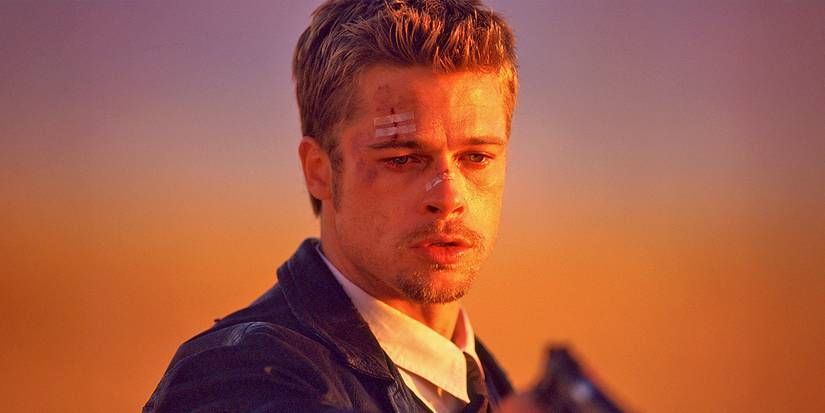
A close-up of Detective Mills (Brad Pitt) crying while holding a gun in Se7en.Image via New Line Cinema
To this day, Seven remains one of the most disturbing thrillers ever made because it understands that real horror comes from psychology, not just spectacle. David Fincher’s masterpiece follows exhausted detective William Somerset (Morgan Freeman) and impulsive younger cop David Mills (Brad Pitt) as they investigate a series of gruesome murders inspired by the seven deadly sins. The killer, John Doe (Kevin Spacey), seems to be carrying out some twisted form of moral punishment, which makes Seven so much more unsettling than a standard serial-killer thriller. Fincher strays away from excessive exposition and overcomplicated action sequences to keep the audience invested.
The dreary atmosphere of the unnamed city in which the story takes place practically embodies Somerset and Mills’s exhaustion. Seven doesn’t rush to catch the murderer because it understands that the ending only works if the audience has been slowly consumed by the same sense of fear as the characters. The film’s unforgettable climaxstill hits like a sucker punch while also feeling completely inevitable at the same time. Many thrillers have tried copying Seven over the years, but have failed to understand that the film’s stylistic choices alone aren’t what made it work. Seven still holds up today because it’s intelligent in how it treats its violence with a larger purpose. That unique angle is something many modern thrillers just can’t seem to recreate.
Advertisement
2
‘The Silence of the Lambs’ (1991)
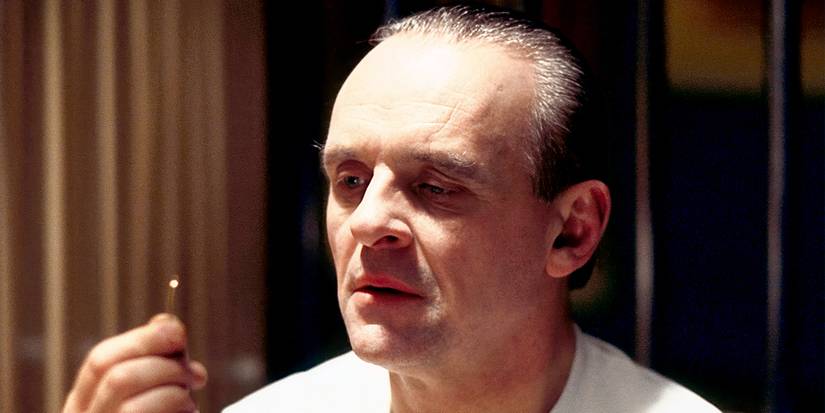
Anthony Hopkins staring intently at a small metal object in The Silence of the Lambs.Image via Orion Pictures
The Silence of the Lambsis another genre-defining thriller that understands the art of blending style with substance. The film follows FBI trainee Clarice Starling (Jodie Foster), who is assigned to interview imprisoned cannibalistic psychiatrist Hannibal Lecter (Anthony Hopkins) in the hope that he can help authorities catch another serial killer known as Buffalo Bill. The investigation gradually evolves into something much more intense as every conversation between the two feels psychologically intense and manipulative. The story is constantly focused on her perspective, especially her experience navigating male-dominated institutions where she is routinely underestimated.
That detail becomes important in her scenes with Lecter because, despite how terrifying he is, he also becomes one of the few characters who fully recognize her intelligence. Hopkins’s performance as the notorious serial killer is controlled, yet suffocating because the audience knows that he is always ahead of the curve. The Silence of the Lambs is a masterclass in character building and demands the audience’s full attention. Many modern thrillers still borrow elements from the film, especially the archetypes of the brilliant serial killer and morally complex investigator. However, very few manage to replicate the film’s emotional depth.
Advertisement
Collider Exclusive · Action Hero Quiz Which Action Hero Would Be Your Perfect Partner? Rambo · James Bond · Indiana Jones · John McClane · Ethan Hunt
Advertisement
Five legends. Five completely different ways of getting out alive — with style, with muscle, with charm, with luck, or with a plan so intricate it probably shouldn’t work. Ten questions will reveal which action hero was built to have your back.
🎖️Rambo
🍸James Bond
🏺Indiana Jones
🔧John McClane
Advertisement
🎭Ethan Hunt
Advertisement
01
You’re dropped into a dangerous situation with no warning. What do you need most from a partner? The first few seconds tell you everything about who belongs beside you.
Advertisement
02
You have to get somewhere dangerous, fast. How do you travel? How you get there is half the mission.
Advertisement
03
You’re pinned down and outnumbered. What does your ideal partner do? This is when you find out what someone is really made of.
Advertisement
04
The mission is paused. You have one evening to decompress. What does your partner suggest? Who someone is when the pressure drops is who they actually are.
Advertisement
05
How do you prefer your partner to communicate mid-mission? Good communication is the difference between partners and a liability.
Advertisement
06
Your enemy is powerful, well-resourced, and has the upper hand. How should your partner approach them? The approach to the enemy defines the partnership.
Advertisement
07
Things go badly wrong and you’re captured. What do you trust your partner to do? Who someone is when you need them most is the only thing that matters.
Advertisement
08
What does your ideal partner bring to the table that you couldn’t replace? A great partner fills the gap you didn’t know you had.
Advertisement
09
Every partnership has a cost. Which of these can you live with? No one comes without baggage. The question is whether you can carry it together.
Advertisement
10
It’s the final moment. Everything is on the line. What do you need from your partner right now? The last question is the most honest one.
Advertisement
Your Partner Has Been Assigned Your Perfect Partner Is…
Your answers have pointed to one action hero above all others. This is the person built to have your back — for better or considerably, spectacularly worse.
Rambo
Advertisement
Your partner doesn’t talk much, doesn’t need to, and will have assessed every threat in your immediate environment before you’ve finished your first sentence. John Rambo is not a man of plans or politics — he is a force of nature shaped by survival, loyalty, and a capacity for endurance that goes beyond anything training can produce. He will not leave you behind. He has never left anyone behind who deserved to come home. What you get with Rambo is the most capable, most quietly ferocious partner imaginable — one who has been through things that would have broken anyone else, and who chose to keep going anyway. You’ll never need to ask if he has your back. You’ll just know.
James Bond
Your partner will arrive perfectly dressed, perfectly briefed, and with a cover story so convincing it’ll take you a moment to remember what’s actually true. James Bond is the most professionally dangerous person in any room he enters — and the most disarmingly charming, which is the point. He operates in a world of layers, where nothing is what it appears and every advantage is used without apology. You’ll never be bored. You’ll occasionally be furious. But when it matters — when the mission is genuinely on the line and the margin for error has collapsed to nothing — Bond is exactly the partner you want. He has survived things that have no business being survivable. He does it with style. That is not nothing.
Advertisement
Indiana Jones
Your partner will know the history, the language, the cultural context, and exactly why the thing everyone else is ignoring is actually the most important thing in the room. Indiana Jones is brilliant, reckless, and occasionally impossible — but he is also one of the most resourceful, most genuinely knowledgeable partners you could find yourself beside. He approaches every situation with a scholar’s eye and a brawler’s instinct, which is an unusual combination and a remarkably effective one. He hates snakes and gets personally attached to objects of historical significance, both of which will slow you down at least once. It doesn’t matter. What Indy brings is irreplaceable — and the adventures you’ll have together will be the kind people write books about. Assuming you survive them.
Advertisement
John McClane
Your partner was not supposed to be here. He does not have the right equipment, the right information, or anything approaching the right odds. He has a sarcastic remark and an absolute refusal to accept that the situation is as bad as it looks. John McClane is the greatest accidental hero in the history of action cinema — a man whose superpower is stubbornness, whose contingency plan is improvisation, and whose capacity to absorb punishment and keep moving would be alarming if it weren’t so useful. He will complain the entire time. He will make it significantly more chaotic than it needed to be. And he will absolutely, unconditionally, without question come through when it counts. Yippee-ki-yay.
Ethan Hunt
Advertisement
Your partner has already run seventeen scenarios by the time you’ve finished reading the briefing, and the plan he’s settled on involves at least two things that should be physically impossible. Ethan Hunt operates at the absolute edge of human capability — technically, physically, and intellectually — and he brings the same relentless precision to protecting his partners that he brings to dismantling organisations that shouldn’t exist. He is not easy to know and he will never fully tell you everything. But he will carry the weight of the mission so completely, so absolutely, that your job is simply to trust him — and the remarkable thing is that trusting him always turns out to be the right call. The mission will be impossible. He will complete it anyway.
Advertisement
3
‘A Few Good Men’ (1992)
Kevin Bacon as Captain Jack Ross in A Few Good MenImage via Columbia Pictures
A Few Good Men proves that dialogue can be just as intense as action. Rob Reiner’s courtroom drama follows Navy lawyer Daniel Kaffee (Tom Cruise), who is assigned to defend two Marines accused of murdering a fellow soldier at Guantanamo Bay. At first, the case appears fairly straightforward, but things become far more complicated once Kaffee and fellow lawyer Joanne Galloway (Demi Moore) begin suspecting that the accused Marines were acting under orders as part of an illegal disciplinary hazing known as a code red. The investigation slowly leads them toward the intimidating Colonel Nathan Jessep (Jack Nicholson), whose rigid worldview and obsession with military order fuel the central conflict of the story.
Advertisement
A Few Good Men features Cruise in one of the strongest performances of his career as he perfectly portrays Kaffee’s transformation from a smug lawyer who avoids difficult trials into someone genuinely willing to risk his career to uncover the truth. The final courtroom confrontation remains one of the most iconic climaxes in thriller history thanks to the psychological battle leading up to it. A Few Good Men never overcomplicates its story with unnecessary twists or shock factors. Instead, it trusts its characters, performances, and writing to carry the suspense, which is exactly why the film still feels so gripping more than 30 years later.
4
‘Heat’ (1995)
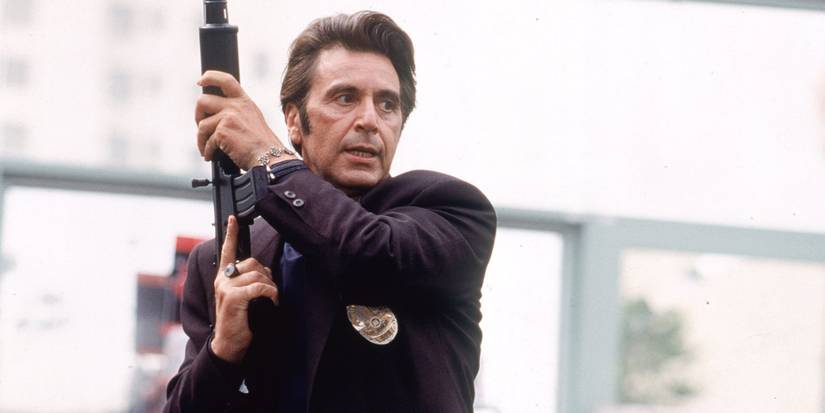
Al Pacino holding a rifle in ‘Heat’Image via Warner Bros. Pictures
Heat is the rare crime thriller that feels massive in scale yet intimate at the same time. The gripping story follows expert thief Neil McCauley (Robert De Niro) and obsessive LAPD detective Vincent Hanna (Al Pacino), two men who are standing on opposite sides of the law but are more similar than they might think. Both characters are brilliant at their jobs and terrible at maintaining pretty much anything outside of them. This dynamic is what hooks the audience as the story slowly brings these two men closer together. However, Heat never feels like a standard cop-versus-criminal showdown, but rather more like something inevitable because of its refusal to portray these characters as simply good or bad.
Advertisement
In fact, it constantly blurs the line between hunter and hunted until Hanna and Neil begin to feel almost interchangeable. The storytelling is patient and focuses just as much time on McCauley and Hanna’s personal lives as it does on the robberies themselves. Speaking of which, Neil’s final heist culminates in one of the most iconic shootouts ever put on screen. Aside from the thrill of it all, the sequence feels extremely realistic since it’s shot with brutal precision rather than flashy editing or exaggerated action. By the end, Heat goes behind the excitement of the heists and becomes a surprisingly sad story about two men who sacrificed everything for lives they know they can never escape.
5
‘12 Monkeys’ (1995)
Bruce Willis as James Cole looking offscreen in 12 MonkeysImage via Universal Pictures
Terry Gilliam’s sci-fi thriller, 12 Monkeys, has only gotten more unsettling with time. The story takes place in a future where a deadly virus has wiped out most of humanity and follows prisoner James Cole (Bruce Willis), who is sent back in time to gather information about the outbreak before it happens. However, things quickly spiral once Cole is mistakenly sent to 1990 instead of 1996 and ends up trapped inside a psychiatric hospital. There, he meets psychiatrist Dr. Kathryn Railly (Madeleine Stowe) and unpredictable mental patient Jeffrey Goines (Brad Pitt), whose connection to the mysterious Army of the Twelve Monkeys slowly drives the film deeper into paranoia and uncertainty.
Advertisement
The plot constantly shifts between reality, memory, dreams, and possible delusion, which gives the movie its unique, disorienting atmosphere.12 Monkeys never treats time travel like a pure gimmick and actually focuses on its psychological consequences. The protagonist is trapped in this almost nightmarish world where both he and the audience are forced to question everything. By the end, 12 Monkeys turns into something far more tragic than a standard sci-fi thriller with a haunting conclusion that feels impossible to escape.
6
‘Jacob’s Ladder’ (1990)
Image via Tri-Star Pictures
Jacob’s Ladder is easily one of the most disturbing psychological horror films ever made. The story follows Vietnam veteran Jacob Singer (Tim Robbins), whose life slowly begins falling apart after returning home from the war. He starts experiencing terrifying hallucinations, violent flashes of imagery, and moments where reality feels unstable. As these visions become more intense, Jacob starts believing that something happened to his platoon in Vietnam, possibly involving a secret military experiment, and his desperate search for answers slowly turns into something much darker.
Advertisement
The film traps the audience inside Jacob’s perspective and blurs the line between nightmare, memory, and reality until the viewers become just as disoriented as Jacob. This sense of uncertainty makes the horror scenes genuinely terrifying instead of being driven by shock value. Robbins gives one of the best performances of his career thanks to the vulnerability and exhaustion he brings to Jacob’s character. The movie’s spiritual themes also give it far more depth than most horror films from that era. Beneath the paranoia and surreal imagery, Jacob’s Ladder is really about accepting death, letting go of suffering, and finding peace in the middle of chaos.





You must be logged in to post a comment Login