The six thrillers on this list are stories of systems turning hungry. Rules become loopholes, routines become rituals, and ordinary ambitions begin demanding sacrifices their owners never expected to make. And at their core, that depth is exactly what makes a thriller thrill.
Their methods vary though. One may tighten around the viewer almost imperceptibly, while another arrives already breathless and stays that way. What connects them is the cruel precision of their design. Each film finds the pressure point in its protagonist’s life and keeps pressing until profession, desire, and identity collapse into the same problem. Every institution in these films makes a promise. Let’s dig in.
Advertisement
6
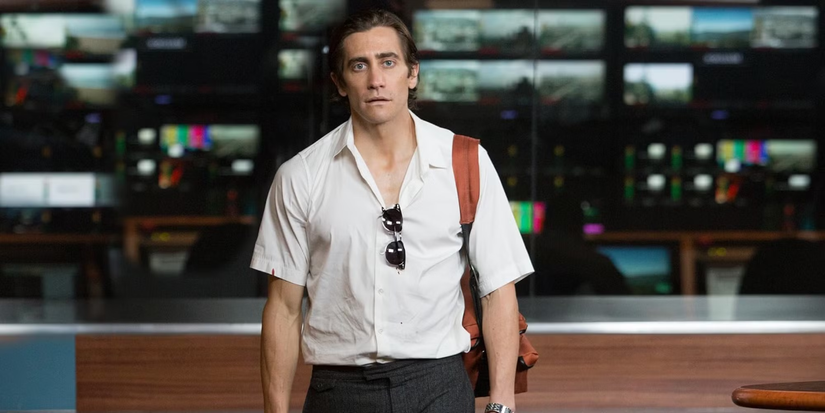
‘Nightcrawler’ (2014)
Image via Open Road Films
Los Angeles after midnight becomes a marketplace in Nightcrawler, where Lou Bloom (Jake Gyllenhaal) discovers that freelance camera crews can sell footage of crashes, fires, and murders to local television stations. Lou has no journalism experience and even less empathy. He does possess ambition, discipline, and an alarming talent for learning exactly how close he can get to suffering before anyone stops him. News director Nina Romina (Rene Russo) rewards the ugliest footage, giving Lou a customer who understands that frightened viewers are excellent for ratings.
Lou is terrifying since he speaks the language of self-improvement while treating every person around him as equipment. Compliments sound rehearsed. Negotiations become threats with good posture. His employee Rick (Riz Ahmed) slowly realizes that working for Lou means entering a business where basic decency counts as a competitive disadvantage. Dan Gilroy’s screenplay received an Academy Award nomination, and its attack on sensationalist news has only grown sharper in an age built around engagement at any cost. Put this on after midnight. The city will look slightly hungrier afterward.
Advertisement
5
‘Sicario’ (2015)
Benicio del Toro as Alejandro Gillick looking to the side, standing in a doorway in Sicario.Image via Lionsgate
Sicario places FBI agent Kate Macer (Emily Blunt) inside a government operation targeting a major drug cartel along the United States, Mexico border. Kate joins expecting a difficult law-enforcement mission. She quickly discovers that task-force leader Matt Graver (Josh Brolin) and mysterious consultant Alejandro Gillick (Benicio del Toro) follow rules she has never been allowed to read. Her credentials get her through the door. They do very little once the operation begins moving.
The border convoy establishes the film’s entire power structure through glances, traffic, and armed men waiting for permission to react. Kate is capable, alert, and increasingly aware that her presence may serve a purpose unrelated to her expertise. The film is written by Taylor Sheridan, and it entered competition at Cannes and later received Academy Award nominations for cinematography, original score, and sound editing.
Advertisement
4
‘Uncut Gems’ (2019)
Adam Sandler as Howard in an elevator in Uncut Gems.Image via A24
One enormous bet is never enough for Howard Ratner (Adam Sandler) in Uncut Gems. He runs a jewelry store in New York’s Diamond District, owes money to dangerous people, and keeps moving valuables between customers, relatives, pawnbrokers, and lenders to create another chance at a life-changing score. An Ethiopian black opal and a visit from basketball star Kevin Garnett appear to offer the breakthrough Howard has been chasing. He immediately finds several ways to make the situation riskier.
Howard is intelligent enough to understand every deal and addicted enough to ignore the total picture. Success calms him for seconds before producing a larger appetite. The overlapping conversations, cramped rooms, buzzing phones, locked security doors, and electronic score make daily business feel like a citywide panic attack. Kevin Garnett appears as himself, and his belief in the opal becomes another variable inside Howard’s increasingly fragile calculations. The astonishing part is how often you begin believing his next move could actually solve everything. Then he starts talking again.
Advertisement
Collider Exclusive · Oscar Best Picture Quiz Which Oscar Best Picture Is Your Perfect Movie? Parasite · Everything Everywhere · Oppenheimer · Birdman · No Country
Advertisement
Five Oscar Best Picture winners. Five completely different visions of what cinema can be — and what it can do to you. One of them is the film that was made for the way your mind works. Ten questions will figure out which one.
🪜Parasite
🌀Everything Everywhere
☢️Oppenheimer
🐦Birdman
Advertisement
🪙No Country for Old Men
Advertisement
01
What kind of film experience do you actually want? The best movies don’t just entertain — they leave something behind.
Advertisement
02
Which idea grabs you most in a film? Great films are driven by a central obsession. What’s yours?
Advertisement
03
How do you like your story told? Form is content. The way a story is shaped changes what it means.
Advertisement
04
What makes a truly great antagonist? The opposition defines the protagonist. What kind of opposition fascinates you?
Advertisement
05
What do you want from a film’s ending? The final note is the one that lingers. What do you want it to sound like?
Advertisement
06
Which setting pulls you in most? Where a film takes place shapes everything — mood, stakes, what’s even possible.
Advertisement
07
What cinematic craft impresses you most? Every great film has a signature — a technical or artistic element that makes it unmistakable.
Advertisement
08
What kind of main character do you root for? The protagonist is the lens. Who you choose to follow says something about you.
Advertisement
09
How do you feel about a film that takes its time? Pace is a choice. Some films sprint; others let tension accumulate slowly, deliberately.
Advertisement
10
What do you want to feel walking out of the cinema? The best films leave a mark. What kind of mark do you want?
Advertisement
The Academy Has Decided Your Perfect Film Is…
Your answers have pointed to one Oscar Best Picture winner above all others. This is the film that was made for the way your mind works.
Advertisement
Parasite
You are drawn to films that operate on multiple levels simultaneously — that begin in one genre and quietly, brilliantly migrate into another. Bong Joon-ho’s Parasite is a film about class, desire, and the architecture of inequality that manages to be darkly funny, deeply suspenseful, and genuinely shocking across a single extraordinary running time. Your instinct is for cinema that hides its true intentions until the moment it’s ready to reveal them. Parasite is exactly that — a film that rewards close attention and punishes assumptions, right up to its devastating final image.
Advertisement
Everything Everywhere All at Once
You want it all — and this film gives you all of it. The Daniels’ Everything Everywhere All at Once is one of the most maximalist films ever made: action comedy, multiverse sci-fi, family drama, existential crisis, and a genuinely earned emotional core that sneaks up on you amid the chaos. You are someone who responds to ambition, who doesn’t want cinema to choose between being entertaining and being meaningful. This film refuses that choice entirely. It is overwhelming by design, and its overwhelming nature is precisely the point — because the feeling of being crushed by infinite possibility is exactly what it’s about.
Advertisement
Oppenheimer
You are drawn to cinema on a grand scale — films that understand history not as a backdrop but as a force, and that place their characters inside that force and watch what happens. Christopher Nolan’s Oppenheimer is a film about the terrifying gap between what we can do and what we should do, told with the full weight of one of the most consequential moments in human history behind it. You want your films to feel important without feeling self-important — to earn their ambition through sheer craft and the gravity of their subject. Oppenheimer does exactly that. It is enormous, complicated, and refuses easy comfort.
Advertisement
Birdman
You are drawn to films that foreground their own construction — that make the how of the filmmaking part of the what it’s about. Alejandro González Iñárritu’s Birdman, shot to appear as a single continuous take, is cinema examining itself through the cracked mirror of a fading actor’s ego. You respond to formal daring, to the feeling that a film is doing something that probably shouldn’t be possible. Michael Keaton’s performance and Emmanuel Lubezki’s restless camera create something genuinely unlike anything else — a film that is simultaneously about creativity, relevance, self-destruction, and the impossibility of ever truly knowing if your work means anything at all.
Advertisement
No Country for Old Men
You are drawn to cinema that trusts silence, that refuses to explain itself, and that treats dread as a form of meaning. The Coen Brothers’ No Country for Old Men is a film about the arrival of a new kind of evil — implacable, arbitrary, and utterly indifferent to the moral frameworks we use to make sense of the world. It is one of the most formally controlled films ever made, and its controlled restraint is what makes it so terrifying. You want your films to haunt you, not comfort you. You are not interested in resolution if resolution would be dishonest. No Country for Old Men is honest in a way that most cinema never dares to be.
Advertisement
3
‘Prisoners’ (2013)
Hugh Jackman’s Keller looking intense in PrisonersImage via Summit Entertainment
Advertisement
A Thanksgiving gathering becomes every parent’s nightmare in Prisoners when two young girls disappear from a Pennsylvania neighborhood. Detective Loki (Jake Gyllenhaal) follows the available evidence, beginning with an RV seen nearby. Keller Dover (Hugh Jackman), the father of one missing child, decides the official investigation is moving too slowly and takes control of the main suspect himself. From there, the search becomes two stories about certainty. One man needs proof. The other believes fear has given him permission to act without it.
Keller’s choices create the film’s most uncomfortable question. How much cruelty will an audience tolerate from someone whose desperation feels understandable? Loki keeps encountering mazes, damaged witnesses, old crimes, and leads that seem meaningful until examined from another angle. The cold November landscape traps everyone beneath gray skies and constant rain, with homes offering almost no sense of safety. The film’s sole Academy Award nomination recognized the cinematography of Roger Deakins. Few missing-person thrillers sustain this much moral pressure for this long.
2
‘The Handmaiden’ (2016)
Image via Amazon Studios
Advertisement
Set in Korea during Japanese colonial rule, The Handmaiden begins with pickpocket Sook-hee (Kim Tae-ri) entering the secluded estate of Lady Hideko (Kim Min-hee). She has been hired as Hideko’s maid while secretly helping a con man, Count Fujiwara (Ha Jung-woo), who plans to marry the heiress and steal her fortune. The scheme looks carefully designed. The estate contains its own systems of control, and Hideko understands far more about captivity than her new handmaiden initially realizes.
The source is Sarah Waters’ novel Fingersmith, originally set in Victorian England. Relocating the story to 1930s Korea adds colonial identity, language, architecture, and cultural performance to an already elaborate con. The three-part structure revisits crucial events from new perspectives, transforming gestures that appeared innocent, calculated, or cruel. Its production design blends Japanese and British influences inside a house that feels beautiful, divided, and deeply unhealthy. The film competed at Cannes and later won the BAFTA for Film Not in the English Language.
1
‘Parasite’ (2019)
Park So-dam and Choi Woo-shik check their cellphones in a scene from Parasite.Image via NEON
Advertisement
Parasite begins with the unemployed Kim family living together in a cramped semi-basement apartment in Seoul. When son Ki-woo (Choi Woo-shik) gets an opportunity to tutor the daughter of the wealthy Park family, the Kims recognize an opening. One position inside the Park household gradually leads to another, and the family builds an elegant plan around forged qualifications, social confidence, and the Parks’ inability to imagine how carefully they are being studied.
The class argument is built into physical space. The Parks live behind walls and above the city in sunlight. The Kims climb stairs to reach them, then descend through Seoul whenever wealth sends them home. Comedy, con-game tension, domestic drama, and horror move together so naturally that the genre seems to change before the viewer notices. Its Cannes Palme d’Or began an extraordinary awards run, followed by Oscars for Best Picture, directing, original screenplay, and international feature. It became the first non-English-language film to win Best Picture. No thriller since 2010 has balanced entertainment, craft, anger, and emotional damage this completely.










You must be logged in to post a comment Login