Entertainment
6 Near-Perfect Hard Sci-Fi Shows on Apple TV, Ranked

One of the most addictive genres on television remains science fiction. From space stories to technology thrillers, the genre has provided an opening for viewers to tap into worlds far removed through stories rooted in science. Now, some sci-fi films are so brazen and fantastical that we know they can’t be real. They play by their own rules. But for hard sci-fi, they use elements grounded in facts.
When it comes to hard sci-fi, Apple TV has a handful of series that are near perfect. From journeys into space to adventures before the surface, the streamer has hosted some gripping shows that leave us never wanting the story to end. The six titles on this list will scratch the sci-fi itch while keeping you entertained with authentic scientific elements.
6
‘Constellation’ (2024)


Even though a show is canceled after a single season, it doesn’t mean it’s bad. It just means the right eyes weren’t on it. Such is the case for the near-perfect single season of Constellation. Created by Peter Harness, Constellation follows the events of an unidentified object that collided with the International Space Station, leading to the death of one of the five astronauts aboard and crippling most of the onboard systems and one of the Soyuz descent modules. A physics experiment called CAL, or Cold Atom Lab, designed to study quantum states where objects can exist in two places at once, was running at the time of the catastrophic event, causing the surviving astronauts and cosmonauts to swap places with their mirror-universe doubles. In one reality, it’s Jo Ericsson (Noomi Rapace) who died in the collision. In the other, it’s Paul Lancaster (William Catlett). The mind-bending sci-fi psychological thriller explores quantum superposition, parallel universes, and the simultaneous acceptance and adaptation to the new entangled reality.
Constellation is a series unlike any other. It’s not always the easiest to follow, requiring viewers to focus and not use it as background noise. In turn, the mind-bending narrative taps into an unpredictable puzzle that leaves you guessing throughout the eight episodes. A visually stunning series, Constellation has no shortage of zero-gravity sequences and spacewalks that make you feel as if you’re up in the stars. Constellation is also filled with sensational performances, namely from Rapace and Jonathan Banks as Henry and Bud Caldera, mirror-universe counterparts. Constellation uses legitimate scientific concepts, including the observer effect, to explain phenomena such as the multiverse and parallel realities. Then, add in the practical psychological horror of the trauma from long-term spaceflight, and the narrative feels authentic. Constellation traps everyday astronauts in a scientifically explainable but terrifying phenomenon.
5
‘Dark Matter’ (2024–Present)


The multiverse conceit continues to be a messy but often-used narrative tool that provides for great entertainment. In the series Dark Matter, it serves as the central device that propels the plot. Created by Blake Crouch, the enthralling thriller follows Jason Dessen (Joel Edgerton), a Chicago physicist who is abducted and thrust into the multiverse. He wakes up in alternate realities where his life choices went differently, and he must fight his way back home through a labyrinth of parallel worlds to save his true family from the most dangerous foe imaginable: himself. A deeply character-driven love story set within a high-stakes multiverse thriller, Dark Matter explores the roads not taken, challenging viewers with a core question: Are you happy in your life?
Based on Crouch’s own book, Dark Matter is precisely plotted, ensuring the magic and heart are present in the adaptation. Further, his ability to keep scientific elements within the fantastical premise keeps viewers engaged. Dark Matter uses real quantum mechanics, particularly Schrödinger’s cat and superposition, as the framework for the plot. Giving audiences something tangible lends itself to seamless storytelling that doesn’t pull the viewer out to question the implausible things. Dark Matter features remarkable performances led by Edgerton and carried through by Jennifer Connelly, Alice Braga, and Jimmi Simpson. Edgerton’s ability to navigate his characters, separating regular-guy Jason from ruthless Jason, carries the series to glory. Dark Matter may very well be a sci-fi show, but its human story is the reason to tune in.
4
‘For All Mankind’ (2019–Present)

Imagine a world in which the United States lost the space race. It might be hard to believe, but then For All Mankind told us what that alternative history might look like. Created by Ronald D. Moore, Matt Wolpert, and Ben Nedivi, the series explores what would have happened if the global space race had never ended. The premise begins in 1969 when the Soviet Union successfully lands the first man on the Moon, dealing a devastating blow to the United States and intensifying the Cold War. By changing a single significant historical event, For All Mankind creates a massive butterfly effect, featuring rapid technological innovation, political intrigue, and an optimistic vision of human perseverance.
For All Mankind is a brilliant “what if” drama. Across each season, the series organically leaps about a decade forward, showcasing how that inciting event reshaped reality. In turn, it forces characters to age, evolve, and adapt to new eras of technology and global politics. For All Mankind is rooted in character-driven drama, centered on human ambition, sacrifice, and the emotional toll that space exploration and grueling career choices take on the astronauts and their families. The hard science comes in as For All Mankind changes events, but not the science itself. The series, among other things, delves into real-world orbital mechanics, engineering, and physics that govern humanity’s expansion into space. A bingeable epic, For All Mankind is a brilliant alternate-history season that is so good you get more from a different perspective: Star City.
3
‘Foundation’ (2021–Present)

Predicting the future may yield grim outcomes, leading to further destruction to prevent imminent doom. That’s the basic premise of Foundation. Based on Isaac Asimov’s novels, the three-season series follows mathematician Hari Seldon, who invents “psychohistory,” a mathematical science capable of predicting the behavior of massive populations and charting the future of the galaxy. In turn, it predicts the inevitable fall of the Galactic Empire. To prevent a 30,000-year dark age, he leads exiles to establish “the Foundation” to preserve humanity’s knowledge and rebuild civilization. The tyrannical ruling dynasty attempts to crush the Foundation, viewing it as a threat to their absolute power. Successfully adapting Asimov’s “unadaptable” novels, Foundation is rooted in grounded, emotional narratives with rich world-building and hard science.
The century-spanning story centers on the conflict between the ruling imperial Genetic Dynasty via the clones of Emperor Cleon (Lee Pace) and the Foundation, including Gaal Dornick (Lou Llobell), a prodigy who helps develop the plan, and Salvor Hardin (Leah Harvey), the warden of Terminus, as they navigate the predicted fall. The series relies heavily on the tension between science and faith, the nature of power, and the question of whether historical events can be altered. With Asimov’s invention of psychohistory, Foundation has, well, a foundation on which to stand. Having a meticulous, predictable, mathematical science at its core, there is great freedom to build a detailed, multi-generational galactic history. It may not be instantly familiar, but it swiftly becomes accessible. With breathtaking cinematography, Foundation is an intelligent and entertaining series.
2
‘Invasion’ (2021–Present)

And now it’s time for some aliens! Created by Simon Kinberg and David Weil, the multilingual format Invasion tells the story of an extraterrestrial threat to Earth’s existence, told through the eyes of ordinary people around the world. Rather than focusing purely on military battles, the show explores human relationships, fear, and survival during an extinction-level event. In New York, the Malik family fights to survive both the alien chaos and collapsing societal norms. Then there is Mitsuki Yamato (Shioli Kutsuna), a communications specialist for the Japanese space agency, who searches for answers regarding a lost spacecraft; Caspar Morrow (Billy Barratt), a bullied schoolboy in London on a field trip that takes a dangerous, mysterious turn; and Trevante Ward (Shamier Anderson), a U.S. Navy SEAL whose unit is ambushed in the Middle East. A tried-and-true character-driven drama that spans multiple continents into a harrowing tale, Invasion captures the raw, psychological terror of a global catastrophe.
Invasion smartly focuses on humanity over spectacle. That said, the visuals’ cinematic quality, atmospheric score, and international locales give the series a theatricality that feels like a global event. A slow-burning series, Invasion is one for patient people. The story allows its characters and narrative arcs to develop fully over multiple seasons, giving it a truly episodic vibe. While there is great mystery surrounding the extraterrestrials, the characters’ arcs are heavily rooted in the scientific process and deep personal grief rather than fantastical technology. Everything found inside Invasion is methodical, giving the show a more psychologically grounded science-fiction survival-story epic. There may be aliens, but Invasion is a refreshing people-first thriller.
1
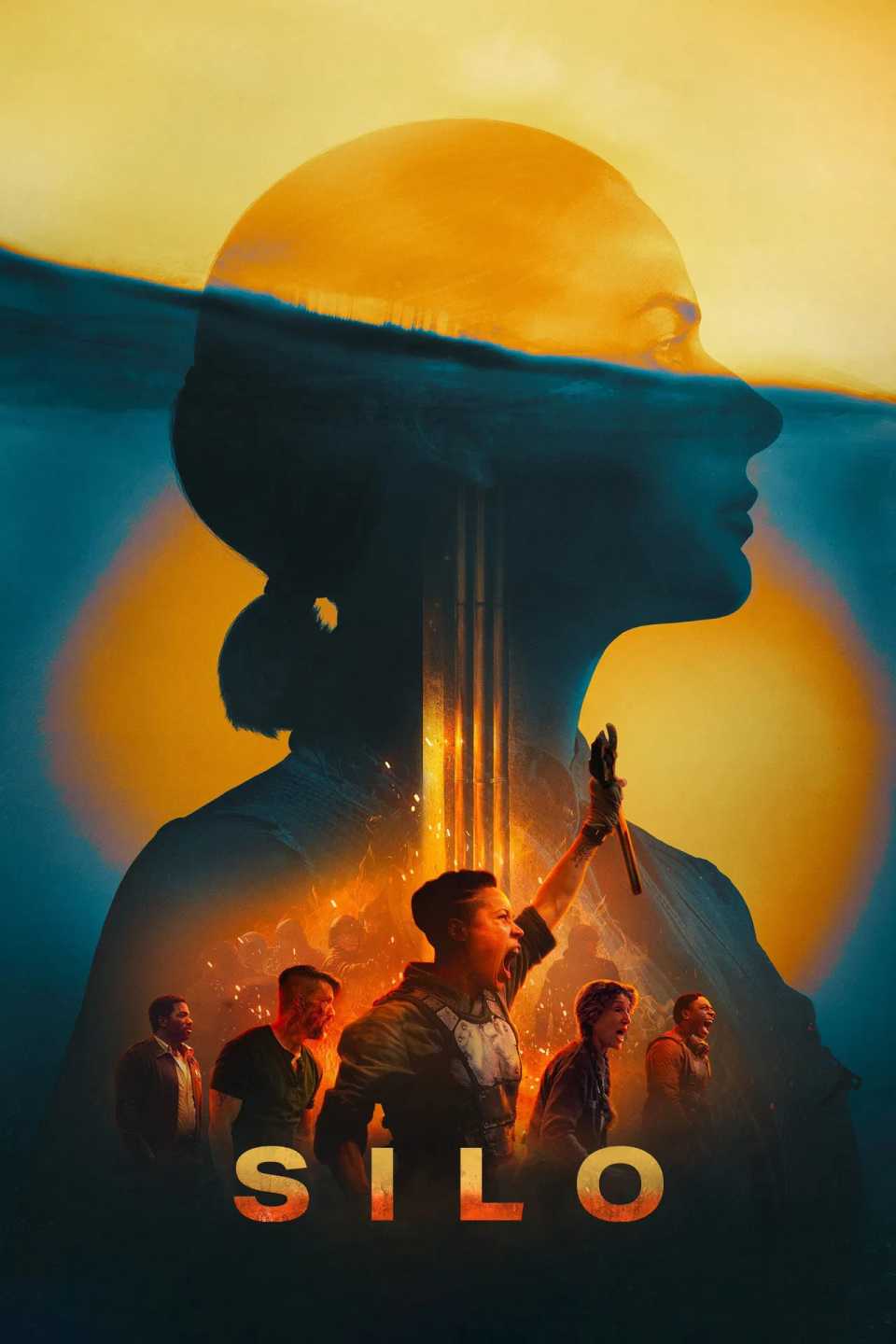
‘Silo’ (2023–Present)

It pains my soul to say Silo is only near-perfect, but compared to Severance and Pluribus, it’s a notch below. Nevertheless, it remains one of the greatest shows on the streamer. Created by Graham Yost and based on the Silo trilogy of novels by Hugh Howey, the series is set in a dystopian future where a community lives in a giant underground silo with 144 levels. The residents are governed by strict rules and believe the outside world is a toxic, ruined wasteland. Engineer Juliette Nichols (Rebecca Ferguson) becomes embroiled in the mystery of the past and the present as she seeks to uncover the dark, murderous conspiracy behind their existence. A brilliant mystery box that continues to expand the universe’s lore season by season, Silo is a fight for survival after a lie to survive.
Instead of relying on magical or futuristic technology, the show grounds itself in realistic mechanics, sociological theory, and the harsh, immutable rules of a confined, dystopian environment. And this society is no cakewalk to live in. The psychological effects of scarcity, resource management, and how totalitarian surveillance and history-erasure can shape a closed population over centuries are central to its narrative. Despite being a future-set thriller, science falls into the past. Due to the lack of technological evolution, the denizens of the silo use our modern technology in their future dystopia — steam, generators, heat dissipation, and the brutal physics of moving up and down the massive structure — making it appear as a mind-bending juxtaposition. Come for the intriguing story, stay for the top-rate ensemble, featuring Rashida Jones, David Oyelowo, Common, Tim Robbins, Harriet Walter, and more. Silo is a great example of why hard science is such a necessary genre within the sci-fi umbrella.

- Release Date
-
May 5, 2023
- Showrunner
-
Graham Yost
You must be logged in to post a comment Login