Entertainment
8 Best Alternate History Movies That Leave Period Pieces in the Dust

Well-done historical films often strive for accuracy, meticulously recreating costumes, settings, and real-world events in an effort to transport audiences back into the past. But sometimes the most fascinating way to explore history is by asking a simple question: what if things had gone differently? Alternate history stories take familiar timelines and twist them, imagining worlds where scientific breakthroughs arrive earlier, wars end differently, or hidden forces reshape the course of events entirely.
The results can be far more imaginative — and sometimes more revealing — than traditional period pieces. By bending reality, filmmakers gain the freedom to explore deeper cultural anxieties, political tensions, and philosophical questions that might otherwise remain hidden. So, whether through satirical mockumentaries, speculative science fiction, or bold genre mashups, these are the films that transform history into something thrillingly unpredictable.
1
‘C.S.A.: The Confederate State of America’ (2004)


Presented as a satirical television broadcast, C.S.A.: The Confederate States of America imagines a chilling alternate timeline in which the Confederacy won the American Civil War. Framed like a documentary airing on a fictional Confederate television network, the film depicts a modern America still governed by slavery, racial hierarchy, and deeply ingrained systemic oppression. Through fake commercials, news segments, and historical retrospectives, it constructs an unsettling version of history that feels disturbingly plausible.
What makes the film so effective is its commitment to the format. Writer-director Kevin Willmott uses the mockumentary structure to expose the absurdity and brutality of institutional racism by presenting it through the mundane language of everyday media. The result is both darkly satirical and deeply uncomfortable. Indeed, rather than romanticizing the past like many traditional period pieces, C.S.A. weaponizes history to confront audiences with a version of America that forces difficult reflection.
2
‘Never Let Me Go’ (2005)


Set in an alternate version of late-20th-century England, three children are raised at an idyllic yet strangely secluded boarding school, Hailsham. As they grow older, the trio gradually learns the devastating truth about their purpose: they have been created to serve as organ donors, destined to sacrifice their lives so that others may live longer. Despite this looming fate, their lives unfold through friendships, jealousy, and love.
Never Let Me Go has proved itself as a haunting piece of alternate history in how quietly it presents its premise. The world looks almost identical to our own, with the dystopian reality revealed ever so slowly through subtle details rather than dramatic exposition. Of course, Kazuo Ishiguro‘s source novel lays the foundation for this retrained approach. However, credit must be given for the film’s ability to explore questions of humanity, morality, and what it means to live a meaningful life. Instead of rewriting history through spectacle, Never Let Me Go imagines a society shaped by a single scientific advancement — and the moral cost that follows.
3
‘Anastasia’ (1997)

In this animated re-imagining of Russian history, after the fall of the Romanov dynasty, two charming men plan to pawn off a phony Princess Anastasia look-alike to earn a reward from the Dowager Empress (Dame Angela Lansbury). Luckily for them, Anya (Meg Ryan) — a young woman suffering from amnesia — stumbles into the auditions, bearing a striking resemblance to the missing Princess. Little do they know, she is exactly the woman they are looking for.
While it does take enormous creative liberties with historical fact (note the megalomaniac lich sorcerer), Anastasia transforms tragedy into a sweeping fantasy adventure. The film blends alternate history with vibrant fairy tale elements, turning the mystery of the Romanov daughter’s fate into a lush animated musical. Sure, historians may raise their eyebrows, but between the story’s romantic optimism and rich visual style, Anastasia creates a sweeter version of history that feels far more magical than reality. Plus, at least this one is perfect for the whole family.
4
‘District 9’ (2009)

When a massive alien spacecraft arrives above Johannesburg in an alternate 1982 (and then seemingly stalls), humanity discovers its passengers are stranded extraterrestrial refugees. Decades later, the aliens have found themselves confined to overcrowded slums, while corporations exploit their technology. Meanwhile, government agent Wikus van de Merwe (Sharlto Copley) becomes entangled in the conflict after a mysterious accident begins transforming him into one of the creatures himself.
As a critically acclaimed sci-fi flick, District 9 brilliantly fuses the genre with alternate history by showcasing an apartheid society through the lens of extraterrestrial contact. The film’s documentary-style storytelling and gritty realism make its premise feel disturbingly believable. Rather than a traditional alien invasion tale, District 9 uses the vague framework of “history” to examine prejudice, exploitation, and systemic injustice with striking power.
5
‘Richard III’ (1995)

Set in an alternate version of the 1930s, this bold adaptation of Shakespeare‘s Richard III relocates the classic play to an England torn by civil war. Richard (Sir Ian McKellen) from the House of York dreams of nothing more than to become a fascist dictator — even if those ambitions require him to take out members of his own family.
By transforming the story into a stylized fascist Britain, the film grounds this famed Shakespearean drama deeper into humanity and reality. Director Richard Loncrain merges stage theatrics with cinematic spectacle, creating a world that feels both historical and eerily modern. The result is a political thriller that highlights how power-hungry ambition can flourish in any era.
6
‘April and the Extraordinary World’ (2015)
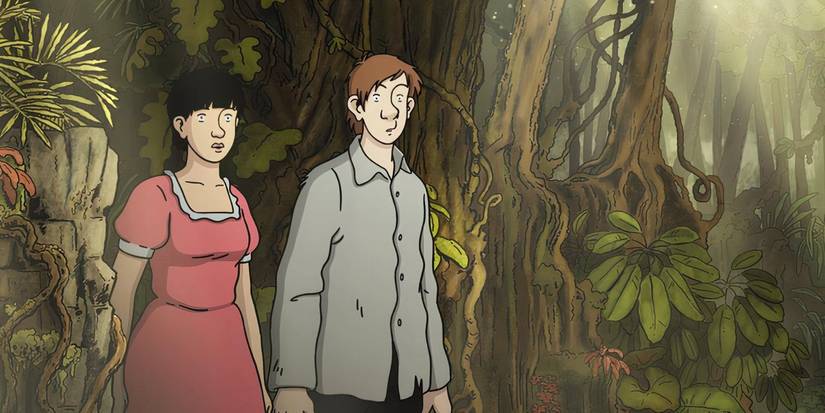
In a version of 1940s France, where the Franco-Prussian War was averted following the sudden death of Napoleon III, the world’s greatest scientists have mysteriously vanished for generations, leaving technological progress frozen in time. While young April (Marion Cotillard) spends her life searching for her missing parents — brilliant researchers who may hold the key to humanity’s stalled future — her journey leads her into secret societies, hidden laboratories, and a conspiracy stretching across the globe.
The film’s alternate timeline creates a fascinating world where steam technology dominates and modern innovation never fully arrives. With its hand-drawn animation and richly imagined setting, April and the Extraordinary World feels like a Jules Verne novel brought to life. The result is a whimsical yet thoughtful exploration of how scientific discovery shapes civilization itself. It’s a true underrated gem of the animated form.
7
‘Lola’ (2022)

Set in 1940s England, young inventor Thom (Emma Appleton) manages to build a mysterious machine capable of receiving radio and television broadcasts from the future. At first, she and her sister, Mars (Stefanie Martini), use the device to enjoy music and films that haven’t been released yet. But as World War II intensifies, the sisters begin sharing future knowledge with the British military — unknowingly altering the course of history itself.
Starting out as a playful sci-fi premise, Lola captivates audiences as it gradually evolves into something far more unsettling. The sisters’ attempt to manipulate the timeline creates ripple effects that reshape the war and ultimately spiral beyond their control. Told through archival-style footage — shot beautifully on 16mm and 35mm black-and-white film — Lola cleverly blurs the line between historical dramas and psychological thrills, crafting a tale that feels eerily dystopian even as it centers around history.
8
‘Inglourious Basterds’ (2009)

In a tale set during World War II, audiences are met with two parallel storylines: a group of Jewish-American soldiers hunts Nazis across occupied Europe, while a wronged young woman named Shosanna Dreyfuss (Mélanie Laurent) plots revenge against the regime that murdered her family. Their paths ultimately converge in Paris as they attempt to assassinate Nazi Germany’s leadership at a large cinema premiere.
In true Quentin Tarantino fashion, Inglourious Basterds delivers one of the most audacious alternate-history twists ever put on screen. Rather than faithfully recreating the past, the story gleefully rewrites it, turning a movie theater into the site of an explosive historical reckoning. Blending razor-sharp dialogue, unforgettable performances, and nerve-wracking suspense, this film proves that alternate history can sometimes be more cathartic — and definitely more thrilling — than traditional historical drama.
You must be logged in to post a comment Login