Entertainment
8 Books You Should Read If You Loved Stephen King’s ‘The Stand’

Of all the Stephen King books, The Stand is one of the greatest. The immensity and ambition of it all has something to do with that, admittedly, though it’s also just a great story told well, focusing on the aftermath of a deadly flu outbreak that leaves less than 1% of the world’s population left standing. That aftermath involves a conflict over the future of the world, or at least what remains of it.
It was not the first post-apocalyptic story, but it is one of the best, and also – as mentioned before – one of the most epic in scale, especially if you read the uncut version published in 1990, which is about 1200 pages, versus the 800-ish pages of the original 1978 version. What follows are some compelling books that are easy to recommend to those who liked The Stand. Sure, most are here because they’re about some kind of apocalypse, or because they’re epics, or a bit of both. There shouldn’t be too many surprises here (there was an attempt not to get too abstract, or go about recommending books only a little like The Stand).
8
‘Swan Song’ (1987)


There’s no real ranking here, or attempt to get the relevant order based on how similar they are to The Stand, but it can be observed – and pointed out – that Swan Song is perhaps like The Stand the most, or in the most ways. There isn’t a flu here that ends the world, with Swan Song instead being about a nuclear war that breaks out and, again, kills just about everyone. But not literally everyone.
The real similarities kick in when Swan Song has a bit of a good versus evil thing, with some characters fulfilling similar roles in the story to characters in The Stand. And everyone is caught up in some kind of battle that’s about as epic in scale as things can get, with so few people left in the world. You throw in the horror and fantastical elements, and yeah, Swan Song is very The Stand-ish. It’s got enough differences to make it entertaining and sometimes surprising, but it needed more differences if it ever wanted to have a chance at not living in The Stand’s shadow, to be perfectly blunt.
7
‘World War Z’ (2013)


World War Z was published at a time when zombie media was kind of everywhere, and then it got a bit more everywhere a few years later, with the 2010s being a probably more fruitful decade for the sub-genre than the already fairly packed 2000s. So, it was the right time for a book that had aspirations of being potentially the “ultimate zombie book,” trying to tackle how an outbreak on a worldwide scale (hence the word “World” being in the title) might go down.
Stephen King had a go at writing a zombie story of sorts that happened to be published the same year as World War Z: Cell.
If something similar ever happened for real, then it would be possible to say that World War Z was definitely realistic. For now, and hopefully forever, it can only be said that the events covered here would probably go down something like this, if a zombie outbreak ever really happened. Also, Stephen King had a go at writing a zombie story of sorts that happened to be published the same year as World War Z: Cell (World War Z was much better).
6
‘Under the Dome’ (2009)

Remember that bit at the end of the introduction about unsurprising books being included here? Look, it’s another one by Stephen King! It’s Under the Dome, and though it’s not as long as the uncut version of The Stand, it is one of King’s longest single books. The biggest difference is that it takes place over a much shorter span of time than The Stand, and the second-biggest difference (or maybe it’s equally big, whatever) is that Under the Dome also has a much more limited setting.
There’s just the one small town, and the buildings/people in it get trapped under a dome, out of nowhere. Things fall apart fast, partly because lots of things were already unstable before the dome came down. There are characters on the other side of the dome, looking in and trying to help, but most of the action takes place inside. It feels like a mini-post-apocalyptic story, because for most of the characters, their world gets very small, and then that small world is pushed to a point where, in many ways, it feels like it’s ending.
5
‘On the Beach’ (1957)

Published almost two decades before The Stand, On the Beach is an admittedly quite different sort of post-apocalyptic novel. It lacks the fantasy and/or sci-fi and/or supernatural elements that pop up in most of the examples here, with On the Beach instead being a novel about a few people who’ve survived a nuclear war coming to terms with the fact that their survival won’t last for long, since the radiation from the war is spreading some years later.
Australia, in all its isolation, is where On the Beach takes place, and it’s all very sobering to think about how a nuclear war, on a grand enough scale, would eventually impact everyone and very likely cause planet-wide extinction. It’s like a more downbeat and grounded Swan Song, in that regard, and definitely not a fun read, but that’s okay, because it’s not trying to be that, and it does stand overall as an important read.
4
‘King Sorrow’ (2025)

King Sorrow was written by Joe Hill, who’s one of Stephen King’s sons, and his work does stand alone from his father’s, but scratches the same itch, to some extent. If you’ve got a parent who writes like Stephen King, though, and you’re also interested in writing, then you’re probably going to be learning from the best, you know? Everyone else has to settle for Stephen King’s non-fiction book On Writing, though that’s not a terrible substitute, if you’re after writing advice and/or inspiration.
As for the genre of King Sorrow, it’s not post-apocalyptic like most of the books being mentioned here, but it is an epic that blends together fantasy, horror, and some other genres into one surprisingly coherent whole. It’s probably Hill’s most impressive book so far, and a fairly easy one to recommend to anyone who’s already a fan of Hill’s father’s work.
3
‘The Road’ (2006)
While The Road is probably the most approachable book Cormac McCarthy ever wrote, it’s still far from an easy read, and it’s more in line with On the Beach than The Stand. But if On the Beach got a mention here, The Road can get one, too. You just need to make sure you go into it knowing that it’s a Cormac McCarthy book, rather than something that’s willing to entertain (or even have a little fun) with the idea of the world ending.
The Road is about a father and his son just trying to survive, and what caused the devastation they’re living/enduring in isn’t really the point, and it’s not even specified. It’s all about survival and holding onto what little hope or meaning in life remains, and the sense of desperation with surviving continually feels visceral and uncompromising (again, it’s the McCarthy way).
2
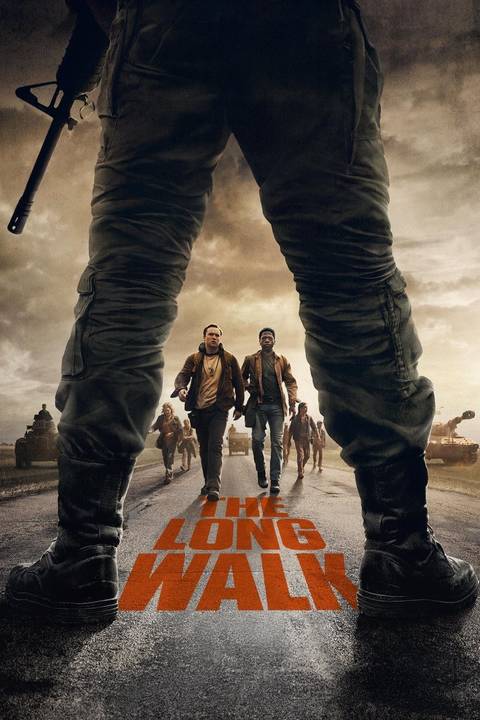
‘The Long Walk’ (1979)

Sneaking a Richard Bachman novel on here, but it’s a pseudonym of King’s, so The Long Walk is another King book. It’s more dystopian than post-apocalyptic, but what goes down here does feel like it’s happening in a world that’s a bit closer to “over” than a fair few dystopian books. Some kind of war has drastically changed the U.S., in the alternate timeline here, and part of that has to do with the titular competition.
Teenage boys are made to walk for, you know, a very long time. Actually, for as long as they can, before collapsing in exhaustion, and those who collapse and thereby drop out are executed, making it about as high-stakes as a competition can get. There is also a lot of walking in The Stand, for what it’s worth, but The Stand and The Long Walk find slightly different ways to be horrifying. Also, The Long Walk is probably slightly more horrifying, not to mention a more grueling read, even if it’s a lot shorter than The Stand.

The Long Walk
- Release Date
-
September 12, 2025
- Runtime
-
108 Minutes
- Director
-
Francis Lawrence
-

Cooper Hoffman
Raymond Garraty / #47
-

David Jonsson
Peter McVries / #23

1
‘Lucifer’s Hammer’ (1977)

Lucifer’s Hammer is partly about the world dealing with an approaching comet, and then partly about life after the comet hits. It’s divided into two halves, albeit not precisely, in that kind of way, and there’s a real focus on scientific accuracy in the first half or so of the story… and still a little in the part of Lucifer’s Hammer that seeks to be more of a post-apocalyptic thing, too.
It makes for a compelling and largely consistent reading experience, and then Lucifer’s Hammer also feels sufficiently epic in scope, but without going on for too long (not that The Stand is too long necessarily, but the number of pages there might seem somewhat intimidating). Lucifer’s Hammer is fairly underrated, too. Not perfect or anything, but it gets the job done on a fair few fronts.
You must be logged in to post a comment Login