Entertainment
8 Great Sci-Fi Movies That Just Don’t Make Sense

Science fiction is a genre that’s tricky to get right. When done properly, these stories of space exploration, futuristic societies, and speculative technology can make for some of the most fascinating movies out there. It’s remarkably easy, however, for a sci-fi movie to make no sense. Perhaps its time travel plot is a bit too convoluted, or its world-building involves rules that defy traditional logic, or the director made use of elements of surrealism that are hard to get a grasp on.
Whatever the case, it’s still very much possible for a sci-fi movie to make no sense and still be absolutely phenomenal, and there are eight movies in particular that best demonstrate that. Sure, these films aren’t the kind of puzzle that you can put together in a way that’s fully and appropriately satisfying, but that may just be the whole point. After all, if there’s any genre that can easily earn the right to ask its audience to stretch the limits of their imagination, it’s science fiction.
‘Looper’ (2012)


There’s a certain subgenre of science fiction that tends to have more than a few issues with logic, and that’s the time travel story. Case in point: Rian Johnson‘s Looper, where a hired gun learns that the mob wants to take him out by sending his future self back in time to assassinate him. The mere synopsis already brings up too many paradoxes for any one screenwriter to solve, so Johnson did something that some may consider clever and others may consider a cheap cop-out.
Looper pretty much admits that the rules of time travel make no sense and asks its audience to not think about it too closely. And frankly, one can only be grateful that it does, because that allows Johnson to focus on the nitty-gritty of the action and deliver a character-driven spectacle that shows science fiction at its most entertaining. In other words, enjoy Looper for what it is, and don’t concern yourself with making sense out of it.
‘Tokyo Gore Police’ (2008)

Anyone who watches a movie called Tokyo Gore Police expecting anything less than a brutal bloodfest is a fool. One of the most underrated splatter movies of the 21st century, this sci-fi horror film is set in a futuristic Tokyo, where a young policewoman tracks down her father’s killer while battling against mutant rebels. The result of such a wild premise is definitely not for everyone, but for people who love gory and over-the-top sci-fi, it’s a must-see.
As you could imagine, Tokyo Gore Police is a ridiculous film that plays its cards in an entirely tongue-in-cheek way, and it never really takes itself seriously. As a result of its focus on camp and shock value, it doesn’t really spend any time trying to make any element of its narrative make any sort of sense. However, if you went into this movie expecting a serious drama that prioritizes logic over style, then that’s on you, honestly.
‘Southland Tales’ (2006)


After he revived the midnight screening circuit of the cult cinema world in 2001, Richard Kelly followed things up with one of the most ambitious and divisive films of the 2000s, Southland Tales. Upon release, it split critics and performed atrociously at the box office, but in the years since, it has grown to become one of the biggest sci-fi cult classics of the era. But if there’s one thing that even the movie’s loyal cult following will admit, it’s that it makes next to no sense.
The narrative is bloated and chaotic, and Kelly develops a ton of ideas that don’t really mesh well together at first glance — or at second or at third. But patient and committed viewers will slowly be taken over by Southland Tales‘ unparalleled charm and fascinating vision of the future, captivated by a movie that often feels like a crazy fever dream you don’t really want to wake up from.
‘Under the Skin’ (2013)

A24 has distributed some of the best mind-bending movies of the 21st century over its history, but there is arguably no outing in its filmography more masterfully confusing than Jonathan Glazer‘s Under the Skin. And like any surrealist, mind-bending masterpiece, this one has remained highly divisive as the years have passed. Nevertheless, it’s one of the boldest drama movies of the 21st century.
Glazer spent over a decade developing what would end up becoming Under the Skin, turning it from the effects-heavy concept that it was originally devised as into a more minimalistic story about the human condition. But while the film makes sense philosophically, it doesn’t really make all that much sense narratively. There’s nothing here that resembles the traditional understanding of plot or character work; Glazer instead favors an abstract and experimental nature over any sort of logic. This approach has cemented Under the Skin as a true modern classic, but it has also made it unapproachable for most mainstream audiences.
‘Interstellar’ (2014)
Ever since the start of Hollywood’s blockbuster era in the mid-’70s, the film industry has had several different kinds of blockbusters. The one who sits on the throne today is arguably Christopher Nolan. The question of what his best film is will inevitably elicit many different answers, but one is guaranteed to come up more than most: the emotionally stirring space opera Interstellar, which is one of those sci-fi movies that get better with every rewatch.
But though a few of Interstellar‘s mind-bending aspects definitely start making a little more sense as one revisits the story, there are other elements that simply don’t track. From the mechanics of the tesseract to the whole “love transcends time” theme, there are a few elements of Interstellar that demand quite a bit of suspension of disbelief in order for the whole movie to not fall apart. For all its commitment to being accurate to real-life physics, the film remains a piece of art that is, first and foremost, concerned with its narrative rather than with any genuine logic.
‘Brazil’ (1985)
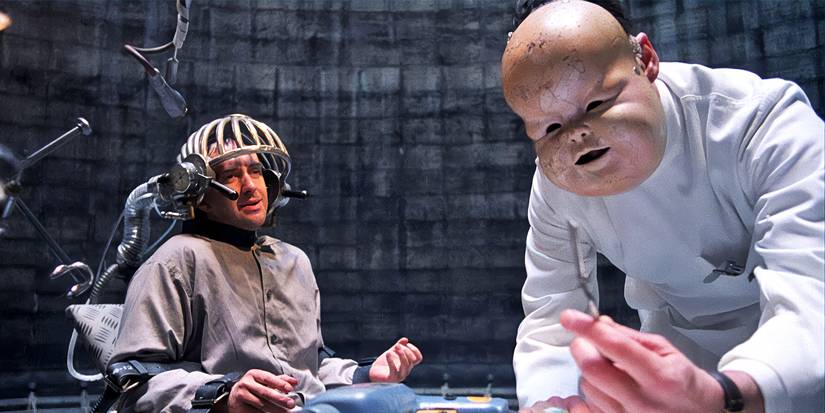
Terry Gilliam of Monty Python fame has a filmography that proves that the best comedies can often be the ones that make the least sense. Highly surrealist and with a uniquely absurdist sense of humor, Gilliam has made plenty of exceptional films over the course of his career, and Brazil might be the most acclaimed of the bunch. This satire of bureaucracy, capitalism, and technocracy has aged incredibly well, with its over-the-top, satirical tone even more resonant today than it was in 1985.
It’s one of the best sci-fi noir masterpieces ever, a scathing critique of the dehumanizing effects of industrial society and excessive bureaucracy that keeps revealing new angles to itself. But Gilliam intentionally designed Brazil to be a confusing, surreal, almost nightmarish experience, and he most definitely succeeded. It’s an outstanding movie, but not one that cares much about its audience making any sense of it.
‘Donnie Darko’ (2001)

Throughout the ’90s, the culture of the midnight movie lay dormant due to the boom of the home video market and cable television. It was a man called Richard Kelly who brought it back with one of the most notorious box office bombs of the 21st century, Donnie Darko. Its highly convoluted plot made it an instant cult classic that lent itself flawlessly to rewatches, and with the rise of DVD home viewing, the writing was on the wall for this becoming the next big thing on the cult film circuit.
With its thought-provoking narrative, Kelly’s enrapturing and deeply atmospheric direction, and one of the best movie soundtracks of all time, Donnie Darko has aged like fine wine through and through. But it’s impossible to deny that the main thing that made it a cult classic back in the 2000s is what still keeps it as a cult classic today: It’s the fact that it doesn’t make sense. Its mind-twisting narrative evades logic in ways that feel entirely intentional and brilliantly handled, making for a movie that makes rewatching and theorizing something that never gets old.
‘Stalker’ (1979)

Though his career was cut short by his death from lung cancer at the age of 54, Soviet auteur Andrei Tarkovsky has still managed to remain one of the most acclaimed and beloved European filmmakers in history. It’s a widely held belief that it was Stalker that contributed to his premature death, since it was shot in highly toxic environments that led many members of the cast and crew to contract different kinds of cancer in the years following the shoot. But the legacy that Tarkovsky left behind is an indelible one, and Stalker is one of the best sci-fi movies of the last 75 years.
That said, Stalker doesn’t really make much narrative or logical sense, but neither does the majority of Tarkovsky’s filmography. That’s because he was a filmmaker whose work audiences were meant to feel, not think, their way through, and Stalker is no different. Though its sci-fi elements are hugely creative and deeply powerful, they’re not the core of the story. Instead, it’s Tarkovsky’s potent exploration of faith and how it has evolved and faded in the modern world that serves as the beating heart of Stalker. Any sort of intellectual analysis of its plot is pointless because it is a masterpiece that proves that a sci-fi movie can make no sense and still be great.
You must be logged in to post a comment Login