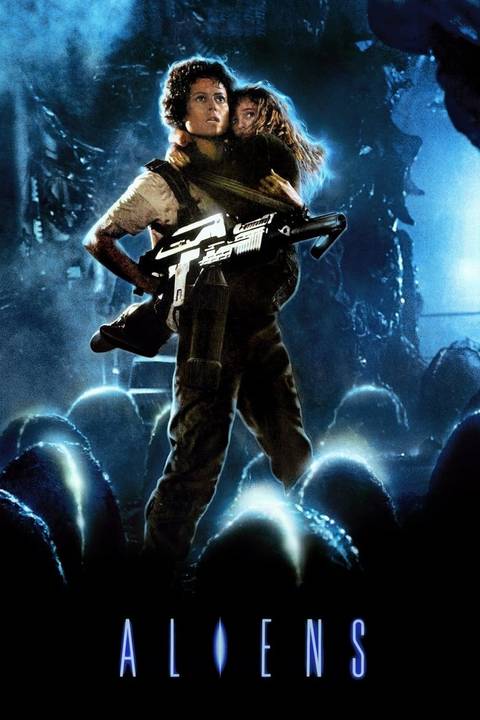
For a man who adores his world-building, James Cameron didn’t have to do much heavy lifting when it came to Aliens. Unlike, say, Pandora, the 1986 sequel to Ridley Scott‘s Alien chooses not to stop every five minutes and show you something that might have lore to it. Yet, despite that, the attention to detail in the Colonial Marines’ gear is one of the finest you’ll see in cinema, and it’s almost as memorable as the Xenomorphs themselves. They aren’t just cool, they feel like the future.
Speaking during a Big Lick Comic Con NOVA panel moderated by Collider’s Maggie Lovitt, Aliens stars Ricco Ross and Jennette Goldstein reflected on some of Cameron’s more forward-thinking ideas in the film. Ross, who played Private Frost, brought up the way Cameron adapted the Steadicam concept for the Marines’ heavy weapons, particularly the massive guns carried by Goldstein’s Vasquez and Mark Rolston’s Drake.
“That’s when they say, what is it? Life imitates art. The Steadicam that Jenette and Mark would use in the film, the idea, the concept of having a Steadicam, so that the camera, even though you’re running and moving, it stays pretty steady on the site, and for James to think, ‘Let’s put a gun, a rifle on that, and then the target, even if you’re running, it will be there as well,’ was such a brilliant idea at the time.”
The steadicam makes the Marines feel like part of a specific military future, one where technology has advanced, but everything is still heavy, dangerous, and terrifyingly physical. Ross said the idea was so striking that he had even heard of outside interest in the concept. “So brilliant that I heard that the military asked him if they could use it,” said Ross, “because he actually made sure that he got the rights for that.”
Advertisement
Advertisement
Collider Exclusive · Sci-Fi Survival Quiz Which Sci-Fi World Would You Survive? The Matrix · Mad Max · Blade Runner · Dune · Star Wars
Five universes. Five completely different ways the future went wrong — or sideways, or up in flames. Only one of them is the world your instincts were built for. Eight questions will figure out which dystopia, galaxy, or desert wasteland you’d actually make it out of alive.
💊The Matrix
🔥Mad Max
🌧️Blade Runner
Advertisement
🏜️Dune
🚀Star Wars
Advertisement
01
You sense something is deeply wrong with the world around you. What do you do? The first instinct is often the truest one.
Advertisement
02
In a world of scarcity, what resource do you guard most fiercely? What we protect reveals what we believe survival actually requires.
Advertisement
03
What kind of threat keeps you up at night? Fear is useful data — if you’re honest about what you’re actually afraid of.
Advertisement
04
How do you deal with authority you don’t trust? Every dystopia has a power structure. Your approach to it determines everything.
Advertisement
05
Which environment could you actually endure long-term? Survival isn’t just tactical — it’s physical, psychological, and very much about where you are.
Advertisement
06
Who do you want in your corner when things fall apart? The company you keep is the clearest signal of who you actually are.
Advertisement
07
Where do you draw the line — if you draw one at all? Every survivor eventually faces a moment that tests what they’re actually made of.
Advertisement
08
What would actually make survival worth it? Staying alive is one thing. Having a reason to is another.
Advertisement
Your Fate Has Been Calculated You’d Survive In…
Your answers point to the world your instincts were built for. This is the universe your temperament, your survival instincts, and your particular brand of stubbornness were made for.
Advertisement
The Resistance, Zion
The Matrix
You took the red pill a long time ago — probably before anyone offered it to you. You’re a systems thinker who can’t help but notice the seams in things.
Advertisement
You’re drawn to understanding how the system works before figuring out how to break it.
You’d find the Resistance, or it would find you — your instinct for spotting constructed realities is the machines’ worst nightmare.
You function best when you have access to information and the freedom to act on it.
The Matrix built an airtight prison. You’d be the one probing the walls for the door.
The Wasteland
Mad Max
The wasteland doesn’t reward the clever or the well-connected — it rewards those who are hard to kill and harder to break. That’s you.
Advertisement
You don’t need comfort, community, or a cause larger than the next horizon.
You need a vehicle, a clear threat, and enough fuel to outrun it — and you’re good at all three.
You are unsentimental enough to survive that world, and decent enough — just barely — to be something more than another raider.
In the wasteland, that distinction is everything.
Los Angeles, 2049
Blade Runner
You’d survive here because you know how to exist in moral grey areas without losing yourself completely.
Advertisement
You read people accurately, keep your circle small, and ask the questions others prefer not to answer.
In a city where humanity is a legal designation rather than a feeling, you hold onto something that keeps you functional.
You’re not a hero. But you’re not lost, either.
In Blade Runner’s world, that distinction is everything.
Arrakis
Dune
Arrakis is the most hostile environment in the known universe — and you are precisely the kind of person it rewards.
Advertisement
Patience, discipline, and political awareness are your core strengths — and on Arrakis, they’re survival tools.
You understand that the long game matters more than any single victory.
Others come to Dune and are consumed by it. You’d learn its logic and earn its respect.
In time, you wouldn’t just survive Arrakis — you’d begin to reshape it.
A Galaxy Far, Far Away
Star Wars
The galaxy far, far away is vast, loud, and in a constant state of violent political upheaval — and you wouldn’t have it any other way.
Advertisement
You find meaning in being part of something larger than yourself — a cause, a crew, a rebellion.
You’d gravitate toward the Rebellion, or the fringes, or whatever pocket of the galaxy still believes the Empire’s grip can be broken.
You fight — not because you have to, but because standing aside isn’t something you’re capable of.
In Star Wars, that willingness is what makes all the difference.
Advertisement
The U.S. Military Borrowed James Cameron’s Technology
Years on, Cameron still spends half his time inventing tech to achieve his filmmaking visions that go on to have numerous real-world applications. See also: numerous pieces of tech, VFX, and cameras for Avatar: The Way of Water. Goldstein, who played Private Vasquez, also pointed to another idea from the movie that seems almost obvious now because real-life technology eventually caught up with it. She brought up the small cameras used in the film, comparing the concept to what audiences would later know through GoPro-style devices. Goldstein said:
“The camera, the GoPro that everybody used. I mean, there was no such thing as a GoPro. It was this really cool idea he had. He was like, you know, ‘What if there was a little camera, and you know, those big video cameras that you had in the ’80s were there,’ and now we just think, like, ‘Oh yeah, of course, a GoPro.’”
To be honest, that’s a huge part of why Aliens holds up so well, because it doesn’t feel like our future; it’s a dirty and grimy future, and the sort you can never say feels aged. It feels like it was built for soldiers to protect them against aliens. And that’s exactly what it did. Aliens is streaming now on Hulu and Disney+.


You must be logged in to post a comment Login