Entertainment
All 10 Hayao Miyazaki Fantasy Movies, Ranked

Hayao Miyazaki is one of the most influential and beloved animators in the entire world. He began his career by sketching airplanes, then co-founded Studio Ghibli alongside Isao Takahata, director of the heartbreaking Grave of the Fireflies, Toshio Suzuki, and Yasuyoshi Tokuma. Miyazaki’s films have often been heralded as the best of Ghibli’s lineup, and though he has tried to retire several times over the years, a new idea always pulls him back into the game.
The majority of Miyazaki’s films are fantasy stories, though they often contain heavy science fiction themes and iconography as well. Aside from their gorgeous animation, his films are beloved for their environmentalist messages, strong characters who almost never fall into simple good or evil binaries, and his endless creativity, which results in all manner of one-of-a-kind locations and creatures. Every Miyazaki fantasy movie is great, but some are undoubtedly better than others: the question is, which is the best?
10
‘Ponyo’ (2008)


Brunhilda (Yuuri Nara/Noah Cyrus) is a goldfish-like creature and eldest daughter of the wizard Fujimoto (George Tokoro/Liam Neeson) and the sea spirit Gran Mamare (Yūki Amami/Cate Blanchett). One day, she ends up stranded on land, but is rescued by a little boy named Sōsuke (Hiroki Doi/Frankie Jonas), who calls her Ponyo. Fujimoto retrieves his daughter, but thanks to tasting Sōsuke’s blood when she healed a cut on his hand, she is able to take human form, an act which threatens to throw off the balance of nature and flood the world.
Ponyo is by far Miyazaki’s lowest-stakes film, emphasized by the fact that the protagonists are small children. That doesn’t make it bad by any stretch of the imagination: Miyazaki still goes all out with the animation and the fantastical imagery, especially with how the magical imbalance starts to transform the ocean. Plus, Ponyo and Sōsuke have a very sweet bond, which results in a cute love story.
9
‘Porco Rosso’ (1992)

Marco Pagot (Shūichirō Moriyama/Michael Keaton) is a bounty hunter living in Fascist Italy who is plagued by survivor’s guilt following the loss of his squadron in World War I. Somehow, he received a curse that transformed his head into a pig’s, so now he goes by Porco Rosso as he pursues pirates in the open sky. However, the pirates recruit American ace pilot Donald Curtis (Akio Ōtsuka/Cary Elwes) to deal with Porco, leading him to team up with Fio (Akemi Okamura/Kimberly Williams-Paisley), the granddaughter of his old mechanic.
Porco Rosso is the least fantastical of the films on this list, but the way it uses its fantasy elements is creative and thematic. Porco’s pig-head is implied at times to be a self-inflicted curse that reflects how he views himself, allowing others to occasionally glimpse his real self at key moments. Visually, it’s as gorgeous as you’d expect a Ghibli film to be, and the flight scenes might be the best in any of their movies.
8
‘Howl’s Moving Castle’ (2004)

Sophie’s (Chieko Baisho/Emily Mortimer and Jean Simmons) life changes forever when she has a chance encounter with a wizard named Howl (Takuya Kimura/Christian Bale), which prompts the Witch of the Waste (Akihiro Miwa/Lauren Bacall), who desires Howl for herself, to curse her. Now transformed into an old woman, Sophie heads into the countryside, where she befriends a living scarecrow named Turnip Head before finding Howl’s moving castle, where she gets a job as a cleaning lady. As she learns more about Howl and his relationship with a fire demon named Calcifer (Tatsuya Gashūin/Billy Crystal) who powers the castle, her nation soon finds itself at war, and Howl puts his life on the line to try and stop it.
Howl’s Moving Castle is based on the book of the same name by Diana Wynne Jones, but Miyazaki changed the story based on his disgust at the Iraq War. Accordingly, one of the major themes of the film is the horrors of war, demonstrated through beautifully detailed scenes of cities burning and airships crashing to the ground. It’s not all about war, however: Sophie’s story sees her go on a journey of self-discovery and personal growth, which is demonstrated through her shifting age based on how much she believes in herself.
7
‘Kiki’s Delivery Service’ (1989)

Adolescent witch Kiki (Minami Takayama/Kirsten Dunst) leaves home on her mother’s broomstick with her familiar spirit, Jiji (Rei Sakuma/Phil Hartman), for the town of Koriko. Upon arriving, she befriends an aviation enthusiast named Tombo (Kappei Yamaguchi/Matthew Lawrence) and gets room and board from a baking couple named Osono (Keiko Toda/Tress MacNeille) and Fukuo (Koichi Yamadera/John Hostetter). As Kiki tries to find her way forward in life, she decides to put her powers to good use by opening a delivery service.
Kiki’s Delivery Service was the first Ghibli film to be dubbed by Disney, and there’s something magnetic about it that keeps audiences coming back for more. Kiki’s struggles are, at their core, universal for anyone coming-of-age, such as the stresses of moving away from home and trying to get a job. It also helps that the movie has a fun, casual tone to it that allows you to get immersed in the characters, their dynamics, and their struggles.
6
‘My Neighbor Totoro’ (1988)

With their mother, Yasuko (Sumi Shimamoto/Lea Salonga), recovering in the hospital, sisters Satsuki (Noriko Hidaka/Dakota Fanning) and Mei Kusakabe (Chika Sakamoto/Elle Fanning) move with their father, Tatsuo (Shigesato Itoi/Tim Daly), to a countryside house. They soon discover that the nearby forest is full of numerous spirits, from dust spirits to aspects of nature and a cat that acts as a bus. The one they grow closest to is a big, rotund, friendly creature known as Totoro (Hitoshi Takagi/Frank Welker), who takes them on many adventures.
My Neighbor Totoro is the movie that made Studio Ghibli a global name, and Totoro himself has since become the company’s mascot. The film is a beautiful snapshot of childhood, namely the innocence and wonder that comes from going on adventures in one’s backyard and encountering new experiences for the first time. The girl’s interactions with Totoro and the spirits can also be seen as an allegory for how humans tend to use fantasy as a means of coping with difficult moments in our lives.
5
‘Nausicaä of the Valley of the Wind’ (1984)

One thousand years after an apocalyptic war, humans try to rebuild around the Toxic Jungle, a poisonous forest inhabited by gigantic insects, including gigantic near-sentient insects called Ohm. Princess Nausicaä (Sumi Shimamoto/Alison Lohman) from the Valley of the Wind regularly ventures into the jungle to study it and hopes to find a way for humans and the insects to live in harmony. Unfortunately, her plans are jeopardized when soldiers from the militaristic Empire of Tolmekia arrive, bringing with them their war with another nation called Pejite.
Unlike the other members of this list, Nausicaä of the Valley of the Wind came from Topcraft, the company whose collapse birthed Studio Ghibli, and which worked on several other fantasy films, like The Last Unicorn and The Flight of Dragons. The story is one of Miyazaki’s making, so it’s no surprise that it also contains some of the strongest depictions of his common themes, especially the environmental message and female protagonist. Speaking of, Nausicaä herself is a terrific character thanks to her bravery, kindness, and how much she is willing to sacrifice in the name of peaceful coexistence.
4
‘Castle in the Sky’ (1986)

Pazu (Mayumi Tanaka/James Van Der Beek) is a young, orphaned mechanic who is obsessed with the legend of Laputa, a floating castle said to be built by an ancient civilization. One day, he sees a girl named Sheeta (Keiko Yokozawa/Debi Derryberry and Anna Paquin) fall out of the sky, but is saved by a magical crystal she wears. Pazu learns that the crystal is linked to Laputa somehow, but they’re forced to go on the run from sky pirates and a government agent named Muska (Minori Terada/Mark Hamill), who want to find Laputa for their own reasons.
Castle in the Sky incorporates a lot of sci-fi elements into its story and worldbuilding, which leads to some of the most iconic of Miyazaki’s environmentally conscious imagery as nature and technology merge. The rest of the story is a fantastic adventure, with lots of mystery and exploration as the characters, and thus the audience, get to experience this unique world of steampunk airships and magic crystals. The characters are all fun, but the antagonists stand out the best: Muska is a mysterious man with grand ambitions, while the sky pirates are a beautifully dysfunctional family.
3
‘The Boy and the Heron’ (2023)
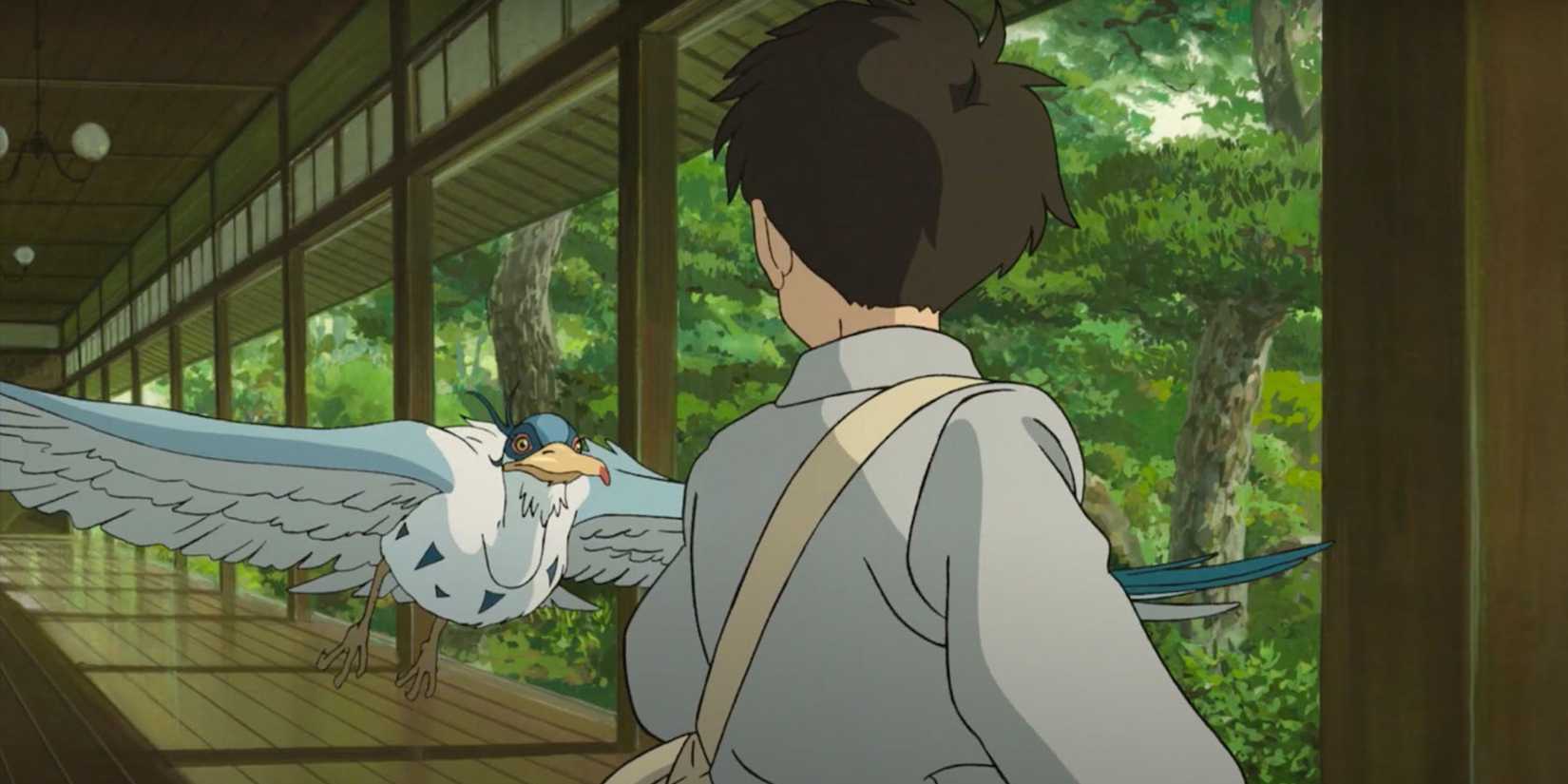
After losing his mother in a firebombing during World War II, Mahito’s (Soma Santoki/Luca Padovan) father, Shoichi (Takuya Kimura/Christian Bale), marries his dead wife’s sister, Natsuko (Yoshino Kimura/Gemma Chan), and moves them to her estate while he establishes an air munitions factory. Soon after arriving, Mahito encounters a strange grey heron (Masaki Suda/Robert Pattinson) who claims it can help him see his mother again. This leads Mahito into a sealed tower built by his mysterious granduncle (Shōhei Hino/Mark Hamill), which leads to fantastical discoveries regarding the family’s past.
The Boy and the Heron plays out like a lucid dream at times, especially in the third act. This ethereal aesthetic is a great way to explore the film’s primary themes concerning grief and legacy: the first half is much quieter and somber to better reflect Mahito’s isolation due to his grief, while the second half is more vibrant and ambiguous, which becomes even more fascinating when it’s explained where these more fantastical elements come from and why they are here. The voice cast in both Japanese and English is fantastic, but Pattinson stands out the most in the dub because he is unrecognizable as the heron.
2
‘Princess Mononoke’ (1997)
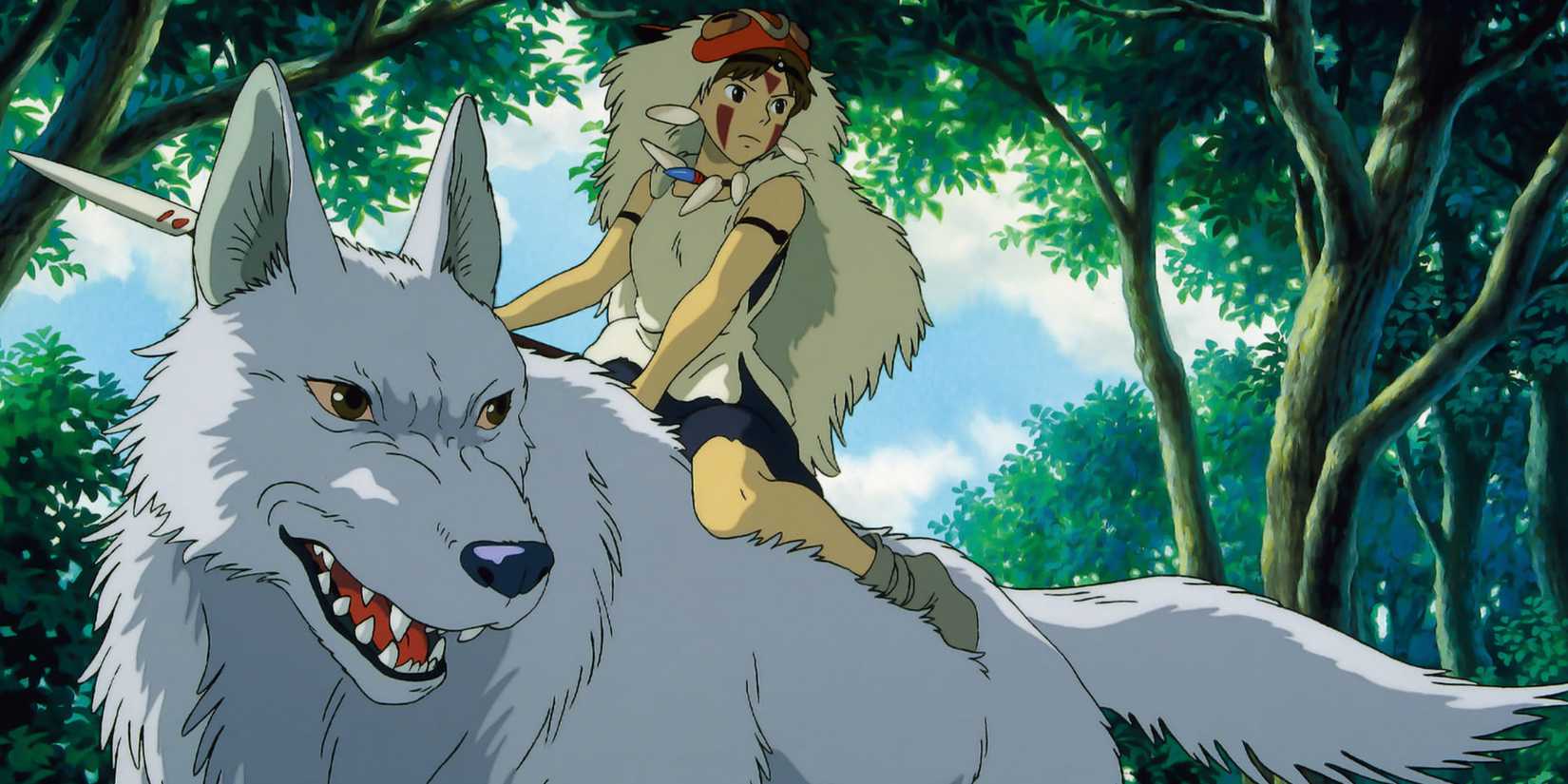
Prince Ashitaka (Yōji Matsuda/Billy Crudup) of the Emishi slays a demon that used to be a boar god named Nago (Makoto Satō/John DiMaggio), but is given a fatal curse in the process. He follows Nago’s trail and arrives at Irontown, a mining colony built next to a forest inhabited by animal gods. The two groups are on the verge of war, and as Ashitaka does what he can to keep things from escalating, he meets a woman named San (Yuriko Ishida/Claire Danes) who was raised by the wolf gods.
Princess Mononoke is perhaps the best movie to showcase Miyazaki’s common themes. The conflict in the film is handled brilliantly: rather than go the easy route and say nature good, civilization bad, the film shows how both sides have their positive and negative traits, making them feel like two groups of individuals just struggling to survive in an ever-changing world. Speaking of the world, this movie is some of the most beautiful animation to come from Studio Ghibli, with gorgeous landscapes that look like photographs at times, and creative visual depictions of life and death.
1
‘Spirited Away’ (2001)
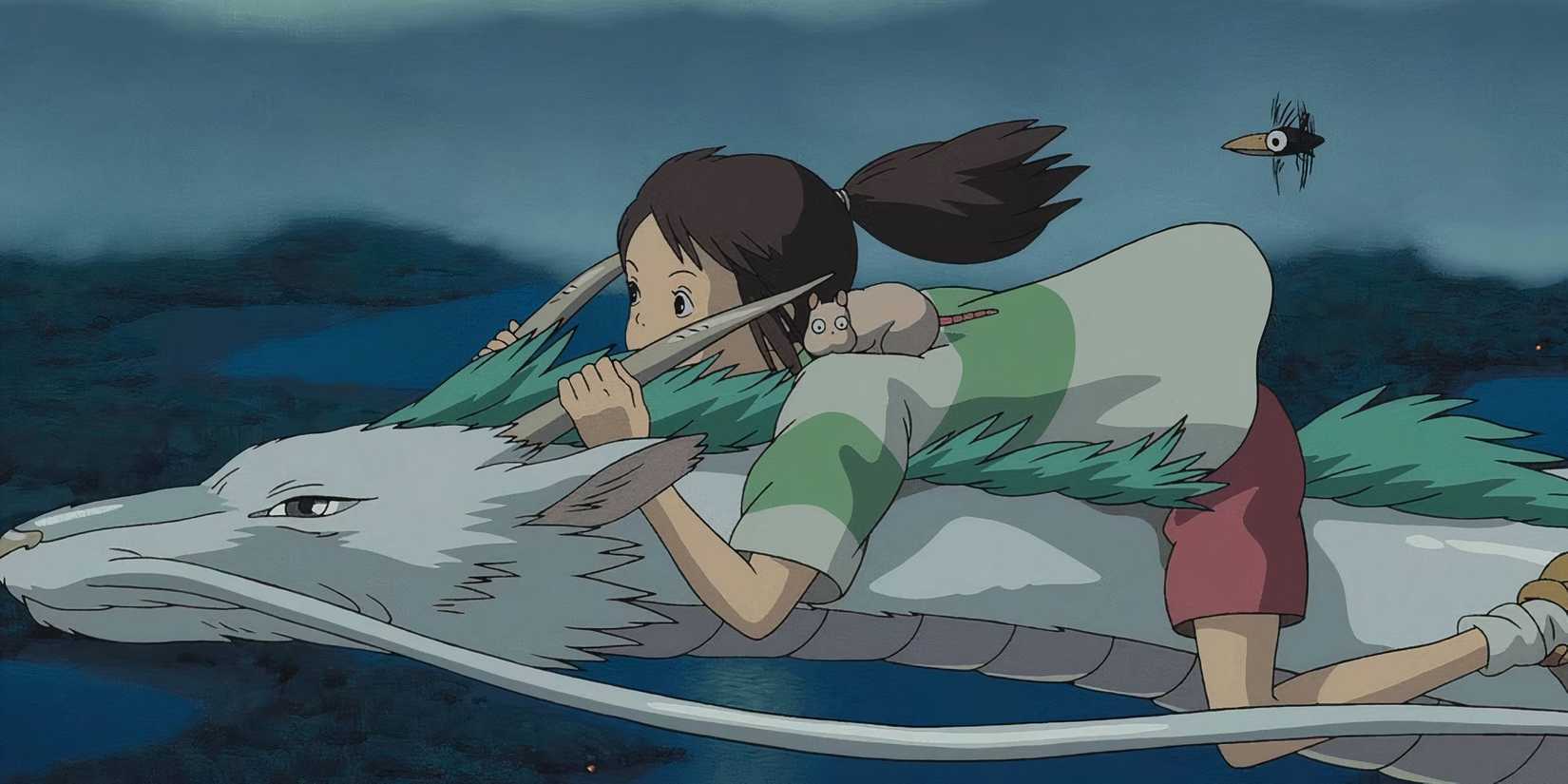
While moving to their new home, Chihiro (Rumi Hiiragi/Daveigh Chase) and her parents find an abandoned carnival that serves as a gateway to the spirit world. Her parents are turned into pigs, but Chihiro is aided by a strange boy named Haku (Miyu Irino/Jason Marsden), who helps her get a job at the local bathhouse run by the witch Yubaba (Mari Natsuki/Suzanne Pleshette). Chihiro is safe while she tries to find a way to free her parents, but Yubaba further complicates things by taking Chihiro’s name as part of the contract, renaming her Sen.
It can be hard to put into words just how magical an experience Spirited Away is. The spirit world is a masterfully constructed world inhabited by all manner of creatures, many of whom have deep symbolic meaning behind their design and actions, as is the case with the mysterious No Face (Akio Nakamura/Bob Bergan). It’s the kind of film that knows when to let the atmosphere tell the story rather than dialogue, leading to many soft, introspective moments that facilitate Chihiro’s coming-of-age journey, and allowing audiences to bask in the lush, detailed animation.
You must be logged in to post a comment Login