I’ve never been able to watch The Godfather films casually. Even when I try to put one on just to revisit a scene, I end up sitting through much more than I planned because the story pulls me back in without effort. At the same time, I’ve noticed that not all three films hold my attention in the same way. Some parts feel tighter, more engaging, while others take their time in a way that doesn’t always land the same.
That difference becomes clearer when you stop looking at them as one complete saga and start paying attention to how each film works on its own. The pacing, the focus, and even the way certain moments are handled can change how involved you feel while watching. Ranking them this way isn’t about which one is better, it’s about which one keeps you watching without drifting away, so here we go.
Advertisement
3
‘The Godfather Part III’ (1990)
Michael Corleone looking at the camera in The Godfather Part IIIImage via Paramount Pictures
The Godfather Part IIItakes place years after Michael Corleone (Al Pacino)has secured his control of the empire. Now older, he tries to move the family business into legitimate ventures, distancing himself from the violent past while still holding influence through legal and financial structures. His efforts led him into negotiations with powerful international institutions, showing how far the Corleone reach has extended. At the same time, Vincent Mancini (Andy Garcia) begins to step into the spotlight and become more involved in family affairs, showing his ambition to take on a larger role.
As Michael works to legitimize the Corleone empire, he finds himself caught between external resistance and internal family conflicts. Vincent plays an important role, pulling himself deeper into the family’s affairs. Meanwhile, Michael struggles to maintain control without fully reverting to the violent methods of the past.
Advertisement
2
‘The Godfather’ (1972)
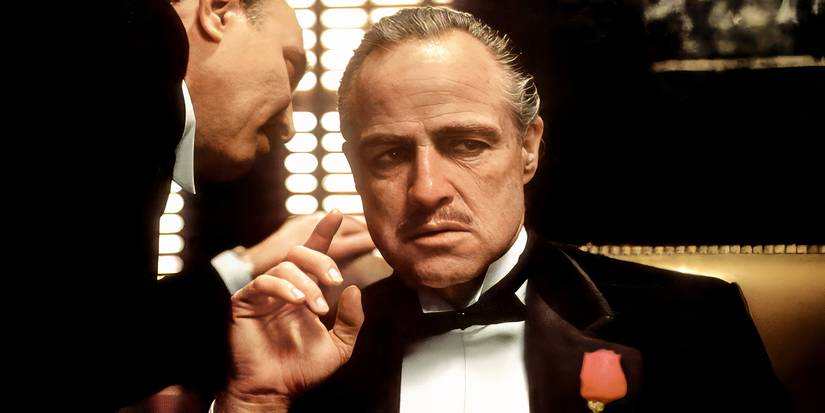
Marlon Brando as Don Vito Corleone, getting a message from someone in The Godfather.Image via Paramount Pictures
The story of The Godfather begins with Vito Corleone (Marlon Brando), who oversees his family’s operations while maintaining authority through alliances and controlled influence. His youngest son, Michael Corleone (Al Pacino), initially remains separate from the family business and focuses on his own path. This position changes when an attempt is made on Vito’s life, forcing Michael to become directly involved in protecting the family and responding to threats.
As things move forward, Michael takes on duties that force him to make choices affecting both his family and their place among other groups. Each decision brings new consequences, slowly changing his role in the organization. Over time, Michael shifts from being an outsider and becomes the central figure, guiding the family’s future through the choices he makes.
Advertisement
1
‘The Godfather Part II’ (1974)
Al Pacino as Michael Corleone sitting in a chair, looking up in The Godfather Part II.Image via Paramount Pictures
The narrative of The Godfather: Part IIfollows two timelines that develop in parallel. In one, Michael Corleone (Al Pacino) strengthens his control while facing threats to his power. He manages relationships with other powerful figures and deals with dangers that rise from inside his own circle. At the same time, he works to maintain his position while dealing with growing complications that affect both his business and personal life.
In contrast, the second timeline follows a younger Vito Corleone (Robert De Niro) as he builds his position from the beginning. His early experiences show how he gains influence through careful choices and steady actions. As both timelines progress, the links between past and present become clear, showing how earlier choices shape later results. The story continues by connecting these developments across time.
Advertisement
Collider Exclusive · Oscar Best Picture Quiz Which Oscar Best Picture Is Your Perfect Movie? Parasite · Everything Everywhere · Oppenheimer · Birdman · No Country
Advertisement
Five Oscar Best Picture winners. Five completely different visions of what cinema can be — and what it can do to you. One of them is the film that was made for the way your mind works. Ten questions will figure out which one.
🪜Parasite
🌀Everything Everywhere
☢️Oppenheimer
🐦Birdman
Advertisement
🪙No Country for Old Men
Advertisement
01
What kind of film experience do you actually want? The best movies don’t just entertain — they leave something behind.
Advertisement
02
Which idea grabs you most in a film? Great films are driven by a central obsession. What’s yours?
Advertisement
03
How do you like your story told? Form is content. The way a story is shaped changes what it means.
Advertisement
04
What makes a truly great antagonist? The opposition defines the protagonist. What kind of opposition fascinates you?
Advertisement
05
What do you want from a film’s ending? The final note is the one that lingers. What do you want it to sound like?
Advertisement
06
Which setting pulls you in most? Where a film takes place shapes everything — mood, stakes, what’s even possible.
Advertisement
07
What cinematic craft impresses you most? Every great film has a signature — a technical or artistic element that makes it unmistakable.
Advertisement
08
What kind of main character do you root for? The protagonist is the lens. Who you choose to follow says something about you.
Advertisement
09
How do you feel about a film that takes its time? Pace is a choice. Some films sprint; others let tension accumulate slowly, deliberately.
Advertisement
10
What do you want to feel walking out of the cinema? The best films leave a mark. What kind of mark do you want?
Advertisement
The Academy Has Decided Your Perfect Film Is…
Your answers have pointed to one Oscar Best Picture winner above all others. This is the film that was made for the way your mind works.
Advertisement
Parasite
You are drawn to films that operate on multiple levels simultaneously — that begin in one genre and quietly, brilliantly migrate into another. Bong Joon-ho’s Parasite is a film about class, desire, and the architecture of inequality that manages to be darkly funny, deeply suspenseful, and genuinely shocking across a single extraordinary running time. Your instinct is for cinema that hides its true intentions until the moment it’s ready to reveal them. Parasite is exactly that — a film that rewards close attention and punishes assumptions, right up to its devastating final image.
Advertisement
Everything Everywhere All at Once
You want it all — and this film gives you all of it. The Daniels’ Everything Everywhere All at Once is one of the most maximalist films ever made: action comedy, multiverse sci-fi, family drama, existential crisis, and a genuinely earned emotional core that sneaks up on you amid the chaos. You are someone who responds to ambition, who doesn’t want cinema to choose between being entertaining and being meaningful. This film refuses that choice entirely. It is overwhelming by design, and its overwhelming nature is precisely the point — because the feeling of being crushed by infinite possibility is exactly what it’s about.
Advertisement
Oppenheimer
You are drawn to cinema on a grand scale — films that understand history not as a backdrop but as a force, and that place their characters inside that force and watch what happens. Christopher Nolan’s Oppenheimer is a film about the terrifying gap between what we can do and what we should do, told with the full weight of one of the most consequential moments in human history behind it. You want your films to feel important without feeling self-important — to earn their ambition through sheer craft and the gravity of their subject. Oppenheimer does exactly that. It is enormous, complicated, and refuses easy comfort.
Advertisement
Birdman
You are drawn to films that foreground their own construction — that make the how of the filmmaking part of the what it’s about. Alejandro González Iñárritu’s Birdman, shot to appear as a single continuous take, is cinema examining itself through the cracked mirror of a fading actor’s ego. You respond to formal daring, to the feeling that a film is doing something that probably shouldn’t be possible. Michael Keaton’s performance and Emmanuel Lubezki’s restless camera create something genuinely unlike anything else — a film that is simultaneously about creativity, relevance, self-destruction, and the impossibility of ever truly knowing if your work means anything at all.
Advertisement
No Country for Old Men
You are drawn to cinema that trusts silence, that refuses to explain itself, and that treats dread as a form of meaning. The Coen Brothers’ No Country for Old Men is a film about the arrival of a new kind of evil — implacable, arbitrary, and utterly indifferent to the moral frameworks we use to make sense of the world. It is one of the most formally controlled films ever made, and its controlled restraint is what makes it so terrifying. You want your films to haunt you, not comfort you. You are not interested in resolution if resolution would be dishonest. No Country for Old Men is honest in a way that most cinema never dares to be.




You must be logged in to post a comment Login