Traditionally, as movie franchises chug along with one sequel after another, each entry gets worse and makes less money. The same can’t be said for Toy Story. The first film changed the face of animation when it came out in 1995. Arguably, the second and third films were even better. 31 years later, Toy Story 5 just had the biggest opening in franchise history.
What keeps us coming back is easy to explain — audiences care about the characters and the storylines they’re put in. The Toy Story movies make us laugh, but they are also emotionally devastating in the best way possible. Nostalgia and a deep love for these toys come to life have left fans weeping across generations.
Advertisement
5
‘Toy Story’ (1995)
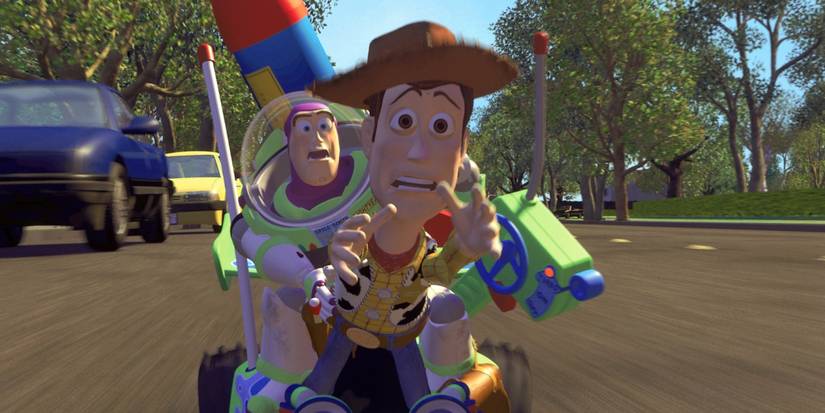
Buzz and Woody racing down a street on a remote control car reaching out and looking stressed in Toy Story.Image via Pixar Animation Studios
There is also Buzz’s sad origin story. Fresh out of the box, he believes he’s a real Star Command astronaut, only to learn that he is a toy. Accepting that he’s not who he thinks he is takes Buzz on a journey that moves from painful to heartwarming as he welcomes his role and becomes friends with Woody and the other toys.
Advertisement
4
‘Toy Story 5’ (2026)
Jessie, Bullseye, Smarty Pants, and other toys in ‘Toy Story 5’Image via Pixar Animation
Before even seeing a single frame of Toy Story 5 outside the trailer, the latest entry has perhaps the saddest premise. The idea of a new, rival toy entering the scene isn’t anything new, but this time, our beloved characters are threatened by the most imposing antagonist of all: technology. How do toys from a bygone era compete with a smart tablet set on replacing them all?
That’s already depressing enough in a storyline pulled from our real society. What’s worse is watching what it does to both Jessie and Bonnie. The child who loves these toys so much is growing up, and her friends make fun of her for still being a child who plays with dolls. Lonely and wanting to fit in, Bonnie rejects them all, including her favorite, Jessie (Joan Cusack).
Left behind, Jessie returns to the home of her former owner, Emily, whom she has never gotten over all these years later. There will never be a going back to the past, but Jessie finds closure when she discovers a lunchbox belonging to Emily’s daughter. On the surface is the child’s name: Jessie. Throw in a bit of “When She Loved Me,” and it’s a tearjerker moment as the cowgirl realizes just how much she meant to Emily.
Advertisement
Advertisement
Collider Exclusive · Oscar Best Picture Quiz Which Oscar Best Picture Is Your Perfect Movie? Parasite · Everything Everywhere · Oppenheimer · Birdman · No Country
Five Oscar Best Picture winners. Five completely different visions of what cinema can be — and what it can do to you. One of them is the film that was made for the way your mind works. Ten questions will figure out which one.
🪜Parasite
🌀Everything Everywhere
☢️Oppenheimer
Advertisement
🐦Birdman
🪙No Country for Old Men
Advertisement
01
What kind of film experience do you actually want? The best movies don’t just entertain — they leave something behind.
Advertisement
02
Which idea grabs you most in a film? Great films are driven by a central obsession. What’s yours?
Advertisement
03
How do you like your story told? Form is content. The way a story is shaped changes what it means.
Advertisement
04
What makes a truly great antagonist? The opposition defines the protagonist. What kind of opposition fascinates you?
Advertisement
05
What do you want from a film’s ending? The final note is the one that lingers. What do you want it to sound like?
Advertisement
06
Which setting pulls you in most? Where a film takes place shapes everything — mood, stakes, what’s even possible.
Advertisement
07
What cinematic craft impresses you most? Every great film has a signature — a technical or artistic element that makes it unmistakable.
Advertisement
08
What kind of main character do you root for? The protagonist is the lens. Who you choose to follow says something about you.
Advertisement
09
How do you feel about a film that takes its time? Pace is a choice. Some films sprint; others let tension accumulate slowly, deliberately.
Advertisement
10
What do you want to feel walking out of the cinema? The best films leave a mark. What kind of mark do you want?
Advertisement
The Academy Has Decided Your Perfect Film Is…
Your answers have pointed to one Oscar Best Picture winner above all others. This is the film that was made for the way your mind works.
Advertisement
Parasite
You are drawn to films that operate on multiple levels simultaneously — that begin in one genre and quietly, brilliantly migrate into another. Bong Joon-ho’s Parasite is a film about class, desire, and the architecture of inequality that manages to be darkly funny, deeply suspenseful, and genuinely shocking across a single extraordinary running time. Your instinct is for cinema that hides its true intentions until the moment it’s ready to reveal them. Parasite is exactly that — a film that rewards close attention and punishes assumptions, right up to its devastating final image.
Advertisement
Everything Everywhere All at Once
You want it all — and this film gives you all of it. The Daniels’ Everything Everywhere All at Once is one of the most maximalist films ever made: action comedy, multiverse sci-fi, family drama, existential crisis, and a genuinely earned emotional core that sneaks up on you amid the chaos. You are someone who responds to ambition, who doesn’t want cinema to choose between being entertaining and being meaningful. This film refuses that choice entirely. It is overwhelming by design, and its overwhelming nature is precisely the point — because the feeling of being crushed by infinite possibility is exactly what it’s about.
Advertisement
Oppenheimer
You are drawn to cinema on a grand scale — films that understand history not as a backdrop but as a force, and that place their characters inside that force and watch what happens. Christopher Nolan’s Oppenheimer is a film about the terrifying gap between what we can do and what we should do, told with the full weight of one of the most consequential moments in human history behind it. You want your films to feel important without feeling self-important — to earn their ambition through sheer craft and the gravity of their subject. Oppenheimer does exactly that. It is enormous, complicated, and refuses easy comfort.
Advertisement
Birdman
You are drawn to films that foreground their own construction — that make the how of the filmmaking part of the what it’s about. Alejandro González Iñárritu’s Birdman, shot to appear as a single continuous take, is cinema examining itself through the cracked mirror of a fading actor’s ego. You respond to formal daring, to the feeling that a film is doing something that probably shouldn’t be possible. Michael Keaton’s performance and Emmanuel Lubezki’s restless camera create something genuinely unlike anything else — a film that is simultaneously about creativity, relevance, self-destruction, and the impossibility of ever truly knowing if your work means anything at all.
Advertisement
No Country for Old Men
You are drawn to cinema that trusts silence, that refuses to explain itself, and that treats dread as a form of meaning. The Coen Brothers’ No Country for Old Men is a film about the arrival of a new kind of evil — implacable, arbitrary, and utterly indifferent to the moral frameworks we use to make sense of the world. It is one of the most formally controlled films ever made, and its controlled restraint is what makes it so terrifying. You want your films to haunt you, not comfort you. You are not interested in resolution if resolution would be dishonest. No Country for Old Men is honest in a way that most cinema never dares to be.
Advertisement
Advertisement
3
‘Toy Story 2’ (1999)
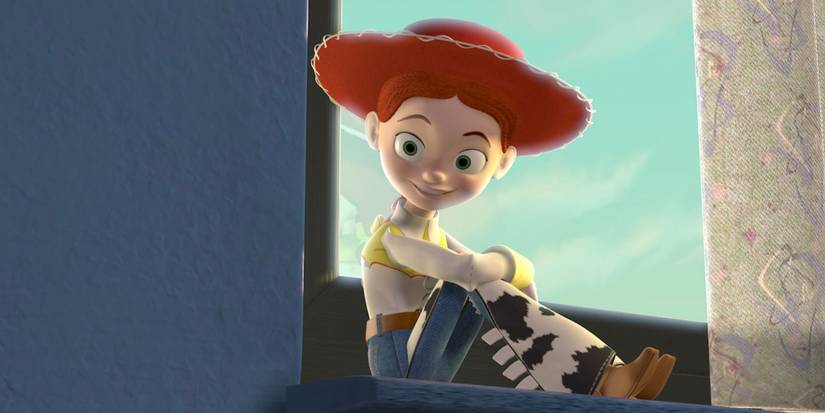
Joan Cusack as Jessie from the Roundup Gang looking down from her stoop in Toy Story 2Image via Pixar Animation Studios
In Toy Story 2, another new toy takes center stage. This time, it’s a cowgirl named Jessie. She, too, had a child owner she once loved, only to be abandoned. Now she’s a lonely, unplayed-with collectible. The sad montage of Sarah McLachlan‘s “When She Loved Me” played over scenes of Jessie going from a favorite toy to being forgotten is gut-wrenching.
Toy Story 2 is about being forgotten, whether in smaller or bigger moments. One scene finds Woody on a dusty shelf, where he discovers a penguin with a broken squeaker named Wheezy. He’s sat up here for years with no one, completely forgotten about. In a bittersweet moment, Woody, forever the hero, decides to give up a life with Andy to stay with the rest of the Round-Up Gang. This means saying goodbye to everyone he knows and letting Andy go. He’ll come back, but even if you know this, it’s a scene that’ll get the tears flowing.
Advertisement
2
‘Toy Story 4’ (2019)
Woody and Buzz hugging in Toy Story 4Image via Pixar Animation Studios
When Toy Story 4 was released, many fans weren’t accepting. The third film was the perfect ending, and a fourth risked messing it up. While it’s not as good as what came before, Toy Story 4 still excelled at going straight for the heartstrings. With the toys now living with Bonnie, Woody has to accept that he is no longer the favorite. As their scared owner enters pre-school, she creates a makeshift toy named Forky (Tony Hale) to get her through it. Built out of a spork, Forky doesn’t understand his worth. To him, he’s just trash and wants to throw himself away. It’s tragic to see Forky’s lack of self-worth, but sweet to watch him grow and realize how important he is.
At the end of Toy Story 4, Woody accepts that his time as an important toy to Bonnie has ended. It’s time for him to move on and save other lost toys with Bo Peep (Annie Potts). This means Woody must say goodbye, seemingly forever, to the other toys. They all gather around, hugging and laughing, but it’s the silent embrace with Buzz that really grabs you by the throat. As the RV pulls away, Woody and Bo watch, ready to begin their next journey. “He’s not lost, not anymore,” Buzz says.
Advertisement
1
‘Toy Story 3’ (2010)
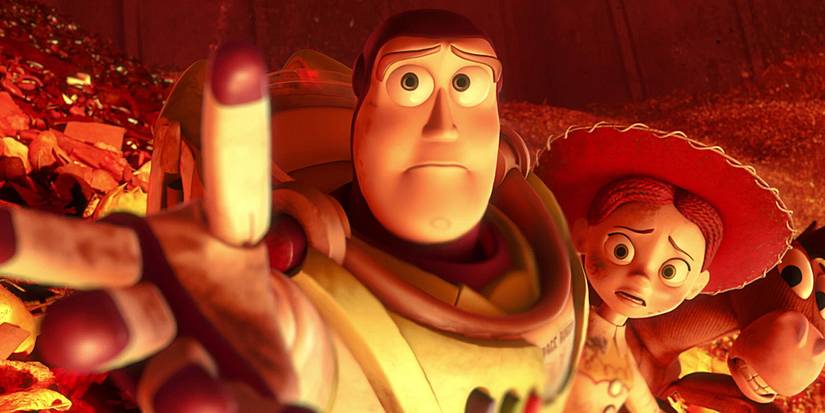
Buzz reaches out his hand to someone off-camera as he and Jessie look sad and scared in Toy Story 3.Image via Walt Disney Studios Motion Pictures
Number one on this list is obvious. The original franchise came to a perfect end in 2010 with Toy Story 3. It’s the best of them all and has a double wallop of scenes that left audiences bawling their eyes out. The first comes during the film’s climax. When the toys end up in a dump, they find themselves on a conveyor belt headed for the fires of an incinerator. With no way out, the toys accept their fate and grab each other’s hands. In their final moments, all they want to do is be together. Would a kid’s movie dare kill them? Even if you know that they’re going to be saved, to see the love they have for each other as the music swells will leave you a mess. A writer can’t even type this out without getting misty-eyed!
Then comes the ending. The toys have been with Andy since the beginning of the franchise. Now that he’s off to college, he wants to give them to another child who can appreciate them. He takes them to Bonnie’s house and shows her how fun they are. At the bottom of the box sits Woody, Andy’s favorite toy of all. He hesitates. How can he let go of him? Seeing the look on Bonnie’s face, though, Andy hands him over, letting go of his childhood. He has grown up, but everything will be okay because another child has already fallen in love with the toys that mean so much.





You must be logged in to post a comment Login