Entertainment
Andy Serkis Confirms Key Changes Made to ‘Animal Farm’ for a New Generation

Summary
- Collider’s Steve Weintraub talks with Andy Serkis about Animal Farm.
- Serkis discusses the long development process from 2012 to today and how their approach and story have evolved over time.
- He also discusses the film’s core message, how a key change in the movie became essential to its impact, as well as how performance capture is viewed within the industry.
Andy Serkis’s long-gestating passion project, Animal Farm, is now in theaters. The adaptation has been in development for more than a decade, shifting from an initial live-action, performance capture to a softer animated aesthetic for its target audience, “particularly for young, inquiring minds,” Serkis tells Collider’s Steve Weintraub. For the director, the goal is to reintroduce George Orwell’s enduring satire to a new generation. Now, he shares with us the challenges he and the creative team overcame, adhering to what’s most relevant today, and why the inclusion of a hopeful tomorrow is key.
Serkis’ retelling of Animal Farm, adapted by Nicholas Stoller, is a family film that explores the source’s corruption, oppression, exploitation, and control prevalent in the world today, without being “patronizing.” Serkis explains, “The last thing that any of us wanted to do was make a sort of… ‘message-y’ movie.” Instead, he calls it “experiential,” allowing viewers to see the rebellion and farm takeover through a piglet’s eyes when Lucky (Gaten Matarazzo) becomes close with the de facto leader, Napoleon (Seth Rogen), who deviously seizes power over their hopeful utopia. The movie also features the vocal talents of Serkis, Laverne Cox, Woody Harrelson, Steve Buscemi, Glenn Close, and Kieran Culkin.
During this conversation, Serkis further explains how the change from performance capture to animation suited the less graphic, “Disney-esque” (“when Disney was able to be darker”) telling of Orwell’s novella, without removing its bite. He reflects on the long journey it took to get Animal Farm to the big screen, how this story evolved throughout the years, and why he chose to include a new character, Lucky, to navigate these ideas through a younger perspective.
Andy Serkis Turns ‘Animal Farm’ Into a Story for Kids About Corruption and Truth
“It’s all about how do we engage young people…?”


COLLIDER: I saw Animal Farm at Annecy last year when we spoke for the film, and first of all, I really want to say you did a great job with this. I think that this film is more important than ever to come out and have people see. But I do have a question. When I saw it at Annecy last year, in the version I just watched the other day, you made a few changes since I saw it, or am I wrong about this?
ANDY SERKIS: Very minimal changes. Tiny, tiny little things which we just thought about that we wanted to crisp up and sharpen. Mainly towards the end, yeah.
You’ve been working on Animal Farm for years, and you’ve gone through ups and downs on this material where a lot of people might have just said, “F it, it’s just not meant to be.” What kept you going and why was this story and movie so important to you that you were like, “This needs to happen?”
SERKIS: It’s the subject matter. It’s the book that spoke to me, and really hit me hard as one of the first reads as a young adult. I carried it with me, and I still do. I still reread it. In fact, I’ve just found another audiobook recording of it, as well, which comes out on the same day as the film, bizarrely. So the book itself, the subject matter, [George] Orwell as a writer, and what he talks about, the world that we’re living in now, needs a film like this for young people.
For me, it’s all about how do we engage young people, pull them away from their phones for a minute, and just start enjoying seeing a story that has pathos, meaning, where there’s something going on underneath it that really makes them want to have a debate with their parents and their grandparents about, “Why is it that we, as human beings, always make the same mistakes, that we keep going round in circles?” That, for me, has been the driving force.
We always wanted to make this as a four-quadrant picture, but particularly for young, inquiring minds. I think we talked about this before when we last saw each other, but there’s a lack of point of view in the book, and I felt it crucial that we saw the world through a young piglet’s eyes, and goes on this journey of being morally corrupted, and then finally the scales fall from his eyes, and he sees that he’s made the same mistake that we always do, which is to listen to bad leadership or be around people who are not good for us, or to accept or begin to accept lies. So it really puts the young audience member in the center of all of that.

When I was watching it again, you just can’t help but get angry, because what’s going on in the real world, what’s going on in the movie, it’s just gain and again. It’s the same mistakes, the same leadership that gets corrupted, the same bullshit. It’s just so frustrating.
SERKIS: Really, I suppose, if I were to tell people about what it quintessentially revolves around is this notion that we’re all animals. That we don’t see ourselves as separate. There’s a key moment in the film where Lucky, the protagonist, is asked, “Are you a pig or are you an animal?” And that, for me, is what the movie is about. Are you someone who wants to see yourself as above others? Are you someone who wants to be happy with being elite when there are people struggling below you? Or are you going to serve everybody? That is the question that the world is facing right now.
Then all of the other things, the fake news, the way that we are constantly lied to, the tastemakers who decide what’s right and wrong, it’s all in there, but we’ve not been overtly political about it, which is why it’s taken so long to make. I think people’s assumptions, with particular studios or whoever we’ve engaged with, they’ve always thought, “Oh, it’s going to be a politically message-y film, and it’s not gonna be entertainment. You would never get a family to come and see it.” And it’s absolutely for a family to sit and watch together.
I’m going to butcher the quote, but it’s like “all animals are equal, but some animals are more equal than others.” So Orwell wrote this as a critique of Stalinism, but the themes of misinformation and alternative facts feel incredibly modern. How much did the current global politics influence the tone of your adaptation?
SERKIS: Remember, we started making this in 2012. So social media, clickbait, fake news, AI, and misinformation have only snowballed since then, pardon the expression. It’s only escalated since then, but you could see it coming. Because Orwell, look how prescient he is as a writer, to be able to see all of that back in the ‘40s when he was writing it. So, we always wanted to make a film that was raising and dealing with contemporary issues, because you’re not going to get a young audience of five, six, seven, eight-year-olds to even know what totalitarian Russia was like in the ‘40s.
So, that was always the ambition, to make it ring and resonate with today. And as I say, it’s changed, and weirdly, world politics and the mess that the world is in at the moment and the film have actually sort of grown towards each other in a strange way.
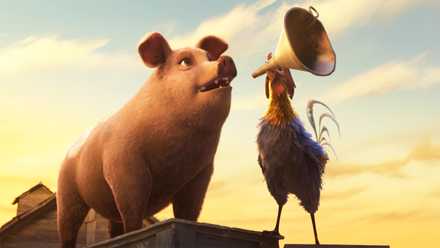

Andy Serkis’ ‘Animal Farm’ Revealed in a Gripping New First Look [Exclusive]
A young piglet named Lucky stands at the crossroads of revolution.
Andy Serkis on Why ‘Animal Farm’ Isn’t the “Message-y Movie” People Expected
“This is sort of experiential in a way, because you’re seeing it through a young character’s eyes.”
When you first started working on this in 2012, and where it is now, how has it changed along the way? Did you go through any radical changes along the way?
SERKIS: Well, yeah, because originally it was going to be a live-action, performance capture-driven movie because it was inspired by the moment, when we were making the [Planet of the] Apes movies, when I realized that there hadn’t been an adaptation of Animal Farm for a long time. And I was making Mowgli [Legend of the Jungle] shortly after that. It came out of, “Can we take a great piece of literature like this and make a performance capture-driven live-action version?” But that would have necessarily made it a darker film.
There’s so many graphic images in the novel, of things like the dogs tearing up the other animals, attacking them, and it’s brutal, but we wanted to have the impending threat there without it being so graphic, and actually it be cleverer, in a way, that actually the misinformation, the lies, and the violence is the undercurrent of it, but you never actually see it because we live in a world where we’re desensitized enough to see violence all the time, but we don’t see it anymore. So this was a way of looking at those themes without actually having to go there and be as graphically violent.
In the movie, there’s a scene where Snowball goes out of the farm with the dogs, and we never see Snowball again.
SERKIS: Right. Exactly. And that’s the sort of Disney-esque approach when Disney was able to be darker. It’s that and then learning from great animation companies like Pixar about how you can discuss modern themes and modern psychology and really interesting family themes, but intelligently, and not be patronizing. Because the last thing that any of us wanted to do was make a sort of, as I say, “message-y” movie, which is telling the audience what to think. This is sort of experiential in a way, because you’re seeing it through a young character’s eyes.
Andy Serkis Explains ‘Animal Farm’s Key Change From the Book
“We’ve sort of slightly shifted here and there, but I think it fits the tone of our movie better.”

Animal Farm is a story that many people know, many people have read. Were there any aspects of the book that you discovered in a new way when adapting it?
SERKIS: Yeah. Very early on in the book, actually, the pigs are already separating themselves almost immediately. Old Major’s speech, the old pig who has the dream about the future, almost immediately, they are separating themselves from the other animals. So by the time the rebellion happens in the book, they’ve already been learning to read and things like that. But actually, with this, we wanted to slightly, for a moment, make it feel like everyone is equal at the beginning.
There are characters like Napoleon who always, by dint of their personality, want to take center stage, or Snowball, who’s going to try and do the right thing, but they weren’t as prepared for it as this. It comes out of nowhere because the opening of the movie is a shock. They’re being taken somewhere they don’t think that they’re being taken to, but that’s because of the benign neglect of the drunk farmer. So we’ve sort of slightly shifted here and there, but I think it fits the tone of our movie better, in a way.
One of the things that I’ve thought about recently, and it’s true in this, is the importance of education. The more educated you are, the easier it is to see through the lies and the facade.
SERKIS: Correct. That’s why it’s very touching, and there’s a sadness to the character Boxer, who remains a victim of being lied to. The tragedy of that character is that you can never see that what he’s being told isn’t true, and that he blindly follows, and the tragedy of being separated from his best friend, as well, who happens to be of a species that is not the same as him.

I’ll tell you one of the things that we were very keen to do, though. Obviously, the book ends in a very dark place. There is no hope. There’s no moment of hope. There’s no third act in a way, one could say. But we did want to offer not tying it up in a nice, neat bow and saying, “It’s okay, everybody. It’s going to be alright.” It’s sort of saying, “They’ve messed it up again. The wheel is going round. History repeats itself, but you cannot shy away from the fact that we have to keep trying.” And that’s why this film, again, speaks, hopefully, to young people. They’re the ones who are going to have to deal with the future. So, it is, “Okay, don’t shy away from it. It’s going to be your problem, but don’t be so despondent about it. You have to think that there is a way because there will be.”
Andy Serkis on the Future of Performance Capture


Is there still a stigma around performance capture when it comes to awards recognition, or do you think the industry is finally starting to respect it as acting?
SERKIS: I think it is definitely beginning to understand it more and to respect it more. Whether or not it’ll just be considered as part of the acting category, I don’t know. That might take a little bit longer. But the marriage of technology and all sorts of different aspects of filmmaking to create an actor’s performance is something that we are certainly more used to and are not shying away from. I think it won’t be too long, hopefully, before it is accepted as acting, as authoring the role, in the same way that an actor reads and plays a character from page one to 120 of a script.
You’ve helped pioneer the art form of performance capture. Is there something you think people still misunderstand about performance capture?
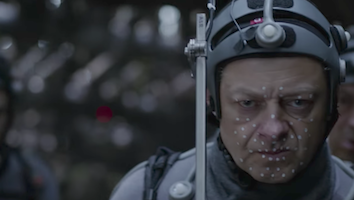
SERKIS: Yeah. [Laughs] It’s weird because people are so used to now being able to put their iPhone on themselves and create an avatar, so they understand that aspect of it. But I suppose it’s just the notion of being on set and actually facially capturing an actor’s performance. It is, to a certain extent, director’s choice. Some directors choose to let the retargeting or the reanimation of that into the face of the character, the avatar.
There are certain directors, like James Cameron, for instance, who absolutely want it 100% to represent the choices the actors made in the moment. There are other examples of it where there’s more latitude in terms of, “Well, we can reanimate it slightly to make the expressions a bit bigger and broader,” as we did in Tintin, for example.
So, there’s still slightly latitude with it, but ultimately it comes down to director’s choice. Matt Reeves, for example, for all the Planet of the Apes movies, would sit with the animators and go, “That is not what Andy is doing.” To the nth degree, he would push them, push them, push them until finally it was represented in the face of Caesar. So, it’s a tool that can be used in different ways.

Do you think we’re ever going to get another Tintin movie?
SERKIS: Oh gosh, I wish! I really hope so. I love that Tintin film. I loved the process of making that film with such great filmmakers. I think Peter [Jackson] really, really wants to make it, so hopefully down the line.
I would love it. But I also love what Peter’s doing with bringing old footage back to life with The Beatles. What he’s doing is just so important and valuable that it’s almost like I’m willing to accept he’s not going to make a movie if he’s going to do all of this and work.
SERKIS: Totally. He’s a proper explorative imagineer. His mind is vast, and the things that he wants to approach and the stories that he wants to tell are endless. I’m always in awe of it.
Animal Farm is now playing in theaters.


- Release Date
-
May 1, 2026
- Runtime
-
96 minutes
You must be logged in to post a comment Login