Entertainment
Brendan Fraser’s 10/10 WWII Thriller Is Climbing Peacock’s Streaming Charts

World War II has been the subject of a nearly countless number of films — the first WWII movies were released shortlly after the war itself began — but that doesn’t mean that there aren’t new stories to tell. Even today, a significant global conflict of that size, with so many different parties involved and theaters of warfare, still offers new opportunities to show what a “war film” can look like — especially when merged with different genres.
Pressure is an effective chamberpiece based on a stageplay of the same name that explores the critical process of planning D-Day, the Allied campaign that changed the course of the war and turned the tide against the Nazis. Rather than focusing on the actual combat on the battlefield, Pressure offers insights into how preparations were handled among the different offices tasked with research. It’s not only a great showcase for a terrific cast to deliver memorable depictions of some of the most important historical figures of the 20th century, but a reminder of how close D-Day was to being a catastrophic failure that doomed the world to live under fascism.
Before becoming President of the United States, Dwight Eisenhower was the supreme commander of the United States military in World War II, and became the leader of the entire Allied Forces. Played by Brendan Fraser, Eisenhower gathers a close circle of advisors and military allies to ensure that D-Day will go smoothly. Among those that Eisenhower enlists is RAF Group Captain James Stagg (Andrew Scott), a Scottish meteorologist who is told to put together a weather forecast for the day of the planned attack. Eisenhower expects this to be nothing more than a precaution, but Stagg’s instincts suggest that there could be a storm that would prevent a seabound invasion from working. It’s a fascinating showcase about trying to plan for the unpredictable when the stakes couldn’t be higher. Scott and Fraser are beloved and well-known actors, but they completely disappear into their roles. And at 100 minutes, Pressure is the perfect bottled-up thriller that offers more than a standard history lesson.
‘Pressure’ Is a Different Type of World War II Drama

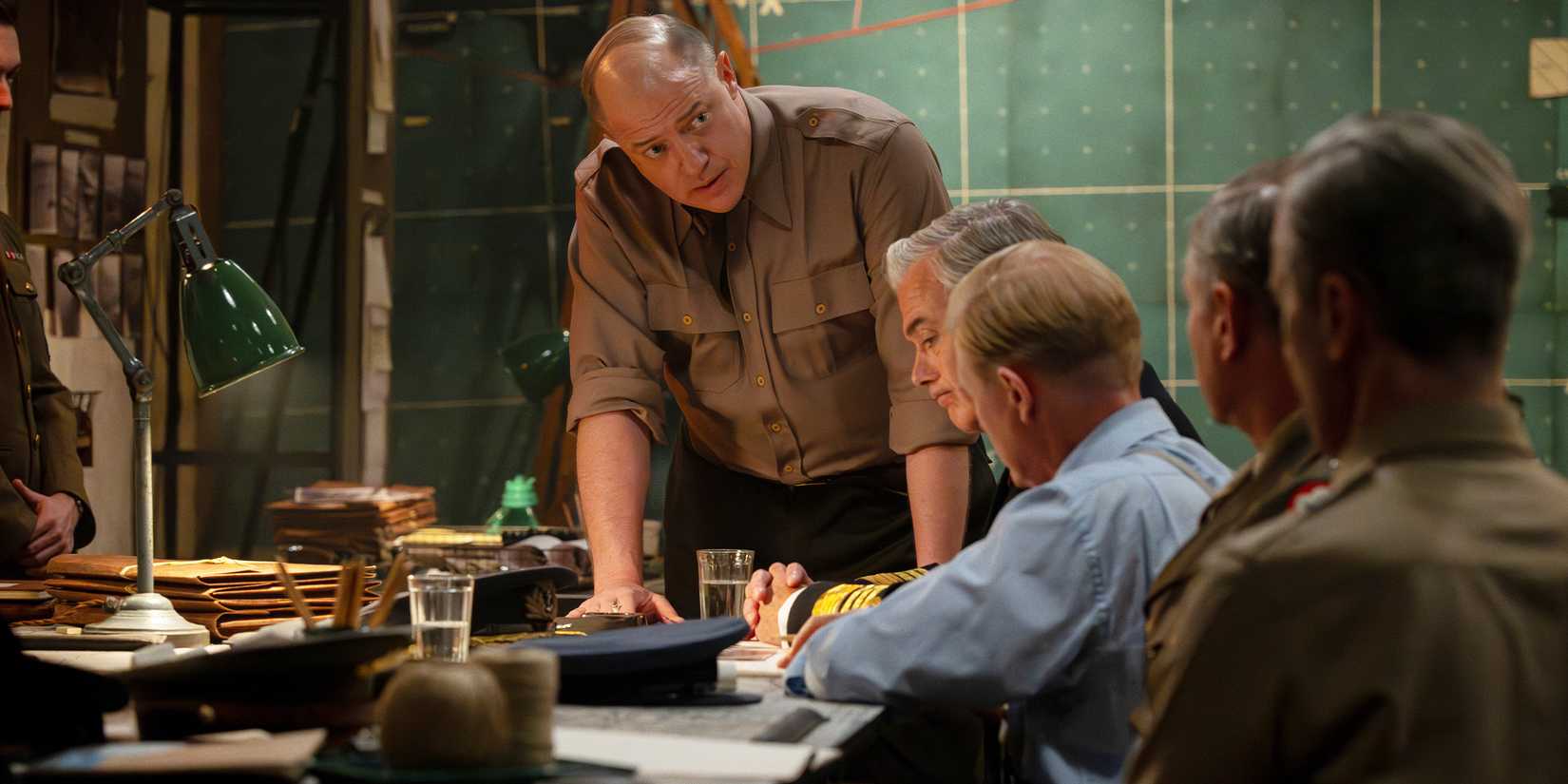
World War II is a fascinating subject for dramatic interpretations because it was a war in which military officials from different nationalities had to pool their resources to create a cohesive strategy, even if there were clashes of culture along the way. Eisenhower developed respectful relationships with the English MTC First Lieutenant Kay Summersby (Kerry Condon), British Army General Bernard Montgomery (Damian Lewis), and USAAF Colonel Irving P. Krick (Chris Messina), but Stagg is framed as being an outsider who is unused to military protocol. Since the tension couldn’t be more bracing, the initial awkwardness of Stagg’s introduction to the other military leaders causes friction when they later have to work together. That Stagg is a meteorologist first and a military man second is held against him, especially when compared to Krick, who is a longtime ally of Eisenhower.
Pressure feels like an authentic depiction of what went on behind closed doors during the preparations for D-Day, because there is legitimacy to the perspective of every figure in the story. The feud between Krick and Stagg is particularly illuminating because of the different methods that they utilize to calculate their predictions: Krick uses his past experience in similar weather conditions to form a pattern, whereas Stagg pulls from a larger pool of data, including information that would otherwise not have been considered. Since the technology used to put together these forecasts was far less advanced than it is today, the decision of whom to trust comes down to a matter of guesswork. Even if it’s a professional debate, there’s a personal edge to the dispute, because Stagg feels disrespected and doesn’t understand why Eisenhower would bring in another advisor when he has already proven to be loyal.
‘Pressure’ Is a Successful Stage-To-Screen Adaptation
Fraser delivers a terrific performance that captures the General at a unique stage in his career. It would have been easy to paint Eisenhower as an aggressive, grumpy veteran determined to win the war as soon as possible, but Fraser shows how personal the conflict is for him, given that he feels responsible for any loss of life among his men. That the decision comes down to Eisenhower alone is one of the film’s most significant points, as Stagg grows to respect the General and wants to ensure that his strategy is appropriate. At the same time, it never feels like Eisenhower is ignoring science to stroke his own ego; his desire to proceed with D-Day is informed by his knowledge that there will be more casualties if Europe continues to live under fascist rule.
Pressure is an appropriate companion piece to the many World War II films that explore the actual D-Day invasion, because it gives a window into the anxiety of watching a battle proceed from afar. While there was a novelty to the fact that the original stage play was able to encapsulate the scope of an entire conflict within a few intense moments, Pressure is an appropriately cinematic film that succeeds in both its claustrophobic, confined moments and the grandiose spectacle of an epic.


Pressure
- Release Date
-
May 29, 2026
- Runtime
-
100 Minutes
- Director
-
Anthony Maras
- Writers
-
David Haig, Anthony Maras
You must be logged in to post a comment Login