Emily Blunt standing outside her farm house with a gun at her side in LooperImage via TriStar
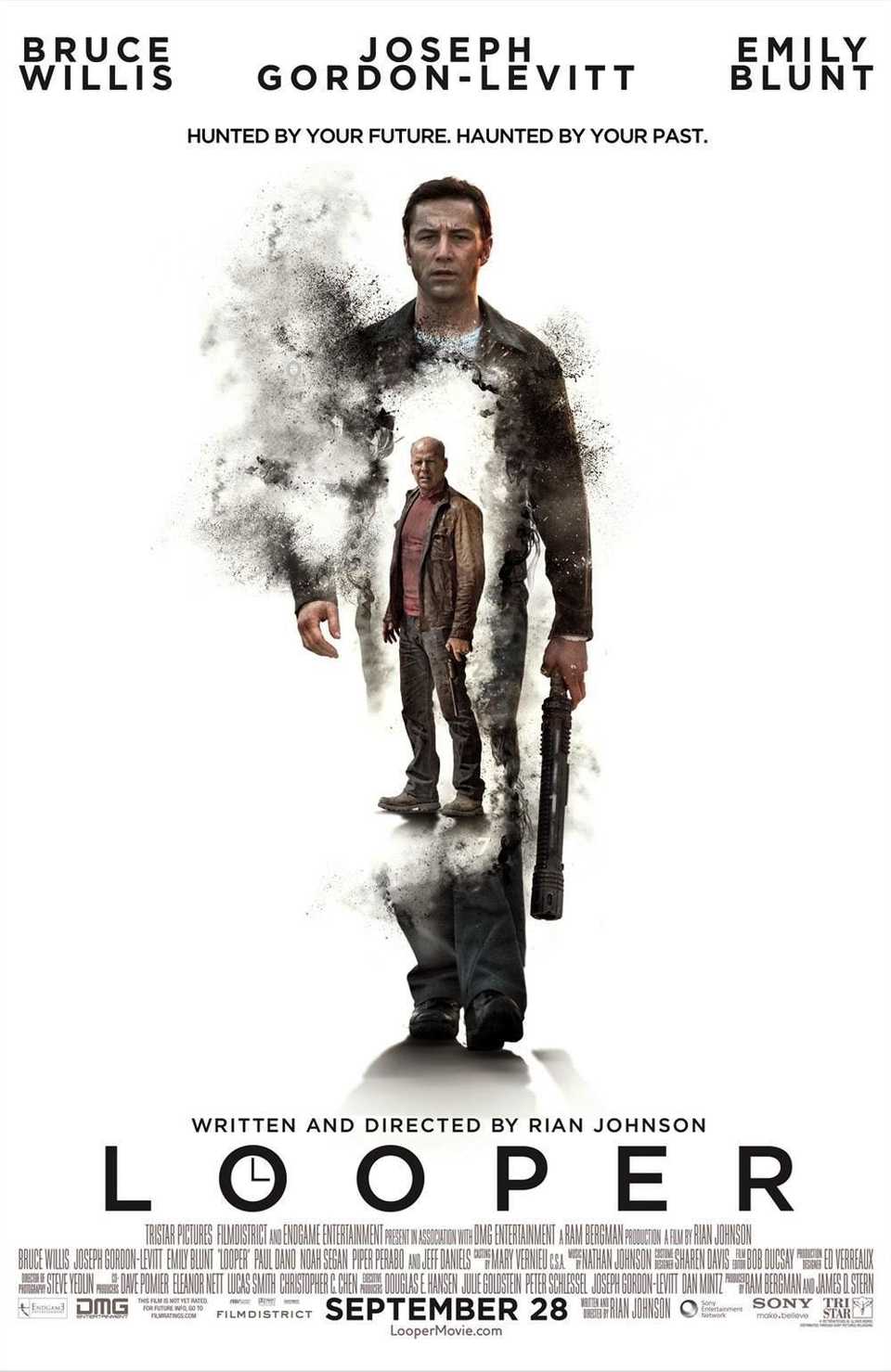
Even before he sent shockwaves across the Star Wars fandom with Star Wars: Episode VIII — The Last Jedi, director Rian Johnson had been deconstructing popular genres with uncommon intelligence. His first movie, the small-budget gem Brick, transported film noir tropes to a high-school setting. He followed it up with The Brothers Bloom, his version of a crime caper. By the time he made his third movie, which was recently added to the Starz streaming library, he was already hailed as someone to watch out for. Johnson’s third feature was a mind-bending time-travel thriller about an assassin tasked with killing his future self.
The movie features Joseph Gordon-Levitt and Bruce Willis as the assassin, with Emily Blunt, Paul Dano, and Jeff Daniels in supporting roles. It premiered at the Toronto International Film Festival in 2012, and was released theatrically to critical acclaim and commercial success a few weeks later. The film’s release came only a few months after the success of Duncan Jones‘ Source Code, starring Jake Gyllenhaal. That movie was massively successful as well, grossing nearly $150 million worldwide and scoring a terrific 92% on the aggregator website Rotten Tomatoes. Johnson’s film one-upped it with a 93% Rotten Tomatoes score and a $176 million global box-office haul.
Advertisement
Advertisement
Collider Exclusive · Sci-Fi Survival Quiz Which Sci-Fi World Would You Survive? The Matrix · Mad Max · Blade Runner · Dune · Star Wars
Five universes. Five completely different ways the future went wrong — or sideways, or up in flames. Only one of them is the world your instincts were built for. Eight questions will figure out which dystopia, galaxy, or desert wasteland you’d actually make it out of alive.
💊The Matrix
🔥Mad Max
🌧️Blade Runner
Advertisement
🏜️Dune
🚀Star Wars
Advertisement
01
You sense something is deeply wrong with the world around you. What do you do? The first instinct is often the truest one.
Advertisement
02
In a world of scarcity, what resource do you guard most fiercely? What we protect reveals what we believe survival actually requires.
Advertisement
03
What kind of threat keeps you up at night? Fear is useful data — if you’re honest about what you’re actually afraid of.
Advertisement
04
How do you deal with authority you don’t trust? Every dystopia has a power structure. Your approach to it determines everything.
Advertisement
05
Which environment could you actually endure long-term? Survival isn’t just tactical — it’s physical, psychological, and very much about where you are.
Advertisement
06
Who do you want in your corner when things fall apart? The company you keep is the clearest signal of who you actually are.
Advertisement
07
Where do you draw the line — if you draw one at all? Every survivor eventually faces a moment that tests what they’re actually made of.
Advertisement
08
What would actually make survival worth it? Staying alive is one thing. Having a reason to is another.
Advertisement
Your Fate Has Been Calculated You’d Survive In…
Your answers point to the world your instincts were built for. This is the universe your temperament, your survival instincts, and your particular brand of stubbornness were made for.
Advertisement
The Resistance, Zion
The Matrix
You took the red pill a long time ago — probably before anyone offered it to you. You’re a systems thinker who can’t help but notice the seams in things.
Advertisement
You’re drawn to understanding how the system works before figuring out how to break it.
You’d find the Resistance, or it would find you — your instinct for spotting constructed realities is the machines’ worst nightmare.
You function best when you have access to information and the freedom to act on it.
The Matrix built an airtight prison. You’d be the one probing the walls for the door.
The Wasteland
Mad Max
The wasteland doesn’t reward the clever or the well-connected — it rewards those who are hard to kill and harder to break. That’s you.
Advertisement
You don’t need comfort, community, or a cause larger than the next horizon.
You need a vehicle, a clear threat, and enough fuel to outrun it — and you’re good at all three.
You are unsentimental enough to survive that world, and decent enough — just barely — to be something more than another raider.
In the wasteland, that distinction is everything.
Los Angeles, 2049
Blade Runner
You’d survive here because you know how to exist in moral grey areas without losing yourself completely.
Advertisement
You read people accurately, keep your circle small, and ask the questions others prefer not to answer.
In a city where humanity is a legal designation rather than a feeling, you hold onto something that keeps you functional.
You’re not a hero. But you’re not lost, either.
In Blade Runner’s world, that distinction is everything.
Arrakis
Dune
Arrakis is the most hostile environment in the known universe — and you are precisely the kind of person it rewards.
Advertisement
Patience, discipline, and political awareness are your core strengths — and on Arrakis, they’re survival tools.
You understand that the long game matters more than any single victory.
Others come to Dune and are consumed by it. You’d learn its logic and earn its respect.
In time, you wouldn’t just survive Arrakis — you’d begin to reshape it.
A Galaxy Far, Far Away
Star Wars
The galaxy far, far away is vast, loud, and in a constant state of violent political upheaval — and you wouldn’t have it any other way.
Advertisement
You find meaning in being part of something larger than yourself — a cause, a crew, a rebellion.
You’d gravitate toward the Rebellion, or the fringes, or whatever pocket of the galaxy still believes the Empire’s grip can be broken.
You fight — not because you have to, but because standing aside isn’t something you’re capable of.
In Star Wars, that willingness is what makes all the difference.
Advertisement
One of the Most Acclaimed Sci-Fi Movies of the Decade Just Became Easier to Access
We’re talking, of course, about Looper. The movie’s consensus on the aggregator website reads, “As thought-provoking as it is thrilling, Looper delivers an uncommonly smart, bravely original blend of futuristic sci-fi and good old-fashioned action.” Johnson moved on to the Star Wars franchise next, and delivered arguably the most divisive installment that the series had ever witnessed. His film was critically acclaimed, but Johnson’s narrative choices didn’t fully resonate with audiences. In recent years, he has devoted himself to the Knives Out film series, each installment of which has been acclaimed by critics. Starring Daniel Craig, the franchise began with a blockbuster theatrical feature, followed by two sequels that were released on Netflix. Looper, on the other hand, was recently added to Starz. Stay tuned to Collider for more updates.


You must be logged in to post a comment Login