Entertainment
Did Star Trek’s Best Series Secretly Doom The Franchise?
By Chris Snellgrove
| Published


Star Trek: Deep Space Nine is considered the best show in the franchise by many fans, myself included. The show focused on extensive characterization, long-running arcs, and fairly dark plots, including the Dominion War story that dominated the last two seasons. Decades later, NuTrek shows like Discovery, Picard, and Starfleet Academy fizzled, leaving the frustrated fandom to ask a simple question: why can’t these newer shows be more like Deep Space Nine?
However, here’s a troubling fact: NuTrek sucked so much precisely because the creators were trying to make shows like DS9. Obviously, they didn’t do a very good job, mostly because executive producer Alex Kurtzman is a complete hack. But if you pound a few shots of Romulan Ale and squint, you can see that the architects of NuTrek went all-in on the idea of creating “darker” Star Trek shows in a failed attempt to recapture the magic of what made Deep Space Nine so special.
Star Trek Into Darkness


Deep Space Nine is considered the dark (if not the darkest) Star Trek show for many reasons. It doesn’t feature the squeaky-clean heroes of The Next Generation; instead, our heroes include a former terrorist (Kira), a former spy (Garak), and an angry widower who ends up becoming a reluctant Space Jesus (Sisko). His chief foe is basically Trek’s closest analog to Adolf Hitler (Gul Dukat). Even the relatively “normal” characters get dark backgrounds and plots. For example, fresh-faced medical prodigy Dr. Bashir is revealed to be a Khan-like augmented human. Affable everyman O’Brien, meanwhile, gets physically and mentally tortured at least once a season.
The show also used its Dominion War arc to test the boundaries of Star Trek’s endless idealism. Sisko becomes an accessory to a murder, but he never admits it because this act finally gets the Romulans to join the war. He also discovers that Starfleet has a secret wetworks division known as Section 31, which handles everything from assassinations to genocides. Odo gets so distracted by shapeshifter sex that he becomes a collaborator with monsters (again). Oh, and Worf murders Gowron (with Sisko’s blessing!) so he can install his buddy as Chancellor of the Klingon Empire.
NuTrek Is An Edgerlord’s Paradise
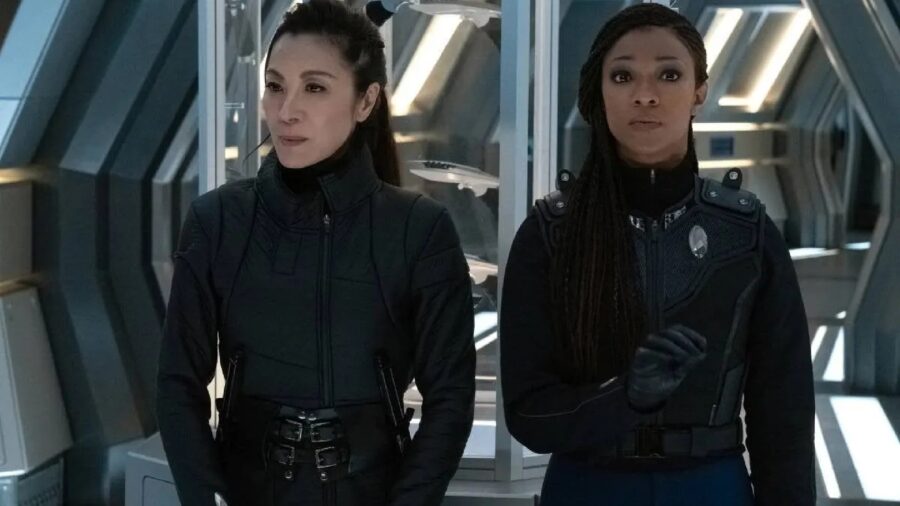
Obviously, DS9 had dark characters and storylines, but what does that have to do with NuTrek? In short, the entire Kurtzman era of this franchise has been filled with lame, edgelord attempts at making the franchise darker. The first season of Star Trek: Discovery, for example, centers on a mutineer who started a war as its main character. It’s a season where Klingons eat their dead foes and strip down to engage in sex that’s half play, half intimate assault. An evil Starfleet captain tortures a tardigrade before the good Starfleet captains one-up him with a plan to blow up an entire planet in an attempt to end a costly war.
Star Trek continued going (ahem) into darkness with other spinoffs. Picard inexplicably features a beloved Voyager B-lister getting tortured and murdered while Picard cozies up to a Romulan swordsman whose only solution to any problem is cutting someone’s head off. They’re fighting to save a Federation that is now cool with creating synthetic slaves. Later, Season 2 has our heroes fighting ICE, watching Q die, and discovering that a young Picard accidentally helped his mother unalive herself. Even the relatively lighthearted Starfleet Academy had the good guys put the entire Federation in danger because they meddled with and accidentally weaponized the most dangerous molecule in the galaxy.
It’s All About Testing Characters’ Morality


In retrospect, it’s clear that Alex Kurtzman and his writers thought they could recapture the old Deep Space Nine magic by throwing a bunch of grimdark characters into gritty situations and calling it a day. However, this didn’t work because DS9’s characters weren’t inherently dark; instead, they were good men and women forced to weigh their morals against the greater good. In the classic episode “In the Pale Moonlight,” Sisko isn’t compelling simply because he’s a morally murky character. No, what makes this episode fascinating is that he’s a good man forced to do bad things, with the fate of potentially billions of lives riding on his decision.
Similarly, Worf doesn’t kill Gowron because of petty vengeance or a haunted past. Instead, he weighs his cultural values as both a Klingon and a Starfleet officer, ultimately deciding it’s better to kill a tyrant than let him continue getting others killed. Even plain, simple Garak seems happy with his life as a tailor, and he’s only reluctantly drawn back into active spycraft because he realizes the best way to save his homeworld is to save it from the Cardassians who have sold its soul, one alliance at a time.
This obviously extends to the Dominion War arc as a whole. We see the toll the war has on good men and women: Nog becomes a wounded and disillusioned war veteran, and Rom nearly gets killed trying to save the Alpha Quadrant. Jadzia Dax does get killed fighting superpowered space Hitler, and Odo begins to question his loyalties. However, characters retain their morality throughout every ordeal. Bashir repeatedly refuses to join Section 31, and Odo saves the Changelings from that organization’s attempted genocide. Standing victorious on Cardassia, Captain Sisko and Admiral Ross refuse to toast their victory, instead choosing to mourn this utterly senseless and completely preventable loss of life.
NuTrek Made Its Worst Villain Into A Hero

Compare that to NuTrek, where the Klingon War hardens hearts and makes the wisest people lose their moral compass. Both Sarek and Starfleet are willing to blow up the Klingon homeworld and kill billions in order to end the war. Starfleet has suddenly decided to trust its war planning to Mirror Universe Georgiou, a woman who has terrorized the entire galaxy while murdering countless people. Later, she’s put in Section 31 (a DS9 invention NuTrek tried very hard to capitalize on) so the entire Federation can continue to benefit from her completely amoral advice. That’s because the Feds believed the same thing that Picard suddenly starts believing over a century later: violence is great as long as the ends justify the means.
This is basically the problem with NuTrek in a nutshell. We don’t get fully fleshed-out characters whose morality is tested by unthinkable scenarios. Instead, we get one-dimensional characters who are dark and compromised from the beginning. Michael Burnham is meant to be the embodiment of Starfleet ideals, but she comes to us as an angry, nearly broken mutineer who, in her guilt, saves an alternate universe’s most murderous monster from certain doom. Even formerly complex characters like Picard are made dumb, violent, and impulsive by writers who value blunt spectacle over elegant storytelling.
Star Trek Needs More Than Darkness

Alex Kurtzman tried to copy the Deep Space Nine formula for NuTrek, but, in typical fashion, he went about it in the stupidest possible way. It’s not enough to give us dark settings and plots; we need well-developed characters whose morality is an idealistic counterpart to the darkness around them. Stories needed to reinforce Star Trek’s hopeful ethos and reward audiences who never lost faith in the greatest sci-fi franchise of all time. Instead, what we got was a collection of dark characters, pointless action scenes, and endless violence, all wrapped up with another snoozeworthy Michael Burnham speech.
This is Kurtzman’s warped idea of what makes Star Trek so great. Is it any wonder that every one of his NuTrek shows has been a colossal failure?
You must be logged in to post a comment Login