For anyone born after, say, 2000-ish, it’s surely hard to fathom a Batman era before the Christopher Nolan pictures. Starting with the critically acclaimed sleeper hit Batman Begins before skyrocketing as a cultural marker with the unprecedented success and acclaim of The Dark Knight, the Nolan trilogy completely revolutionized comic-book, superhero and blockbuster filmmaking as we know it. Surely The Dark Knight is the single most influential motion picture of the 21st century.
Alas, there was a time before Nolan, and there were Batman movies that were huge successes in their own respective rights. From the gothic duology from Tim Burton that began in 1989 to the glittering fever dream that was the Joel Schumacher films, this era was uneven and chaotic to put it mildly. It was brilliant at times, too, and tangibly influenced Nolan and plenty of other filmmakers in generations to come. The following ranks every theatrically released Batman movie of this era, specifically the ’80s and ’90s, from worst to best.
Advertisement
5
‘Batman & Robin’ (1997)
Image via Warner Bros.
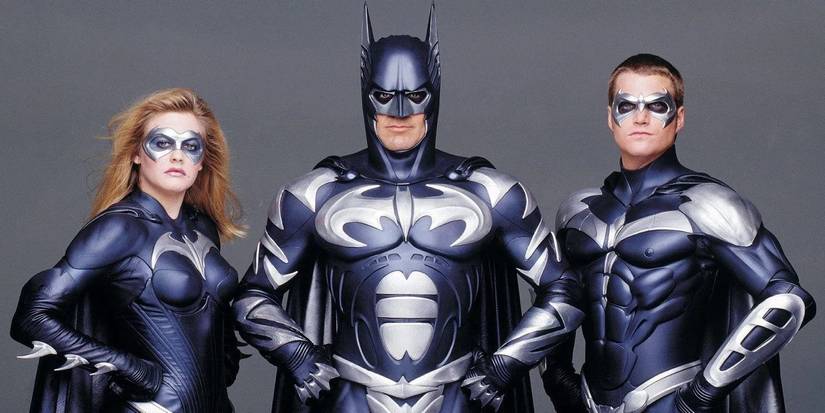
Joel Schumacher’s second Bat outing has a reputation as one of the worst movies ever made, and though whether it fully earns this is up for debate, its placement on this ranking is not. Batman & Robin is an overproduced—but, it must be said, slickly produced—mess of pat-puns, Adam West-era corniness and garish production design. There were plans for a fifth live-action Batman movie of this era, which would have been Schumacher’s third, but the box-office and critical failure of Batman & Robin nipped this in the bud. Schumacher has even apologized for the infamous movie on camera. Respect, honestly.
But is Batman & Robin really that bad? Well, yes and no. If you sit down and watch the Batman movies of this era in chronological order, it is is truly jarring in all the wrong ways. The Burton films had their flaws, mostly narrative ones, but their commitment to a tone and to character is mostly demolished here in favor of “toyetic” freneticism that distracted some kids and sold some admittedly cool toys, perhaps, while largely repelling the target demographic and almost anyone who’d enjoyed previous Batman entries. Uma Thurman is the one actor who famously emerges entirely unscathed here, playing Poison Ivy with just the right amount of camp. She understood the assignment, and she’s even gone on to say she loved making Batman & Robin.
Advertisement
4
‘Batman Forever’ (1995)
Image via Warner Bros.
Batman Returns was a critical and financial disappointment in 1992, and this was generally chalked up to the film being overly dark and punishing… perhaps an odd complaint with hindsight. All the same, Warner Bros. insisted on a new direction and reportedly, essentially fired Burton, with Michael Keaton quitting the third film in solidarity. Despite the reputation he now holds, Schumacher may have seemed like a sound replacement at the time, thanks to having The Lost Boys and numerous dark thrillers under his belt. And to be fair, Batman Forever is far from a terrible film. It’s confused and conflicted, with a notorious lost cut that, contrary to popular belief, would probably only improve it marginally.
Val Kilmer plays a serviceable Batman and a pretty decent Bruce Wayne, sharing top billing with Tommy Lee Jones and Jim Carrey. The former delivers a total miscalculation of a performance as Two-Face, empty and shrill buffonery that ranks about the worst turns in comic-book movies. Carrey, on the other hand, pretty much walks away with the movie as Riddler. Every joke lands, every mannerism registers. A year after his historic rise to stardom with a trio of comedy blockbusters, it was the right casting at the right time. Batman Forever feels like something of a footnote in the overall Batman franchise, but on its own merits, it’s a pretty decent and watchable action blockbuster.
Advertisement
3
‘Batman’ (1989)
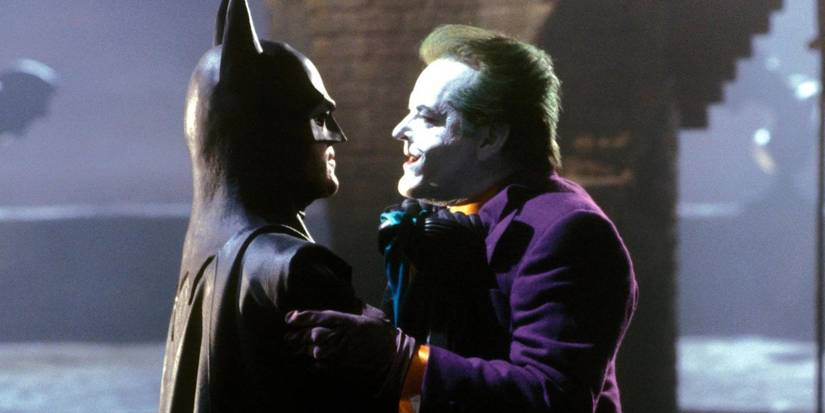
Batman (Michael Keaton) and the Joker (Jack Nicholson) argue in each other’s faces in Batman.Image via Warner Bros.
Over two decades after his ridiculous, shark-punching previous big-screen appearance, which truthfully was a cash-grab transplant of TV show at its height, Batman finally arrived in fully fleshed-out summer blockbuster form, with Burton of recent Beetlejuice fame at the helm and the seemingly unlikely Michael Keaton of, er, Mr. Mom fame, in the title role. Top billing actually went to Jack Nicholson as Joker, in an iconic, transformative and darkly hilarious performance that netted the actor something around $90 million thanks to a back-end deal. Memorable as it is, it just doesn’t match anything like the depth of Heath Ledger‘s take on the character two decades later.
Batman won an Academy Award for its production design, and it’s hard to imagine it not winning this looking at it now. The story, though, really is paper-thin, and it’s been done no favors by comparison to the Nolan films over the years. Even the weakest of Nolan’s pictures, The Dark Knight Rises, giant plot holes and all, is demonstrably more satisfying as a narrative than Burton’s original blockbuster. Still, film is a visual medium, and it’s hard to overstate the achievement here on that level. 1989 was simply the year of Batman at the box office. At the time of release, this was the sixth highest-grossing movie ever.
Advertisement
Collider Exclusive · Action Hero Quiz Which Action Hero Would Be Your Perfect Partner? Rambo · James Bond · Indiana Jones · John McClane · Ethan Hunt
Advertisement
Five legends. Five completely different ways of getting out alive — with style, with muscle, with charm, with luck, or with a plan so intricate it probably shouldn’t work. Ten questions will reveal which action hero was built to have your back.
🎖️Rambo
🍸James Bond
🏺Indiana Jones
🔧John McClane
Advertisement
🎭Ethan Hunt
Advertisement
01
You’re dropped into a dangerous situation with no warning. What do you need most from a partner? The first few seconds tell you everything about who belongs beside you.
Advertisement
02
You have to get somewhere dangerous, fast. How do you travel? How you get there is half the mission.
Advertisement
03
You’re pinned down and outnumbered. What does your ideal partner do? This is when you find out what someone is really made of.
Advertisement
04
The mission is paused. You have one evening to decompress. What does your partner suggest? Who someone is when the pressure drops is who they actually are.
Advertisement
05
How do you prefer your partner to communicate mid-mission? Good communication is the difference between partners and a liability.
Advertisement
06
Your enemy is powerful, well-resourced, and has the upper hand. How should your partner approach them? The approach to the enemy defines the partnership.
Advertisement
07
Things go badly wrong and you’re captured. What do you trust your partner to do? Who someone is when you need them most is the only thing that matters.
Advertisement
08
What does your ideal partner bring to the table that you couldn’t replace? A great partner fills the gap you didn’t know you had.
Advertisement
09
Every partnership has a cost. Which of these can you live with? No one comes without baggage. The question is whether you can carry it together.
Advertisement
10
It’s the final moment. Everything is on the line. What do you need from your partner right now? The last question is the most honest one.
Advertisement
Your Partner Has Been Assigned Your Perfect Partner Is…
Your answers have pointed to one action hero above all others. This is the person built to have your back — for better or considerably, spectacularly worse.
Rambo
Advertisement
Your partner doesn’t talk much, doesn’t need to, and will have assessed every threat in your immediate environment before you’ve finished your first sentence. John Rambo is not a man of plans or politics — he is a force of nature shaped by survival, loyalty, and a capacity for endurance that goes beyond anything training can produce. He will not leave you behind. He has never left anyone behind who deserved to come home. What you get with Rambo is the most capable, most quietly ferocious partner imaginable — one who has been through things that would have broken anyone else, and who chose to keep going anyway. You’ll never need to ask if he has your back. You’ll just know.
James Bond
Your partner will arrive perfectly dressed, perfectly briefed, and with a cover story so convincing it’ll take you a moment to remember what’s actually true. James Bond is the most professionally dangerous person in any room he enters — and the most disarmingly charming, which is the point. He operates in a world of layers, where nothing is what it appears and every advantage is used without apology. You’ll never be bored. You’ll occasionally be furious. But when it matters — when the mission is genuinely on the line and the margin for error has collapsed to nothing — Bond is exactly the partner you want. He has survived things that have no business being survivable. He does it with style. That is not nothing.
Advertisement
Indiana Jones
Your partner will know the history, the language, the cultural context, and exactly why the thing everyone else is ignoring is actually the most important thing in the room. Indiana Jones is brilliant, reckless, and occasionally impossible — but he is also one of the most resourceful, most genuinely knowledgeable partners you could find yourself beside. He approaches every situation with a scholar’s eye and a brawler’s instinct, which is an unusual combination and a remarkably effective one. He hates snakes and gets personally attached to objects of historical significance, both of which will slow you down at least once. It doesn’t matter. What Indy brings is irreplaceable — and the adventures you’ll have together will be the kind people write books about. Assuming you survive them.
Advertisement
John McClane
Your partner was not supposed to be here. He does not have the right equipment, the right information, or anything approaching the right odds. He has a sarcastic remark and an absolute refusal to accept that the situation is as bad as it looks. John McClane is the greatest accidental hero in the history of action cinema — a man whose superpower is stubbornness, whose contingency plan is improvisation, and whose capacity to absorb punishment and keep moving would be alarming if it weren’t so useful. He will complain the entire time. He will make it significantly more chaotic than it needed to be. And he will absolutely, unconditionally, without question come through when it counts. Yippee-ki-yay.
Ethan Hunt
Advertisement
Your partner has already run seventeen scenarios by the time you’ve finished reading the briefing, and the plan he’s settled on involves at least two things that should be physically impossible. Ethan Hunt operates at the absolute edge of human capability — technically, physically, and intellectually — and he brings the same relentless precision to protecting his partners that he brings to dismantling organisations that shouldn’t exist. He is not easy to know and he will never fully tell you everything. But he will carry the weight of the mission so completely, so absolutely, that your job is simply to trust him — and the remarkable thing is that trusting him always turns out to be the right call. The mission will be impossible. He will complete it anyway.
Advertisement
2
‘Batman Returns’ (1992)
Michael Keaton in batman returns having torn his mask off in penguin’s lair
Following the absolute mammoth success of the 1989 blockbuster, Burton was afforded near-complete creative control over a sequel he initially didn’t want to make. Whether this creative freedom was a good thing may depend on who you’re asking. Batman Returns is a divisive movie to put it mildly, largely rejected in its day and even highly controversial. It’s one of the weirdest blockbuster movies ever made, and uncommonly gripping. These days, many will call it the best Batman movie ever made.
Advertisement
One thing that’s really important to mention here is that neither Bruce Wayne or Batman have the most screen time, or even the second-most. Danny DeVito’s Penguin and Michelle Pfeiffer‘s Catwoman largely drive the story, a gloomy Christmas-set narrative that sees Oswald Cobblepot seeking vengeance against Gotham for a lifetime of ostracization. Batman Returns is an oddly compelling story of three outsiders, and what it means to be an outsider. It’s also the most visually stunning depiction of Gotham City, ever. Batman Returns lives up to its polarizing reputation for being repellingly bleak and violent, but it’s also a stunningly crafted feature whose merits become more vividly undeniable with every rewatch. TIme has been good to it.
1
‘Batman: Mask of the Phantasm’ (1993)
Batman sits with his head in his hand and his mask off, looking sad in Batman: Mask of the PhantasmImage via Warner Bros.
The best Batman movie of this era, by some distance, is an off-shoot and prequel of Warner Bros. Animation and Fox Kids’ Batman: The Animated Series, a show that is now widely revered and serves as the ultimate depiction of the character for many. Batman: Mask of the Phantasm is particularly haunting for showing us a young Bruce Wayne with a shot at happiness, particularly a tender romance with kindred spirit whose day-to-day is similarly plagued by grief. There’s also an intriguing mystery concerning a Batman-like figure in shadows who’s murdering people in Gotham, but Mask of the Phantasm is widely revered as one of, if not the best Batman film ever made because of how close we get to Bruce Wayne, soulfully played by Kevin Conroy.
Advertisement
It’s perhaps a testament to the divisive, frankly overall rather rejective response to Batman Returns that Mask of the Phantasm was a box-office bomb despite positive reviews. Its reputation has steadily grown since its release on VHS, and these days it’s a touchstone for fans of the character, and even the filmmakers tasked with his various reincarnations. Roger Ebert and Gene Siskel rather famously covered the film some time after its release, praising its artistic merits and story while chiding Warner Bros. for botching its theatrical release. Ebert praised the film for having “more of a story” than the live-action films that preceded it. Siskel encouraged Warner Bros. to greenlight more features from the animation team behind Phantasm and said, “I’m sorry we caught up with this picture a couple of years late.”






You must be logged in to post a comment Login