Entertainment
Fan Favourite Sci-Fi Story Is Officially Getting The Adaptation It Deserves

Summary
- Collider’s Steve Weintraub talks with writer-director Duncan Jones for Rogue Trooper which is an adaptation of 2000 AD’s 1981 comic strip.
- At the Annecy International Animation Film Festival, Jones celebrated the world premiere of his comic strip adaptation film, over a decade in the making.
- He discusses using Unreal Engine 5, maintaining the source’s political edge, working with an ensemble of comedians, and more.
Filmmaker Duncan Jones (Moon) has four feature films under his belt, but for well over a decade, he’s been chasing his directorial white whale: an adaptation of 2000 AD’s 1981 comic strip Rogue Trooper. While talking with Collider’s Steve Weintraub at this year’s Annecy International Animation Film Festival, where his longtime dream finally celebrated its world premiere, Jones explains that despite his affinity for Hollywood’s greatest World War II epics, it was the core group of buddies at the heart of the UK comic that inspired him most.
Rogue Trooper is a gritty sci-fi behemoth that Jones deftly adapted for screen from Gerry Finley-Day and Dave Gibbons’s original story, opting for Unreal Engine 5-powered animation to capture the futuristic war between the Norts and Southers. The movie follows Rogue (Aneurin Barnard) as he traverses enemy territory during a secret military operation, accompanied only by the biochips of his former pals, Gunnar (Jack Lowden), Helm (Daryl McCormack), and Bagman (Reece Shearsmith). The movie also enlists the talents of comedians like Jemaine Clement, Matt Berry, Diane Morgan, Al Murray, and Henning Wehn, plus stars like Game of Thrones icon Sean Bean and MCU favorite Hayley Atwell as the treacherous Venus Bluegenes.
“There’s a couple of little Easter eggs in there for the fans of the comic book,” Jones teases, but for the uninitiated, he adds, “Really, for an audience who doesn’t know about the biochips, it’s really making sure that they understand that the chips are in people’s heads, that their personalities, the people that they are, are recorded on those chips when they die.”
In their recent conversation, which you can read below, Jones further explains the lore and the themes he wanted to capture in his long-gestating adaptation. He discusses the full animation process and why their team had to shift from fully animating with Unreal Engine, tackling a massive world build through independent animation, without Disney-sized finances, and what about 2000 AD’s comic sources inspired him over the box office-busting Marvel or DC. Jones also addresses Rogue Trooper’s distinctly British aesthetic, how the “amazing comedians” in the cast helped shape the final film, adhering to 2000 AD’s political edge, the inspiration of WWII classics like A Bridge Too Far and more, working with Bear McCreary (Battlestar Galactica, The Walking Dead) on the score, and paying tribute to the creatives behind the original comic.
How ‘Rogue Trooper’ Was Made Using Unreal Engine 5 (Sort of)
“We didn’t know how the film was going to get made when we started.”


COLLIDER: How did you make this movie using only Unreal Engine 5?
DUNCAN JONES: [Laughs] We didn’t. We started that way. We thought we were going to be able to do that, and about two and a half years in, we realized that it’s not ready yet. So we actually took it out of Unreal 5 and ended up using Maya and some other software, and then we reimported it back at the end to basically do our rendering through path tracing.
Pipeline-wise, we didn’t know how the film was going to get made when we started. We thought we had a plan, but it didn’t quite work out, and that’s one of the reasons the film took four years. We were kind of working it out as we went along. It was maybe a little crazy of us to go ahead when we didn’t really know how we were going to do it, and we didn’t know what the film was going to look like by the end of it.
We knew what we wanted. There was this amazing comic that Dave Gibbons did with Will Simpson called War Machine, and we knew we wanted it to look something like that. Lots of beautiful rendered fog and a watercolor kind of feel to it. I mean, you would attest that that’s kind of how it looks?
100%.
JONES: That’s what we were going for, but we didn’t know how we were going to get there, and that’s why it took so long. One of the reasons.
For people who want to do something like this in the future, what’s the big lesson you learned?
JONES: Well, first of all, that it’s possible and that you can make big-world movies in independent cinema now, I believe. You need to get the expertise around you. The technology is moving so fast, and I’m sure you’ve heard me say this before, but there is no AI in this movie. We didn’t want AI. You can still do this without using AI. You can make an independent movie that looks like this without AI. It’s really just a matter of finding the combination of technologies to get you that.
I don’t want you to tell me, and I have no business knowing, but a lot of people are wondering, like, what did this actually cost? Is this something that a real indie can do? I’m sure a lot of people are wondering, “Can I actually do this?”
JONES: I’ll just put it this way, I don’t know any theatrical animated films that have been made at this budget.
‘Rogue Trooper’ Isn’t Working With a Disney-Sized Budget
“It’s a very British film, as well.”

When we talk about Pixar or Disney, those people are spending over $100 million.
JONES: We’re not talking about that. Even independent films, animated films that have gone to theaters, I’m sure there are others, but it really hits over its cost.
Absolutely. You world premiered here at Annecy, which is amazing, but how many times have you screened for studios and people? Was it like, “Let’s show here and see how it goes?” Because it’s a big decision to world premiere somewhere.
JONES: We did some test screenings, but it was a while ago, and that was still while we were in the editing room. But no, this was a proper first time in front of a real audience. We were proud of the film. We felt confident. I’ve been working with the guys at 2000 AD, and we’ve been working for such a long time refining it the best way we could, and we just wanted to put it in front of an audience. We felt confident. We felt like we had something.
Sometimes, the distribution plan can be a big question mark.
JONES: It is a big question. Look, it’s a very British film, as well. One of the reasons we wanted to come to Annecy in particular is that we feel confident that it is going to work with a British audience, but is it a British film that only British people will get, or is it like Shaun of the Dead, where audiences beyond that will appreciate it? That’s what we wanted to see. That’s why we wanted to come here.
This is a 2000 AD property with a very specific British sci-fi attitude. What was the most important piece of that 2000 AD DNA to preserve?
JONES: Not being afraid of being a little bit political. 2008 AD comic book has always worn its politics and its cynical humor on its shoulder, and that’s one of the things, to me at least, that differentiates it a little bit from DC and Marvel. I mean, they have those things, but I think 2000 AD does it in a very British way. It’s very Python-esque in some ways. There’s a cynicism in 2000 AD, which is maybe not as… You know what? I’m talking out of my knowledge because I don’t know DC and Marvel as well as I know 2000 AD, but I know what I wanted to capture in 2000 AD again, and it’s that it’s being funny, being acerbic, and being a little bit political at the same time.
As someone who’s watched all the Marvel and DC movies, they are not doing what this movie is doing and what they’re addressing. I will say that Thunderbolts*, which is a recent film, really addressed mental health in a way that I’ve never seen a comic book movie do, and it really impressed me what they pulled off, but that is a rarity, and it’s not about politics.
JONES: I understand, and those are big studio films. Again, one of the other benefits of being indie is that you can kind of just say what you want to say and do what you want to do.
Rogue is on a revenge mission, but the story also has a lot to say about soldiers being manufactured, used, and discarded. How political did you want the movie to feel?
JONES: The timing of everything was unplanned. I’ve been working on it for a long time, and it synced up that we started production roughly the same time as the SMO in Ukraine began. So we’ve been making the movie while watching the horrors of what’s been going on out there. I don’t know if you know much about what I do online, but I’ve been keeping in contact with a lot of people out there and trying to understand what’s been going on and how they’re getting through it in Ukraine. In my own small way, I’ve been trying to say, “Okay, what can I learn from your experiences that you feel would be helpful to communicating what we’ve done?”
I am so pro-Ukraine. Also, I’m blown away by the way they have taken drone technology to a level that no military command person on the planet, even with the biggest military, has even fathomed. They are revolutionizing warfare.
JONES: There’s a lot of rethinking that has to go on about what asymmetry has brought to modern superpowers, how they’re going to have to rethink what they do. I think sovereignty of smaller nations is in a different place now than it was four years ago.
Absolutely. There’s a lot of world-building baked into Rogue Trooper — Nu-Earth, the Norts, the Southers, and genetic infantry biochips. What was the hardest thing to explain elegantly without stopping the movie cold?
JONES: I think it was the biochips. We hit it a few times, and hopefully, each time that we do hit it, we add just a little bit more information. The key is to try and keep those moments action and entertaining, as well as you learning something. So, there’s a couple of little Easter eggs in there for the fans of the comic book, but really, for an audience who doesn’t know about the biochips, it’s really making sure that they understand that the chips are in people’s heads, that their personalities, the people that they are, are recorded on those chips when they die, and then obviously that they can be brought out and put in the equipment and stored until they can be put into a real body later on. That becomes the ticking clock for us with the chips, which are traveling in Gunnar and Helm and Bagman.
WW2 Classics Like ‘The Dirty Dozen’ Were a Major Influence on ‘Rogue Trooper’
Duncan Jones also praises Bear McCreary’s original score.
I love Bear McCreary’s soundtrack.
JONES: Oh, me too! That was so much fun.
What did his music unlock in the movie that you weren’t expecting?
JONES: Well, I knew that it was going to be great. Because of the weight of what we had talked about, we really wanted to tap into those old World War II movies that I’m kind of nostalgic about, whether it’s A Bridge Too Far, The Dirty Dozen, or Where Eagles Dare. Those were the things we were listening to. I had a few of those as a temp score in the film, and Bear immediately got it. He’s fantastic, and it was amazing to work with him. As soon as we started talking about having a march and using bagpipes and writing lyrics that were as in character with the movie as the story itself, we just had the best time.
The movie’s about two hours. With the process that you did, how exponential is every extra minute in terms of cost, or once you’ve refined this process, was it like, “If we want to do 100 minutes or 120, it’s not that different?”
JONES: For finished film, you’re using more resources than the rough cut, the animatic. Those things, you can have a two and half-hour movie or a 90-minute movie. At the animatic stage, it’s not that much of a problem. We actually ended up taking about nine months to make our animatic, but that wasn’t really because of resource hogging. It was really just working out the story as we went along. I guess it’s a little bit like what Pixar and those people do, is you keep refining and doing new versions of it as you see the finished movie in front of you, and you start realizing where it’s a little bit heavy or where it doesn’t quite work, and you’re able to keep iterating on it.
But isn’t that also because once you start animating, if you will, that’s where the cost is? When you’re doing animatics for those nine months, isn’t the cost minimal, or is it still expensive?
JONES: No, it is minimal. It is minimal, but the interesting thing is, because we use a lot of mocap, there’s a lot of hand animation, as well, but you can do rough hand animation. It only really becomes time-intensive in this experience when you start refining the animation. So, it’s those last passes of iteration where you’re getting it to finished quality. That takes up a lot of time and resources. But you can iterate and have characters moving and get the basic movements down, and that doesn’t really eat up resources in the same way as the finishing off of the film. You just want to know that you’ve done, and then you do your refining.
You’ve wanted to make this for a very long time, and you’ve talked about it for almost 10 years.
JONES: [Laughs] I think we’ve talked about.
It’s possible. What was it about this material that has kept you so passionate for so long?
JONES: Well, the crazy thing is, it wasn’t even the fact that it was a war movie, or that it was even necessarily 2000 AD. I always loved the group of buddies traveling together part of it, between Rogue, Bagman, Helm, and Gunnar. I loved it. It was a road trip movie in some respects. I always thought that the banter and the reliance that these three guys had on Rogue to get them home was just a wonderful setup for a story.
One of the things that really impressed me about the film is that you used actual comic panels at the beginning and at the end. It’s a love letter to the comic, and I don’t think I’ve seen another comic book movie that really embraces comic book frames in the movie. Is it hard to get permission to put the panels on the screen, and why was that so important to you?
JONES: We were lucky enough to show Gerry Finley-Day and Dave Gibbons the movie a couple of weeks ago, and they immediately appreciated the fact that we start our movie with the panels they started the comic book with. We didn’t know exactly what we were going to do at the start of the movie, but as soon as that idea came to me, it just felt so right.
We literally start with the first three panels of the comic book. That’s how we start our movie. Then, when we did that, we started thinking about how we’d like to end the movie, and obviously, this very iconic, massive tank that we start the film with is also at the end of the movie, so the opportunity to do that as a comic panel — that’s not from the comic. That’s one that we had one of the artists who does work in 2000 AD and has done Rogue work, he came in and did this bespoke ending comic panel for us to end the movie.
That’s fantastic. Something else I want to commend you on is that in the credits, you mentioned all the people who worked on the comic. No disrespect to Marvel and DC, but it’s almost like they’ve been forced to mention Bob Kane, or they’ve been forced to mention some of these creators.
JONES: Why wouldn’t you want to mention them?
It’s because of money, attrition, or residuals. Who knows? But all of this stems from these people. It’s their ideas.
JONES: Yeah. We’ve got Gerry and Dave’s credit right up front, the beginning of the movie. That’s how we start.
Edgar Wright’s ‘The Running Man’ Played a Surprising Role in Duncan Jones’ Acclaimed Sci-Fi Feature
“I stole that.”
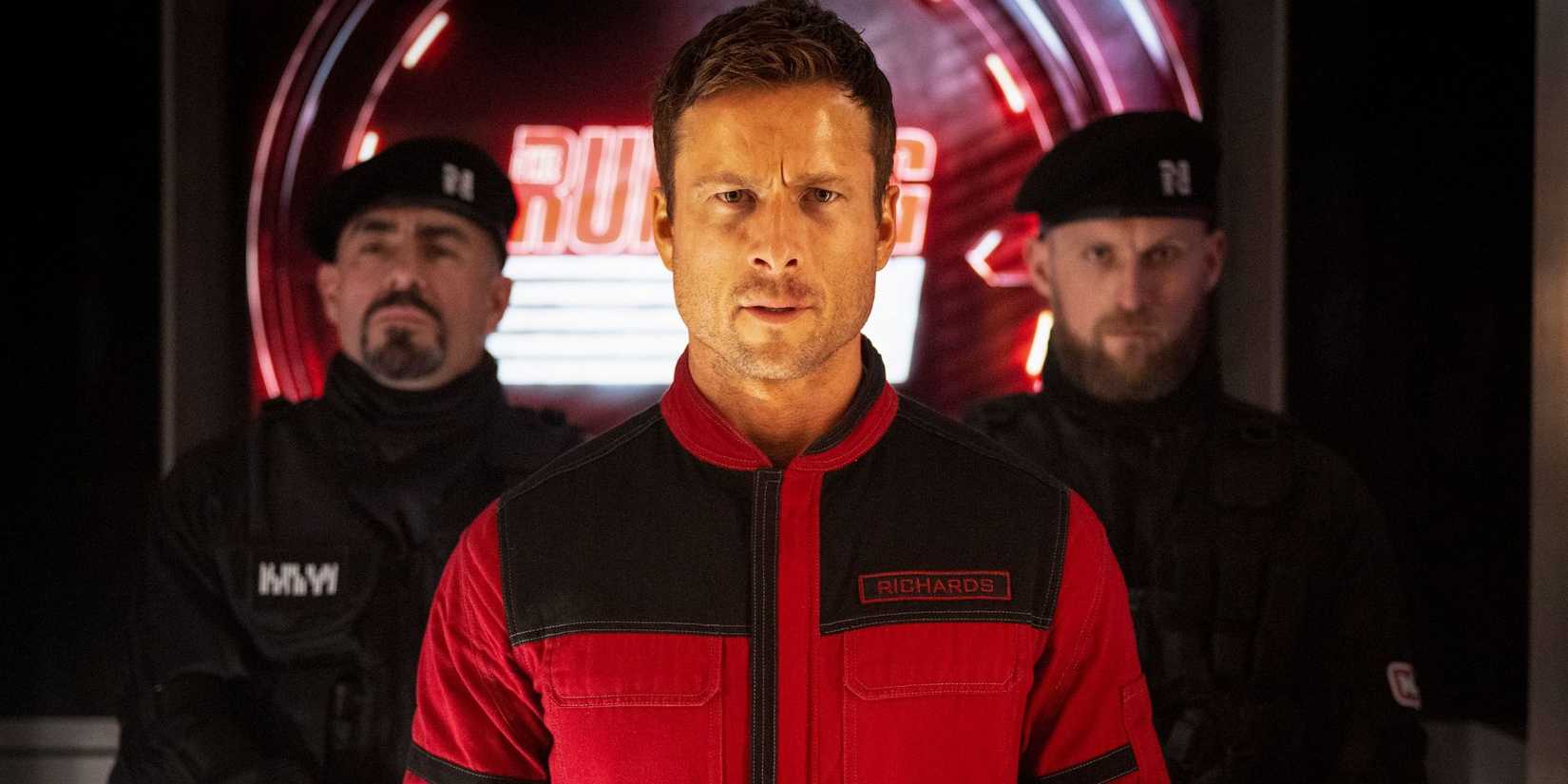
I give you credit because you have all the people. There’s a huge number of people thanked in the credits. Again, why was that important?
JONES: Well, it was important because they made the damn thing! [Laughs] And secondly, I love the graphic design of the end credits, the end roller. I stole that. I stole that idea. I had seen Edgar [Wright]’s most recent movie, The Running Man, and The Running Man credits were beautiful. The end credits, the end roller on Running Man, were beautiful, and I just said, “Who did that? Who did that?” And I worked with the same artist to do ours, and he was amazing. So, the people who made Rogue Trooper deserve to have their credit, and then we had beautiful credits, so I was like, “Put everyone in there!”
You start the movie with a little bit of what’s going on, and then you’re thrown into the action with Genetic Infantryman. How did you decide where to start the beginning of the movie, and did you ever have a version that explained the differences between the sides more?
JONES: It’s always such a balancing act with science fiction conceits, as to how much do you have to explain? How much time do you want to spend explaining it? We went through all sorts of different permutations early on. So yeah, there were some scenes that we played around with. It was just too clunky. I went even more [Paul] Verhoeven at the beginning. It was much more setting up the war, setting up the grunts on the ground, and doing all that kind of stuff. I was like, “This is a lot of starts before we actually start the movie. I don’t think we need to explain all of this.” I think the way we’ve structured how the G.I.s find out where they are, we can learn all the stuff that we need the audience to learn. So, we trimmed off a lot of that, and I think it was the right move.
I believe that this is your first time co-writing a song.
JONES: I guess technically, yeah.
You co-wrote the Rogue Trooper march, and it’s a good song.
JONES: I’m not taking credit for that. I wrote a few lyrics just because I wanted to make sure it felt like 2000 AD, but that’s not writing a song. Not in my mind. I wrote a few couplets. [Laughs]
I did just want to mention that you did co-write a song, and it’s good. It’s really selling the troops.
JONES: I love it. I love what they did, and it’s freaking contagious.
I can hear the song in my head.
JONES: I’ll tell you what I did, and you’ll probably recognize this: I gave very specific notes on what I wanted “I Am the One and Only” to sound like at the end of the movie. The Flash Gordon ending music, the big Queen ending there, I was like, “We’ve got to do that, or we’ve got to use ‘I Am the One and Only.’ I need a big guitar solo. I need a screaming performance of the song at the end, and we’ve got to start with the chorus, not the way the song originally begins.” So that one, I feel like, I had more notes on that than what I did on the march.
This movie feels like a movie without studio notes. It really feels like you’re getting your brain on screen. Did you have a lot of notes to deal with, or did you have incredible creative freedom?
JONES: I did have incredible creative freedom. I did work very, very closely with Jason and Chris [Kingsley] at 2008 AD, at Rebellion, to basically make sure that they were happy both with what I wanted to do and also all of the improv that came into the film. Obviously, we were working with these amazing comedians, so there’s no point having amazing comedians come in and think that they’re going to deliver your lines, and that’s going to be the best option.
So they came in, they watched the animatic, they read the lines, they said, “Okay, I see what you want to do. I see what you need to get out of this scene,” and then they ran with it. So, Matt Berry, Jermaine Clement, they come in, they do their own version of what they want to do, we’re laughing our asses off, and adding bits into the project that weren’t even planned on being there just because they’re making us laugh. I mean, how much fun is that? I had them coming in, I had Diane Morgan coming in, I had Al Murray and Henning Wehn coming in. All of these comedians. Like every two days, there were new comedians coming in. It was amazing. It was like being at a comedy festival was what the shoot was like.
Rogue Trooper does not have an official release date yet. Keep an eye on Collider for more updates!


- Director
-
Duncan Jones
- Writers
-
Duncan Jones
You must be logged in to post a comment Login