Entertainment
‘Firefly’s Greatest 44 Minutes Are Still Its Most Overlooked Sci-Fi Masterpiece

There’s a certain corner of TV history where the best stuff isn’t loud; it buzzes low, waits for you to remember it exists, and then taps you on the shoulder with a line or a look that shouldn’t still sting, but does. Firefly’s “Objects in Space” lives in that exact neighborhood — the same back alley where Buffy the Vampire Slayer’s “The Body” hides when no one’s speaking its name, or where Battlestar Galactica keeps its late-night paranoia episodes — the ones you don’t recommend casually because you know they’ll crack something open in a person. It’s the vibe you get rewatching Lost’s “The Constant,” when the emotional gravity sneaks up on you even after the eleventh viewing, or the way The X-Files used to hit you with a bottle episode that suddenly felt like a thesis statement. This is the space where a show’s intentions get a little clearer — the space between plot and pulse.
That pulse suddenly feels louder now, with Nathan Fillion confirming that a new animated Firefly spinoff is in advanced development — one that could bring much of the original Serenity crew back into orbit. And with Firefly, that revelation comes at the strangest possible moment: right when the show was about to disappear from television altogether. There’s something bittersweet about that timing, like finding a handwritten letter months after the sender’s long gone.
“Objects in Space” was the final broadcast hour, the last breath before Fox yanked the plug, and instead of a barn-burning finale or some frantic backdoor pilot energy, the show went small. Not fragile — small. Intimate. The kind of quiet that’s so self-assured it almost feels defiant. If you stacked it next to most sci-fi finales of that era — the operatic bloat of Farscape, the propulsive cliffhangers of Stargate SG-1, the monster-of-the-moment flourishes of Angel — the contrast is almost charming. Firefly chose stillness… and somehow made that louder than any shootout.
‘Firefly’s “Objects in Space” Feels Like a Dream You Only Half Remember
If there’s a paradox at the heart of “Objects in Space,” it’s this: the episode is tiny on paper and absolutely massive in feeling. The plot, on paper, feels almost too simple — the kind of thing someone would pitch when they’re told there’s no money left in the budget: a bounty hunter slips on board, pokes around, grabs for the girl. But the episode doesn’t land the way that summary suggests. It drifts. It sort of shuffles around instead of marching forward, like the whole ship’s stuck in a weird lull. There’s that early-morning hush to it, the kind you get when you’re awake before everyone else, and the place feels off by just a hair. River’s (Summer Glau) sensing the ship more than she’s moving through it — a flash of dread here, a whisper of somebody else’s worry there — and the story stops pretending it belongs to anyone but her.
Series creator Joss Whedon leans into her interior static with the kind of confidence you only get when you stop worrying about plot mechanics and start trusting a character to carry the whole episode on her heartbeat. One moment, she’s drifting barefoot like the ship’s made of warm dust, the next she’s holding a gun she doesn’t perceive as a weapon at all. Everyone else is trying to keep their reality straight; River’s quietly proving that the frame they think they’re standing inside might not be the real one.
And then there’s Early (Richard Brooks). He’s got this unsettling way of talking like he’s explaining a children’s book, only he remembers reading, drifting from room to room as if gravity doesn’t apply to him quite the same way. He doesn’t have to raise his voice — doesn’t even seem interested in the performance of intimidation. He whispers, he muses, he circles you with these offhand observations that feel like secrets you didn’t know you had. On any other sci-fi show, he’d be a loud, armored bruiser. Here, he’s just this quiet, unnerving presence — not loud, not dramatic, just a guy who talks like he already knows how the night ends. By the time things finally settle, it stops feeling like a chase at all and more like the episode nudging everyone to look at themselves without the usual noise drowning them out.
‘Firefly’s Finale Is When River Finally Comes Into Focus

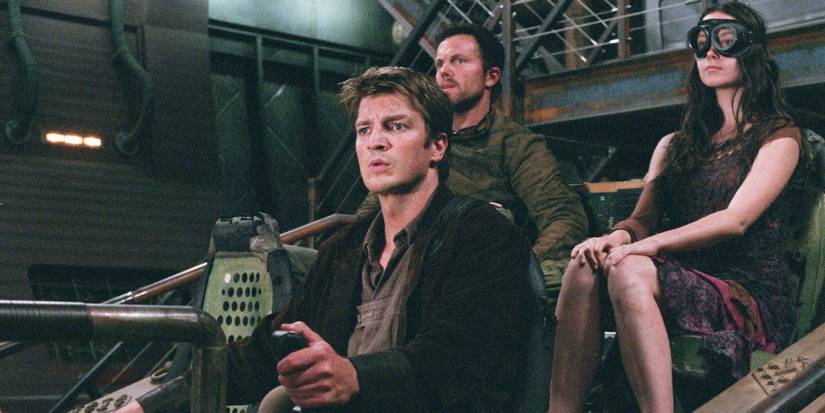
Until this point in Firefly’s run, River is almost treated like a narrative wildcard — brilliant, damaged, unpredictable, occasionally dangerous, and often pushed to the side whenever the plot needs to snap back into place. “Objects in Space” doesn’t just bring her into the light; it lets her speak in her own language.
There’s a moment — small, quiet, easy to miss — where she tells Early, “I can win.” It isn’t a boast or a threat. It’s a realization. She’s been treated like everyone’s question mark for most of the season — smart, unpredictable, handled like she might go sideways at any moment — so watching her take the wheel here feels different, like she finally catches up to herself. And she stops being the crew’s problem to tiptoe around and turns into the one person who actually understands what’s simmering underneath everyone else.


A Forgotten 82% RT Sci-Fi Space Western Already Solved ‘The Mandalorian & Grogu’s Biggest Problem
There’s a lot riding on Pedro Pascal’s upcoming Star Wars movie.
She clocks Kaylee’s (Jewel Staite) fear before Kaylee even finishes the thought. She feels Simon’s (Sean Maher) panic tugging at the edges of the room. She can tell what Mal’s (Nathan Fillion) bracing himself for before he even says anything. And Jayne’s (Adam Baldwin) guilt — the thing he pretends isn’t there — shows on him for half a second, just enough for her to catch it. The ship’s layout hasn’t changed, but for River it’s suddenly readable — a kind of living diagram she can slip through with her eyes closed.
There’s a version of Firefly — the version we never got — where the show slowly drifts into River’s orbit. Not the River of Chaos, but the River that could see the shape of things before they happened. “Objects in Space” feels like the pilot of that show, tucked quietly at the end of Firefly‘s first and only season, like someone hid the real blueprint under the mattress.
‘Firefly’s Final Hour Redefines What the Sci-Fi Show Could’ve Been

If Firefly had survived, this episode would’ve been the pivot — the moment the show tilted toward the introspective, the surreal, the spiritual. The early episodes are loud with frontier swagger: train heists, gunfights, banter that slides around the room like a bar fight waiting to break out. It’s fun as hell, but it’s also familiar. “Objects in Space” suggests something else was brewing.
The silence lands heavier. The camera hangs back just a beat longer. Characters speak less, listen more. Even the ship feels different — not in how it looks, just in the mood of the place. The halls feel a little longer, like everyone’s moving through them more carefully than usual. People tread more softly. The air has that charged stillness you get right before a storm decides whether it’s actually going to break.
And it hits you, maybe an act or two in, that this was the last hour anyone saw on broadcast. There’s something quietly heartbreaking about that — the idea that the show’s final note wasn’t a blaze of glory but this fragile, introspective murmur. It plays like the confession of a series that finally figured out what it wanted to be… right as the lights went out.
This Forgotten ‘Firefly’ Episode Is a Hidden Gem That Deserves a Louder Echo
For a series that lasted only 14 episodes, Firefly has accumulated a mountain of lore — the cancellation stories, the resurrected fandom, the movie that arrived like a second chance ten sizes too small. In all that noise, “Objects in Space” gets weirdly lost.
It isn’t flashy. It doesn’t have the most quotable lines. It’s not the episode that gets trotted out for cosplay montages or convention shout-alongs. What it does offer is a glimpse of the more unguarded version of the show — the one that wasn’t worried about pleasing anyone and finally trusted itself enough to go quiet, go strange, go inward. It plays like a finale by accident — not because it ties anything off, but because it drops the performance and lets the truth seep out.
Rewatching it now, the episode sits differently. There’s a weight to it you don’t catch the first time around, like everyone knew they were reaching for something the show might not get to follow through on. The ambition’s there, but it’s quiet, more like a steady pulse under the scenes than anything the episode asks you to notice. It’s not the flashiest hour of Firefly, not the one fans quote, but it sticks with you anyway. You remember it days later for reasons you can’t quite pin down. It feels like a last note the show didn’t intend to play, but somehow ends up saying the most.

- Release Date
-
2002 – 2003-00-00
- Network
-
FOX
- Showrunner
-
Joss Whedon
- Directors
-
Allan Kroeker, David Solomon, James A. Contner, Marita Grabiak, Michael Grossman, Tim Minear, Vern Gillum
- Writers
-
Cheryl Cain, Drew Z. Greenberg, Jane Espenson
You must be logged in to post a comment Login