Entertainment
Forget ‘Chernobyl’ — Prime Video’s 3-Part Political Thriller Is a Near-Perfect Weekend Binge

On March 4, 2018, Sergei Skripal (Wayne Swann) and his daughter, Yulia (Jill Winternitz), were poisoned with Novichok, a Russian nerve agent, in the quiet, sleepy town of Salisbury, England. The attack took place just months before Russia hosted the World Cup, an event overshadowed by the international crisis, and saw Russian diplomats expelled and numerous world leaders weighing in. Fear and paranoia were heightened to a level few had seen in a long time, as it appeared a nuclear power — Russia — had committed a chemical attack on a fellow atomic power — Britain — to assassinate a former Russian spy. Yet, for the people who directly suffered as a result, these emotions were more devastating than anyone could imagine, and that is exactly what the three-part miniseries, The Salisbury Poisonings, portrays so poignantly.
Now, with the three-part documentary Salisbury Poisonings: The Untold Story surging up streaming charts and featuring previously unheard testimonies from those involved, there’s renewed attention on the case — making it the perfect moment to revisit the earlier dramatization.
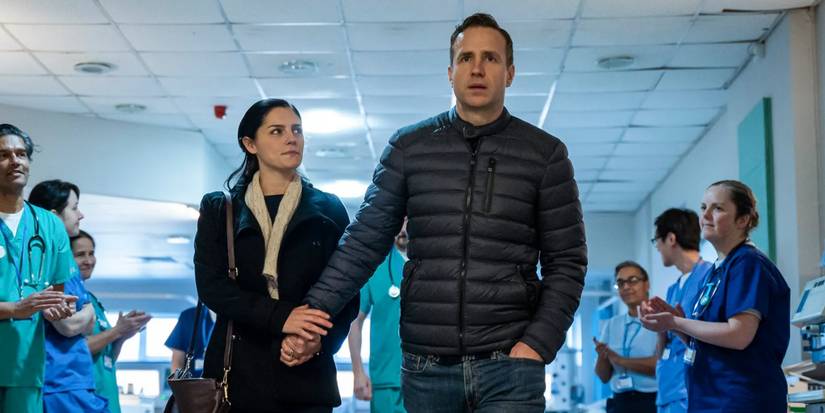
Through The Salisbury Poisonings, we primarily follow Tracy (Anne-Marie Duff), the head of public health for Salisbury and wider Wiltshire, and Nick Bailey (Rafe Spall), a police officer who accidentally became exposed to the nerve agent whilst investigating. Not only does this miniseries show just how large a task was undertaken to prevent further contamination, but the focus on Bailey, Tracy, and other victims, such as Dawn Sturgess (MyAnna Buring), empathetically portrays the suffering ordinary people faced in a far larger geopolitical game that governments and world leaders, on both sides, seemed somewhat unfazed by.
‘The Salisbury Poisonings’ Uses the Stories of Average People to Portray Devastation
What can always be difficult in weaving a narrative through real-world events is making the audience care about something when they know the outcome. Many might not know about the Novichok poisonings, but they do know there hasn’t been a war between Russia and the UK, so it can be argued that, on the international level, the stakes aren’t high for the viewer. That is where the genius of The Salisbury Poisonings shines through, as it uses individuals’ stories to make us feel the emotional stakes of fear, loss, and paranoia.
Through Nick’s poisoning and recovery, we see how his family is put through an emotional wringer, constantly terrified of losing their husband and father as well as being shown Nick’s horrifying symptoms, such as driving a car before blacking out for a few seconds, which the real-life Bailey told an inquiry made him feel like his life was “in frames.” Furthermore, the subplot of Dawn’s struggles as a mother in shared accommodation builds our connection to this woman who only wants a better life for her and her daughter, only to be killed when, in the most unlikely of circumstances, she comes into contact with the nerve agent. It’s heartbreaking because we see these people, with their own lives, families, and dreams, being dragged into a geopolitical conflict they had no intention of ever joining. They weren’t killed because they did something wrong. They were killed by accident as collateral damage by people who didn’t care who else got hurt.
‘The Salisbury Poisonings’ Shows Unsung Heroes Who Deserve the Most Credit

With all the tragedy, one could be forgiven for refusing to watch The Salisbury Poisonings because they worry it would be overwhelmingly depressing. However, the strength of our protagonist, Tracy, and her willpower in the search for the source of Novichok and her commitment to making Salisbury safe again for its inhabitants are key to giving us a character whom we can admire and root for. Far from being an archetypal detective/investigator, Tracy is not some kind of confident veteran, nor does she have some kind of dark past where she is fighting inner demons. She is just someone trying to do the best she can.
In the show, she admits she has never done anything like this before and might not be qualified, reminding us of the scale of the issue. Working to decontaminate the sites identified by Tracy, where Novichok was found, took so long to clear that officers got hyperthermia. Scenes such as Tracy having to brace herself in front of a mirror before giving briefings or her constant fidgeting remind us of how this is a normal human being with flaws and anxieties of her own. Yet, this only makes the character more likable, and the final scene, where it is stated and reaffirmed that she is a hero, makes for thoroughly satisfying moments where we can choose to still believe in humanity, even after what has happened.
‘The Salisbury Poisonings’ Focus Means It Slightly Downplays Government Failings
By focusing on the victims rather than turning this into a geopolitical thriller, The Salisbury Poisonings emphasizes the personal human cost of the attack. By doing so, they engage audiences on a far more emotional level. However, for those who might not do their own research, the show does not truly cover the ways governments responded or the failings that occurred. On the latter, both in the case of the Skripals and Sturgess poisonings, the UK government certainly failed to act as it should have. Speaking at a 2024 inquiry into the matter, it was heard that police investigating the incident found that counter-terrorism was “dismissive” of claims that a Russian spy had been poisoned, and they even told them there was no Russian spy living in that area.
Furthermore, in the case of Dawn Sturgess, The Salisbury Poisonings displays how members of Whitehall, a government agency, are mostly focused on reducing panic and moving on from the incident, and in real life, people were not given a warning to not pick up discarded waste, despite health officials at the time considering this to be done. Though The Salisbury Poisonings acknowledges these failings through its portrayal of Whitehall characters, it could have delved deeper into the government’s shortcomings.
Going beyond the UK government’s response, The Salisbury Poisonings also put limited focus on Russia or other allies’ responses to the incident. We are only told via radio and news channel clips, and we are shown Americans heavily sympathizing, while Russia reportedly denies it. Putin not only denied involvement but also called Sergei Skripal a “scumbag” and a “traitor”, highlighting the animosity held and showing why it was so likely civilians like Yulia, Nick, and Dawn would become victims. The Salisbury Poisonings tried to present the West as united in its opposition against Russia.


The 21st-Century’s Greatest Espionage Thriller Spin-off Series Just Became the Best Weekend Binge
You can literally watch all 12 episodes in a single day!
However, the then-president, Donald Trump, greatly downplayed the significance of the incident. According to the BBC, at a meeting in Chequers, Trump and Theresa May’s team “were arguing about how bad and destabilizing that was – he asked why,” and when the point was made, it was chemical warfare between two nuclear powers, Trump only quipped, “I didn’t know the UK had nuclear weapons.”
This isn’t to say that The Salisbury Poisonings failed in its mission. It succeeded in what it set out to do. This was to make people understand the human suffering that occurred because of an international incident, displaying how civilians live every day with the fear they may be accidentally targeted in a far larger game than they even know is at play. The Salisbury Poisonings display the victims and heroes of the ground level brilliantly, and that makes this a show more than worthy of a watch to truly understand what happened in Salisbury that fateful day. However, viewers must understand the wider context surrounding these events. The tension between English local and national services, as well as international enemies and allies, skyrocketed in the wake of these poisonings, and in all of this lie the innocent victims we witness suffer because of this tension.
The Salisbury Poisonings is available to stream on Prime Video.


- Release Date
-
2020 – 2020-00-00
- Network
-
BBC One
- Directors
-
Saul Dibb
- Writers
-
Declan Lawn
-

Anne-Marie Duff
Tracy Daszkiewicz
-

Duncan Pow
Dr James Haslam
-

Rafe Spall
DS Nick Bailey
-

MyAnna Buring
Dawn Sturgess

You must be logged in to post a comment Login