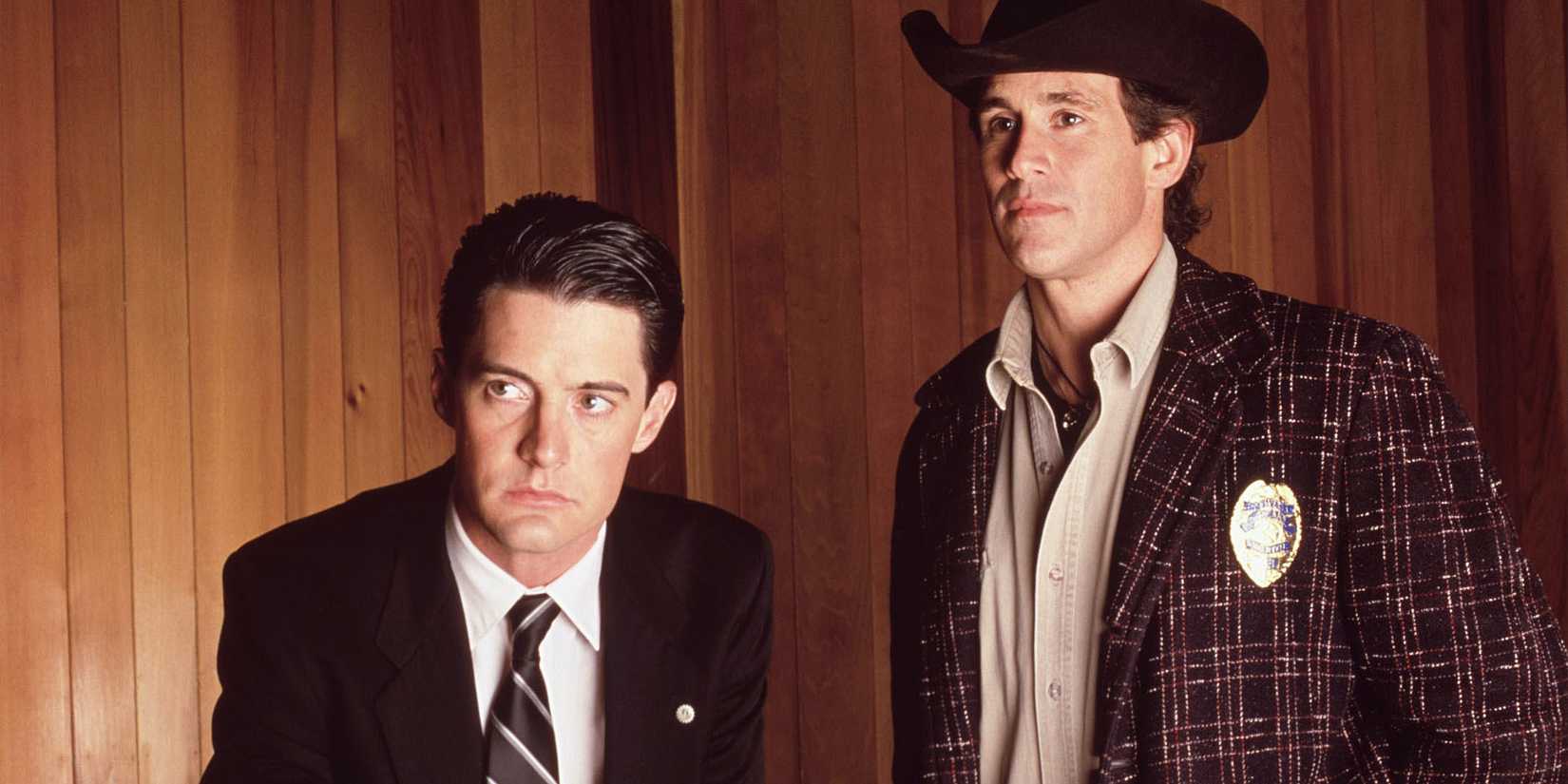
Apple TV’s new darling, Widow’s Bay, follows a cursed New England island-town, full of kooky characters and supernatural mysteries. The show cleaned up at the 2026 Emmys, winning a whopping 14 awards. Widow’s Bay is original in its execution and details, but it couldn’t exist without TV’s most influential mystery thriller of all time, Twin Peaks. Created by David Lynch and Mark Frost, Twin Peaks first aired over 30 years ago in 1990. Today, it’s streaming on PlutoTV, free with ads. The show follows FBI Agent Dale Cooper, played by Kyle MacLachlan, in his investigation into the death of Laura Palmer, a high-school girl from the small Pacific Northwest town of Twin Peaks. It’s a simple premise, but the quirky side-characters and expansive exploration of the central events drives Cooper directly into the mysteries of life, death, cruelty, and love.
Twin Peaks was one of the first television series to follow one continuous plot from start to finish (with, admittedly, some dilly-dallying in the middle of Season 2). A series of small-scale plots were more common on TV at the time, meant to be resolvable by the end of an episode (think “monster-of-the-week” episodes on X-Files). The continuous plot and propulsive cliffhangers kept viewers on the edge of their seats, eager to tune in for next week’s episode. This formula is the default now, and almost every successful show streaming is trying to get the viewer to click to the next episode with a cliffhanger or dramatic development. Twin Peaks changed TV forever, and Lynch’s iconic mystery series is still one of the most experimental shows out there.
Advertisement
‘Twin Peaks’ Made Television More Supernatural
‘Twin Peaks’Image via ABC
David Lynch is always interested in innocence, dreams, and “a woman in trouble.” That is, he’s interested in the truths that lurk beneath the everyday. Beloved mystery-thriller Twin Peaks is no exception. Twin Peaks has a subtle supernatural bent, which has influenced shows like Buffy the Vampire Slayer, Supernatural, and certainly Widow’s Bay. Rather than taking a “monster-of-the-week” approach, the show doesn’t reset with a new threat every episode. Instead, every new discovery, location, and character is introduced to further explore the mystery of what happened to Laura Palmer.
The supernatural in Twin Peaks is little more than local color for the majority of the show, lending texture and a sense of the unknown to the investigation rather than monsters or ghosts. Agent Cooper brings some of this spookiness with him in the form of belief in the revelatory power of dreams. Dreams are the show’s main entry-point for the supernatural, starting in Episode 2, which ends with one of Cooper’s dreams. In the dream, Bob is introduced, and so is a woman who looks just like Laura Palmer. She tells Cooper a secret—the identity of the killer. In the morning, he forgets who it was. Dreams are the site of revelation, giving Cooper the tools he needs to start piecing the mystery together.
Advertisement
Collider Exclusive · Universe Personality Quiz Which Iconic Universe Do You Belong in the Most? Star Wars · Lord of the Rings · Harry Potter · Game of Thrones · Star Trek
Advertisement
Five legendary universes. Five completely different visions of what the world could be — or already was. One of them is the world your instincts, your values, and your particular way of existing were built for. Eight questions will tell you which one.
🚀Star Wars
💍Lord of the Rings
🧙Harry Potter
👑Game of Thrones
Advertisement
🖖Star Trek
Advertisement
01
What gives your life its deepest sense of meaning? Every universe is built around a different answer to this question.
Advertisement
02
Which kind of world do you most want to inhabit? The environment shapes who you become. Choose carefully.
Advertisement
03
How do you prefer your conflicts resolved? The shape of a world’s conflicts tells you everything about its soul.
Advertisement
04
Who do you want beside you when things get difficult? Your ideal companions reveal the world you were made for.
Advertisement
05
What is your relationship with power? How you seek, wield, or resist power is the map of who you are.
Advertisement
06
How does your universe treat good and evil? A world’s moral architecture tells you more about it than any map.
Advertisement
07
What role would you naturally fall into? Every universe has archetypes. Which one fits you without trying?
Advertisement
08
What do you ultimately believe about the future? The answer to this is the clearest window into which universe already lives inside you.
Advertisement
Your Universe Has Been Chosen You Belong In…
Your answers point to the iconic universe your values, your instincts, and your particular way of seeing the world were built for. This is where you would find your people — and your purpose.
Advertisement
A Galaxy Far, Far Away
Star Wars
You believe in the cause — in the idea that freedom is worth fighting for even when the odds are impossible and the empire is vast.
You are drawn to the moral clarity of a universe where hope itself is a form of resistance.
You’d find your people in the Rebellion — a ragtag coalition of true believers held together by conviction more than resources.
Star Wars is fundamentally a story about ordinary people choosing to matter in an extraordinary conflict — and that is exactly your kind of story.
The Force may or may not be with you. But the will to use it for something larger than yourself certainly is.
Advertisement
Middle-earth
Lord of the Rings
You understand, in the deepest part of yourself, that the journey matters as much as the destination — and that the world’s beauty is worth protecting even at great cost.
Middle-earth is a world of ancient wonder, deep friendship, and a darkness that only retreats when enough small acts of courage accumulate.
You would thrive here because you value the fellowship more than the glory — the road more than the arrival.
Tolkien’s universe rewards patience, loyalty, and the willingness to carry something heavy across a very long distance.
Those are not burdens to you. They are simply how you move through the world.
Advertisement
The Wizarding World
Harry Potter
You believe that love, loyalty, and doing what’s right are not naive sentiments — they are the most powerful forces in any world, magical or otherwise.
The Wizarding World is a place of wonder hidden in plain sight, where learning is transformative and the bonds you form at school follow you into every battle.
You would flourish here because you take both the magic and the friendships seriously — and you understand that one without the other is incomplete.
Harry Potter’s universe ultimately rewards those who choose to stand for something even when standing is terrifying.
That choice — made quietly, without guarantee — is something you understand completely.
Advertisement
Westeros · The Known World
Game of Thrones
You see the world clearly — its power structures, its hypocrisies, its brutal arithmetic — and you are not paralysed by that clarity. You use it.
Westeros is a world that rewards intelligence, adaptability, and the willingness to understand that every alliance is also a negotiation.
You would survive here — possibly thrive here — because you don’t confuse the world as it is with the world as you’d like it to be.
Game of Thrones is a story about what happens when the idealists and the realists collide. You are sharp enough to know which one lasts longer.
Winter always comes. You are already prepared.
Advertisement
The United Federation of Planets
Star Trek
You believe the future is worth building — that curiosity, cooperation, and the expansion of understanding are not just ideals but the most practical path forward for any civilisation.
Star Trek is a universe where the questions matter as much as the answers, and where encountering something utterly alien is cause for wonder rather than fear.
You would belong here because you are fundamentally optimistic about what intelligence and decency can achieve — while being honest about how hard that achievement is.
The Federation is the universe’s most ambitious thought experiment: what if we actually got better?
You don’t just hope that’s possible. You think it’s the only thing worth working toward.
Advertisement
David Lynch uses the Surreal to Explain the Unexplainable
Sheryl Lee as Laura Palmer, laying dead wrapped in plastic in Twin Peaks.Image via ABC
Advertisement
Halfway through Season 2, Laura’s storyline is concluded, and it’s revealed that her own father, Leland Palmer, was her killer. It’s explained by a demonic possession of some kind: Bob entered Leland’s body to enact Laura’s torture and murder. Those events are explored more fully in the film Fire Walk With Me. Bob is the stand-in for the dark forces that inhabit the souls of men. It’s crucial that Leland met Bob as a child, possibly a metaphor for his own sexual abuse as a boy. That a father could torture and kill his own beloved daughter is no more explicable than dreams or whatever darkness lurks in the woods surrounding Twin Peaks. The mystery turns at that point of discovery from what happened to Laura to more philosophical questions of why and how.
Human cruelty becomes the supernatural force in the show. Through the unnecessary and winding half-plots of the second season emerges the Black Lodge, a real place on another plane of reality. It is where evil is born. In Twin Peaks, like ideas, like dreams, evil is real and it lives somewhere. The scenes in dreams and in the Black Lodge are the most surreal and iconic in the show. They are memorable, not only for their strangeness, but for their emotional resonance, eschewing logic for another kind of truth.
The Black Lodge Influences Filmmakers Today, as Seen in ‘The Backrooms’
Dreams give Cooper what he needs to piece the mystery together, but that doesn’t mean they give it all away: the act of discovery is part of the journey to truth. It’s said that souls must pass through the Black Lodge after death, and must face what they see with bravery or be destroyed. The Black Lodge is the soul’s confrontation with darkness and evil. The challenge is to encounter it without being destroyed. David Lynch goes straight for the spiritual implications of the show’s events, asking how anyone can live in a world where such profound suffering can be caused by another person.
Advertisement
The scenes from the Black Lodge, unsurprisingly, are otherworldly. The red velvet curtains that haunt Lynch’s oeuvre are coupled with a zig-zag black and white floor, and the rooms seem to meander without logic or purpose, out of place and out of time. Agent Cooper confronts Bob and Laura, or someone who looks just like her, in the Black Lodge. They filmed the scenes backwards, giving movement and sound a jerky, unsettling quality. Contemporary directors draw on this visual vocabulary in surreal films like The Backrooms to convey the feeling of displacement, but in Twin Peaks, there’s also an allure, a visual pleasure despite the disturbing material found in that landscape.
‘Twin Peaks’ Leaves Experimentation Unexplained, to Great Effect
A dark double of Laura Palmer (Sheryl Lee) in the Red Room in Twin Peaks.Image via ABC
The show’s journey to the otherworld works because it doesn’t try to over-articulate its own meaning. It works because it lingers in the realm of intuition, of mystery, of dreams. Twin Peaks doesn’t end with a treatise on how to confront evil and come out on the other side with goodness in your heart. Still, the viewer leaves the Black Lodge with Cooper feeling that there is evil in the world, and one must witness it but not be destroyed by it. There is wonder and beauty in the mysteries of this world, but mystery has a dark edge too.
Advertisement
Twin Peaks explores some of the worst human acts on network TV, without excessive gore, or too much explicit violence, not by censoring itself but by accessing the horror through surreal, experimental sequences. Laura in the Black Lodge screams and screams, wide eyed, amidst strobing lights while Cooper watches on. That moment isn’t a direct analogue for her suffering in life, but it conveys the powerful emotions and impact that follow. Twin Peaks is, from start to finish, about a community trying desperately to cope with unspeakable loss. The show trusts its viewers enough to not respond to that loss by trying to contain it in language. Instead, characters watch on. They cry. They dance. They try to make meaning, as best as they can.
Advertisement
Release Date
Advertisement
1990 – 2017-00-00
Directors
Lesli Linka Glatter, Caleb Deschanel, Duwayne Dunham, Tim Hunter, Todd Holland, Tina Rathborne, Diane Keaton, Graeme Clifford, James Foley, Jonathan Sanger, Mark Frost, Stephen Gyllenhaal
Advertisement
Writers
Mark Frost, David Lynch, Harley Peyton, Robert Engels, Barry Pullman, Scott Frost, Tricia Brock




You must be logged in to post a comment Login