Entertainment
Fox’s 6-Part Biblical Miniseries Can’t Live Up To Prime Video’s Shows

Renewed interest in using the Bible as on-screen source material has been on the rise in the last decade. Since the crowd-funded darling, The Chosen, took off, a wave of adaptations has followed in its wake. More networks, studios, and streamers have returned their attention to these centuries-old tales in the past few years than the industry at large has in decades. So, perhaps it isn’t surprising that FOX would take a more novel approach with The Faithful: Women of the Bible.
This miniseries — set to air over the course of three Sundays leading up to Easter: March 22, March 29, and April 5 — aims to tackle the matriarchs that established the bloodline that would lead not only to the founding of the Kingdom of Israel but also the lineage of Jesus Christ. However, despite the name, The Faithful is anything but, and those deviations keep the drama from being compelling or effective.
‘The Faithful: Women of the Bible’ Tells the Events of Genesis From a Female Perspective

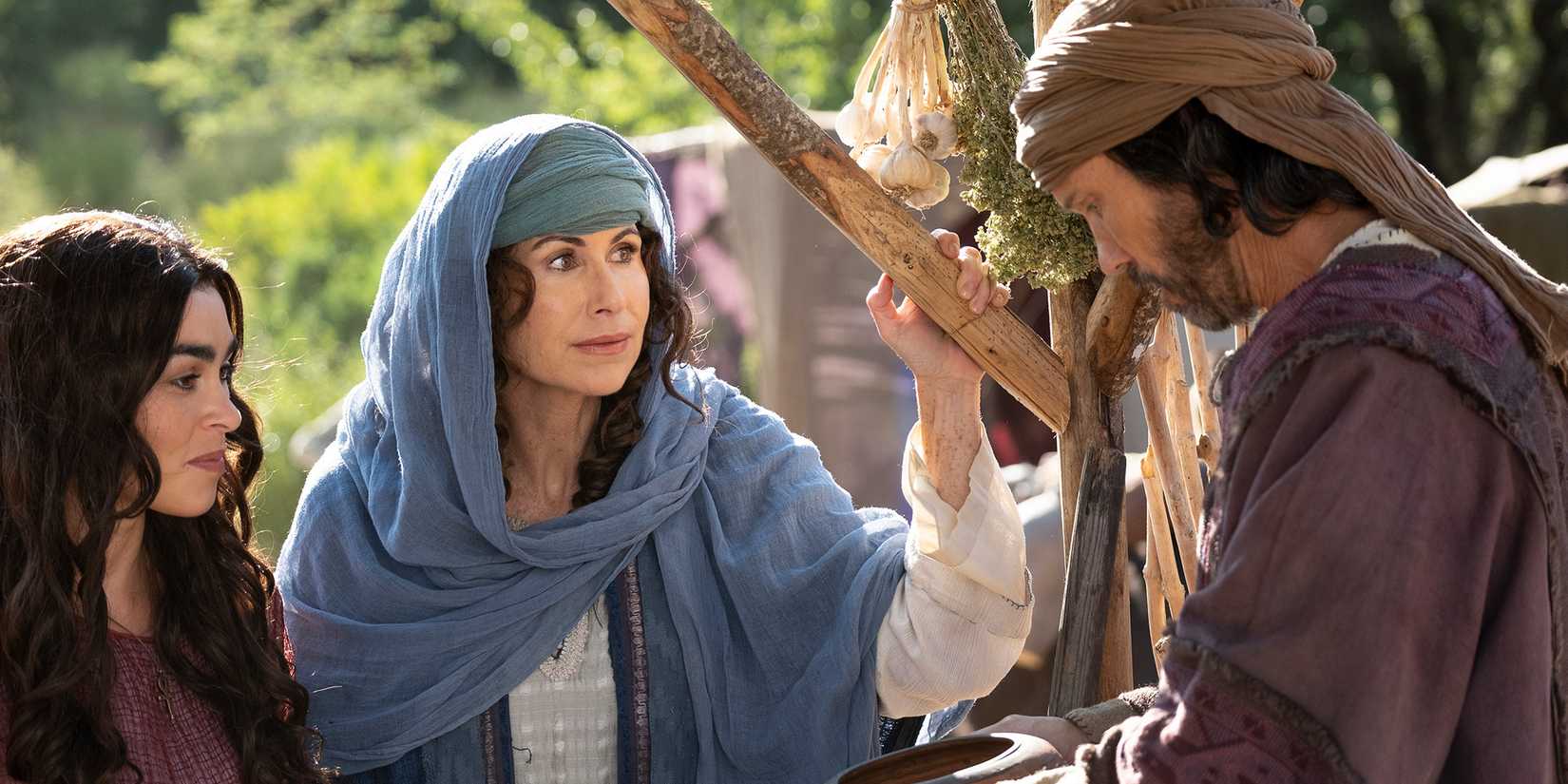
The Faithful aims to use each part of its three-night airing to follow a different heroine (or heroines) from the middle chapters of Genesis. The saga begins with the two-part “The Woman Who Bowed to No One/The Woman Who Spoke to God,” highlighting Sarah (Minnie Driver), the wife of Abraham (Jeffrey Donovan), and her Egyptian servant Hagar (Natacha Karam), who gave birth to the patriarch’s firstborn son. The second night — the two-part “The Woman Who Risked Everything” — revolves around the story of Rebekah (Alexa Davalos), the bride of Abraham and Sarah’s son, Isaac (Tom Mison). The third night’s two-part finale, “The Woman Who Loved,” is about the sister brides of Rebekah’s son Jacob (Tom Payne), detailing the tragic story of Leah (Millie Brady) and the complicated romance of Rachel (Blu Hunt). Together, these were the women who birthed entire nations, and The Faithful aims to “finally” tell their story in earnest. At least, that’s the goal.
With only the first two episodes provided for review, there are several impressive aspects of The Faithful worth noting up front, like the series’ overall production value. The visuals are quite enthralling and propel the viewer instantly back in time. Given the current cinematic “Bible boom,” productions that take great care to appear at least visually faithful to the material stand out, even if they’re not shot on location in the Middle East. (Prime Video’s House of David is another such series). Like The Passion of the Christ before it, The Faithful utilizes Italian scenery to stand in for the ancient Levant region in which these events take place, specifically Malta and Rome. There’s certainly a sense of place created here as Sarah and her household move from their initial home in Harran to Egypt and eventually to the land of Canaan.


The Biblical Series Boom Continues With New Female-Led Genesis Adaptation From ‘CSI’ Producer
‘The Chosen’ and ‘House of David’ have become major success stories recently.
Additionally, The Faithful‘s cast includes several capable performers who really carry the show in light of its fractured material. Minnie Driver would never have been my first pick for Sarah, but there are moments here where she shines. Her distant cadence serves the story well when she struggles to trust God for an heir, not sure if her husband is completely sane. However, this also proves a distraction whenever more intimate moments of happiness or levity appear. In many respects, her work on The Faithful is rivaled by Natacha Karam, who wears Hagar’s inner turmoil on her sleeve as she wrestles with her initial desire to return home to Egypt and her present conflict with her mistress. Her moments of desperation in the desert are an effective and beautiful reflection of the original text, further elevating Karam’s role. Yet The Faithful doesn’t lean far enough into her plight, opting instead to spend the majority of its premiere on Sarah.
‘The Faithful’ Tries and Fails To Rewrite the Biblical Narrative

As was the case with D.J. Caruso‘s bold take on Mary that hit Netflix back in 2024 and other subpar Bible-based features like Darren Aronofsky‘s Noah or ABC’s attempt to retell the tale of King David in Of Kings and Prophets, The Faithful makes such bold strides away from the source material that there are moments where the result is simply unrecognizable. The clear deviations from the text make this uneven adaptation feel like wasted potential. Admittedly, creative liberties will always be taken when it comes to adapting any beloved source material, but there’s a difference between small cosmetic changes and fundamental misunderstandings.
When Sarah is taken away to Egypt by Pharaoh (Amr Waked), for instance, she tells the ancient ruler that Abraham was her brother rather than her husband to save his life. She then tries to kill Pharaoh before he can take her, only for God to intervene and the ruler to cast her (and Hagar) out. While the inclusion of Hagar in this sequence is a creative liberty that works well in the context of the broader narrative, the rest is a reworking of the material that falls flat. The original chapter in Genesis depicts Abraham as the offending party, who introduces Sarah as his sister rather than his wife, and adhering to that version would’ve given Driver a more emotionally rich and morally compelling struggle to work with on screen.
It certainly doesn’t help that The Faithful ignores the most important (and certainly most thought-provoking) chapter in the Abraham saga: the sacrifice of Isaac. Genesis recounts the story where God tells Abraham to sacrifice his only son, only for the patriarch to be stopped at the last moment by divine intervention. It’s perhaps the most famous story about Abraham and this time period, though The Faithful ignores this entirely, at least in the first two episodes. Whether the second batch of episodes, following Isaac’s wife, Rebekah, will delve into it remains to be seen.
While The Faithful offers some interesting notions of doubt for Sarah, particularly her initial disbelief that God wants her to have a child, this undercurrent is never fully developed. What could have been a challenging statement about the difficulty and perseverance of faith is ultimately diluted by surface-level lip service to the text. Had the series tackled the most controversial aspect of this biblical story from Sarah’s perspective, it would have allowed for a more earnest foundation for these doubts, leading to a more cathartic outcome, but The Faithful‘s version is too hollow to be substantially meaningful.
‘The Faithful’ Is a Bold Attempt That Strays Too Far To Be Relevant

Despite these criticisms, there are still a few redeeming qualities to be found in The Faithful. Hagar’s story is a compelling chapter that is often overlooked, here presented as one of the most foundational moments in early Judeo-Christian history. Karam is a standout in the part, and she is certainly the heroine to cling to most tightly in the premiere. Donovan is a compelling Abraham every time he’s on-screen, and his intimate moments with Sarah are some of the show’s highlights — in fact, his casting is almost strong enough to forgive the show’s general lack of authenticity in the casting of its principal actors and the clear lack of a region-accurate dialect coach (à la The Chosen or House of David).
For those who have read the Bible and have long hoped for an adaptation that puts its female characters in the spotlight, The Faithful certainly claims to be just that. However, upon careful examination, the series can’t strike a successful balance between authentically bringing these women to life and rewriting their stories to fit the prepackaged concept the series was sold as in the first place. Perhaps future episodes will prove this reviewer wrong and better embrace the text that first turned these women into historical, even legendary, figures in the first place.
The Faithful: The Women of the Bible premieres Sunday, March 22, on FOX and will be available the next day for streaming on Hulu.


- Release Date
-
March 22, 2026
- Network
-
FOX
- Directors
-
Danny Cannon
- Writers
-
René Echevarria
- The miniseries features a solid cast that carries most of the narrative weight.
- Hagar’s arc is genuinely compelling, though it’s a shame there isn’t more of her.
- The miniseries doesn’t commit enough to the source material to feel like a genuine adaptation or examination.
- There’s a lack of development in Sarah’s wrestling with God and in the fallout of her actions.
- Couldn’t this show have cast actors who better looked (and sounded) the part?
You must be logged in to post a comment Login