Entertainment
George R.R. Martin’s Newest ‘Game of Thrones’ Story Finally Fills in the Blanks HBO Missed

Walking into one of the most iconic theaters in the world, to be greeted by characters you have known for years yet never seen up close or met, is inherently strange. Rhaegar Targaryen, Lyanna Stark, Elia Martell, and the Mad King, Aerys Targaryen, himself have existed largely as ghosts throughout A Song of Ice and Fire and Game of Thrones, with the choices, the decisions and the mistakes they made almost entirely shaping the bloodshed that would follow throughout every word we read and every scene we saw in decades of books and eight seasons of epic television. George R. R. Martin’s Game of Thrones: The Mad King gives those ghosts flesh and fire and blood, transforming one of the most important pieces of Westerosi history into an enormously ambitious four-hour theatrical epic that doesn’t always justify the Balerion-sized run time, even if it’s quite magical when all the pieces fall together.
‘The Mad King’ Is Not HBO’s Westeros
Perhaps the smartest decision director Dominic Cooke and adapter Duncan Macmillan make is refusing to treat The Mad King as a theatrical prequel to HBO’s Game of Thrones. After all, what we see on stage is recognizably Westeros, but the visual language is distinct. Even the banners and sigils have been redesigned. The Targaryen dragon, for example, has a longer, more serpentine appearance than the wyvern-like creature familiar from television, which immediately establishes that this is not a prequel to the television series, but rather its own piece of lore.
Those details help because ensuring it’s clear this is not a prequel to the show will make it easier for those diehard fans rushing to see the play to process the fact that some of your heroes will not resemble those you see on television. We have spent years associating characters such as Robert Baratheon, Ned Stark, and Jaime Lannister with the actors who played them on television, and seeing someone else wearing those names can initially be distracting. Curiously, characters who never really existed on screen have an advantage. There is no definitive live-action Rhaegar or Aerys lodged in the imagination that Noah Ritter or Michael Shaeffer must displace in your mind’s eye. Once you get your head around that, The Mad King becomes something much more interesting than a nostalgic exercise.
‘The Mad King’ Chronicles the Fall of the Targaryen Dynasty


The first half takes place around the legendary Tourney at Harrenhal, where Prince Rhaegar Targaryen (Ritter) hopes to gather support against his increasingly unstable father, King Aerys II (Shaeffer). What follows brings together an extraordinary collection of characters whose relationships will eventually tear the Seven Kingdoms apart: Lyanna Stark (Harmony Rose-Bremner), Eddard Stark (Michael Abubakar), Robert Baratheon (Callum Woodhouse), Elia Martell (Elizabeth Ayodele), Ashara Dayne (Tanisha Spring) and Brandon Stark (Luke Brady), among many others.
This is where the play is at its strongest, because Harrenhal gives the huge company the chance to breathe and allows relationships to develop — you see the political chessboard in action as various factions attempt to make their moves, and get a glimpse of what might have been. Particularly key is the fact that, following a vile moment where Aerys performs a dreadful act of cruelty upon a grieving Robert, the Starks pledge their banners to Rhaegar. The world would look extremely different had Rhaegar not been so impetuous.
The play is also considerably funnier than you might expect. Robert’s utterings get plenty of laughs, such is the way that character was always depicted across all forms of media. A big lad with a short temper is always funny when he’s had a drink, and he meets a pretty girl. The supporting characters help to steal the show. Hughie O’Donnell’s hilariously poisonous Varys and Richard Hansell’s simpering, mewling Grand Maester Pycelle threaten to steal scenes by leaning into heightened versions of the characters audiences already know. The performances are exaggerated without becoming outright impersonations, and the humor rarely diminishes the threat lurking beneath everything.
Noah Ritter and Michael Shaeffer Shine as Rhaegar and Aerys II
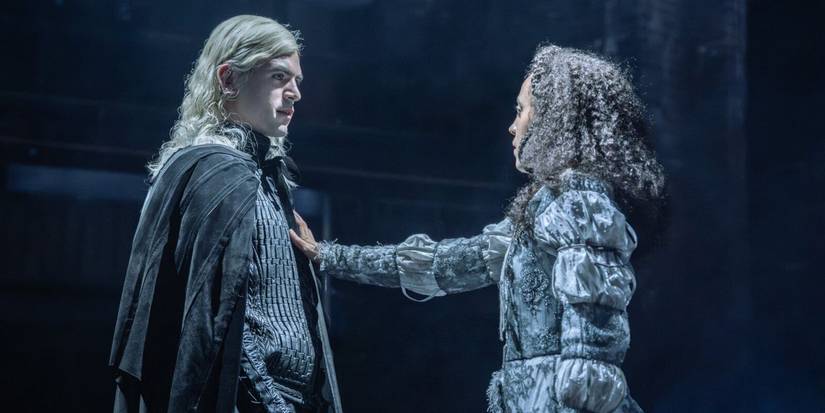
Ritter’s Rhaegar is particularly fascinating because The Mad King resists turning him into the perfect lost prince that decades of Westerosi mythology have created. He is intelligent, romantic, and well-intentioned, that’s true, but what hasn’t previously been depicted is how politically immature, dangerously obsessive, and reckless he is. There’s an air of Hamlet to him; he’s overwhelmed by expectation but he’s utterly incapable of turning that conviction into effective action. You also suspect that, were he placed amongst the Targaryens of House of the Dragon, he would be eaten alive by the likes of Rhaenyra, Daemon, and especially Aemond.
There is a wonderful irony in Aerys and Rhaegar’s relationship, too. Despite his self-admitted madness, Aerys is the only person capable of seeing through Rhaegar’s folly. The king is unquestionably insane, yet even he possesses enough clarity to recognize how foolish it is for Rhaegar to convince himself that he must be the answer to an ancient prophecy. Shaeffer’s performance finds shadows of humanity within Aerys but never asks us to side with him, and his memories of both the tragedy at Summerhall and Rhaegar’s birth are particularly effective because it allows us to see who he was before the monster. But make no mistake, Aerys is a monster. This is a man who visibly laughs at death, at suffering and sorrow, and he relishes in the twisted glee of being the one who causes it.
Rhaegar’s relationship with Rose-Bremner’s Lyanna ultimately becomes our focus as the play continues. They have a sincere romance, and an entirely joyful meet-cute, but the production never endorses their decisions. In fact, one of the benefits of the four-sided stage is that we’re able to get better looks at the reactions of those around them as their obsession with each other and their poor decision-making causes more damage. They never understand that the consequences of their actions spread far beyond the little world they’ve created together, and the whole thing becomes much stranger and sadder for it.
The Performances in ‘The Mad King’ Bring Characters Out of the Shadows

One of the production’s biggest treats is Woodhouse’s Robert Baratheon. This isn’t yet the drunken, exhausted, and very fat king played by Mark Addy that audiences met at the beginning of Game of Thrones. This is a man who, despite his grief, could inspire people to follow him and to depose a king. Woodhouse is imperious, and his Robert is charming, very funny, and surprisingly vulnerable, particularly when discussing the death of his parents, but when the fighting begins, he is terrifying. For perhaps the first time outside Martin’s prose, it becomes immediately obvious why Abubakar’s Ned Stark would follow this man into a rebellion and why soldiers would rally around him.
And of course, we’ve been cursed with the knowledge of what victory will eventually do to Robert. Here, he still has something to fight for, because he hasn’t yet won the crown, hasn’t yet lost the woman he believes he loves, and hasn’t yet discovered that achieving everything he wanted is going to leave him purposeless and a soft man at the end of it all.
The ensemble surrounding these characters is strong and sturdy, too. Ayodele gives Elia far more agency than the tragic footnote she could easily have become, while Spring’s charismatic Ashara is enormously entertaining. You can see why, with that level of energy, people would have suspected she was the mother of Jon Snow as Catelyn once accused of Ned. Mariah Gale makes an extraordinary impression with relatively little material as both Queen Rhaella and Lady Shella Whent, and while Jaime is only a supporting presence, Maxim Ays may be the most immediately convincing piece of visual casting in the entire production. He is perfectly pompous, and he looks entirely the part in his white Kingsguard attire, all swagger, smugness and self-confidence. Meanwhile, Abubakar, who brings the requisite heart and stoicism to Ned, commands a different sort of physicality from that of Sean Bean, who, for many, was the original face of Westeros.
Westeros Looks Incredible on Stage
The technical achievement is frequently jaw-dropping. The Royal Shakespeare Theatre has been transformed around a four-sided, cross-shaped stage, with an imposing arch across it, that brings the action remarkably close to the audience. Director Dominic Cooke uses every side of it, creating the sensation that you’re sitting within Harrenhal rather than watching it from a safe distance. An enormous weirwood and the Iron Throne emerge dramatically from the stage. The opening Targaryen procession will live long in the memory, as they cross the stage on their horses with ominous music playing. It makes them seem ethereal, or alien, but then the Targaryens and Valyrians have always been considered different even in a world as foreign as Westeros.
And then there’s the puppetry, which is extraordinary, particularly when viewed at close range. Horses thunder through Harrenhal at the hands puppets, while Gregor Clegane becomes an enormous, largely voiceless construction, a genuine mountain of engineering. A gigantic dragon appearing during a vision is one of the production’s most magical images, as Rhaegar witnesses the future that will bring Daenerys Targaryen to power with her three dragons, Drogon, Rhaegal and Viserion.
But the puppetry isn’t perfect, as they occasionally substitute for performers during combat, and while technically impressive, the Battle of the Trident loses some of the personality that comes from watching two human beings physically confront each other and try to bash each other’s skulls in. That’s a very minor quibble because, while you lament that on one front, you marvel at the technical wizardry. The production also repeatedly freezes the surrounding company while important conversations continue. When your attention remains exactly where Cooke wants it, the effect is excellent, but there is a downside to this, and that’s the unintended humor that you may find when you end up spotting a reveler in mid-dance with a frozen face of ecstasy and glee while a morbid conversation about fate is going on in the background. This may need some refinement, but it’s a clever idea.
Four Hours Is Simply Too Long for ‘The Mad King’

If the Tourney at Harrenhal demonstrates everything The Mad King can be, the second half is where the stage limits the story that it’s trying to tell. The first half is set over a couple of days, at one location (for the most part), and at one event. This is probably what the whole play should have been like, but attempting to tell the story of Robert’s Rebellion in full across roughly two hours is an almost impossible task. The production races between locations, deaths, battles, and political upheavals, occasionally reducing enormous events to mere moments and, as a result, relationships that deserve more time — particularly Ned and Robert’s — inevitably get shortened. It’s not that any of this isn’t interesting, far from it; it’s just that there is too much to say and too little time in which to say it.
It’s an odd, paradoxical conundrum because, at approximately four hours, including an interval, The Mad King is too long and yet it feels rushed in that second half. Cutting 30 or even 40 minutes would not seriously damage the story, particularly if the material were streamlined around its strongest characters rather than attempting to touch so many pieces of Robert’s Rebellion.
The final image, with Ned returning to Catelyn (Marty Breen) and introducing the infant Jon Snow, certainly provides recognition for Game of Thrones fans, but that feels more like a nod to fans, particularly those who flew the R+L=J flag for so many years, rather than focusing on the inevitable conclusion of the tragedy we’ve just watched, and tragedy is probably the thing the play does the best.
These aren’t historical figures moving towards predetermined positions on a Westerosi timeline; they’re all young, impulsive, and foolhardy people making decisions we can sympathize with and understand, even if we know they’re making the worst mistakes they could ever make, without knowing they will be vilified or canonized in later years. Rhaegar isn’t yet the melancholy prince remembered in songs, admired even by those he fought against for his nobility and honor. Robert isn’t the fat king drinking himself into an early grave. Ned isn’t the legendary honorable Lord of Winterfell. Lyanna isn’t a statue in a crypt. They’re just people, young people, not realizing they’re pawns in a greater game being played from the bowels of Casterly Rock.
That is where Game of Thrones: The Mad King works best, because it doesn’t need to imitate HBO’s Westeros. Martin’s world existed long before television gave it a face, and Cooke and Macmillan have instead created their own version of it: theatrical, strange, funny, a bit too much at times, but it will also knock your socks off. There is probably a tighter, even better version of The Mad King hiding somewhere inside these four hours, but what is already on stage is a very worthy addition to George R.R. Martin’s world, and it gives life to those ghosts about whom we’ve only heard songs of ice and fire.


- Author
-
Written by Duncan Macmillan and directed by Dominic Cooke
- Genre
-
Drama, Fantasy
- Publication Date
-
First performance August 8, 2026 in the Royal Shakespeare Theatre at Stratford-upon-Avon, Warwickshire, England
- The staging, puppetry and atmosphere is utterly exceptional.
- Strong performances bring previously forgotten characters to life.
- Characters like Robert Baratheon, Lyanna Stark and Rhaegar Targaryen are superbly fleshed out.
- Long-time fans may have difficulty with some casting choices.
- The second half of the play tries to do too much.
- The play feels too long at almost four hours.
You must be logged in to post a comment Login