Entertainment
Is Star Trek Right-Wing Or Left-Wing?
By Chris Snellgrove
| Published


Star Trek is often seen as a left-wing franchise. Thanks to cutting-edge technology (including replicators that can make anything you need), this moneyless society is often considered the embodiment of the old meme “Fully Automated Luxury Gay Space Communism.” With that being said, Trek has a far larger number of right-wing fans, and this often leads sections of the fandom to ask a simple question: “Why do conservatives watch Star Trek?” After trawling old messageboards and subreddits long enough, I found a tentative answer.
The general consensus online is that liberals like Star Trek for its emphasis on diversity and its portrayal of different groups coming together to solve problems through diplomacy and cultural understanding. Meanwhile, conservatives allegedly like Trek because they see Starfleet as a symbol of America and enjoy watching captains warping in and saving otherwise helpless alien societies (basically, world police on a galactic scale). As you might imagine, the internet considers these positions to be polar opposites. But Star Trek is all about Infinite Diversity in Infinite Combinations, and, in an ironic twist, the franchise has proven that both liberal and conservative readings of its text are, more or less, correct!
Is Star Trek Left-Wing?

It’s not that hard to see why many consider Star Trek to be a left-wing franchise. Characters like Kirk and Picard have frequently insisted that their futuristic society has moved beyond the need or desire for money (this is largely thanks to the replicator). In this way, Trek thoroughly rejects capitalism, and writers go out of their way to mock 21st-century-style greed. The best example of this is the Ferengi, who are explicitly portrayed as a caricature of capitalist culture and, accordingly, always turned into the butt of the joke.
Star Trek also fully aligns with diversity, both in the stories (again, the future is all about IDIC) and its casting. Back in the ‘60s, The Original Series made Nichelle Nichols into an international icon, and she stayed on the show after Martin Luther King, Jr. told her that what she was doing (being a prominent Black actor during the Civil Rights era) was just as important as marching in the streets for freedom. Trek continued to emphasize diversity in the decades since, with the inclusion of more prominent Black characters, gay characters, trans characters, nonbinary characters, etc.

Finally, Star Trek often rejects prominent conservative values. Not only is Christianity practically non-existent in this franchise, but religion is often portrayed as a dangerous tool used to control others (like Kai Winn trying to force the Bajoran gospel in the classroom). Exceptionalism is more or less non-existent, with characters like Spock reminding us that no one person’s life is worth more than saving the lives of others.
Trek also rejects the notion of cowboy diplomacy: Kirk spends a lifetime shooting at Klingons and resents them for killing his son, but in The Undiscovered Country, he realizes the importance of laying his weapons down, forgiving his enemies, and using diplomacy to create a better future for billions of people.
Is Star Trek Right-Wing?

Star Trek still has great appeal to conservative audiences. For one thing, Star Trek has always stressed the importance of hierarchy, which is part and parcel to right-wing thought. We know exactly who’s in charge at all times, and that chain of command is frequently portrayed as vital to everyone’s survival.
Speaking of which, Starfleet is (despite the nominal emphasis on science and exploration) clearly the embodiment of Federation military might. Notably, we haven’t gotten any Trek series focusing on random space hippies; instead, we keep getting shows and movies focused on heroic military officers fighting hostile nations, terrorists, and other extremists, which clearly appeals to conservatives.
While Star Trek acknowledges the importance of diversity, the vast majority of the crew in any show or film are human. This is even lampshaded in The Undiscovered Country, in which the Federation is described as “nothing more than a homo sapiens only club.”
In general, human characters are easier for audiences of all stripes to relate to, but this arguably appeals more to conservatives. Not only does this franchise prominently feature tribalism, but it presents tribalism as necessary: now that humans have all united together, we have an easier time helping everyone in the galaxy learn and grow thanks to our superior wisdom.
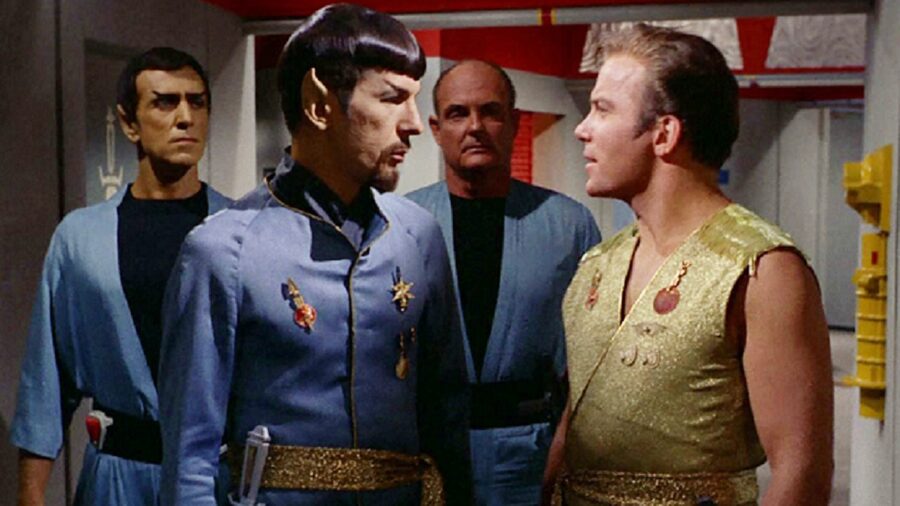
That leads to the final point: Star Trek really is mostly about humans (most of them straight, white, and male) warping around the galaxy and solving everyone’s problems. In every alternate universe where Starfleet doesn’t exist (the Mirror Universe, the alternate reality of Picard Season 2, even the changed future in “City On the Edge of Forever”), the entire galaxy goes to sh*t. If you accept the premise that Starfleet is a stand-in for America, then the franchise has spent the better part of a century showing how everything falls apart without the United States intervening. Honestly, is it any wonder that conservatives love this message?
Shaka, When The Culture War Fell

What does all of this tell us about the political divide of the Star Trek fandom? That it is, on a pretty literal level, completely useless. Not because fans shouldn’t argue about their favorite media; heck, the entire internet was built on trivial fan debates! But Trek is the literal embodiment of its values, and with Infinite Diversity in Infinite Combinations, it can mean (wait for it) infinite things to infinite people. It can be a liberal show, with its emphasis on diversity and socialized everything creating a utopia. And it can be a conservative show, with its emphasis on protecting that utopia through military might and strong leadership.
Will this keep people from arguing about politics in Star Trek when they hop online? Probably not. But maybe it will soften the discourse a bit when both sides learn that their favorite franchise isn’t simply one thing. Trek is bigger than all of us, and its values are correspondingly complex. That’s a good thing, of course: we can always come back to our favorite shows and movies to uncover new meaning. If all you’re watching Trek for is to find something to scream about on the internet, though, you need to take William Shatner’s controversial Saturday Night Live advice to heart and do one thing right away: get a life!
You must be logged in to post a comment Login