Entertainment
Life On The Red Planet? Newly Discovered Mars Molecules
By TeeJay Small
| Published


Since the dawn of mankind, humans have looked up at the sky and wondered if we were alone in the universe. As complex astronomy and space travel became possible, we’ve begun unraveling the mysteries of our solar system, though we’ve had very little in the way of straight answers. Now, according to a scientific study published in Nature Communications, NASA scientists may have uncovered the first concrete evidence of life on other planets. If the current hypothesis is correct, the Curiosity rover has recovered organic molecules which have been preserved on Mars for over 3 billion years.
Per the scientific journal, five of seven newly found molecules identified in a Mars soil sample can be linked to the building blocks of life. The materials, which were smushed into a dried-up lakebed near Mars’ equator, may be native to the big red planet, or they may have been carried by a crashed meteorite billions of years ago. Either way, the robot’s findings suggest that microbial life could have formed based on these molecules, and even thrived.
An Exceedingly Hostile Environment
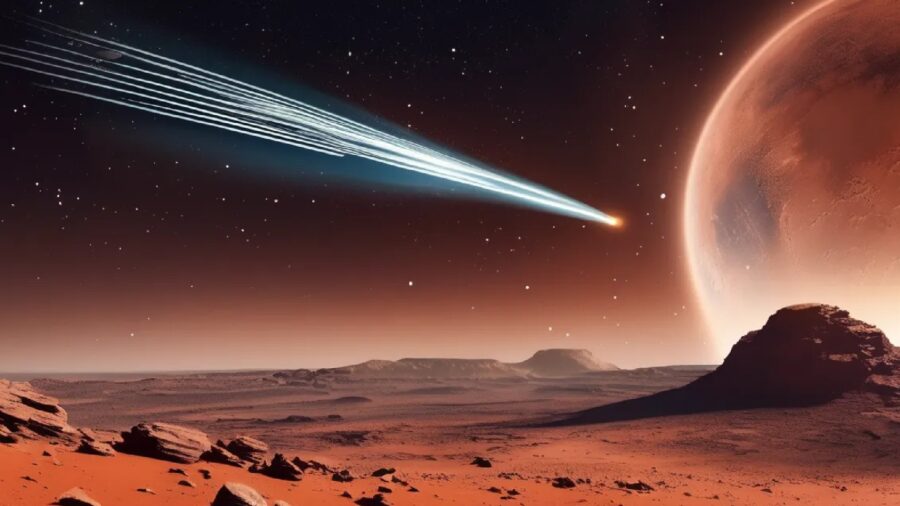
While discussing these findings with The Guardian, University College London’s Professor Andrew Coates explained “[Mars] had all the conditions for life to start there when life was starting on Earth. There’s no known reason why it shouldn’t have started on Mars as well.” These days, there’s no need to wonder why creatures don’t inhabit Mars, as the planet’s surface is exceedingly hostile. The lack of and Earth-like atmosphere means that the planet is constantly getting blasted with powerful radiation, and temperatures are known to drop below -100 degrees Celsius when the sun sets.
In the past, skeptics have been content to write-off life on Mars as a fringe theory. Still, recent research suggests that the planet was once home to flowing water, meaning Mars’ atmosphere could have supported life long before humans became the predominant species on Earth. University of Florida astrogeologist Amy Williams is credited with leading the Curiosity mission that found these new organic molecules, strengthening her belief that life could have persisted on the red planet more recently than previously theorized.

Professor Williams has stated “For a long time, we thought that all organic matter was going to be seriously degraded by that harsh radiation environment. It’s really exciting to see [that] large complex material can survive in the subsurface environment.” Even with this exciting new information, Williams has cautioned that the molecules themselves are not DNA. Strictly speaking, she claims the molecules are “definitely a building block to how DNA is made now. But it is truly just the bricks, not the house.”
Any way you slice it, this rover discovery is extremely exciting. With any luck, we won’t have to go to the trouble of sending Matt Damon up to Mars to figure out what’s going on up there. Soon enough, we might have concrete proof of little green men, who evolved around the same time as dinosaurs on Earth.
You must be logged in to post a comment Login