Entertainment
Marvel Is Officially Failing the X-Men

Comic books have come a long way since their advent in 1933, but they have evolved significantly over the last ten years as the industry has grappled with writing stories in a post-Comicsgate era. Still, some of the most celebrated titles have found themselves falling into familiar and oftentimes uncomfortable patterns.
Few writers embody this evolution more uniquely than Gail Simone, whose early commentary helped redefine how gender and agency are understood in mainstream superhero media. In 1999, prior to her professional writing debut, Simone launched the website “Women in Refrigerators,” coining a phrase that forever altered comic book criticism. Sparked by the infamous death of Kyle Rayner’s girlfriend Alexandra DeWitt (who was murdered and stuffed into a refrigerator in Green Lantern #54) the term described a pervasive industry trope where female characters were routinely killed, maimed, or otherwise de-powered purely to advance the emotional arcs of male heroes.
Simone’s sharp critique propelled her into the industry itself, where she swiftly became a powerhouse writer for both DC and Marvel, crafting acclaimed runs on titles like Birds of Prey, Wonder Woman, and even Deadpool while proving that female characters could anchor the same complex narratives as their male peers.
That legacy makes the last two years of her run on Uncanny X-Men all the more jarring. As the first woman to be the mainline’s sole writer, Simone benefited from a degree of “plot armor,” so to say, which allowed her early missteps to be given a pass. However, this run has slowly become a depressing descent into the very creative pitfalls she spent decades dismantling.
Rather than propelling the mutant flagship forward, Simone’s work succumbs to clunky prose, dated characterizations, and a frustrating reliance on regressive tropes that feel out of character for not only the franchise, but Simone as a writer. Perhaps most glaring is how the narrative falters under the weight of subtle microaggressions and tone-deaf interpersonal dynamics, which begets the question of how an icon of feminist comic commentary could deliver a story so strangely out of step with her own established standard.
‘Uncanny X-Men’ Is Fixated on Overhyping Already Overhyped Characters

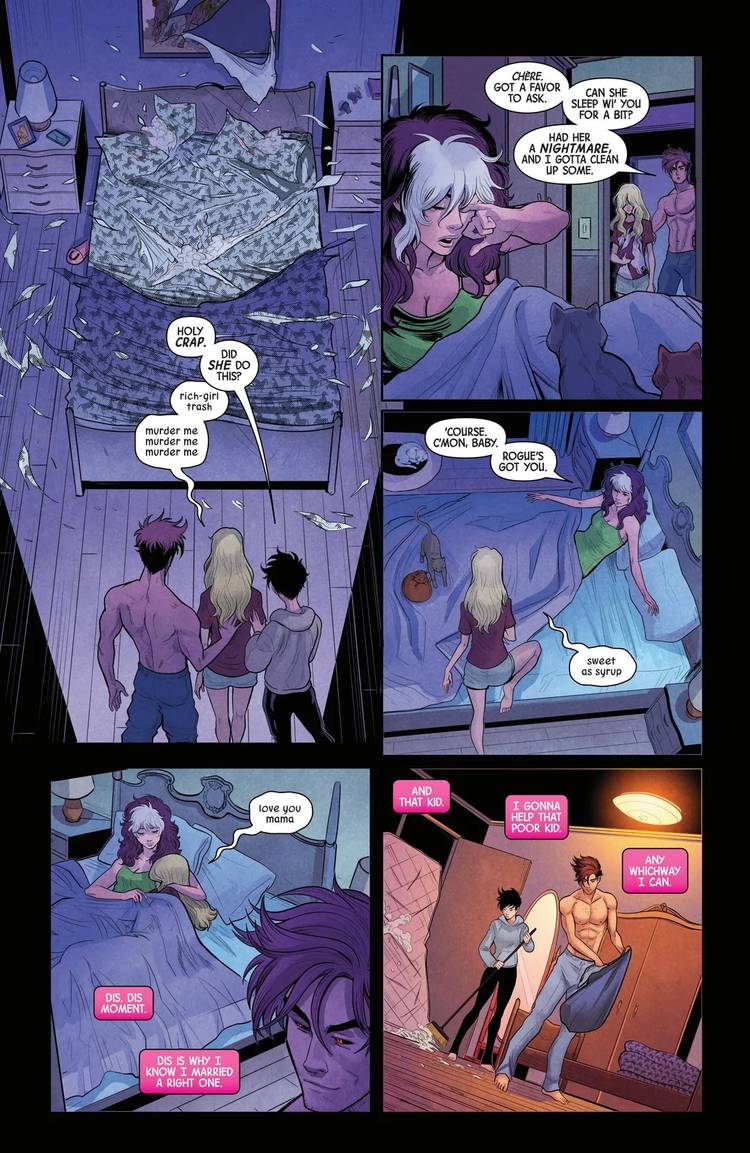
The most immediate, and perhaps least egregious, casualty of this run is the regression of Rogue and Gambit, whose iconic relationship is flattened into a hollow caricature. Rather than leading the team as a formidable leader in her own right, Rogue is reduced to little more than a domestic “tradwife” existing solely in relation to her husband. It quickly becomes evident that the narrative prioritizes making Gambit look effortless and cool instead of allowing Rogue to command respect as an actual leader.
Rogue’s dialogue (and Remy’s, admittedly) is weighed down by heavy-handed, exaggerated Southern phonetics that read more like mocking stereotypes than authentic regional voices. Compounding this domestic imbalance is the awkward insertion of Calico; forcing an infantilized teenage mutant into their immediate living situation pushes Rogue further into a suburban foster-parent trope, taking her even further away from the frontlines of mutant leadership. The narrative comes across as off-putting as Calico is written in a deeply juvenile way which includes seeing the teenage mutant crawling into bed with Rogue and Remy — a couple she has only known for a few months.
This superficial obsession with making Gambit look cool constantly sacrifices basic narrative logic for cheap, unearned hype. A glaring example occurs during a major battle sequence in Uncanny X-Men #32, where Remy abruptly transforms into the “Wyvern” — a monstrous form that has been teased relentlessly for nearly ten issues and hyped up on promotional art. Instead of delivering a dramatic, satisfying payoff to all of that teasing, the transformation arrives suddenly at a moment that makes little sense within the flow of the story.
While the storyline is still in flux, with next week’s issue intending to follow up on Gambit’s new dragon dilemma, it remains a textbook case of style over substance: prioritizing flashy “badass” visuals over a coherent plot, leaving Gambit with an empty spectacle that will inevitably lead nowhere. But these minor scruples pale in comparison to the optics of some of Simone’s more confounding narrative choices.
This uneven focus extends to the rest of the cast and setting, leaving the broader team dynamic severely undercooked. Cyclops, who is historically the tactical anchor and ideological heart of the franchise, is thoroughly underwritten, stripped of his usual gravity and pushed to the periphery. Meanwhile, the narrative’s focus on the Outliers feels deeply skewed and underdeveloped, giving priority to a new cast that lacks the emotional weight or narrative setup to justify their page time.
Anchoring Rogue’s team in Louisiana only exacerbates these issues; compared to the high-stakes, globally resonant scope that has always defined the X-Men, this regional backdrop feels insular. Ultimately, it reads as a weak attempt to force Gambit’s specific corner of the universe into a level of importance it was never meant to hold. But these minor scruples pale in comparison to the optics of some of Simone’s more confounding narrative choices.
‘Uncanny X-Men’ Is Failing the Legacy of the Series

The systemic issues in this run extend far beyond casual tone-deafness, hardening into a pattern of micro- and macro- aggressions specifically targeting Black and Asian characters. This harmful dynamic serves as the driving impetus for the “Raid on Graymalkin” and “Manhunt” arcs, which ultimately fizzled out into frustratingly dead ends, despite allegedly being planned from Uncanny X-Men #1.
Most striking is the treatment of Monet St. Croix, a Black Muslim woman whose established characterization has always centered on bodily autonomy and a fierce opposition to incarceration. Reducing her to the temporary warden of Graymalkin — a fascist concentration camp where mutants are detained until human authorities arrive — completely guts the core of her identity, reframing a hero of liberation as an enforcer of state-sanctioned violence.
What renders this direction as so acutely offensive is the sheer hypocrisy of its poor execution. For a run that postures an understanding of prison abolition and the horrors of systemic marginalization against those deemed as “other,” it arrives at a conclusion where a fascist camp’s existence is justified so long as a marginalized woman is the one holding the keys. This is a profound failure of text and subtext.
Placing Monet in direct parallel with figures like Corina (effectively weaponizing her as a cop and a jailer to her own oppressed people) turns the comic’s underlying civil rights allegory — a staple for the X-Men — on its head for all the wrong reasons. While it is true that what a character says and does is not an endorsement by the author, that does not mean authorial choices are above reproach, particularly when a pattern begins to emerge.
‘Uncanny X-Men’ Is Doubling Down on Its Missteps
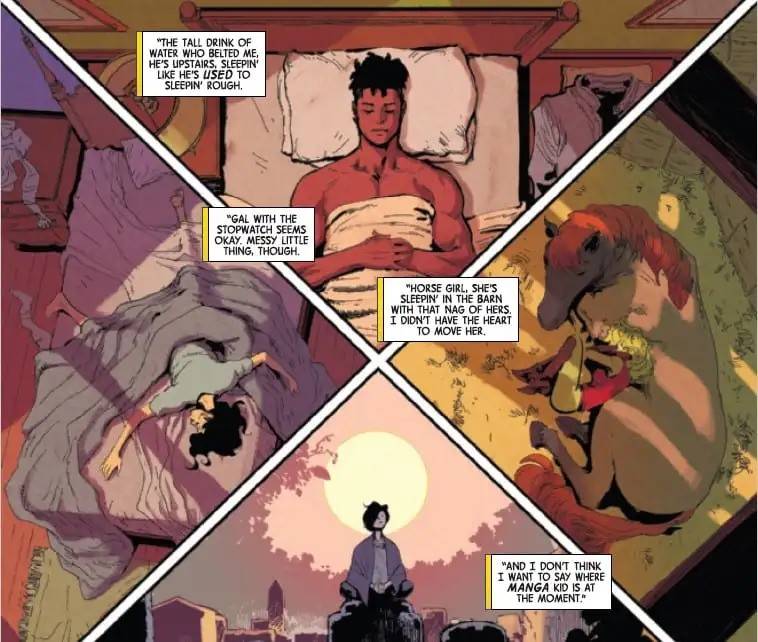
Another recurring pattern in Simone’s Uncanny X-Men run is the abundance of cultural insensitivity and subtle microaggressions woven into the dialogue. Asian characters are routinely subjected to lazy, exoticized tropes. Of note, Logan casually refers to the young Japanese mutant Deathdream as a “manga kid,” which Simone glibly responded to criticism by framing it as Wolverine “incorrectly” calling him that. This casual bias rears its head again with Calico’s most recent interactions with Pietro Maximoff. Calico treats Pietro — a character of Romani heritage and a man of color — with a smug, condescending superiority (despite being in a moment of crisis), dismissively refusing to even view him as a true mutant.
Rather than celebrating the rich diversity that has long defined the franchise, these characterizations alienate readers, reducing an ambitious flagship era to a series of uncomfortable missteps. While there is some narrative explanation for Calico’s behavior, it is nevertheless jarring to see a blue-eyed, blonde-haired white woman othering a character who is, historically, the son of a Holocaust survivor. Coupled with the optics of tethering her to the franchise’s most cookie-cutter Southern couple, it feels as though Simone is doubling down on an inherent and accepted bias about Southern ideals.
Watching an industry titan like Gail Simone, whose entire legacy was built on dismantling harmful tropes, fall into these exact creative traps is a deeply disheartening turn for modern comic criticism — especially as she argues with fans of her writing on social media. Yet this failure does not rest solely on her shoulders; Marvel shares equal responsibility for allowing one of its most iconic flagships to languish without editorial discipline or vision.
At a crucial inflection point in the franchise’s decades-long history, when the X-Men’s core allegories require genuine nuance, intersectional awareness, and real gravitas, the publisher has instead settled for superficial gimmicks and passive oversight. What should have been a landmark era led by one of the industry’s most influential female voices has instead devolved into a stark reminder that legacy alone cannot sustain a title — and that the X-Men, along with their readership, deserve far better than unexamined tropes and hollow execution.

- Writer
-
Stan Lee, Chris Claremont, Len Wein, John Byrne, Scott Lobdell, Steven T. Seagle, Matt Fraction, Kieron Gillen, Gail Simone
- Penciler
-
Jack Kirby, Barry Windsor-Smith, Dave Cockrum, John Romita Jr., Marc Silvestri, Jim Lee, Rick Leonardi, Greg Land, David Marquez
- Publisher(s)
-
Marvel Comics
You must be logged in to post a comment Login