Entertainment

Netflix’s 8-Part Comedy Drama Got Better After Losing Its Biggest Star

Published

on

We need to say something disloyal about Steve Carell, a man we would defend in almost any court. The Four Seasons is better without him. At the end of Season 1, Nick (Carell) dies in a car accident just as he was starting his shiny new midlife crisis with Ginny (Erika Henningsen). On paper, this seemed like an insane decision by Tina Fey and company. You don’t cast the most recognizable face in the TV comedy pantheon and then write him out after eight episodes.

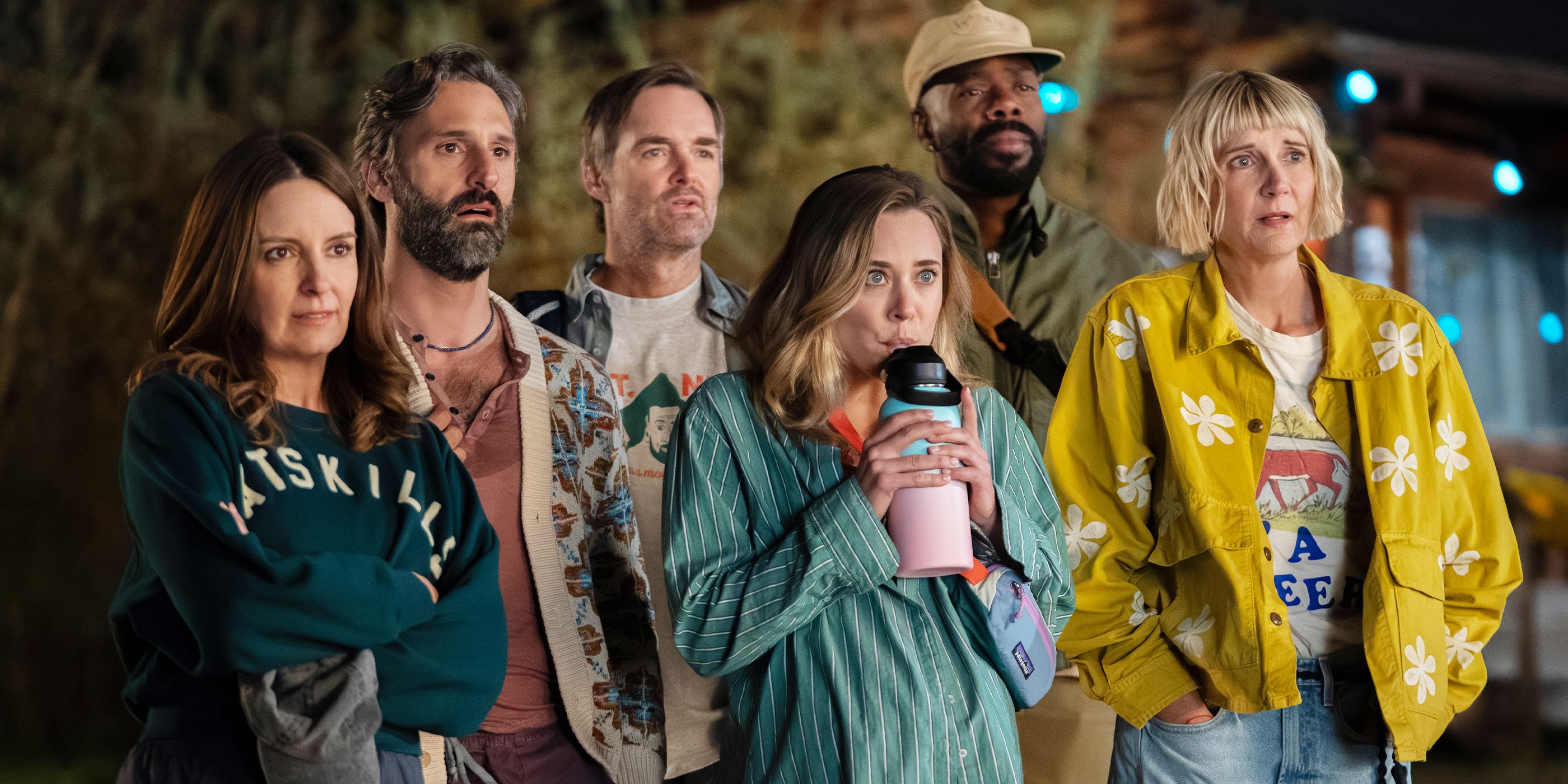
Except Fey and co-creators Lang Fisher and Tracey Wigfield did exactly that. With Season 2, there might’ve been some second-guessing. A finale without your biggest star is one thing; a whole season is another beast entirely. And yet the show’s sophomore outing, which hit Netflix on May 28, doesn’t slump; it soars, making comedic work of grief in a way few shows would dare.

Advertisement

‘The Four Seasons’ Season 2 Builds Its Best Vacations Around Nick’s Death

Season 1 of the Four Seasons was a pleasant, low-stakes hang. Three couples, four trips, one divorce bomb. As far as comedy premises go, it’s a goldmine. But Season 2 came with baggage, and not the kind you can tip a bellhop to carry. The first episode opens with the surviving friends hiking up a mountain to scatter Nick’s ashes. (As if we could forget this hedge-fund executive died doing DoorDash duty for a roomful of millennials he was trying to impress.) Every quarterly trip now has a ghost on the itinerary, and that turns out to be exactly what this ensemble needed.


Advertisement

Collider Exclusive · Universe Personality Quiz
Which Iconic Universe Do You Belong in the Most?
Star Wars · Lord of the Rings · Harry Potter · Game of Thrones · Star Trek

Five legendary universes. Five completely different visions of what the world could be — or already was. One of them is the world your instincts, your values, and your particular way of existing were built for. Eight questions will tell you which one.

🚀Star Wars

💍Lord of the Rings

Advertisement

🧙Harry Potter

👑Game of Thrones

🖖Star Trek

Advertisement

01

What gives your life its deepest sense of meaning?
Every universe is built around a different answer to this question.


Advertisement

02

Which kind of world do you most want to inhabit?
The environment shapes who you become. Choose carefully.


Advertisement

03

How do you prefer your conflicts resolved?
The shape of a world’s conflicts tells you everything about its soul.


Advertisement

04

Who do you want beside you when things get difficult?
Your ideal companions reveal the world you were made for.


Advertisement

05

What is your relationship with power?
How you seek, wield, or resist power is the map of who you are.


Advertisement

06

How does your universe treat good and evil?
A world’s moral architecture tells you more about it than any map.


Advertisement

07

What role would you naturally fall into?
Every universe has archetypes. Which one fits you without trying?


Advertisement

08

What do you ultimately believe about the future?
The answer to this is the clearest window into which universe already lives inside you.


Advertisement

Your Universe Has Been Chosen
You Belong In…

Your answers point to the iconic universe your values, your instincts, and your particular way of seeing the world were built for. This is where you would find your people — and your purpose.

Advertisement


A Galaxy Far, Far Away

Star Wars
Advertisement

You believe in the cause — in the idea that freedom is worth fighting for even when the odds are impossible and the empire is vast.

  • You are drawn to the moral clarity of a universe where hope itself is a form of resistance.
  • You’d find your people in the Rebellion — a ragtag coalition of true believers held together by conviction more than resources.
  • Star Wars is fundamentally a story about ordinary people choosing to matter in an extraordinary conflict — and that is exactly your kind of story.
  • The Force may or may not be with you. But the will to use it for something larger than yourself certainly is.


Middle-earth

Lord of the Rings
Advertisement

You understand, in the deepest part of yourself, that the journey matters as much as the destination — and that the world’s beauty is worth protecting even at great cost.

  • Middle-earth is a world of ancient wonder, deep friendship, and a darkness that only retreats when enough small acts of courage accumulate.
  • You would thrive here because you value the fellowship more than the glory — the road more than the arrival.
  • Tolkien’s universe rewards patience, loyalty, and the willingness to carry something heavy across a very long distance.
  • Those are not burdens to you. They are simply how you move through the world.


The Wizarding World

Harry Potter
Advertisement

You believe that love, loyalty, and doing what’s right are not naive sentiments — they are the most powerful forces in any world, magical or otherwise.

  • The Wizarding World is a place of wonder hidden in plain sight, where learning is transformative and the bonds you form at school follow you into every battle.
  • You would flourish here because you take both the magic and the friendships seriously — and you understand that one without the other is incomplete.
  • Harry Potter’s universe ultimately rewards those who choose to stand for something even when standing is terrifying.
  • That choice — made quietly, without guarantee — is something you understand completely.


Westeros · The Known World

Game of Thrones
Advertisement

You see the world clearly — its power structures, its hypocrisies, its brutal arithmetic — and you are not paralysed by that clarity. You use it.

  • Westeros is a world that rewards intelligence, adaptability, and the willingness to understand that every alliance is also a negotiation.
  • You would survive here — possibly thrive here — because you don’t confuse the world as it is with the world as you’d like it to be.
  • Game of Thrones is a story about what happens when the idealists and the realists collide. You are sharp enough to know which one lasts longer.
  • Winter always comes. You are already prepared.


The United Federation of Planets

Star Trek
Advertisement

You believe the future is worth building — that curiosity, cooperation, and the expansion of understanding are not just ideals but the most practical path forward for any civilisation.

  • Star Trek is a universe where the questions matter as much as the answers, and where encountering something utterly alien is cause for wonder rather than fear.
  • You would belong here because you are fundamentally optimistic about what intelligence and decency can achieve — while being honest about how hard that achievement is.
  • The Federation is the universe’s most ambitious thought experiment: what if we actually got better?
  • You don’t just hope that’s possible. You think it’s the only thing worth working toward.

Advertisement

Somehow, grief doesn’t suck the air out of the funny moments; it pressurizes them. Kate (Fey) and Jack (Will Forte) keep failing to comfort each other because they’re mourning at completely different speeds. Danny (Colman Domingo) and Claude (Marco Calvani) handle their grief the way plenty of couples do: by floating the baby question. The debate is hilarious and a little heartbreaking because we all know a baby has never once fixed an existential crisis, and on some level, so do they. When they bail on the idea and move to Claude’s hometown of Trento, Italy, instead, you get it. Sometimes the only answer to death is a dramatic change of address. And then there’s the odd couple nobody asked for: Anne (Kerri Kenney-Silver), the ex-wife, and Ginny, the girlfriend, stuck haggling over Nick’s estate before baby Gino turns them into reluctant co-parents. It’s the season’s strangest, sweetest pairing, and the show is smart enough to know it shouldn’t last.

‘The Four Seasons’ Season 2 Belongs to Will Forte and Kerri Kenney-Silver

Forte has spent his career being the weirdest guy in the room, so watching him play the season’s most grounded tragedy is a small revelation. Jack copes with Nick’s death the way a lot of mild-mannered men cope with anything: by holding everyone else together while privately falling apart, with a little help from a robust personal weed regimen and a newly-picked-up marathon hobby. Episode 8 is his season-best, and on paper it’s pure sitcom: Kate strong-arms a clearly not-okay Jack into running an Italian marathon to “turn this year around.” It’s two people having the fight they’ve been dodging for seven episodes, except now they’re having it mid-race, sweaty and furious, while strangers in foil blankets cheer them on. And Forte sells every second of it as a guy who can’t pinpoint when he stopped being okay. If we complain too much about fragile masculinity and men who can’t express their feelings, his Jack is the answer to that. But he’s not the only supporting player who finally gets their due in Season 2.

The Four Seasons’ first outing mostly used Anne as the wronged woman, the wife Nick discarded on the way to his new life. Season 2 hands Kenney-Silver the keys. Anne and Ginny start by squabbling over Nick’s estate and end up co-parenting baby Gino. Then, in the move that gives the finale its spine, Anne does the last thing anyone expects from her: she stays. While the rest of the group flies home from Italy, Anne volunteers to housesit Danny and Claude’s place in Trento… alone, in a country where she knows nobody. Then David Tennant strolls in as a charming local stranger, and the show closes on Anne flirting in broken Italian with the energy of a woman who has finally remembered she exists. It’s the most satisfying cliffhanger Netflix has produced in ages, and it belongs entirely to a character who spent her first season as collateral damage in someone else’s storyline.

Advertisement

For a while now, Netflix has been positioning The Four Seasons as its cozier answer to The White Lotus, but Season 1 never had the stakes to back that up. Season 2 does, and it gets there without a single murder mystery. Even when Carell returns for a flashback episode, the show resists the urge to build a shrine. Nick shows up as he actually was: charming, selfish, beloved, and, in a way, already gone. By killing him off and sticking to that choice, The Four Seasons didn’t lose its biggest star; it let him go and found its best self on the other side.

Source link

You must be logged in to post a comment Login

Leave a Reply

Cancel reply

Trending

Exit mobile version