

Entertainment
Perfect Buffy Episode Secretly Channels Greatest Movie Of All Time

By Chris Snellgrove
| Published

Normally, The Godfather is the last movie you’d associate with Buffy the Vampire Slayer. After all, the former is the greatest mafia film ever made, and the latter is a show about plucky teenagers fighting demons. As it turns out, though, one perfect episode of Buffy managed to honor The Godfather in a powerful way.
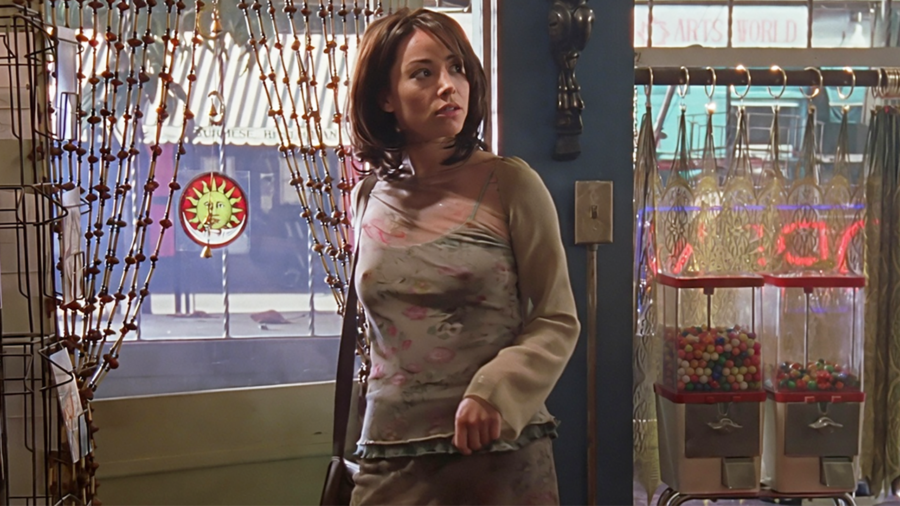
In the episode “Passion,” there is a fairly innocuous scene where a newly evil Angel harasses Joyce Summers, causing her to drop some oranges. Shortly after, Angel murders the Sunnydale High computer science teacher in a brutal attack. These may not seem like related events, but the whole thing is secretly an homage to The Godfather’s “orange motif,” which went on to inspire decades of groundbreaking cinema!
The Not-So-Annoying Orange

What the heck is the orange motif, you ask? If you go back and rewatch The Godfather, you’ll notice there are oranges in so many very important scenes. At first glance, they don’t seem to have much special significance, and you might be forgiven for thinking that director Francis Ford Coppola just has a thing for oranges.
However, what’s important is when the oranges appear: namely, they appear shortly before a character is killed. For example, Vito Corleone is killed, it is while he’s peeling oranges. When the titular Godfather is shot, he is buying oranges, which dramatically scatter on the ground. When the Five Families meet, you can see oranges near the Mafia leaders that would soon be killed.

Because The Godfather was so influential, “the orange motif” (as this phenomenon was eventually called after it was used in the subsequent Godfather films) started popping up in other movies, including Point Break, American Beauty, and Requiem for a Dream. Fittingly enough, the orange motif also popped up in The Sopranos, where we see Tony Soprano buy some orange juice shortly before someone tries to whack him. Before that, though, Joss Whedon hid an orange motif reference in an episode of Buffy the Vampire Slayer.
Orange You Glad To See Him?

In “Passion,” Angel (who has recently lost his soul and become evil) harasses Joyce Summers outside of her own home, causing her to drop some oranges. While Joyce herself doesn’t die, those dropped oranges and the presence of the show’s scariest vampire foreshadow a major death right around the corner. Soon afterward, Angel kills Jenny Calendar, a beloved character whose death sends a chilling message to viewers: none of your favorites are guaranteed to make it out of Season 2 alive.
In retrospect, it’s not really all that shocking that Buffy the Vampire Slayer hid such a powerful reference to The Godfather in plain sight. After all, the show is filled with references to countless other movies and shows, mostly courtesy of quip-heavy characters like Buffy and Xander. Given how much of a film buff showrunner Joss Whedon and the rest of his team were, it’s not that surprising they wanted to homage one of the greatest movies of all time.

But is the orange motif from The Godfather the greatest cinematic trope of all time? It’s certainly one of the most prolific. As for me, I don’t really like this Godfather reference as much as some Buffy fans turned cinephiles. Why? Because, in the immortal words of Peter Griffin, it insists upon itself!

Entertainment
‘High Potential’ Finally Spotlights a Fan-Favorite Character in This Must-Watch Episode
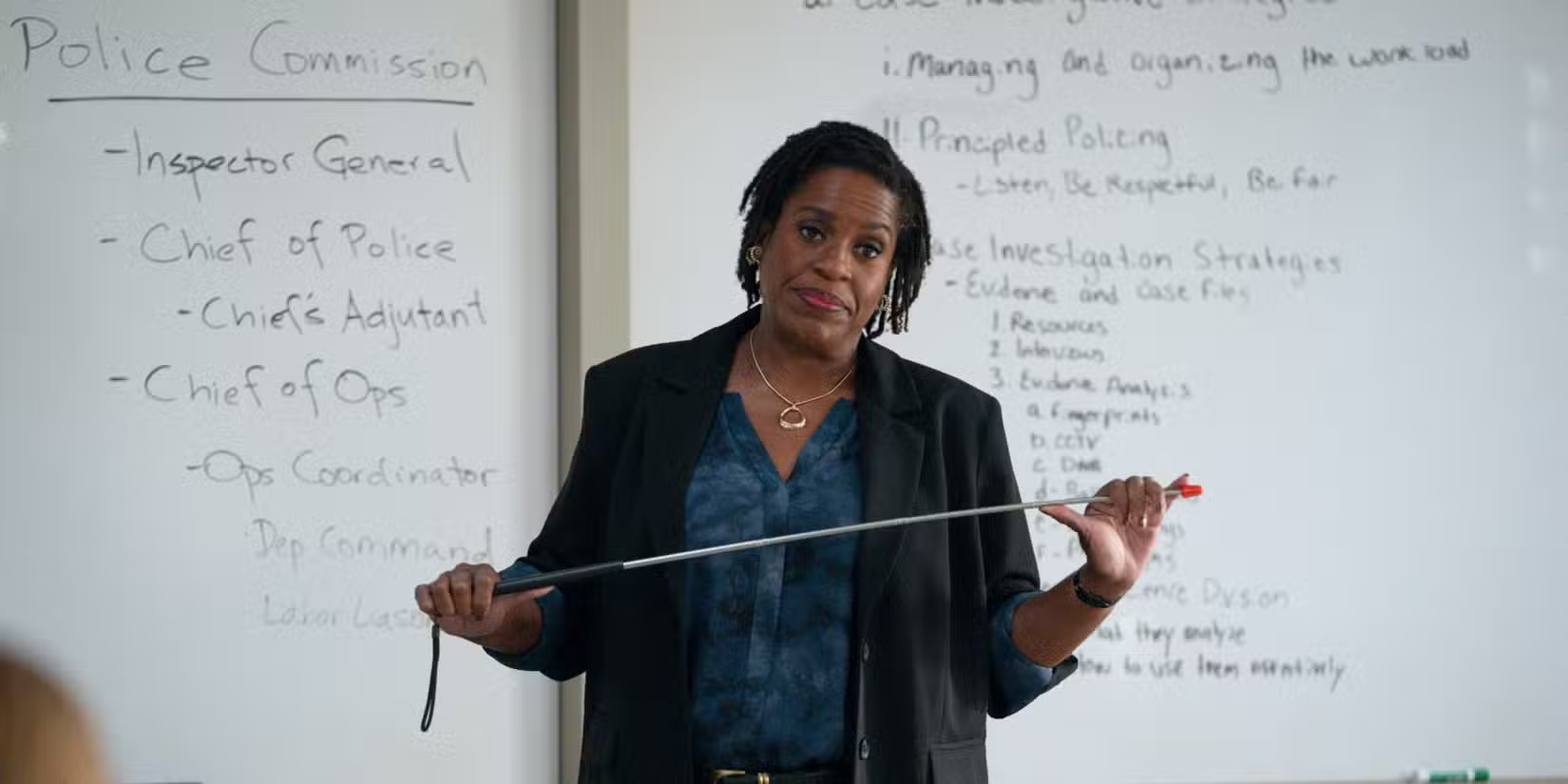
Last week’s episode of High Potential left off with the major cliffhanger reveal that the man (John Pyper-Ferguson) who’s been following Arthur (Mekhi Phifer) was the person who abducted Roman 16 years ago. In this episode, it’s revealed that his name is Eric Hayworth, and that he was previously in Special Forces for the military. Not much else is revealed about Hayworth yet, except that he was hired to abduct Roman by an extremely dangerous woman named Willa Quinn. Meanwhile, this episode sees the return of Dottie (Michael Hyatt), Morgan’s (Kaitlin Olson) instructor from the training academy. The episode starts with a murder attempt being made on Dottie’s life, and Major Crimes working to solve the case while she’s unconscious in the hospital.
This episode, titled “If You Come For the Queen,” focuses primarily on Dottie’s case, which later connects to another case that Major Crimes is investigating. Daphne (Javicia Leslie) finally gets her first solo storyline this episode, as it’s revealed that Dottie was her training officer, and they used to be very close. Daphne takes the lead on Dottie’s case in what is an excellent, character-centered episode with a number of powerful storylines.
In ‘High Potential’ Season 2, Episode 14, Major Crimes Investigates an Attempt on Dottie’s Life

Daphne and Morgan are assigned to Dottie’s case, while Karadec (Daniel Sunjata) and Oz (Deniz Akdeniz) investigate a murder. While working on Dottie’s case, Daphne tells Morgan that she and Dottie were very close during the five years they worked together, even after Daphne made detective and Dottie became a full-time instructor at the academy. Dottie pushed Daphne to take the sergeant’s exam and move forward in her career, but Daphne was hesitant to try to get a promotion after watching the discrimination that Selena (Judy Reyes) and Dottie have had to deal with for years as women of color in the police force. Daphne and Dottie got into an awful fight over this, and they haven’t spoken since.
Dottie was getting a massage at her regular spa during the attempt on her life, so Morgan and Daphne check out the spa and ask around. This takes them to Dottie’s classroom, where Morgan and Daphne catch their first suspect: one of Dottie’s students, Officer Hoff. Hoff broke into Dottie’s classroom to keep her from reporting him for a mistake, but he didn’t hurt her. Dottie wakes up, and she starts consulting with Morgan and Daphne on the case. Morgan looks at Karadec and Oz’s case, and she figures out that their victim, Luke Knight, went to the same spa as Dottie. Dottie checks herself out of the hospital early, and she joins Major Crimes to work on her and Luke’s cases.

An Actor Awards Round-Up — The Collider TV Quiz!
Thespians honored their own last Sunday. Just how many of the night’s big winners can you name in today’s round-up?
Daphne and Dottie go to the spa to ask around, while Karadec and Oz question people from Luke’s gym. Karadec speaks with Luke’s boss, Phyllis, who tells them that Luke was new, but that he had already landed some major clients. Karadec and Oz suspect Luke’s work rival, Voz, from whom Luke poached a high-profile client. Daphne and Dottie speak to Kirk Hartwood, the owner of the spa, who tells them that Luke has never been a guest at the spa – and that everyone working at the spa has an alibi placing them there during Luke’s death. Dottie collapses and has to go back to the hospital, where she and Daphne finally talk things through. They’re still at a standstill, though, because Dottie has a lot of hope for Daphne’s future, and Daphne thinks that there’s no point in taking the exam after Selena was unfairly passed over for her promotion.
Later, Morgan realizes that both Dottie and Luke’s cases are connected through a Strangers on a Train-type murder. Two people got together and agreed to kill the target that the other wanted dead, so it couldn’t be traced back to them. The Major Crimes team suspects that Voz was on one end of the pact, and that he got someone at the spa to kill Luke. As it turns out, Kirk has been using a black market supplier for the IVs to save money, and he has been giving them spa sensors in return. The supplier is Phyllis, who made a murder pact with Voz: Phyllis would kill Luke for stealing Voz’s client, and Luke would kill Dottie for Phyllis. Dottie reveals that she joined a sorority in college, and Phyllis was supposed to be her Big Sister. Phyllis went overboard on the hazing, so Dottie turned her in. Phyllis was charged with a felony, and her whole life fell apart after that. As a Black woman, she never got a second chance, and she blames Dottie for reporting her back then.

The One Thing ‘High Potential’ Must Get Right in Season 2 Is Morgan and Karadec
Season 2 can’t afford to drop the ball on this pivotal relationship.
Recently, Phyllis was turned down when trying to remove her felony record, reminding her of everything she lost. Phyllis is already on the run by the time Major Crimes realizes that she put the hit out on Dottie, but the Major Crimes team finds her. Daphne talks to Phyllis one-on-one, and she empathizes with her, saying she knows what it’s like to always have to prove herself. She encourages Phyllis to accept her arrest, and she does. Later, Daphne and Dottie have a touching conversation at the station. Dottie tells Daphne that she pushed her to keep her from letting outside pressure get her down, and Daphne tells her that she understands.
‘High Potential’ Season 2, Episode 14 Parallels Daphne and Ava’s Storylines
At the start of the episode, Ava (Amirah J) tells Morgan that she got into the design class that she applied to. Ava is very excited, until she sees a post online from a classmate that says she only got it because of her race. Morgan supports Ava as best as she can, but she acknowledges that she can’t fully understand what Ava is going through. Later, Ava goes to the station to talk to Daphne. They get derailed by Dottie’s collapse, but at the hospital, Ava tells Daphne what happened. Daphne empathizes with Ava and relates to her, and when Ava asks whether she should stick with the class, Daphne tells her to follow her heart.
Daphne doesn’t feel content with the advice that she gave Ava. Later, after solving Dottie’s case, she talks to Ava again from a new perspective. Daphne had been feeling disheartened since watching Selena get passed over for a promotion that she deserved, which only further convinced her not to even bother taking the sergeant’s exam, even though Dottie wanted her to. After reconciling with Dottie, though, Daphne decides that she wants to lean more into Dottie’s advice. Daphne tells Ava that they can’t control what other people say about them, and that she needs to do what feels right for her, no matter what people think. This encourages Ava, making it seem like she will likely continue with the class. It also bodes well for the possibility of Daphne taking the sergeant’s Exam in the remainder of Season 2.
High Potential airs Tuesdays at 9:00 p.m. ET on ABC.

“The princess is in the building!” — the iconic line that introduced this OG influencer to TV audiences back in 2007 … Can you guess who she is?! We snatched her looking snatched in a behind-the-scenes video for her collab with Nike. Hit the…

In a way, Fringe is still enjoying the last laugh. Never a ratings flop for FOX but still criminally underrated during its five seasons, the 2008 drama’s visionary pedigree, innovative substance, eccentric humor, and one-in-a-million cast have secured its cult classic longevity. Showrunners Jeff Pinkner and J. H. Wyman reinforce their intricate mythology about parallel dimensions and doppelgängers with weighty thematic equivalents — identity, family, responsibility, love’s manifold consequences — while their nigh-seamless narrative framework keeps the most earnest sentiments from dissolving into saccharine triteness.
Fringe had already been solidifying its unique procedural-turned-serialized sensibilities by Season 2’s midway point. The second season’s sixteenth episode, “Peter,” marks a defining moment as figuratively seismic as the planet’s tectonic plates shifting under viewers’ rattling feet. For the first time, Fringe flourishes into one of televised sci-fi’s crowning achievements — in no small part because the episode’s driving crux exemplifies the genre’s enduring fusion of imaginative scope and achingly resonant heart.
‘Fringe’s “Peter” Episode Is the Sci-Fi Show’s Finest Hour
“Peter” deviates from Fringe‘s established format by unfolding as a flashback set within the contemporary framing device of Walter Bishop (John Noble) confessing his sins — specifically, the truth about his son Peter’s (Joshua Jackson) origins — to Olivia Dunham (Anna Torv). Even for a show increasingly comfortable with experimentation, the episode all but thrums with the sharpened texture and potent intentionality this freedom affords. Several long-standing mysteries receive rewarding payoffs, and the same newfound context informs future chain reactions.
“Peter” turns this half-culmination, half-prelude into an experience as disarmingly arresting as a blow to the solar plexus. Fringe‘s looming war emerges from the perfectly imperfect reality of human reaction; a grieving father tears asunder reality’s supposedly immutable boundaries. The kind of cosmic-level cost one would attribute to a supervillain’s experimental hubris — risking an entire universe — instead hails from a ruined, heartbroken man incapable of outmaneuvering his son’s fatal illness.

Netflix Just Lost One of Its Greatest 2-Part Thrillers Ever
Government conspiracy makes this political thriller an addictive binge with a ‘Last of Us’ star.
What’s more, the Walter of 1985 doesn’t hatch some malevolent plan to kidnap “Walternate’s” son as if the two Peters are interchangeable replacements. That motivation is too simplistic for a series concerned with the mosaic of ways trauma, death, and isolation shape our already multidimensional psychologies. Rather, Walter intervenes as a compassionate, desperate, and completely irrational last resort, unable to witness the same irreversible tragedy befalling the only other Peter Bishop in existence.
Make no mistake — he weighs billions of innocent lives against one child. With all the simultaneous authority of a bereaved parent who can’t perceive a way forward and a scientist with a god complex, he chooses the latter’s survival, rejecting his colleagues’ warnings and all the detached tenets of his trade. And once he’s staring at the embodiment of an open wound, he also negates his white-knight promise to return Peter-2 to his loving home. Walter surrenders to temptation after temptation while trying to soothe his unbearable devastation. Interpreting an unconscionable act into something understandable — even sympathetic — is one of fiction’s strongest magic tricks in action.
John Noble’s Brilliant Performance in “Peter” Brings ‘Fringe’s Theoretical Ideas To Aching Life
One can’t wax rhapsodic about “Peter” without casting every known superlative in Noble’s direction. One might even risk hyperbole and call the actor’s entire Fringe run as faultlessly captivating. In this pivotal instance, his staggering performance shoulders the emotional core of what’s essentially a solo piece, a character study, and the axis upon which Fringe‘s future rests, with all the precise layering of pathos, intimacy, and restraint befitting such a Herculean task.
Even in Fringe-land, “Peter” provides a rare opportunity to compare the rhythms of present-day Walter with the past’s pre-quasi-lobotomized incarnation. The former is endearingly kooky to the point of almost harmless yet eternally guilt-ridden, longing for forgiveness while convinced he’s too irredeemable to deserve such mercy; the latter’s haunted by both the repercussions of his selfishness and, in his mind, failing to protect his child. No matter which timeline or dimension, all Walter Bishops contain the same capacity for active good, blithe negligence, disturbing arrogance, fragile vulnerability, and delayed clarity. It’s a suitably tragic irony that Walter inflicts similar heartbreak upon his parallel self, launches an interdimensional war, and ensures Peter’s fate as the multiverse’s sacrificial linchpin.
In the grand scheme of Fringe‘s one hundred episodes, “Peter” remains the series’ breakthrough masterstroke. If that wasn’t enough, this singular installment encapsulates the soaring power of sci-fi at its height by hewing to the genre’s unspoken rule of making the theoretical personal. Science function houses infinite ideas, but even the most ingenious concepts become a dime a dozen when they fail to root themselves in the familiar breadth and overwhelming gravitas of human experience. Fringe‘s dystopian universe-hopping is inseparable from the fact that Walter’s choice — one few people could summon enough strength to resist — emerges from raw familial love.

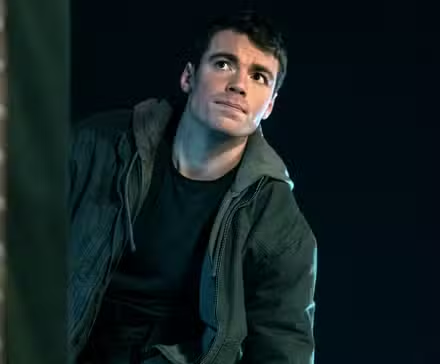
If you’re looking for the best thriller on Netflix right now, you really should stop scrolling past Bodyguard. The six-episode BBC series from 2018 is leaner, meaner, and more emotionally compelling than anything the algorithm is currently pushing at you (The Night Agent, Reacher, take your pick). Richard Madden won a Golden Globe for it, but despite that, a second season didn’t materialize — and, it turns out, that might’ve been the best thing that ever happened to it.
What Is ‘Bodyguard’ About?
Created by Jed Mercurio – a man who has made a career out of turning institutional paranoia into compulsive television with shows like Line of Duty – Bodyguard follows David Budd (Madden), a decorated war veteran turned police protection officer assigned to guard Julia Montague (Keeley Hawes), the UK’s ambitious, polarizing Home Secretary. The catch: he fundamentally disagrees with everything she stands for. Hawes makes Montague formidable, injecting an unknowable quality to her that keeps the audience second-guessing itself, and the slow-burn tension between the two leads gives the show its stakes long before the assassination attempts and political conspiracies kick in. What starts as a procedural quickly escalates into something harder to pin down; a show that’s part psychological thriller, part conspiracy drama, and wholly gripping.
A heart-racing opening train sequence doubles as Bodyguard’s thesis statement. It’s both a warning and a promise: this show is all gas, no brakes. A bomb threat, handled in near real-time, with no swelling score guiding your nerves and no shorthand to reassure you that everything will be fine. Budd scrambles through the cars with the urgency of someone who has witnessed the unthinkable and is terrified of seeing it again. With one crisis thwarted (but plenty more on the way), the show builds on all that dread and adrenaline by thrusting its hero into yet another uncomfortable situation. He is assigned to Montague’s protection detail as a reward for his heroism, and the friction is obvious from the first scene they share. He thinks her policies got soldiers killed; she has no particular interest in his opinion. The professional dynamic is taut and watchable on its own terms, but Mercurio keeps complicating it. By the end of the first episode, you’ve already started quietly revising your read on at least one character, which is exactly what the show wants you to be doing.

The show is built around a web of overlapping conspiracies. There’s a political power play involving Montague’s sweeping new surveillance legislation, which earns her plenty of dangerous enemies in high places. There are people within her own political orbit who want her humiliated. There are people further out who want her dead. And there’s at least one person in Budd’s immediate circle whose loyalties are not what they appear to be. For first-time viewers: go in knowing as little as possible beyond the basic setup. The shock and awe are more than worth it.
Netflix’s ‘Bodyguard’ Works Better as a One-Season Thriller
There’s enough action across Bodyguard’s six episodes to earn its genre placement, but the real draw of this story is Madden and how he plays what should be a conventional hero with an ambiguity just slight enough to make you hesitate labeling him the “good guy.” He’s a man running on fumes – anxious, post-traumatic, completely out of his depth in this shady government-run labyrinth populated by MI5 agents and crime lords. Budd’s good at his job, but it costs him something every time he’s out in the field, and Madden makes sure to remind us of that with physical tics and exasperated expressions that give the impression this guy is just a few seconds shy of a mental breakdown at all times.
It all ends with a setup, a suicide vest, and a tense standoff that feels doomed to end badly for the characters you’ve come to care about, but the important takeaway here is that it ends. Modern storytelling has largely abandoned the complete ending in favor of the strategic pause. Streaming series like to leave threads dangling, questions unanswered, and all signs pointed toward a follow-up that may or may not ever arrive. Bodyguard‘s finale untangles the conspiracy in a way that’s logical rather than convenient, bringing Budd’s arc to a conclusion that lands emotionally because the show has done the work to earn it. It’s a tidy piece of television, another nod that makes it unique among its peers. It’s also why those unrealized promises of Season 2 feel less frustrating. When Bodyguard hit, a follow-up seemed inevitable. The ratings were there, and Netflix seemed interested, too. Even Mercurio entertained the possibility. But years passed, and nothing happened.
Thrillers are notoriously difficult to stretch out. Their energy depends on unresolved tension, and once the central mystery is solved, the show has to manufacture new stakes from scratch. A lot of times, that process cheapens whatever made the original work. But that doesn’t happen here. Bodyguard tells one story, completely, without overstaying its welcome or softening its edges to leave room for expansion. The result is something increasingly hard: a thriller with a beginning, a middle, and an actual end. It’s the complete binge-watching package, and still better than anything trending at the moment.
:max_bytes(150000):strip_icc():format(jpeg)/miley-cyrus-hannah-montana-anniversary-special-trailer-031026-401b3f9e0d794755a5ceff995446c730.jpg)
The special premieres on March 24, 20 years to the day since the show launched on the Disney Channel.
Entertainment
See the new cast of “One Piece” season 2 side-by-side with the anime characters they play
:max_bytes(150000):strip_icc():format(jpeg)/One-Piece-season-2-cast-list-030626-200062d600a6439a96cc1ded21aa55f5.jpg)
Netflix’s live-action adaptation is folding in several beloved characters for its second season.
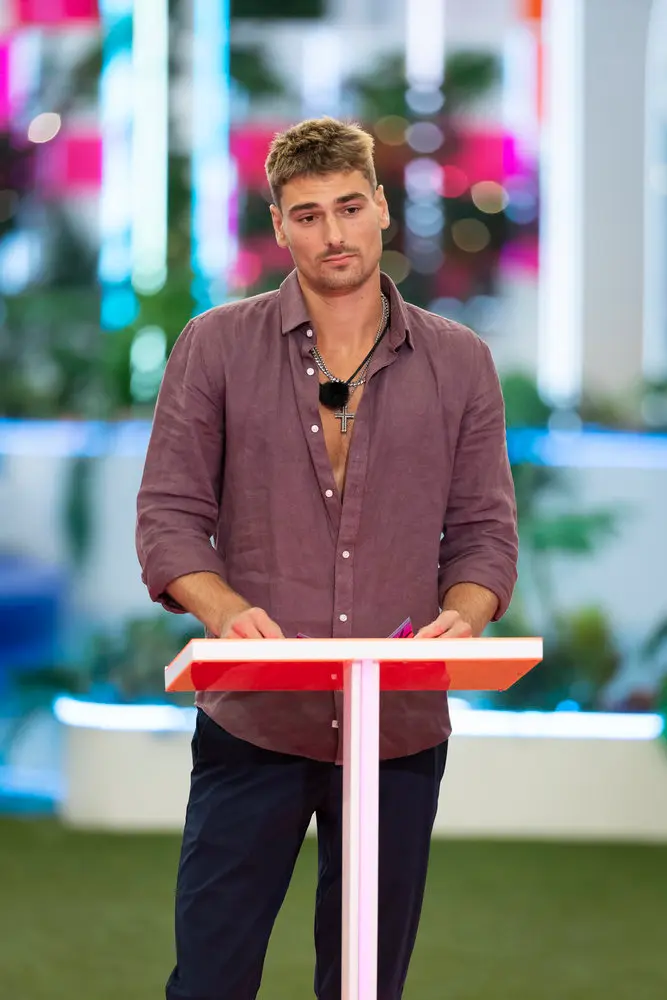
“Love Island” star Austin Shepard is getting real about his struggle with addiction. During a podcast appearance, the 27-year-old opened up about relapsing while filming the show’s spin-off, “Beyond the Villa.”
Austin Shepard is no stranger to the spotlight, as he was also the center of attention during the most recent season of “Love Island” after netizens called him out for reportedly sharing offensive content.
Article continues below advertisement
Austin Shepard Relapsed While Filming The ‘Love Island’ Spin-Off
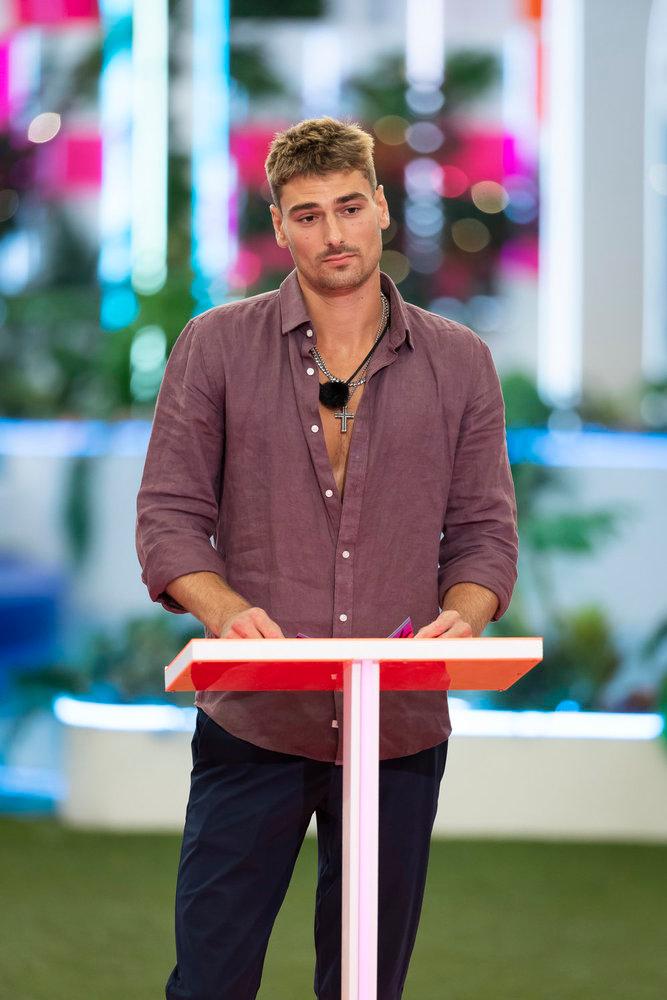
Shepard revealed that he was 11 days sober on the “Previously On” podcast by TMZ. The “Love Island” alum shared that before reaching that point, he relapsed by using opioids while filming season 2 of the show’s spin-off, “Beyond the Villa.”
“No one knew,” he shared. “I’m a pretty manipulative, functional addict until it becomes so unmanageable—like how it got. But I can bullsh-t for a while.”
Shepard likened himself to a “salesman,” adding that he tends to “wave and pretend everything is OK.”
Article continues below advertisement
Austin Shepard Revealed His Co-Stars Noticed A Change In His Behavior
Elsewhere, during his appearance on the podcast, Shepard showed love to his co-stars, who noticed the reality star’s demeanor had changed while filming “Beyond the Villa.”
“Charlie started reaching out in the last month and was like, ‘Bro what’s going on?’” he said. “I just got pretty real with him, just telling him pretty much everything. He’s been wishing me love, giving me love. Same with TJ, Iris. They’ve been sending me love.”
Shepard also got real about the difficulties he’s faced while managing his sobriety.
“I know how this road goes,” he said. “I’ve had plenty of friends who are not here today that have sadly passed from it and it’s either death or a long life of misery.”
“That was my moment of clarity, finally,” he said.
Article continues below advertisement
Austin Shepard Sought Professional Help
For Shepard, gaining clarity was just one of the things that helped him deal with his struggle. He also admitted to seeking professional help at another point during his journey.
“There was one night where I was sitting there, I was just going crazy,” he said. “I hadn’t slept in four nights. I was very sick. Just puking. It was horrible. I was like, ‘I need to go somewhere, medically.’”
The facility Shepard checked into gave him excellent care, he said, adding that the support of his family members has helped strengthen him.
Article continues below advertisement
Shepard Faced Backlash After Sharing Controversial Posts
According to a previous report from The Blast, Shepard faced backlash from the “Love Island” viewers in the summer of 2025 after he reportedly shared offensive content on his social media channels.
“I want to take a moment to address my recent repost that has caused offense to some of you,” he wrote online. “As you all know, I have a very dry sense of humor, and I genuinely didn’t think before sharing that content.”
Shepard had been under fire throughout his stay in the “Love Island” villa, as eagle-eyed social media sleuths called the reality star out for his previous posts before joining the cast.
Article continues below advertisement
“I recognize that my choice of content did not resonate well with everyone, and for that, I sincerely apologize,” Shepard shared. “I’m committed to learning from this experience and to being more mindful in the future. Thank you for your understanding and for holding me accountable.”
Days before his apology, Shepard made headlines after responding to a social media user who branded the Michigan alum a “racist bigot.”
“I’m going to give this attention only one time because this is, like, crazy,” Shepard said in response. “Are you f-cking dumb? Like, honestly, are you dumb? Do you not think?”
Another ‘Love Island’ Star Walks Back Controversial Post

Shepard wasn’t the only “Love Island” star in hot water. A previous report from The Blast states that Yulissa Escobar, who also appeared in season 7 of the competition series, was booted from the show during the second episode after old clips of her using a racial slur resurfaced.
Online, Escobar attempted to own up to her mistakes, sharing that she previously used the N-word while “not fully understanding the weight, history, or pain behind it.”
Escobar went on to say that while she meant no harm, she began to understand how serious her words were after being dismissed from the series.
Article continues below advertisement
“I’ve changed a lot since then, not just in how I speak, but in how I show up, how I carry myself, and how I honor the experiences of others,” Escobar continued. “Growth means recognizing when you were wrong, even if it’s uncomfortable, and choosing to move forward with humility and accountability.”
Entertainment
Timothy Busfield's rep slams 'unproven' allegation that he sexually assaulted costar in the '90s
:max_bytes(150000):strip_icc():format(jpeg)/timothy-busfield-Claudia-Christian-030926-bc5417e642bc428ea033bc8b6c7b769a.jpg)
Actress Claudia Christian worked with Busfield on the 1991 film “Strays” when she was 26 years old.


TMZ.com
Model and reality star Courtney Stodden wants everyone to leave Britney Spears alone following the pop star’s DUI arrest … and Courtney’s serious!
She told us, “I will come for you,” issuing a warning to those preoccupied with judging Britney.
As far as Courtney is concerned, Britney is a national treasure, and everyone’s time would be better spent focusing on their own mental health.
We caught up with Courtney as she hosted “TMZ After Dark” tour Saturday night, where she brought a classic Hollywood vibe to the bus.
Courtney told us she loves TMZ, saying “TMZ is a huge part of her Hollywood story” and brought necessary media attention to a time she was getting taken advantage of. Later, she took peanut butter shots with everybody at Jameson’s on Hollywood Blvd.
TMZ.com

She went full Y2K mode for the ride, having our amazing DJ, DJ Blue, blast early 2000s hits like Fergie and Britney Spears the whole way.
Courtney also brought her husband, Jared, along for the night. The couple got married in 2014, and when we stopped at Rainbow Bar & Grill, we asked them if they’d ever have kids. Courtney joked that she’s actually been “snorting birth control,” so it doesn’t look like she’ll be showing up with a baby bump anytime soon.
Later in the night at Saddle Ranch, Courtney rode her first mechanical bull ever. She had actually never been to Saddle Ranch before, but not only did she ride the bull — in the sexiest way possible — but she also did flips after she defeated it.
Courtney, thank you for the sexiest, most iconic ‘After Dark!’

A lot of movies, even the blockbusters, come and go with the year’s hype cycle. But these ones don’t. These 10 movies listed below are the ones you finish and immediately feel that little rush of certainty: they nailed it. The choices make sense. The tone never wobbles. The performances feel lived-in. The final beat leaves you satisfied and slightly wrecked, because the story didn’t cheat to get there.
This ranking essentially lists the films I consider perfect. The films I can throw on at any time and get the same full-body reaction: laughter that turns uneasy, silence that turns loud, romance that actually stings, dread that feels earned, with near-perfect story-building. Every entry here knows exactly what it’s doing from the first scene to the last.
10
‘Parasite’ (2019)

The first thing I love about Parasite is how fast it makes you care about the Kims as a unit. Ki-woo (Choi Woo-shik) and Ki-jung (Park So-dam), two smart kids trapped in a life that keeps shrinking and they’re hustling. When they slide into the Park family’s world, one job at a time, the movie makes the tension delicious because every little lie has a practical shape: a resume, a phone call, a perfectly timed performance.
Then the story tightens, and you feel your stomach sink because you realize how fragile the fantasy is. The house becomes its own engine, doors, stairs, hidden spaces, and the night everything changes is one of the most purely stressful sequences of the decade. You’re watching people sprint to keep control of a situation that’s already slipping, and the emotional punch comes from how quickly class cruelty becomes physical danger. By the end, you’re thinking about what hope costs when the system is built to deny it.
9
‘Oppenheimer’ (2023)

Oppenheimer is unexplainable. You start watching it for the exact moment when they create the nuclear bomb. And yet that moment comes but it’s just not enough because there’s so much that went on other than just tests. You follow J. Robert Oppenheimer (Cillian Murphy) and the movie constantly keeps you inside his intensity, his ambition, his ego, his hunger to be understood, his need to matter. The early sections move like momentum you can’t stop: the recruitment, the Los Alamos build, the way the project becomes a city of secrets where everyone’s personal life gets swallowed by urgency.
And when the Trinity test arrives, the movie earns that dread through sheer buildup and human detail. People waiting, people pretending they aren’t scared, people betting their souls on equations. The aftermath is where it really gets under your skin: the celebration that feels wrong, the applause that feels like pressure, the way Oppenheimer’s face starts carrying a realization he can’t put back in the box. The hearings turn his life into a slow public stripping, and you feel the cruelty of watching a man used by power, then punished for having a conscience that finally caught up.
8
‘Moonlight’ (2016)

Moonlight shows you exactly how the world shapes a person before they ever get a chance to choose freely. Chiron (Alex R. Hibbert) starts as a quiet kid trying to disappear inside his own body, and Juan (Mahershala Ali) becomes a lifeline in the simplest way. Provides food, protection, a little dignity, a place to breathe. Paula (Naomie Harris) is both love and damage at once, and the film never turns her into a one-note villain. It shows what addiction does to a family, moment by moment.
Each chapter feels like a new skin Chiron has to grow. Teen Chiron (Ashton Sanders) carries the ache of wanting connection while being punished for vulnerability, and the beach scene with Kevin (Jharrel Jerome) stays unforgettable because it’s tender, specific, and honest about how rare that kind of safety can be. Adult Chiron (Trevante Rhodes) shows up armored, and that armor feels heavy because you remember the kid underneath it. The final conversation, in particular, lands so cleanly because the movie earned every second of silence.
7
‘Get Out’ (2017)

Get Out is perfect because it’s funny, tense, and furious in the exact right proportions, and it never wastes a scene. Chris Washington (Daniel Kaluuya) goes to meet his girlfriend’s family, and you feel the discomfort immediately because the micro-aggressions feel specific, awkward, relentless. Rose Armitage (Allison Williams) plays supportive at first in a way that makes you relax just enough to get caught, and the party sequence turns social small talk into a predator’s feeding ground. Then the story snaps into full nightmare logic, and every reveal feels like it was planted on purpose.
The Sunken Place feels scary because it matches Chris’s helplessness with an image you can’t shake. Rod Williams (Lil Rel Howery) brings comedy that never breaks the tension; it keeps your nerves stretched while giving you oxygen. And when Chris finally fights back, the release is pure adrenaline because you’ve been watching him swallow discomfort for so long.
6
‘Once Upon a Time in Hollywood’ (2019)

Once Upon a Time in Hollywood is a star-studded film. It feels like hanging out in a version of Hollywood that’s warm on the surface and anxious underneath. The film follows Rick Dalton (Leonardo DiCaprio) as an actor watching his relevance slip, and the performance is so raw you can feel the humiliation when he cracks in his trailer and the pride when he nails a scene anyway. The other guy is Cliff Booth (Brad Pitt), who moves through the film like calm danger. He’s capable, loyal, amused by everyone else’s panic while still carrying a hint of mystery the movie lets you sit with.
The whole experience builds affection: the driving, the radio, the sets, the little day-to-day grind of making movies. Then the Manson shadow keeps creeping closer, and the tension becomes personal because the film has made you care about these people as people. Then there’s Sharon Tate (Margot Robbie) as well, who is treated with a gentle reverence by the film. It’s a historical yet satirical comedy-drama film that won Pitt an Oscar.
5
‘Lady Bird’ (2017)

This film follows that exact teenage feeling of wanting to escape your life while also wanting someone to prove your life matters. Lady Bird is perfection. It follows Christine “Lady Bird” McPherson (Saoirse Ronan) who talks big, dreams big, messes up loudly, and the movie never punishes her for being complicated. Marion McPherson (Laurie Metcalf) is one of the most accurate parent portrayals ever filmed too. And the audience gets her harp, loving, exhausted, proud, wounded, often in the same conversation.
What makes it hit is how many scenes feel like real memories. The thrift-store shopping that turns into a fight. The friendship highs that flip into jealousy. The way Lady Bird changes herself to fit a new crowd, then realizes what she traded away. The emotional peak of the film comes through accumulation of tiny moments so by the end of it all, you feel that ache of growing up: gratitude arriving late, love being real even when it’s messy, and the realization that leaving home doesn’t erase the home inside you.
4
‘La La Land’ (2016)

La La Land gets me every time because it commits fully to romance and ambition and then refuses to lie about what those two can do to each other. And I’ve never ever liked a musical before, by the way. The film follows Mia Dolan (Emma Stone) and Sebastian Wilder (Ryan Gosling). The two of them meet with irritation, then chemistry, then that bright rush of feeling seen. The movie makes their dreams feel concrete, auditions that humiliate you, gigs that pay bills but drain you, the loneliness of chasing a version of yourself you can’t fully explain to anyone else.
The love story builds with real sweetness, and that’s what makes the cracks hurt. Their fights aren’t random; they’re about time, ego, priorities, and the slow resentment that forms when two people keep asking each other to wait. The film literally leaves you smiling and wrecked at the same time, because it honors both love and sacrifice without pretending the cost is small.
3
‘The Lighthouse’ (2019)

The Lighthouse is the kind of movie you recommend with a warning, and then you secretly get excited when someone texts you afterward like, “What the hell did I just watch?” It follows Thomas Wake (Willem Dafoe) and Ephraim Winslow (Robert Pattinson). They are trapped together on a rock with rules that feel petty until they feel life-or-death. There’s work routines, insults, lectures, punishments. All this while Winslow starts as a man trying to endure the job and slowly becomes a man dissolving inside it.
The tension builds through repetition and humiliation. The drinking, the power struggle, the isolation, the weather trapping them in their own anger. Every conversation becomes a contest, and you can feel sanity fraying in concrete ways: lies exposed, guilt leaking out, paranoia hardening into certainty. The movie’s horror comes from watching two men turn each other into mirrors they can’t look away from. The movie makes you feel sick and exhilarated because the descent was so controlled and so relentless.
2
‘Arrival’ (2016)

This is one of the few sci-fi movies that’s literally about the concept of aliens arriving instead of how they destroy you. And that means Arrival makes you emotional through intelligence rather than spectacle. Louise Banks (Amy Adams) gets called in to communicate with aliens, and the movie treats language as an actual tool with actual stakes. Miscommunication means war, patience means survival. Ian Donnelly (Jeremy Renner) gives the story warmth and steadiness, and Colonel Weber (Forest Whitaker) embodies the pressure of military urgency that keeps trying to force a timeline onto something that doesn’t obey timelines.
The heptapod scenes hook you. You’re watching Louise earn trust one choice at a time: showing up, staying calm, refusing to treat the unknown like an enemy by default. Then the story reveals what it’s really doing emotionally, and it’s devastating because it’s so human. Arrival leaves you thinking about love, loss, and choice. The movie makes you live inside Louise’s perspective and accept what she accepts.
1
‘Portrait of a Lady on Fire’ (2019)

Portrait of a Lady on Fire is perfect for the first spot because it makes falling in love feel precise. There’s Marianne (Noémie Merlant) who arrives to paint Héloïse (Adèle Haenel) in secret. And the film builds intimacy through observation: glances counted, words weighed, time shared in silence before it becomes shared in truth. The island setting traps them in a small world where every gesture matters, and the quiet becomes charged because neither of them is allowed to be careless with feeling.
Their connection grows with a realism that hurts. Trust forming, humor appearing, desire arriving as something both frightening and inevitable. The painting itself becomes a record of attention, and the attention becomes love. When the story reaches its final emotional notes, it lets you sit in the consequence of what they shared and what the world will demand from them afterward. The last musical sequence is one of the most overwhelming endings of the last decade. The movie leaves you feeling that specific kind of ache you only get from a love story that told the truth all the way through.

XRP – They Are Shutting It DOWN! (What Does This Mean?) | Trump Got Rejected! (“Get Out Now”)
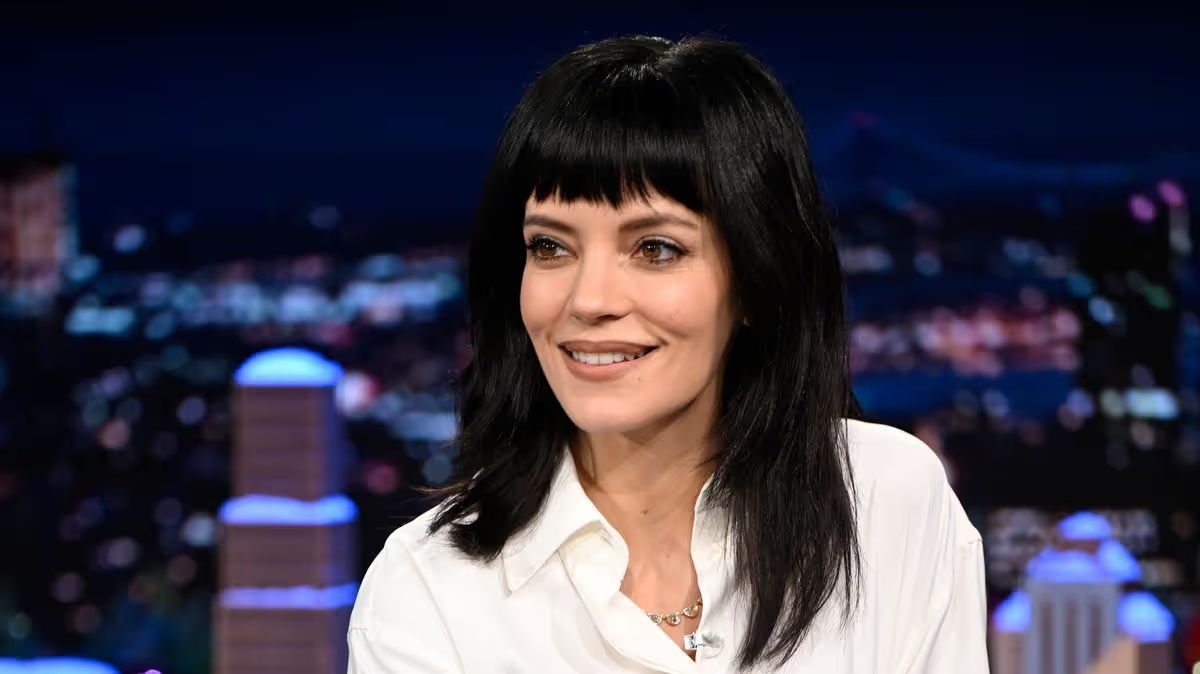
Cheapest Lily Allen tickets as West End Girl comes to Cardiff

Bitcoin’s Quantum Defense Plan: What BIP-360 Actually Changes

Smart energy pays enters the US market, targeting scalable financial infrastructure

Why Israel is blocking foreign journalists from entering

Bitcoin: We’re Entering The Most Dangerous Phase
XRP – They Are Shutting It DOWN! (What Does This Mean?) | Trump Got Rejected! (“Get Out Now”)

“The Biggest Bitcoin Trap I’ve Ever Seen” (Michael Saylor & Benjamin Cowen)

How to save money for your child!!! #wealth #savings #money #investing #finance #529 #investments
-
Business5 days ago
Form 8K Entergy Mississippi LLC For: 6 March
-

 Tech6 days ago
Bitwarden adds support for passkey login on Windows 11
-

 News Videos2 days ago
10th Algebra | Financial Planning | Question Bank Solution | Board Exam 2026
-

 Fashion5 days ago
Weekend Open Thread: Ann Taylor
-

 Crypto World2 days ago
Paradigm, a16z, Winklevoss Capital, Balaji Srinivasan among investors in ZODL
-
 Sports6 days ago
499 runs and 34 sixes later, India beat England to enter T20 World Cup final | Cricket News
-

 Sports4 days ago
Three share 2-shot lead entering final round in Hong Kong
-

 Sports3 days ago
Braveheart Lakshya downs Lai in epic battle to enter All England Open final | Other Sports News
-

 Business16 hours ago
ExxonMobil seeks to move corporate registration from New Jersey to Texas
-
 Politics5 days ago
Top Mamdani aide takes progressive project to the UK
-

 NewsBeat6 days ago
Piccadilly Circus just unveiled ‘London’s newest tourist attraction’ and it only costs 80p to enter
-

 Entertainment4 days ago
Hailey Bieber Poses For Sexy Selfies In New Luscious Lip Thirst Traps
-
 Tech47 minutes ago
A 1,300-Pound NASA Spacecraft To Re-Enter Earth’s Atmosphere
-

 Business3 days ago
Search for Nancy Guthrie Enters 37th Day as FBI Probes Wi-Fi Jammer Theory
-
 NewsBeat1 day ago
Pagazzi Lighting enters administration as 70 jobs lost and 11 stores close across Scotland
-

 Tech2 days ago
Despite challenges, Ireland sixth in EU for board gender diversity
-
Entertainment6 days ago
Harry Styles Has ‘Struggled’ to Discuss Liam Payne’s Death
-

 Crypto World6 days ago
New Crypto Mutuum Finance (MUTM) Reports V1 Protocol Progress as Roadmap Enters Phase 3
-

 Tech6 days ago
ACIP To Discuss COVID ‘Vaccine Injuries’ Next Month, Despite That Not Being In Its Purview
-

 Business2 days ago
Search Enters 39th Day with FBI Tip Line Developments and No Major Breakthroughs