Entertainment
Silo’s Ashley Zukerman Confirms the End of an Era After Sci-Fi Hit’s Game-Changing Episode

Editor’s note: The following contains spoilers for Silo Season 3, Episode 8.
With just two more episodes to go this season, Silo’s latest chapter marks a turning point for Congressman Daniel Keene, played by Ashley Zukerman. The conspiracy he’s been chasing across eight episodes is finally coming into focus and becoming much darker than he thought. Faced with billionaire Per Stensen’s (Colin Hanks) explanation for the silo project and the looming threat of nanotechnology, Daniel now finds himself caught between two futures: one built on duty and survival, and another shaped by the people he loves, including intrepid reporter Helen Drew (Jessica Henwick).
While Zukerman tells Collider exclusively that Per’s argument is “very compelling” to Daniel, everything the politician has witnessed through Helen and his sister Charlotte (Jessica Brown Findlay) means he has no choice but to make “a different decision there.” That internal conflict becomes the emotional backbone of Episode 8’s “Gray Goo.” Though the revelation behind the silos fundamentally changes his character’s understanding of the world, it also forces Daniel to ask a question he has never really considered before.
After a lifetime spent in service to others, the antepenultimate episode is the first time Daniel chooses for himself. “He’s always put himself in a place of service,” Zukerman explains. “For the first time in his life, he’s really able to ask what it is he wants… ‘I want Helen. I want this life. I want this experience.’” In the Collider Signature Q&A below, the actor breaks down why Per’s logic is harder to dismiss than audiences might expect and why Daniel’s latest decision to talk away from everything he once believed in now marks the end of that era.
Ashley Zukerman Understands Why Daniel Is Tempted by the Silo Project
“… if this invitation came to him 10 episodes ago, he probably would have joined the project.”


COLLIDER: Episode 8 completely changes what we thought the silos were. Up until now, viewers could debate whether this was about control, survival, or even something darker. When Daniel hears Per explain the truth about the nanotech and the end of the world, what did you think was actually breaking inside of him at that moment?
ASHLEY ZUKERMAN: I think his argument’s very compelling. I think he makes good points. Us preparing in some way for what is imminent, that makes sense to Daniel. But at the same time, I think if this invitation came to him 10 episodes ago, he probably would have joined the project. But I think over the last 10 episodes, via Charlotte’s experience and Helen’s experience, he’s learned a lot, and he makes a different decision there.
One thing I do love is that Silo never really gives you simple villains. Everybody is very layered, and it comes from a baseline of humanity and what they think is the best thing to do. Per genuinely believes he’s saving humanity and saving the world. Did you find yourself understanding his logic, even if Daniel really couldn’t accept it with the decision he makes at the end of the episode?
ZUKERMAN: Yeah. I could understand it, and Daniel could understand it. I can’t fault the logic. Something’s coming, and we need to prepare. I can’t fault that. But I guess where I am is still a place where, in our world, it feels like the solutions aren’t the problem. We know how to fix these things. All the solutions are simple. They’re all there if we want them. We don’t need to brute-force some technological answer to this question.
All the things being proposed, which are basically just extensions of what we have been doing, we know what we need to do. We can just go and do it. There seem to be some people in the world who believe that, rather than think about the way that we’re behaving and change that, we would rather keep behaving the way we are. For me personally, that’s where I am. That being said, there are no clear villains, and his logic is sound.
‘Silo’s “Gray Goo” Officially Marks the End of an Era for Daniel Keene
Daniel’s Episode 8 decision ends a lifetime of putting duty, service, and his sister’s needs ahead of his own.
Daniel choosing Helen over the project kind of surprised me, but it also feels like he is somebody who always chooses from love, and I thought that was very sweet. He’s walking away from the future of humanity just to be with Helen, and I thought that was so cute. Why do you think that choice becomes so obvious to him, especially with everything he’s been through with her?
ZUKERMAN: I think it paralleled the experience with Charlotte. We get these little bits of information about his upbringing and about his and Charlotte’s experience. They were orphaned very young; he took on this carer position. He was sort of a surrogate father to Charlotte, and so he never stopped caring for Charlotte, and he put himself in that position. I think there’s a straight line between that and then joining the military. He’s always put himself in a place of service, even in Congress, which he was never really happy in. Charlotte’s injury, however tragic now, seems to be exposing something else.
Strangely, in Episode 8, we start to see a respect growing between them. He finally lets her be her own person and make her own choices, and in that separation, it allows him to start to think: what does he want from life for the first time? And I think it’s that that makes him go, “I want this. I want Helen. I want this life. I want this experience.” But you’re right, there is ambivalence, and I mean that in the sense of not apathy, but genuine ambivalence that this is also an incredible project. He’s an engineer. He thinks pragmatically about solutions. So, I think he is drawn to this project, but for the first time in his life, he’s really able to ask what it is he wants, and he chooses Helen.
A lot of shows that are not Silo use that type of relationship as a subplot, but this feels like the emotional heart of the entire origin story we eventually find out. At what point did you realize this wasn’t really a political thriller anymore? At the core, this is Silo’s love story.
ZUKERMAN: I was very surprised because what I had read of Season 3 before we shot that Episode 2 scene, I expected Daniel, for sure, and maybe Helen to be involved in some way in the building of the silo. I thought that’s what we were setting up, that we were actually watching two people as they affected this project. At first, I was a little dismayed, and then I was like, “Oh, wait. No. These are just two people that got sucked into this vortex of this project and then spat out.” It took me a while to understand this origin story is told through a prism of just these two people. We’re not actually looking at the origin story. We’re just looking at two people.
Then, as we got stuck into it and as we worked on it more, I just fell in love with that idea more and more. Because it’s also a better parallel, as well, to what’s happening inside the silo. These are all just the individuals who are stuck in this experience. It would be a little arc to actually explore the Per Stensen version of this origin story. It is a different story that’s also equally fascinating, but it’s not necessarily the story we’re telling. We’re telling the story of people inside a system and the choices they make within it. So, I actually started to love it. I love that, that’s what we were doing.
Was there ever a scene, from Episodes 1–8, where you remember thinking, “This is probably the moment that Daniel can never go back to who he was”? I feel like he’s evolving in every episode, too, and that was something that I really liked seeing because it’s not just a stagnant arc. It’s very much like he’s going through different emotions in every episode, and you can see that also in your performance.
ZUKERMAN: It’s very nice of you to say. For me, I’d say Episode 4 as a whole for Daniel. I think that’s the one that seems really key. It’s in that episode that, while he’s fighting everyone else, he stops fighting himself, and this time we really see him. He’s not tormented anymore. He’s actually outwardly free to express himself. Helen has no issues expressing herself from the beginning of the show. It’s sort of like that is what he has gotten from her. She makes him feel like he can be honest and himself, and he wants to be that. I think that is what opens up for him in that episode. That’s, I think, where we see that shift.
It’s funny that you say that; I feel like Episode 8 is the point where we see Daniel before and after innocence. He is so grown up in how he understands the world from a different standpoint. The politician we met earlier in the season, he’s not the same at the end of this hour. How much did you, as a performer, subconsciously change him to expand that understanding of the world for your character? There’s a lot of work you put in as an actor to give those layers, because what is on the paper is not exact. You’re going to have to put in more.
ZUKERMAN: Because we shot all 10 episodes at once, we had to plot that out and make sure we were across that. I felt that there were a few things happening at play. One, Daniel enters this crucible at the beginning of the show, where I think Episodes 1–8 for their story happened within a four-day span. So this was quick. For me, while the focus was on making sure we felt that we didn’t go too far too soon, that we actually made it feel like four days that these were happening, that the tension kept mounting.
I did spend a lot of time making sure I was tracking at what level the tension that he was under revealed his true self, I guess. And I think you’re right, that by the end of Episode 8, he has grown because of it. Someone else might have maybe been crushed under the pressure, but Daniel was able to see beyond what was happening and stay close to himself and learn. I think maybe that’s what I was trying to think about. He could be under a lot of pressure and still learn something. I think he learned so much from Charlotte, especially in [Episode] 8. There’s that moment where they talk about their family, and he actually kind of sees, and he makes a decision. Because he’s not just saying goodbye to the project, he’s saying goodbye to his sister. For him to be able to have that be not a reaction to their situation, but actually an internalized decision he makes, you are right that that has to show an incredible amount of growth.
‘Silo’s Writers “Bury the Genre” to Keep the Story Human
Zukerman explains how the series keeps its mythology grounded by focusing on people trapped inside systems.


When we’re watching as viewers, I think we don’t really see that, because when you have an arc of four days, for us, when we’re watching movies and stuff, sometimes it’s very abrupt, and you can’t see the character. The character just goes from A to Z very quickly. But for this show, I think that’s a testament to the writing that I wanted to ask you about, too. What is it about this writing that you think is so different than so many other shows? Because, yes, you guys put in so much work as actors — you’re filling in the blanks of that writing — but the writing is the baseline of everything that has been so good about this show. I feel like there’s nothing else on Apple right now that is like Silo.
ZUKERMAN: I think the writing is surprisingly subtle in how effective it is. It buries its story really well. It buries what is happening for the characters really well, and invites us to just live it. As much as we can just engage with what’s happening right there, honestly, the writing really does so much for us. It actually asks us to not oversell things, not to do anything except live it.
I think in a genre show, that’s really rare. In genre shows, there’s usually such an onus on the exposition, selling the world in the writing, but I think what Silo does really well, and what Graham [Yost] and the team do really well, is make sure that this whole thing is always just about people within a system, and they bury the genre.
You and Jessica [Henwick] have amazing chemistry. What was it like building that relationship, especially since we see it happen so quickly, that sort of dynamic? In the beginning, there is a little push-and-pull, and it’s very fun to see that, but then it becomes very genuine, and you see that sincerity between the two of them.
ZUKERMAN: It wasn’t hard to build. We had that between us from the beginning. Because some of the writers were writing Season 4 while we were shooting Season 3, and they would listen to us bickering in between takes to kind of get a sense of how these characters interact for fuel. And for some reason, it’s a combination of, like, who knows how these things happen, but very lucky casting and also insightful casting that the two of us were just placed very well that our on-screen and off-screen chemistry just felt very effortless. That’s one thing.
I’ll say, as well, you can have that with another actor, but it doesn’t necessarily mean that you share the same taste and that you can work together and challenge each other, because some of the work is really difficult. You don’t always have a partner that you can kind of nut scenes out with and try to figure things out with, and Jess and I were really able to do that. I think that was another gift that, while we were navigating the story, we were really able to constantly question, “Where are we? Is this working? What are we doing here?” And that was a very special partnership trying to figure out this storyline together.
Ashley Zukerman Wanted To Bring “All of [Himself]” to ‘Silo’s Daniel
“That was challenging at times, because it was so surprising…”
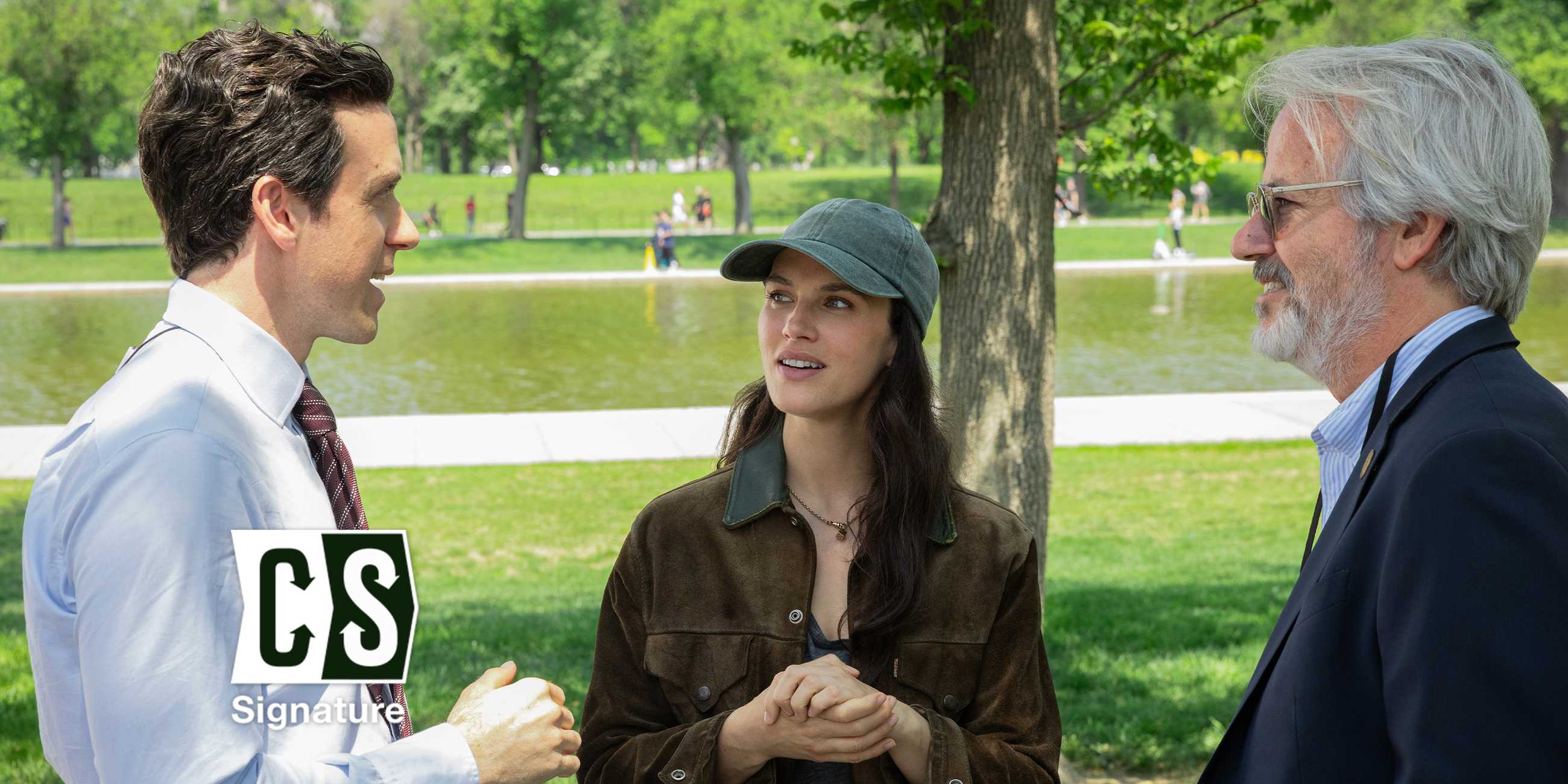
You’ve worked across different genres over the years, and I will say, Fear Street was one of my favorites. You were so good in it. Political dramas you’ve done, too, but Episode 8 asks you to play all three genres at once — science fiction, fantasy, political drama. What was the biggest challenge for you this season in grounding Daniel emotionally while the show redefines its own mythology?
ZUKERMAN: Because of what happens later, there’s a great answer to that. [Laughs] I don’t know if this is a challenge, but I guess challenges and interests are often very well-connected — from the beginning, this origin story, although this is sort of an obvious thing to say for any acting work, but I felt we had a mandate to make it feel as much like right now as possible, make it as loose and as close to 2025, 2026 as we could, and fill it with the nuance and microgestures in microlife of our time.
In doing that, I just felt like I connected so much to Daniel that I just wanted to play him as much for myself as possible. Other than those other projects you’re talking about, which I think were departures from myself, I really wanted to just bring all of myself to Daniel. Then, in doing that, what I found surprising was that what popped up were the things about his history with Charlotte. There was something about his sadness, his innate sadness, that I hadn’t read into in the script, but there is something lost about him, and I hadn’t read that. That was challenging at times, because it was so surprising, but it was also interesting, and I’m happy for it.
If Episode 8 completely changes how we look at Daniel, what can you tease about where that leaves him heading into the last two episodes?
ZUKERMAN: [Laughs] If I get really cheesy, I’d say that his work with the silo project’s not exactly finished. I feel a little sick doing it that tease-y. The other thing I’d say is just that I think there’s something that we’ve learned about Daniel that is so under the surface, that’s so buried, that ends up being the key to what was wrong.
New episodes of Silo Season 3 stream Fridays on Apple TV.
You must be logged in to post a comment Login