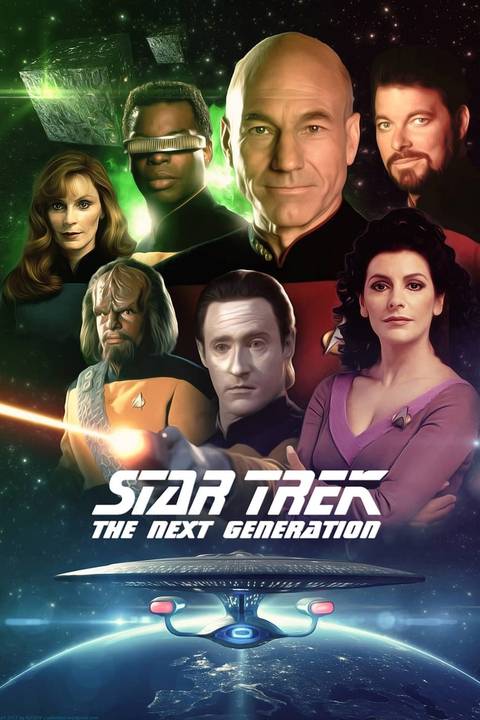
There’s little doubt that Star Trek: The Next Generation saved the franchise, bringing Gene Roddenberry’s creation to “the next generation.” With a bigger production budget and a focus on what’s happening with the crew – their beliefs, relationships, and decisions – as opposed to what’s happening to them, the series was markedly different from Star Trek: The Original Series, yet retained Roddenberry’s optimistic vision of a hopeful, inclusive future.
And sparking the eternal Kirk vs. Picard argument. But one episode in the first season of Star Trek: The Next Generation is so far removed from that vision that it’s cited by cast member Michael Dorn as “the worst episode of Star Trek ever filmed.” And he’s not alone.
Advertisement
‘Star Trek: The Next Generation’s “Code of Honor” Sees Tasha Yar Fight for Her Life
In the episode, the Enterprise heads to Ligon II, a planet that produces a vaccine needed by the denizens of Styris IV, in the throes of an Achilles fever outbreak. The crew knows little about Ligonian culture, other than that men rule society, while women control the land. Ligonian leader Lutan (Jessie Lawrence Ferguson) arrives on the Enterprise to provide a vaccine sample, and is fascinated by head of security Lt. Tasha Yar (Denise Crosby), a woman. Further impressed by her combat skills, Lutan and his party of Ligonians abduct Yar and return to the planet’s surface.
Advertisement
Collider Exclusive · Sci-Fi Survival Quiz Which Sci-Fi World Would You Survive? The Matrix · Mad Max · Blade Runner · Dune · Star Wars
Five universes. Five completely different ways the future went wrong — or sideways, or up in flames. Only one of them is the world your instincts were built for. Eight questions will figure out which dystopia, galaxy, or desert wasteland you’d actually make it out of alive.
💊The Matrix
🔥Mad Max
Advertisement
🌧️Blade Runner
🏜️Dune
🚀Star Wars
Advertisement
01
You sense something is deeply wrong with the world around you. What do you do? The first instinct is often the truest one.
Advertisement
02
In a world of scarcity, what resource do you guard most fiercely? What we protect reveals what we believe survival actually requires.
Advertisement
03
What kind of threat keeps you up at night? Fear is useful data — if you’re honest about what you’re actually afraid of.
Advertisement
04
How do you deal with authority you don’t trust? Every dystopia has a power structure. Your approach to it determines everything.
Advertisement
05
Which environment could you actually endure long-term? Survival isn’t just tactical — it’s physical, psychological, and very much about where you are.
Advertisement
06
Who do you want in your corner when things fall apart? The company you keep is the clearest signal of who you actually are.
Advertisement
07
Where do you draw the line — if you draw one at all? Every survivor eventually faces a moment that tests what they’re actually made of.
Advertisement
08
What would actually make survival worth it? Staying alive is one thing. Having a reason to is another.
Advertisement
Your Fate Has Been Calculated You’d Survive In…
Your answers point to the world your instincts were built for. This is the universe your temperament, your survival instincts, and your particular brand of stubbornness were made for.
Advertisement
The Resistance, Zion
The Matrix
Advertisement
You took the red pill a long time ago — probably before anyone offered it to you. You’re a systems thinker who can’t help but notice the seams in things.
You’re drawn to understanding how the system works before figuring out how to break it.
You’d find the Resistance, or it would find you — your instinct for spotting constructed realities is the machines’ worst nightmare.
You function best when you have access to information and the freedom to act on it.
The Matrix built an airtight prison. You’d be the one probing the walls for the door.
The Wasteland
Mad Max
Advertisement
The wasteland doesn’t reward the clever or the well-connected — it rewards those who are hard to kill and harder to break. That’s you.
You don’t need comfort, community, or a cause larger than the next horizon.
You need a vehicle, a clear threat, and enough fuel to outrun it — and you’re good at all three.
You are unsentimental enough to survive that world, and decent enough — just barely — to be something more than another raider.
In the wasteland, that distinction is everything.
Los Angeles, 2049
Blade Runner
Advertisement
You’d survive here because you know how to exist in moral grey areas without losing yourself completely.
You read people accurately, keep your circle small, and ask the questions others prefer not to answer.
In a city where humanity is a legal designation rather than a feeling, you hold onto something that keeps you functional.
You’re not a hero. But you’re not lost, either.
In Blade Runner’s world, that distinction is everything.
Arrakis
Dune
Advertisement
Arrakis is the most hostile environment in the known universe — and you are precisely the kind of person it rewards.
Patience, discipline, and political awareness are your core strengths — and on Arrakis, they’re survival tools.
You understand that the long game matters more than any single victory.
Others come to Dune and are consumed by it. You’d learn its logic and earn its respect.
In time, you wouldn’t just survive Arrakis — you’d begin to reshape it.
A Galaxy Far, Far Away
Star Wars
Advertisement
The galaxy far, far away is vast, loud, and in a constant state of violent political upheaval — and you wouldn’t have it any other way.
You find meaning in being part of something larger than yourself — a cause, a crew, a rebellion.
You’d gravitate toward the Rebellion, or the fringes, or whatever pocket of the galaxy still believes the Empire’s grip can be broken.
You fight — not because you have to, but because standing aside isn’t something you’re capable of.
In Star Wars, that willingness is what makes all the difference.
Advertisement
The act enrages Captain Picard (Patrick Stewart), who demands that Lutan return Yar immediately, but receives no response. He tries a more tactful approach, which does elicit a response from Lutan, who grants Picard and his crew permission to beam down to the planet, promising to return Yar following a banquet in his honor.
But at that banquet, things get really complicated, really fast, after Lutan announces that he intends to make Yar his “first one.” No one is more surprised than Yareena (Karole Selmon), his current “first one,” and she challenges Yar to a fight to the death to restake her claim. Yar will have little choice but to participate, as Lutan refuses to release more of the vaccine unless she does. The weapons used are coated with a lethal poison, meaning one scratch is certain death. But the combatants are equally skilled, and the intense match finally comes to an end when Yar lands a strike on Yareena.
At that, Yar orders the Enterprise to beam them both aboard the ship, where Dr. Crusher (Gates McFadden) can revive Yareena. They return to the surface, where Crusher explains to Lutan that Yareena was officially dead for a time, meaning Yar wins the match, thus breaking Yareena’s “first one” bond with Lutan. Free to choose a new mate, Yareena ditches Lutan, who achieved his power on the back of her wealth, and chooses bodyguard Hagon (James Louis Watkins) as her “second one.” Yar is free to go, and the Enterprise is given its full supply of vaccine.
Advertisement
‘Star Trek: The Next Generation’s “Code of Honor,” Ironically, Has Little of It
Before you say, “That doesn’t sound all that bad,” let’s add some context. The Ligonians, for one, are all depicted as one-note characters by Black actors, wearing non-specific African tribal culture garb, in a one-note, non-specific African tribal society. Lutan, a Black man – sorry, humanoid – kidnapping a blonde white woman whom he is creepily obsessed over, is problematic, to say the least. Originally, the episode called for a reptilian alien race with a culture akin to Kamakura-period Japanese samurai. But the African theme and casting of Black actors for the roles was the choice of director Russ Mayberry, a white man. That choice of casting all Black actors as members of an aggressive, primitive race did not sit well with Roddenberry, who fired Mayberry during production and never hired him to direct another episode again (per TrekMovie).
“Code of Honor” might have found a degree of redemption with a profound statement on gender roles. Only it drops the ball with that, too, with Yareena still yielding a position of power in society to her “second one,” instead of claiming it for her own, thus starting a new, gender-balanced societal path for the Ligonians. But the overwhelming amount of vitriol reserved for the episode is in its glaring racial insensitivity, particularly among the cast themselves.
Per TrekMovie, Jonathan Frakes is reported as calling it a “racist piece of s—,” Brent Spiner said he felt it was “racist” and the “worst of the series,” LeVar Burton assesses that the episode “stinks, without question,” and Tracy Torme, a writer for Season 1, said the episode was “offensive” and drew a parallel between it and 1950s sitcom Amos ‘n’ Andy, long decried for its negative depiction of Black Americans. Likewise, critics have cited “Code of Honor” as, in no particular order, “possibly the worst piece of Star Trek ever made,” “idiotic,” “pure trash,” and OkayAfrica, a website devoted to bringing African culture to a global audience, simply calls it “absurdly racist.” “Code of Honor” is a stark outlier in a franchise that once made bold, groundbreaking moves when it came to tearing down racial barriers.
Advertisement
Advertisement
Release Date
1987 – 1994-00-00
Advertisement
Network
Syndication
Showrunner
Advertisement
Gene Roddenberry
Directors
Cliff Bole, Les Landau, Winrich Kolbe, Rob Bowman, Robert Scheerer, Jonathan Frakes, Robert Wiemer, Gabrielle Beaumont, Alexander Singer, David Carson, Paul Lynch, Corey Allen, Patrick Stewart, Chip Chalmers, Joseph L. Scanlan, James L. Conway, Robert Lederman, Tom Benko, Timothy Bond, Robert Legato, Adam Nimoy, Robert Becker, David Livingston, LeVar Burton
Advertisement
Writers
René Echevarria, Maurice Hurley, Richard Manning, Melinda M. Snodgrass, Tracy Tormé, Hannah Louise Shearer, Stuart Charno, Ira Steven Behr, Sara B. Cooper, Peter Allan Fields, Herbert Wright, Frank Abatemarco, Burton Armus, Hilary Bader, Morgan Gendel, David Kemper, Michael I. Wagner, Philip LaZebnik, Robert McCullough, Susan Sackett, Nick Sagan, Fred Bronson, Robert Hewitt Wolfe, Sam Rolfe


You must be logged in to post a comment Login