Entertainment
Starfleet Academy Is Secretly The Least Diverse Star Trek Show
By Chris Snellgrove
| Published


Starfleet Academy is the latest Star Trek show, and one of its big hallmarks is diversity. This includes showcasing characters from very different backgrounds (a human thief, a childlike hologram, an empathic princess, a pacifist Klingon, etc), complete with a wide range of sexualities (gay, straight, and bi? Oh my!). There is even diversity in age: the show focuses on both young characters and their older instructors, and Chancellor Ake alone has a few centuries on her young students.
However, calling itself diverse is a lie. Starfleet Academy is secretly the least diverse Star Trek series ever made. That’s because it has one flaw that effectively cancels out all of the diversity of its character backgrounds and sexualities. Namely, that every single alien character is written like a boring old human being.
The Oldest Trope In Star Trek


Since the days of The Original Series, Star Trek has had an unofficial rule: each show must include an outsider alien character who helps the audience learn more about their own humanity. Spock’s emotionless Vulcan ways contrasted with McCoy’s fiery passion, for example, and Spock ultimately sacrificed his life after learning the value of Kirk’s relentless drive (there’s no such thing as a no-win scenario). After Spock died foiling the ultimate no-win scenario, Kirk declared, “Of all the souls I’ve encountered, his was the most human.”
This wasn’t literally true, of course: not only did Spock remain fully green-blooded, but his decision to save the ship was rooted in his flawless Vulcan logic (the needs of the many outweigh the needs of the one). But his death helped Kirk to find joy in life and rededicate himself to new beginnings. In this way, Spock began the oldest trope in Star Trek: the outsider alien helping others learn more about their own humanity.
Trek Trope: The Next Generation

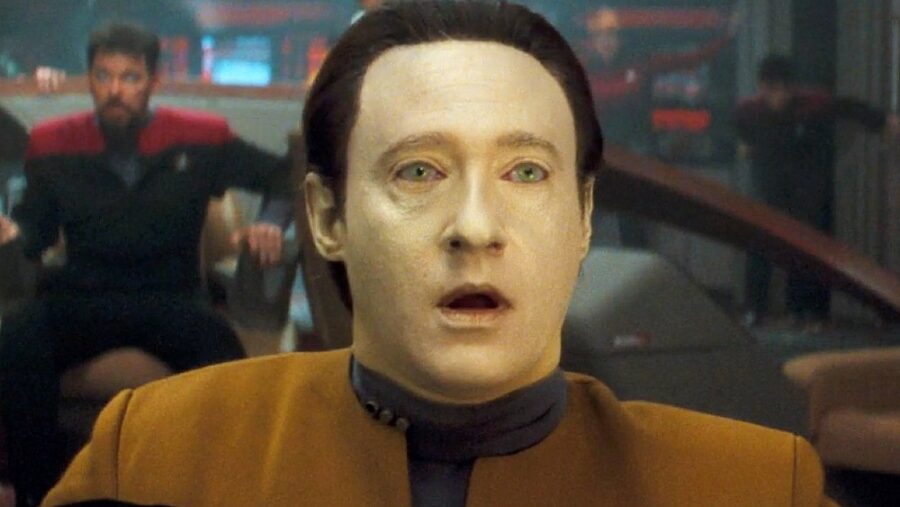
Later Star Trek shows embraced this trope to great effect: on The Next Generation, the android Data dreamed of becoming more human, and his quest helped everyone learn more about the power and promise of their own human journey. On Deep Space Nine, Odo was a Changeling who could never master looking like a solid, but his efforts to understand everyone else helped everyone gain new perspectives on what they took for granted. Neelix helped Voyager’s human crew discover joy in the small things, while T’Pol helped the humans of the Enterprise crew learn from their species’ mistakes as they began exploring strange, new worlds for the first time.
NuTrek has dabbled in this trope: on Discovery, Saru teaches the crew how to adapt to any situation, and Michael Burnham’s Vulcan upbringing helped her discover (for better or for worse) the importance of her emotions. Picard also dabbled in different alien outsiders, ranging from the android Soji to her positronic papa, Data. The return of Data hailed the return of TNG’s beloved alien outsider, and Strange New Worlds brought things full circle by putting Spock front and center.
Starfleet Academy Is Too Human For Its Own Good

Starfleet Academy is often praised for its diversity, and the cast of characters is truly unlike anything we have previously seen in other Star Trek series. Fully eight of the show’s 12 main characters are aliens, and over half of them are women. The show also puts men and women of color front and center: holographic SAM is the show’s biggest link between both Voyager and Deep Space Nine, and Jay-Den Kraag is showing us a strange new world of Klingon culture. Caleb, meanwhile, is the show’s de facto main character, and he often bridges the gap between the more dramatic and comedic elements of the show.
However, once you get past the diverse character archetypes and occasional forehead loaf, a surprising truth emerges: pretty much all the alien characters are written to be human. Darem is meant to be an exotic alien (he’s Khionian, b*tch!), but he is simply written as a cocky human, which is why he and would-be Alpha Caleb are constantly butting heads. SAM is an emissary from a holographic race who knows nothing about humanity, but she is constantly and inexplicably written as a teenage human.
The same goes for Genesis, an alien who is so human that she likes to chew bubblegum and wax philosophic about Daddy issues. Chancellor Ake is a Lanthanite who is nearly half a millennium old, but she is virtually indistinguishable from a quirky wine mom. On paper, the Klingon Jay-Den would be the most alien of them all because he hails from a warrior race, but in making him a softspoken, quippy pacifist making moony eyes at his crush, Starfleet Academy has made him the most human Klingon we’ve ever seen (yes, even more than Alexander).
They’re Only Human

Making all these aliens effectively human is by design, of course: Starfleet Academy is designed to appeal to young audiences, so this is a way of ensuring that these young characters are relatable despite their alien heritage. No matter what exotic planet they hail from, all of these 32nd-century cadets utilize slang and references very familiar to 21st-century youngsters. In this way, Paramount hopes to retain the old guard of Star Trek fans while appealing to Zoomers and even Generation Alpha.
Time will tell if Starfleet Academy manages to secure the (ahem) “next generation” of Star Trek fans, but they are already alienating older fans through (ironically enough) the lack of truly alien characters. There is no alien outsider to help characters and viewers appreciate their own humanity; instead, every alien is written as a human with a chip on their shoulder and a mouth like a sailor. Sure, this makes the latest Star Trek series feel like other popular drama series, but it also dilutes the new show by removing one of the franchise’s most distinctive sci-fi elements.
When Is A Star Trek Show Not Actually A Star Trek Show?
That leads to some downright philosophical questions, like “When is a Star Trek show not actually a Star Trek show?” Paramount is gambling that stripping the franchise of everything familiar in the name of mass appeal is the only way forward, but it’s an approach that has been driving away legacy fans in droves. Now, the studio is about learn the answer to “when is a Star Trek fan no longer a Star Trek fan?”
Simple: when they unsubscribe from Paramount+, the worst streaming platform the galaxy has ever known.
You must be logged in to post a comment Login