Entertainment
The 10 Best Sci-Fi Books of All Time, According to Goodreads

Goodreads is a popular site for logging and rating books, meaning it can be a solid source of new reading recommendations. The highest-rated novels on the platform tend to be classics and bestsellers, often works with wide commercial appeal, but it’s still interesting to see which titles its users love the most.
With that in mind, this list looks at the top-rated sci-fi books on Goodreads, from the cosmic absurdity of The Hitchhiker’s Guide to the Galaxy to the political horror of 1984. There should be something here for almost every kind of genre fan.
10
‘The Martian’ (2011)

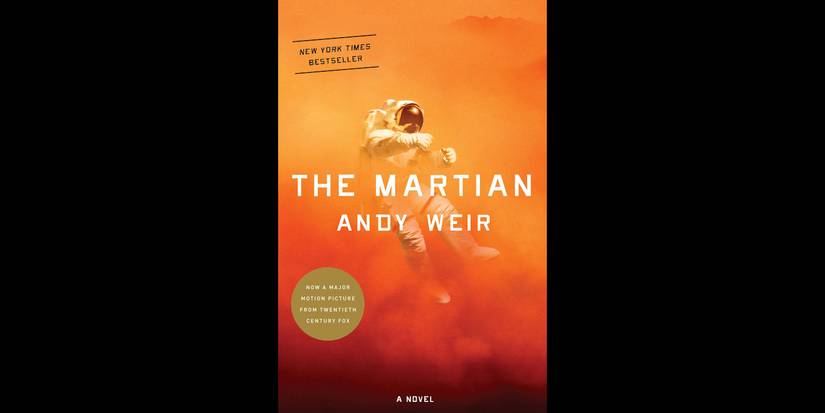
“I’m pretty much f—ed.” It’s no surprise that Andy Weir‘s fast-paced, problem-solving-based thriller made the Goodreads Top 10. In it, astronaut Mark Watney is accidentally left behind after a violent dust storm forces the Ares 3 crew to evacuate Mars. Injured but alive, he discovers that he has limited supplies, no immediate means of contacting NASA, and nowhere near enough food to survive until another mission arrives. Fortunately, he’s a botanist and mechanical engineer with an almost superhuman ability to remain funny while confronting probable death.
From here, the plot becomes a succession of problems and ingenious solutions. A big part of the fun here (as in the movie) is watching Watney try to MacGyver his way out of tricky situations. He grows potatoes using Martian soil, modifies equipment, attempts to establish communication with Earth, and continually improvises around new disasters. Weir explains enough of the underlying science to make those solutions convincing without ever sacrificing narrative momentum.
9
‘Ready Player One’ (2011)

“Videogames are the only thing that make life bearable.” In the bleak 2040s, teenager Wade Watts is among the millions obsessed with finding an Easter egg hidden somewhere inside the OASIS, an enormous virtual universe, by its deceased creator, James Halliday. Whoever discovers it will inherit Halliday’s enormous fortune and control of his company. The problem is that Halliday designed his hunt around an encyclopedic knowledge of the pop culture he loved, particularly games, movies, music, and television from the 1980s.
Wade’s discovery of the first major clue transforms him into a celebrity and puts him in direct competition with both other “gunters” and the sinister corporation IOI. Along the way, the book serves up high-stakes dystopian adventure, along with a nostalgic celebration of nerd culture. Classic movies, Dungeons & Dragons lore, and obscure 1980s arcade gaming all become integral to the plot.
8
‘Ender’s Game’ (1985)


“Humanity does not ask us to be happy. It merely asks us to be brilliant on its behalf.” Earth has fought two devastating conflicts against an alien species known as the Formics, and military leaders are searching for a commander capable of winning the next one. The young Andrew “Ender” Wiggin’s unusual empathy and strategic ability make him an ideal candidate… and therefore a child whom adults are willing to manipulate relentlessly. Recruited into a brutal orbital Battle School, Ender is isolated and systematically broken down by military authorities to shape him into the ultimate weapon.
He’s also caught in a profound inner conflict. He possesses a terrifying capacity for calculated violence alongside an intense desire for peace and love. Author Orson Scott Card uses that premise to delve deep into themes of war, tragedy, xenophobia, and the difficulty of communication, going way beyond the usual ‘humans vs. aliens’ tropes.
7
‘Slaughterhouse-Five’ (1969)

“All this happened, more or less.” With this one, Kurt Vonnegut uses time-warping sci-fi elements to tell an allegorical, deeply personal anti-war story. In Slaughterhouse-Five, protagonist Billy Pilgrim has become unstuck in time. One moment he’s an optometrist living in postwar America; the next he’s a POW in Germany, an elderly widower, a frightened child, or an exhibit inside an alien zoo on the planet Tralfamadore. At the center of Billy’s life is the bombing of Dresden, which Vonnegut himself survived as an American soldier.
The fractured timelines serve as a strong metaphor for PTSD, and the way trauma memories can extend their tentacles into the present. That said, the book doesn’t get too overly heavy, thanks to Vonnegut’s short, punchy sentences (the whole novel clocks in at under 200 pages) and deadpan humor. By treating historical atrocities with a sense of bizarre irony and cosmic absurdity, he highlights just how irrational and senseless human cruelty truly can be.
6
‘The Hitchhiker’s Guide to the Galaxy’ (1979)

“Don’t Panic.” Arthur Dent is having a terrible Thursday. His house is about to be demolished to make way for a bypass, his friend Ford Prefect turns out to be an alien, and before Arthur can properly process either development, Earth itself is destroyed to make way for a hyperspace bypass. Things become considerably stranger from there, as Arthur encounters the two-headed galactic president Zaphod Beeblebrox, the relentlessly cheerful Trillian, and the terminally depressed robot Marvin.
The whole book treats the universe as an enormous cosmic joke. Author Douglas Adams stuffs the novel with ideas that other sci-fi writers might build entire books around and then uses them for punchlines. There’s the Babel fish, the Infinite Improbability Drive, Vogon poetry, and a supercomputer designed to calculate the Answer to the Ultimate Question of Life, the Universe, and Everything. It’s simultaneously entertaining and genuinely philosophical.
5
‘The Handmaid’s Tale’ (1985)

“Better never means better for everyone, he says. It always means worse, for some.” Before it was a hit show, The Handmaid’s Tale was a provocative, much-analyzed novel. In it, the United States has become a totalitarian theocracy where women’s lives are rigidly determined by their social and reproductive roles. For Offred, that means becoming a Handmaid, assigned to a powerful Commander and expected to bear his child. She remembers the world before Gilead, but attempting to bring it back looks like a fool’s errand.
The dystopia works because it’s not all that far-fetched or speculative. Writer Margaret Atwood draws on real-world examples of sexism and oppression, extrapolating believable elements of religious extremism, political fear, surveillance, control over language, and the gradual erosion of rights. Not for nothing, The Handmaid’s Tale has exerted a grip on the cultural imagination for over four decades.
4
‘Brave New World’ (1932)

“But I don’t want comfort. I want God, I want poetry, I want real danger, I want freedom, I want goodness. I want sin.” Not every dystopia needs secret police kicking down doors. Aldous Huxley‘s Brave New World imagines something potentially more disturbing: a society whose inhabitants have been conditioned so thoroughly that most of them don’t want to rebel. In the World State, rampant consumerism is encouraged, lasting relationships are discouraged, and unhappiness can be chemically suppressed with a little pill.
This ‘softer’ vision of totalitarianism was a marked contrast with most sci-fi dystopias at the time, though one could make the case that it was ultimately more prescient. Indeed, some parts of the book now hit a little too close to home, particularly its portrait of citizens who surrender their individuality and critical thinking willingly, content to while away their lives with cheap pleasures and shallow entertainment.
3
‘Fahrenheit 451’ (1953)

“It was a pleasure to burn.” This classic has been let down by some mediocre movie adaptations, but the original novel remains solid. In the future society imagined by Fahrenheit 451, books have been outlawed, and firemen are responsible for finding and burning them. Our protagonist, fireman Guy Montag, initially performs that duty without seriously questioning why. Then he meets Clarisse McClellan. Clarisse’s curiosity destabilizes him because she asks questions his society has largely forgotten how to ask. Is Montag happy? Why do firemen burn books? What was the world like before?
The dystopia here is often summarized as a warning about censorship, but Fahrenheit 451 is equally interested in why a society might cease valuing complex ideas before authorities need to destroy them. Constant entertainment, shortened attention spans, discomfort with challenging ideas, and a preference for easy gratification all contribute to the cultural decline surrounding Montag. A cautionary tale.
2
‘Animal Farm’ (1945)
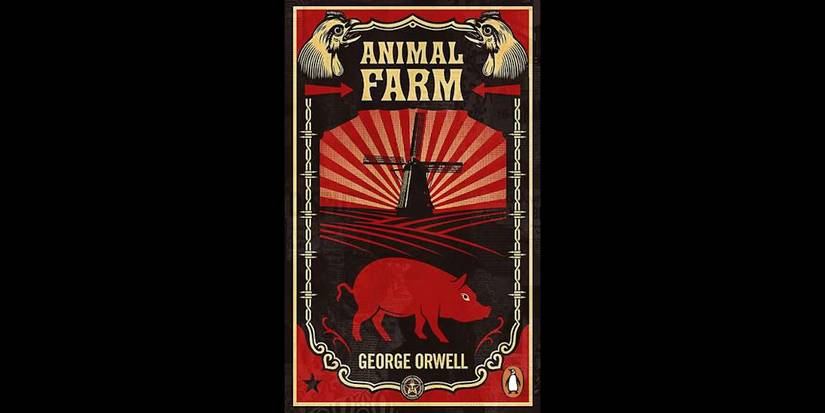
“All animals are equal, but some animals are more equal than others.” While some might quibble with whether Animal Farm can really be classed as sci-fi, there’s no denying the book’s power. With it, George Orwell compresses the bleak tendencies of political revolution into a remarkably short allegorical novel. The plot kicks into gear when the animals of Manor Farm decide they’ve finally had enough. Inspired by a vision of a society free from human exploitation, they overthrow farmer Mr. Jones and establish a new order built upon equality.
For a brief moment, the revolution appears to have worked. Then the pigs begin taking charge. Soon, principles are corrupted, rules change almost imperceptibly, and history is rewritten. Failures are blamed on enemies and privileges become necessities for the ruling class. Here, Orwell was specifically satirizing the Russian Revolution and the rise of Stalinism, but Animal Farm has endured because its observations about political power extend beyond one historical context.
1
‘1984’ (1949)

“It was a bright cold day in April, and the clocks were striking thirteen.” Claiming the top spot on Goodreads’ sci-fi rankings, with an average score of 4.21 out of 5 across 5.7 million ratings, is 1984, far and away the most influential dystopian story the genre has ever produced. Main character Winston Smith lives in Oceania, where the Party controls not only people’s actions but their understanding of reality. They continually rewrite history to suit today’s narrative and have tools for bending dissident minds to their will.
Indeed, the scariest thing about the dictatorship here is that they don’t simply want people to obey but to actually believe the government’s lies. In telling that story, Orwell introduced a ton of concepts that have since become political shorthand: Big Brother, doublethink, thoughtcrime, Newspeak, Room 101, and the Thought Police, to mention just a few. A political sci-fi masterpiece.
You must be logged in to post a comment Login