Entertainment
The 10 Best War Movie Opening Scenes, Ranked

When it comes to writing a story, one of the hardest aspects to nail is the beginning. One would think that’s the easiest part, but in fact, it’s exceptionally difficult to nail the tone, establish the plot, setting, and characters, and hook your audience all at the same time. Audiences should know what to expect from the story right from the get-go, and should trust the story to maintain its momentum all the way through to the end.
wa
It doesn’t matter what kind of media the story is a part of–it’s still a difficult process. Take in cinema, for example. Plenty of movies are known for their dramatic and intense opening scenes, many of them in the war genre. When it comes to crafting an opening scene for a war movie, it’s really important to get the plot moving, provide some historical context, and give the viewers a reason to keep watching. These are the best war movie opening scenes of all time.
10
‘Beasts of No Nation’ (2015)


Beasts of No Nation is set at an unspecified time during an unspecified West African Civil War. The when and the where isn’t really important, as the film is taking a general stance rather than looking at specific historical incidents. The films follows a child named Agu (Abraham Attah), who lives in relative harmony with his family. He begins narrating his struggle during the opening credits as another boy raps in the background. The film then shows Agu and the simple life he lives with his family. They are far from rich, but they seem happy.
That is, until the civil war breaks out. The family is suddenly forced to upend their entire lives and abandoned everything they hold dear, desperately struggling to get to safety, along with everyone else in their village. The movie depicts how civil wars disrupt family lives and turn towns into mad scrambles for survival. It’s a really creative and profound intro sequence that feels truly singular in the genre.
9
‘Dunkirk’ (2017)

Dunkirk is set in 1940, early on in the Second World War. After France was swiftly invaded and defeated by the Third Reich, hundreds of thousands of Allied soldiers were forced into a mass evacuation from the Northern port of Dunkirk. Just across the English Channel from safety, the rescue turned into a race against time as the German war machine rapidly advanced behind the Allies, pushing them towards the sea.
The movie begins with British soldiers walking down the streets of a French town, where pamphlets are being dropped from the sky. The pamphlets inform them of the evacuation, causing a mad scramble to escape the town. This is all interspersed with blocks of text providing short history lessons so the audience understands why the evacuation must happen. This introductory sequence shows how quickly things spiralled out of control, and the chaotic race against time to rescue countless lives from hostile territory.
8
‘Letters from Iwo Jima’ (2006)

Despite being an American film, Letters from Iwo JIma very much follows the Japanese side of the Battle of Iwo Jima, at the end of the Second World War. The movie begins not in 1945, but in the present-day when a team of excavators and archaeologists is searching the tiny island of Iwo Jima for relics from the war. What they dig up is a box full of folded letters, all written by Japanese soldiers.
Then the film transitions back to 1945. Japanese soldiers are depicted writing letters, with their narration playing over their mundane work. The camera gains a washed-out, almost monochrome aesthetic as the main characters dig trenches and prepare defenses for when the Americans arrive. They ruminate about their lives back home, and watch as a prominent military official flies overhead in a plane, coming in for a landing. The movie’s opening is somber and not very action-packed, but it’s very emotional and respectful towards those who fought in the engagement.
7
‘300’ (2007)

300 might be based on a graphic novel, but that graphic novel was also based on true events. The movie is set during the Greco-Persian Wars, which occurred approximately 2,500 years ago. The movie begins with the graphic novel’s original monologue, which is a real killer way to open up. The first iconic lines are “we march,” referring to the Spartan warriors approaching the pass of Thermopylae, where the battle that the film is about takes place.
The movie then cycles through the early life and career of the King of Sparta, Leonidas I (Gerard Butler), albeit it’s likely a highly fictitious version of things. In any event, the slow-motion, the wide angles, and the cinematic scale all come together like an elaborate puzzle that thoroughly displays Zack Snyder‘s signature flair. It’s an introduction that exudes power and strength, hyping audiences up for the slaughter to come.
6
‘1917’ (2019)

1917 is one of those movies that looks like one continuous shot, so it’s kind of all one scene, if you really want to be technical. In any event, the movie still does a great job at setting the stage. Set during World War I, the movie opens with two sleeping British soldiers in a picturesque field, who are abruptly woken up by a runner. They briefly talk about their past experiences and their time on the front, as well as when they hope their relief is coming.
They make their way to the command bunker, where they are assigned a mission to deliver a message several miles down the line. They set off at once, navigating No-Man’s Land and passing deceased soldiers and horses. This opening scene, with its one-shot format, lets you know that there will be very little time to breathe in this film. It also doesn’t waste any time with politics or bureaucracy, diving straight into the plot.
5
‘Casablanca’ (1942)

Casablanca is considered to be one of the greatest cinematic masterpieces of all time, and its opening scene is just one of the hundreds of reasons why. The movie is set during World War II, during the Nazi occupation of North Africa, including the titular city of Casablanca, Morocco. The opening credits depict actual wartime footage, accompanied by a narration of how the Nazis moved in to Morocco and came to occupy much of Northern Africa.
The scene then erupts into chaos, with local law enforcement and Nazi officers rounding up political opponents and arresting people for seemingly no reason. In the midst of the pushing and shoving crowds is the movie’s protagonist, nightclub owner Rick (Humphrey Bogart). This scene is just so well done. It provides a brief, but not overwhelming history lesson, establishes the setting, and shows what life in Nazi-occupied Africa was really like.
4
‘Civil War’ (2024)

2024’s Civil War is set during a fictional Second Civil War in the United States of America. A tyrannical president has taken a third time and dissolved the FBI before executing airstrikes on American civilians, prompting a massive wave of armed resistance. The movie opens up with the president, played by Nick Offerman, rehearsing a speech to deliver on television. The speech is about how his forces are close to victory, and how the opposition will be allowed to rejoin the US when he wins.
This is interspersed with footage of riots and protests, which aren’t fictional–they are actual footage from real events, although in a vastly different context. Meanwhile, a journalist named Lee (Kirsten Dunst) is watching the president deliver his speech on TV. In the distance, something explodes, lighting up the night. This opening scene is tense, and does a fantastic job of establishing the story, and what sorts of events lead to such a conflict.
3
‘Apocalypse Now’ (1979)
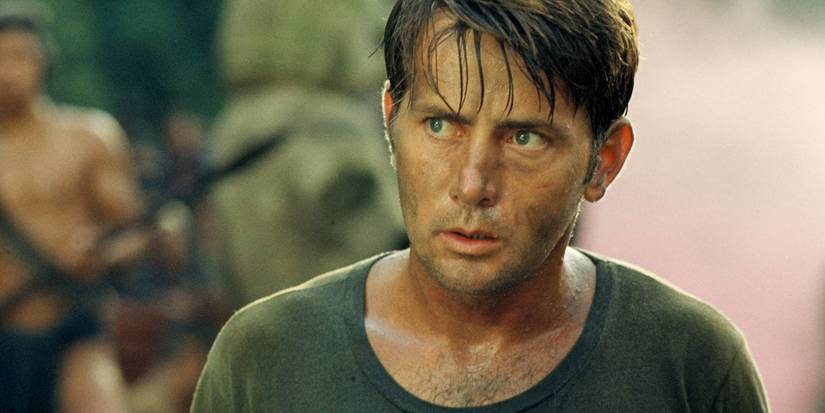
Apocalypse Now is based on the 1899 novella Heart of Darkness by Joseph Conrad. While the setting and time of the original story are vastly different, the core themes of anti-imperialism and trauma are still very much there. The movie opens up in the city of Saigon, Vietnam, where an American military assassin named Willard, played by Martin Sheen, is waiting in a hotel room and slowly losing his mind with boredom as he awaits his next assignment.
He is a seasoned veteran of the Vietnam War, currently serving on his third tour. The movie makes it clear that his sanity is pretty much already gone. He dances in his underwear, does somersaults over his bed, and narrates how maddening the monotony of doing nothing is. It might be a bit of a goofy scene, but it’s a great look at how you don’t necessarily need to be in live combat to develop PTSD, and how it can stick with you at all times, especially when you have little else to do but think.
2
‘All Quiet on the Western Front’ (2022)

Set during the First World War, All Quiet on the Western Front is the third adaptation of Erich Maria Remarque’s classic novel. It opens up a serene, quiet winter scene. Snow drifts lazily down from the boughs of trees, a mother fox and her cubs sleep soundly in their dens… and a pile of bodies lays in a pool of muck and blood. Immediately, the silence is shattered with gunfire and explosions.
The film then transitions to a frontline German soldier, a young man who is clearly a new recruit. He walks past traumatized infantry in a trench before he is ordered up the ladder. His friend is killed in front of him, and he charges out to meet the French military. He is quickly swept up in the chaos, using his spade to attack a Frenchman before the screen cuts to black with another haunting silence. Right away, the movie lets the audience feel how horrific the war really is, and how many young lives were lost in such a senseless conflict.
1
‘Saving Private Ryan’ (1998)


Saving Private Ryan opens up with a wizened old veteran visiting the graveside of his fallen comrades. This brief scene quickly transitions to a flashback, depicting Omaha Beach on June 6, 1944–D-Day. Anyone who knows anything about D-Day knows that Omaha Beach was the worst place you could possibly be, as this landing sector saw the highest amount of casualties.
What results is a 20-minute sequence where American forces storm the beaches, pinned down by German defenses. The scene is widely known as being one of the most visceral, gruesome, and hauntingly realistic depictions of frontline combat in cinema. It was reportedly so intense that the movie studio had to set up a hotline for traumatized veterans who had actually been there. The fact that the movie opens up on something this intense lets you know what you’re in for. It opens up on action, and it lets viewers appreciate the sacrifice and the courage of the Allied troops.
You must be logged in to post a comment Login