Entertainment
The 10 Book Masterpieces That Will Never Work as Movies

For every book that successfully reaches the screen, dozens get lost in translation or simply remain trapped on the page. Many books seem tailor-made for a big-screen adaptation, and some others thrive on the silver screen despite their somewhat complicated premise. However, not every book is as lucky.
Indeed, plenty of classic novels would be borderline impossible to adapt into good movies, whether that’s due to experimental language, fragmented structures, or simply a story intended only for the book format. With that in mind, this list looks at these adaptation nightmares, the novels that most defy the Hollywood treatment, ranging from labyrinthine modernist masterpieces to metafictional mind-benders and philosophical epics.
‘Timequake’ (1997)


“You were sick, but now you’re well again, and there’s work to do.” Timequake is a truly challenging, rambling hodgepodge of a book, so much so that author Kurt Vonnegut himself described it as a “stew.” Indeed, it barely functions as a conventional novel at all. Instead, Timequake is a blend of fiction, autobiography, essays, philosophical musings, and metafictional experimentation, delving into themes like free will, determinism, authorship, depression, and ennui; not exactly the kind of stuff that screams “blockbuster.”
The book’s appeal comes from Vonnegut’s voice: his humor, melancholy, wisdom, and ability to make seemingly unrelated observations feel profound. Remove that voice, and the whole thing falls apart. Consequently, not even the combined powers of Stanley Kubrick, Steven Spielberg, James Cameron, and Ridley Scott could make Timequake work on screen.
‘Hyperion’ (1989)

“The universe is not only stranger than we imagine; it is stranger than we can imagine.” This sci-fi classic takes place in a far-future interstellar civilization and focuses on seven pilgrims journeying toward the mysterious world of Hyperion, where they hope to confront the terrifying creature known as the Shrike. Along the way, each traveler tells their life story, revealing how they became connected to the pilgrimage. It’s a pulpy riff on The Canterbury Tales, but with advanced tech and interdimensional beings.
The book’s scale and structure pose immediate adaptation problems, as does its dense philosophy. Hyperion is challenging and opaque, with a lot to say about religion, mortality, artificial intelligence, poetry, suffering, and the nature of time itself. It would be hard to make these elements work on screen without sacrificing key parts of the novel’s identity.
‘Blood Meridian’ (1985)
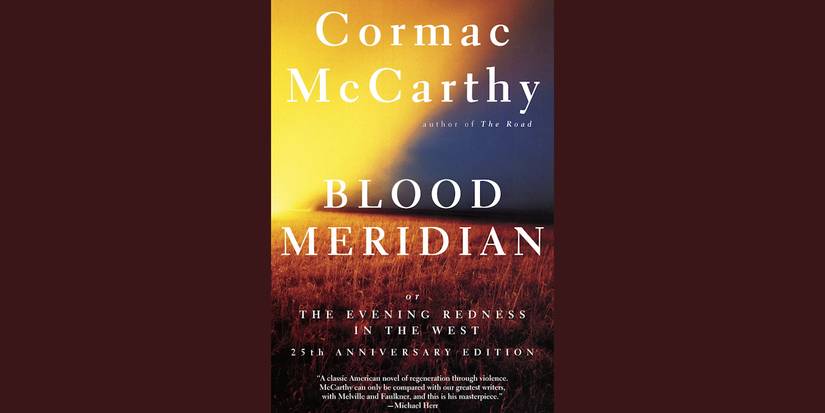
“They rode on.” Numerous filmmakers have expressed interest in adapting this Cormac McCarthy classic, yet the book has remained stubbornly resistant to the screen. The plot revolves around a teenage runaway known only as “the Kid” who joins the Glanton Gang, a real historical group of scalp hunters operating along the U.S.-Mexico border in the mid-nineteenth century. What follows is a relentless descent into violence, brutality, and existential horror as the gang commits atrocities across an increasingly nightmarish landscape.
A bold director could certainly adapt the events of Blood Meridian, and the landscapes, gunfights, and historical setting are all inherently cinematic. But capturing the novel’s soul is another matter entirely. What makes the book extraordinary is not the story it tells, but the way McCarthy tells it and the philosophical weight that hangs over every page. It’s not clear who could pull that off.
‘Finnegans Wake’ (1939)

“Three quarks for Muster Mark!” If James Joyce‘s Ulysses is difficult, his experimental opus Finnegans Wake is another thing entirely. The novel abandons conventional narrative, presenting a dreamlike stream of text that blends dozens of languages, puns, myths, historical references, and invented words. Explaining the plot is nearly impossible because even literary scholars continue debating what exactly happens within the text.
Indeed, characters shift identities, historical figures merge together, and language itself becomes fluid and unstable. The book is also extremely internal. There are scenes, conversations, and recurring motifs, but much of the reading experience involves interpretation rather than observation. Readers search for patterns, decode symbols, uncover hidden meanings, and make connections across hundreds of pages. This intellectual engagement is difficult to replicate in a visual medium, to say the least.
‘The Silmarillion’ (1977)
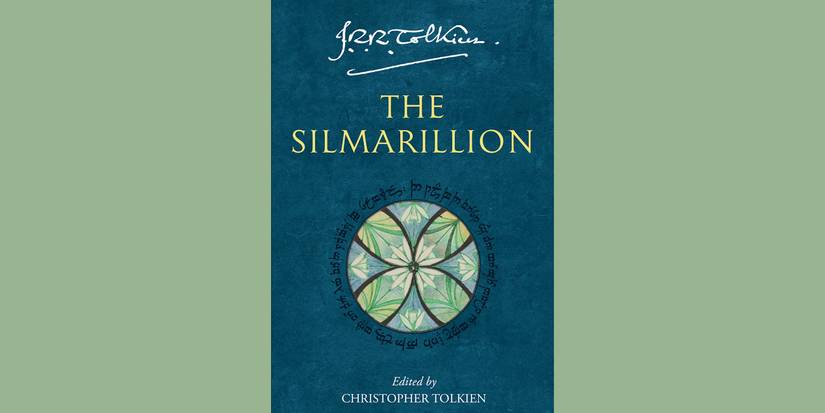
“Thus ended the Silmarils and the Trees of Valinor.” The Silmarillion poses a much more daunting adaptation challenge than any of the other Lord of the Rings books. It’s much drier and more academic than the other Middle-earth books, with a structure more akin to a mythological history than a traditional novel. There is no single protagonist guiding readers through events. Instead, the book introduces dozens of major characters, civilizations, and conflicts across centuries.
Admittedly, there is a wealth of colorful worldbuilding on offer here, yet that density of information is also part of the problem. A film adaptation would have to simplify enormous portions of the mythology, but doing so could strip away much of what makes the work special, and would invariably annoy at least some section of the fanbase. For that reason, a faithful movie adaptation of The Silmarillion would likely be impossible.
‘In Search of Lost Time’ (1913–1927)

“The real voyage of discovery consists not in seeking new landscapes, but in having new eyes.” Marcel Proust‘s monumental In Search of Lost Time is widely regarded as one of the greatest literary achievements in history. Across seven volumes and more than four thousand pages, it follows an unnamed narrator reflecting on childhood, memory, love, art, jealousy, society, and the passage of time. The famous madeleine scene, in which a taste triggers a flood of memories, has become one of literature’s defining explorations of consciousness.
In other words, the adaptation hurdles are legion. There’s the colossal length, the meditative atmosphere, and a focus on sense impressions. There’s the prose, too. Here, Proust writes in extraordinarily long, intricate sentences that mirror the movement of thought itself, but are pretty low on, well, anything actually happening. Likewise, the book’s treatment of time is tricky, with past and present constantly intermingling.
‘Gravity’s Rainbow’ (1973)

“If they can get you asking the wrong questions, they don’t have to worry about answers.” Set during the final months of World War II, Gravity’s Rainbow follows an enormous cast of characters connected in various ways to Germany’s V-2 rocket program. Among them is Tyrone Slothrop, an American soldier who discovers disturbing connections between his life and the locations where rockets strike. Although widely hailed as a literary masterpiece, much of the story is deliberately chaotic, fragmented, and elusive.
People appear and disappear without warning. Storylines branch into tangents that may or may not connect to the central narrative. The novel contains hundreds of characters, dozens of interconnected storylines, songs, conspiracy theories, historical references, scientific discussions, hallucinations, sexual absurdities, and philosophical digressions. The tone is surreal and unstable, moving from slapstick comedy to existential terror within a few pages.
‘House of Leaves’ (2000)


“This is not for you.” This cult classic horror book would never truly work as a movie because its literary structure is intrinsic to its appeal. House of Leaves begins as an analysis of a documentary about a family whose house contains impossible interior dimensions. However, that’s just the beginning of the work’s strangeness. The novel is a labyrinth of nested narratives, footnotes, annotations, typographical experiments, and unreliable narrators.
Part of the reading experience involves physically interacting with the text: words spiral across pages, paragraphs appear upside down, footnotes lead to other footnotes. Entire sections require readers to rotate the book or navigate unusual layouts. Basically, House of Leaves makes full use of the fact that it’s a book as opposed to any other medium. A film could stick to the same basic plot, but it would no longer be House of Leaves.
‘Infinite Jest’ (1996)

“I am in here.” David Foster Wallace‘s magnum opus, Infinite Jest is one of the most ambitious novels of the late twentieth century. Set in a near-future North America, it follows a sprawling cast of characters connected to a prestigious tennis academy, a rehabilitation center, and a mysterious film so entertaining that anyone who watches it loses all desire to do anything else (evoking uncanny parallels with the endless doomscroll of social media today). Along the way, the book tackles addiction, entertainment, depression, family dysfunction, achievement, and loneliness through hundreds of interconnected storylines.
On top of all that, Infinite Jest‘s famous endnotes alone run well over one hundred pages and often contain essential information. Readers constantly move between different characters, timelines, and perspectives, gradually assembling meaning from fragments. Finally, Wallace’s unique style is the main attraction, giving us a front-row seat to the complicated workings of his mind.
‘The Catcher in the Rye’ (1951)

“Don’t ever tell anybody anything. If you do, you start missing everybody.” Unlike many books on this list, The Catcher in the Rye does not seem obviously unfilmable. The plot is relatively straightforward: after being expelled from school, teenager Holden Caulfield wanders around New York City for several days, interacting with teachers, strangers, old friends, and family members while struggling with grief, alienation, and the transition to adulthood.
Yet the novel has remained famously unadapted for more than seventy years, in part because its reclusive author didn’t want it adapted, and partly because of how difficult it would be for a movie to replicate the experience of being in Holden’s head. His humor, insecurity, contradictions, cynicism, vulnerability, and loneliness are what make this a classic. It’s hard to see what a film would add to the experience.
You must be logged in to post a comment Login