Entertainment
The 10 Greatest Classic American Sci-Fi Movies, Ranked

It’s by no means an exaggeration to say that Hollywood’s Classical era—typically understood to have spanned between 1930 and 1960—revolutionized science fiction cinema. Though it wouldn’t be until later that the genre would reach its true peak in Hollywood, there are still plenty of classical American sci-fi masterpieces from Hollywood’s Golden Age which have become essential cornerstones of the sci-fi cinema canon.
Whether it’s a horror classic like Island of Lost Souls, a space opera like Forbidden Planet, or a wholly different kind of sci-fi classic altogether, the genre produced many great films throughout the Classical period of American cinema. It was around the late ’60s and the ’70s that sci-fi really became one of Hollywood’s leading blockbuster genre juggernauts, but those who think that no true sci-fi masterpieces were produced in the US before that are dead wrong.
10
‘Village of the Damned’ (1960)


German-British filmmaker Wolf Rilla never made a film more prominent or timeless than Village of the Damned, based on John Wyndham‘s 1957 sci-fi novel The Midwich Cuckoos. This British-American production was one of the last sci-fi films produced during what’s strictly considered Hollywood’s Golden Age, and what a way this was to close off such a phenomenal period of sci-fi filmmaking.
Turning a tight budget into a tremendous hit, Village of the Damned was widely successful immediately upon release, and has continued to only get better with age. Its approach to horror is powerfully quiet and subtle, which helped further enshrine the “creepy killer children” trope in mainstream horror. Scary, atmospheric, and incredibly dark in tone, it’s one of the best sci-fi horror gems from the ’60s.
9
‘Forbidden Planet’ (1956)

Fred M. Wilcox‘s Forbidden Planet is a true landmark of ’50s genre filmmaking and an important precursor of modern sci-fi cinema, helping prove just how seriously the genre deserved to be taken. Its plot often considered an uncredited adaptation of William Shakespeare‘s The Tempest, the film has been recognized as both the first sci-fi film to depict humans traveling in a manmade faster-than-light starship and the first to be set entirely on a planet orbiting another star.
Thanks to this, Forbidden Planet continues to be remembered as one of the most foundational and influential space operas in the history of cinema 70 years after its release, and that’s why it’s one of those classic sci-fi movies that are still a must-watch in 2026. Thanks to it, audiences realized that even a low-budget sci-fi B-movie could deliver a fully serious and artistically-executed story.
8
‘Dr. Jekyll and Mr. Hyde’ (1931)


Many a great (and not-so-great) film has been made adapting the revolutionary Gothic horror novella Strange Case of Dr Jekyll and Mr Hyde by Scottish author Robert Louis Stevenson, arguably none of them better than Rouben Mamoulian‘s 1931 version. This pre-Code horror gem deservedly earned Fredric March the Academy Award for Best Actor in 1932, but great acting is by no means the only thing that makes this classic a must-watch.
Even with a budget of over half a million dollars, which was quite high for a horror film at the time, Dr. Jekyll and Mr. Hyde was just as successful as the many great Universal horror pictures from the era. Time, too, has been kind to it, with the film still seeming surprisingly creepy and audacious thanks to its inventive special effects, March’s performance, and the uniquely pre-Code depiction of sexuality and violence.
7
‘Island of Lost Souls’ (1932)

Based on H. G. Wells‘ groundbreaking 1896 novel The Island of Doctor Moreau, Erle C. Kenton‘s Island of Lost Souls is another exceptional sci-fi horror film that could have only possibly been produced during the pre-Code era of Hollywood’s Classical period. It was Paramount’s follow-up to Dr. Jekyll and Mr. Hyde, and in more ways than one, it’s generally regarded as the superior film.
But even setting comparisons aside, Island of Lost Souls is a must-see for those who love Golden-Age-Hollywood sci-fi and horror. Thanks to Charles Laughton‘s iconic terrifying performance as Dr. Moreau, the film’s chilling and psychologically-tense atmosphere, and the lack of strict Hays Code restrictions allowing Kenton to deliver body horror and other transgressive elements that couldn’t have worked just a couple of years later, Island of Lost Souls has aged like fine wine.
6
‘Frankenstein’ (1931)

Throughout the ’30s, Universal started making low-budget horror movies, largely in order to keep themselves financially afloat after the stock market crash of 1929. From the cycle of horror movies came several of the best in the history of Hollywood’s Golden Age, the most iconic of the bunch arguably being James Whale‘s sci-fi horror classic Frankenstein from 1931.
On top of introducing the world to one of the best sci-fi horror movie monsters ever, Frankenstein completely reshaped the horror film genre. It may not be all that scary by modern standards, but this adaptation of the Mary Shelley novel that birthed sci-fi as a whole is so well-made, so visually impeccable, and so well-acted by Boris Karloff that it hasn’t gotten old in the slightest as a classic sci-fi masterpiece.
5
‘The Incredible Shrinking Man’ (1957)
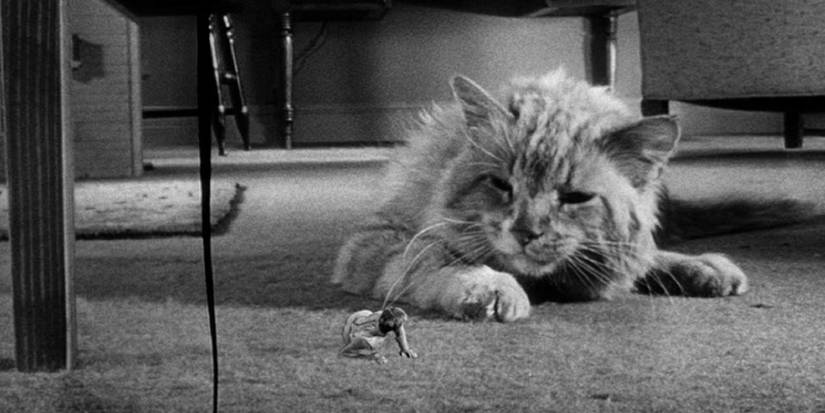
On top of several incredible sci-fi classics that tend to receive every bit as much praise as they deserve, Hollywood’s Golden Age also produced many criminally underappreciated sci-fi gems. Case in point: Jack Arnold‘s The Incredible Shrinking Man, which may look like a cheap B-picture on the surface, but was actually an A-level Universal production with a respectable budget and some very high ambitions.
As the years have passed, it has grown into more and more of a classic sci-fi cult classic.
The movie’s reception was only slightly positive back in 1957, but as the years have passed, it has grown into more and more of a classic sci-fi cult classic. This pulpy premise that you’d expect to see in a B-picture is transformed into a surprisingly profound meditation on human identity and mortality, proving just how philosophically rich and thematically deep sci-fi could be when in the hands of a talented enough team.
4
‘The Invisible Man’ (1933)

H. G. Wells’ 1897 sci-fi novel The Invisible Man is one of the genre’s most important from the late 19th century, and fittingly, Universal’s film adaptation of the same name instantly became one of the most important Hollywood sci-fi productions from its era. As if any more proof were needed that James Whale was an undisputed master of sci-fi horror, The Invisible Man is a gem that has aged like fine wine.
For one, the visual effects were nothing short of jaw-droppingly revolutionary back then, and they’re still just as charming and impressive today. Add to that a powerhouse voice performance by Claude Rains; some exceptionally-written character development; and Whale’s perfect blend of sci-fi creativity, horror, and humor, and you get one of the defining pre-Code masterpieces of 1930s Hollywood.
3
‘Invasion of the Body Snatchers’ (1956)

Released during one of the many peaks of the Cold War, Invasion of the Body Snatchers has come to be retroactively read as a film all about the paranoia and fear that became inherent to the era. Those who don’t much care about the political implications of sci-fi and horror, however, should still be perfectly able to have a hell of a time with this Don Siegel classic, generally regarded as one of the most iconic Hollywood horror classics.
With its impressive score of 97%, Invasion of the Body Snatchers is one of the best-rated alien invasion movies on Rotten Tomatoes, and for plenty of good reasons. Eerily atmospheric, visually perfect, full of underrated performances, and perfectly understanding of everything that makes sci-fi horror fans tick, it’s an essential ’50s classic without which Hollywood horror would simply have never been the same.
2
‘The Day the Earth Stood Still’ (1951)

Well before he became an Oscars darling with epics of the caliber of West Side Story and The Sound of Music, Robert Wise directed The Day the Earth Stood Still, one of the best classic movies from 1951. Based on Harry Bates‘ 1940 short story Farewell to the Master, this legendary classic is yet another sci-fi classic intimately tied to the Cold War era of the United States.
The film proved tremendously influential, thanks to the way it elevated sci-fi from cheap creature features and B-picture fare into art that could prove itself to be philosophically complex, full of clever social commentary, and all-around as serious as any other genre. With its bold anti-war message and the way it manages to be hugely entertaining while prioritizing restraint over pure spectacle, it’s the sort of sci-fi masterpiece that every movie fan should watch at least once in their lives.
1
‘Bride of Frankenstein’ (1935)

Who, if not James Whale, could possibly be worthy of being considered among the directors of not just one, not just two, but three of the best sci-fi movies from Hollywood’s Golden Age? And which James Whale masterpiece could possibly be considered the era’s best American sci-fi outing if not Bride of Frankenstein, one of the best movie sequels ever created?
The film was critically and commercially successful upon release, but its reputation has only kept growing more and more since its release, with its now being considered among the greatest cinematic cult classics of the 1930s. It has been embraced by mainstream cinephiles, LGBTQ+ cinema scholars, horror lovers, and midnight screening fanatics alike over the years, and it will likely only keep being every bit as entertaining a few decades from now as it is today.


The Bride of Frankenstein
- Release Date
-
April 20, 1935
- Runtime
-
75 minutes
- Director
-
James Whale
- Writers
-
Mary Shelley, William Hurlbut, John L. Balderston, Josef Berne, Lawrence G. Blochman, Robert Florey, Edmund Pearson, William Hurlbut
-

Boris Karloff
The Monster
-
Colin Clive
Henry Frankenstein

You must be logged in to post a comment Login