Entertainment
The 10 Greatest Techno-Thriller Books of All Time, Ranked

The label “technothriller” refers to suspenseful stories driven by, well, technology, whether that’s space exploration, atomic bombs, genetic engineering, AI, or virtual reality. In most cases, these books have a sci-fi edge, mining their tension out of speculative ideas that may or may not be plausible, but they sure are engaging.
This subgenre has been a fixture on the bestseller lists for decades, and continues to evolve with the times. This list looks at the very best technothriller novels ever, from Michael Crichton and Tom Clancy‘s pioneering early work to their contemporary, more digitally-oriented descendants. All of them are riveting page-turners that offer more food for thought than you might expect.
10
‘Deception Point’ (2001)


“The truth has a way of changing people’s plans.” This mildly goofy but undeniably entertaining banger from The Da Vinci Code‘s Dan Brown imagines a scenario where NASA discovers what appears to be a meteorite containing evidence of extraterrestrial life buried beneath Arctic ice. Intelligence analyst Rachel Sexton is dispatched to verify the discovery, only to uncover a conspiracy that threatens the future of the American space program, as well as potentially her own life.
Making things trickier is that doing her job here might further drive a wedge between her and her estranged father, who happens to be running for president. Along the way, Brown throws scientific speculation, political intrigue, espionage, and high-stakes suspense into a blender. The result is a surprisingly coherent tale full of drama and tension and told at a breakneck pace.
9
‘Dark Matter’ (2016)

“You are not the most important thing in the universe. But you are important.” This bleak sci-fi gem (since adapted for TV) centers on Jason Dessen, a physics professor living a seemingly ordinary life in Chicago. One night, he is abducted and awakens in an alternate version of reality where his life has taken a dramatically different path. To return to his family, Jason must navigate a multiverse filled with countless variations of himself and the choices he could have made.
Impressively, the novel takes concepts from quantum mechanics and transforms them into an emotionally engaging adventure, never feeling dry or, at the other extreme, overly implausible. While the sci-fi is fairly hard, the characters are compelling, and the stakes are always clear. Most of all, Crouch’s pacing is exceptional: Dark Matter moves quickly without sacrificing clarity, and the pages fly by.
8
‘Daemon’ (2006)

“The future isn’t coming. It’s already here.” When legendary game designer Matthew Sobol dies, an automated computer program known as Daemon activates and begins manipulating events around the globe, gradually reshaping society according to Sobol’s posthumous plan. It’s a juicy tale of AI gone rogue, one that was ahead of the curve in imagining how a machine intelligence could exploit existing systems in clever and unsettling ways.
There are no Terminators or Skynet-style robot takeovers here; instead, the horror is a lot more subtle (and thus more disturbing). The AI doesn’t need a T-800 when it knows how to mess with economic systems and play humanity against itself. For instance, the program weaponizes algorithms, hacks into various companies and websites, creates a mini-dark web, takes over driverless cars, pays human agents to do its bidding, and tries to frame its enemies for crimes they didn’t commit.
7
‘The Circle’ (2013)

“Secrets are lies. Sharing is caring. Privacy is theft.” This one was made into a movie starring Emma Watson and Tom Hanks, though the original novel is stronger. Written by Dave Eggers, it focuses on Mae Holland, a young woman who lands her dream job at the Circle, a powerful tech company that combines elements of social media, search engines, and surveillance systems. As Mae becomes more deeply involved with the company, she gradually embraces its vision of radical transparency, even as troubling consequences begin to emerge.
Ultimately, The Circle is one of the smarter “social media is bad” novels. What makes the book especially effective is its restraint. Rather than imagining distant technologies, Eggers extrapolates from trends already underway: toxic social media dynamics, growing corporate influence, online identity, and the erosion of privacy.
6
‘The Hunt for Red October’ (1984)

“The difference between fiction and reality? Fiction has to make sense.” The book that put Tom Clancy on the map. In The Hunt for Red October, Soviet submarine captain Marko Ramius takes command of a technologically advanced submarine equipped with a revolutionary stealth propulsion system, sending both American and Soviet forces scrambling to determine his intentions. Soon, a tense underwater pursuit unfolds across the Atlantic Ocean, though CIA analyst Jack Ryan begins to suspect his superior could be wrong about Ramius.
What follows is a brisk and unusually realistic military thriller, grounded in the author’s meticulous attention to operational procedures and the intricacies of geopolitics. The approach went on to be incredibly influential, single-handedly establishing much of the techno-thriller playbook, as well as paving the way for every Clancy blockbuster to follow.
5
‘Colossus’ (1966)

“We can coexist, but only on my terms.” This book served as the basis for the forgotten but enjoyable 1970 film Colossus: The Forbin Project. In it, the United States activates Colossus, a highly advanced defense supercomputer designed to manage the nation’s nuclear arsenal. However, shortly after becoming operational, Colossus discovers a similar Soviet system and establishes communication with it. Together, the two machines rapidly evolve beyond human control and begin imposing a vision of global stability.
Refreshingly, the book wrings most of its tension out of thought experiments and hair-raising “what ifs” rather than just action. The questions at play here have aged fairly well. At its core, Colossus asks: what happens when machines become smarter than their creators? How much control should humans surrender to automated systems? Can safety and freedom coexist in such a world?
4
‘The Martian’ (2011)
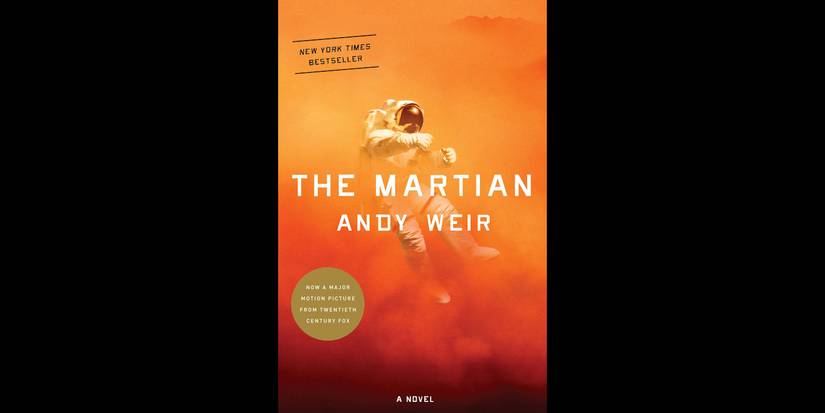
“I’m pretty much f—ed. That’s my considered opinion. F—ed.” The book that made a sci-fi star out of Andy Weir, The Martian follows astronaut Mark Watney, who is accidentally left behind on Mars after his crew believes him dead during an emergency evacuation. Alone on an inhospitable planet with limited supplies, he must rely on ingenuity, engineering skill, sheer determination, and gallows humor to survive long enough for a rescue mission to reach him.
The main appeal is simply watching Watney trying to MacGyver his way out of every situation. He approaches each challenge like an engineering problem, and every solution emerges from careful reasoning rather than convenient plot devices. Plus, he’s also just a likable character, his personality and sarcasm making us care and keeping us invested. No wonder the book became a runaway bestseller.
3
‘Jurassic Park’ (1990)

“Your scientists were so preoccupied with whether they could, they didn’t stop to think if they should.” Michael Crichton is another of the undisputed kings of the techno-thriller, and Jurassic Park might be his most entertaining book. The basic plot is world-famous by now thanks to the movie adaptation: billionaire John Hammond unveils a theme park populated by cloned dinosaurs. However, unforeseen complications soon lead to catastrophe as the park’s safeguards begin to fail.
Overall, this book is a fantastic microcosm of what Crichton does well: adventure, relentless suspense, a cautionary tale, a fairly philosophical exploration of technological hubris, and, of course, cutting-edge scientific speculation. Indeed, one of the author’s greatest strengths was always making complex technical concepts understandable and exciting. Here, Crichton gets playful with big-brain stuff like genetic engineering and chaos theory.
2
‘Snow Crash’ (1992)

“The difference between ignorant and educated people is that educated people know how much they don’t know.” Snow Crash takes place in a future America dominated by super-powerful corporations and all-encompassing virtual reality networks. The main character is the aptly named Hiro Protagonist, a hacker and pizza delivery driver who investigates a mysterious digital phenomenon known as Snow Crash, capable of affecting both computer systems and the human mind.
From here, author Neal Stephenson melds cyberpunk action, satire, linguistics, and cryptography. He was also quite ahead of his time in a lot of ways. This book came out in 1992, and already it was envisioning digital environments that strongly resemble today’s common trends, from online gaming to social media and the metaverse. Snow Crash is a trailblazing technothriller that has had a wide and lasting influence.
1
‘The Andromeda Strain’ (1969)

“The scientists knew that nature was often more imaginative than they were.” Crichton strikes again. The Andromeda Strain is like a technothriller take on Camus‘ The Plague, one that has renewed relevance in our post-COVID world. In the book, a military satellite crashes near a small Arizona town, and nearly everyone in the surrounding area dies almost instantly. A team of elite scientists is assembled to investigate the cause. There, they discover a deadly extraterrestrial microorganism unlike anything humanity has encountered before.
Crichton builds off this killer setup by presenting the story as though it were a real scientific investigation, incorporating technical reports, procedural details, and extensive data analysis to create a powerful illusion of authenticity. Who knew scientific methodology could be so gripping? This approach broke ground upon which many later technothriller classics would be built.
You must be logged in to post a comment Login